• A Q&A with Michelle Oberman

    PregnancyWhat happens when abortion is a crime? Legal scholar Michelle Oberman set out to find the answer in her journeys through distinct legal climates to understand precisely why and how the war over abortion is being fought. Her research took her to El Salvador, where abortion is banned without exception, to pro-life state Oklahoma. The stories are collected in her book Her Body, Our Laws: On the Front Lines of the Abortion War, from El Salvador to Oklahoma. Beacon Broadside editor, Christian Coleman, caught up with Oberman to ask her about the inspiration for the book, the importance of telling the stories of women ensnared in the dragnet of the abortion war, and what she hopes readers learn from her book.

    Christian Coleman: What was the inspiration behind writing this book?

    Michelle Oberman: Americans have spent the past forty-five years fighting over whether abortion should be legal. I spent the past ten years trying to figure out how it matters. I had a couple of reasons for wanting to know why. First, because I’m a law professor and I study women’s health issues, the abortion war has been raging throughout my career. We fight over abortion’s legality like it matters, with both sides investing millions of dollars in lawyers and lawsuits every year. Many Americans now cast votes to elect our public officials based on their abortion stance. But what difference would it make if abortion was illegal? I wanted to know what was really at stake.  

    The second reason for writing this book is more personal: I am pro-choice but I teach at a Catholic school, Santa Clara University School of Law. I know and admire people who oppose legalized abortion. Still, when abortion comes up, we find it almost impossible to talk. It tears us apart. I wanted to know whether we might find common ground, in spite of our differing positions on legalized abortion. 

    CC: Tell us about your background and your interest in writing about the legal and ethical issues surrounding adolescence, pregnancy, and motherhood.

    MO: I guess we’ve all got scars from adolescence. Mine aren’t particularly deep or unique—honestly, they’re pretty uninteresting—but they are just deep enough to make me aware of how much support and luck I’ve had in my life. For those without those benefits and breaks, when things go wrong, it can be a holy mess. The law often gets entangled, and often makes matters worse. Because it could have been me, it feels like it’s on me to do what I can to untangle the mess.

    CC: In the introduction, you write that you are “a collector of stories about women’s dark secrets.” Why is collecting stories involving abortion laws so important?

    MO: Stories about abortion teach us a lot about how it is to be female at any given place in time. In the case of unplanned pregnancy, for example, abortion stories show us much about how we have sex, often without contraception, even when we’re not intending to have babies. What does sex look like, what gets in the way of using contraception, what are the consequences? Abortion stories also show us a lot about society’s attitude toward motherhood and toward children. By noticing the things that lead someone who is pregnant to consider abortion, we suddenly can see the high costs of motherhood, both literally and figuratively.

    CC: You visited El Salvador nine times from 2010 to 2016 to research the country’s battle over abortion law. Did you come across any information or findings in your research that took you by surprise?

    MO: I was shocked to learn that banning abortion doesn’t make it go away. Even though abortion is completely illegal in El Salvador—banned even if a mother’s life is at stake—it is commonplace. By the government’s own account, there are tens of thousands of abortions every year. In fact, the abortion rate there is higher than it is here, where abortion is legal.

    I was also really surprised to learn that the law is seldom enforced. There are no more than ten prosecutions a year. It’s very difficult to enforce abortion laws, whether against doctors or against women.

    CC: What are some of the similarities/comparisons you found between El Salvador’s abortions laws and those of pro-life state Oklahoma?

    MO: Actually, what was similar wasn’t the law, but the way supporters think of the law. For people who are pro-life, banning abortion is important because it’s a way of sending a message that abortion is morally wrong. Even if banning abortion doesn’t make it go away, (and indeed, bans seem to have little impact on abortion rates), pro-life advocates want the law to reflect their position that abortion is killing.

    CC: In your New York Times op-ed, you wrote “The rhetoric of ‘choice’ and ‘life’ encourages us to see a pregnant woman as if she’s balancing a scale, with abortion on one side and motherhood on the other. Which will she choose? Tilt her one way and she might get to finish high school or college, gaining time to plan for the child she wants. Tipped another way, she might become a mother or allow a childless couple to adopt.” What are we missing when we talk about “choice”?

    MO: For too long, we’ve ignored the reality that many women have abortions not because it’s a “choice,” but instead because they feel they have no other choice. Our social policies—the lack of paid maternity leave, flexible work schedules, affordable housing, quality day care and more—make motherhood very expensive. When asked why they’re having abortions, seventy-three percent of women say they can’t afford to have a child now. If we’re serious about giving women choices, pro-choice people need to be as troubled by the idea of a woman having an abortion because she has no other choice as they are by a woman being forced to carry an unwanted pregnancy to term.

    CC: What would you like readers to take away from the book?

    MO: I’m ready for a new conversation about abortion. Our fight over abortion’s legality has left us locked in debate over the question of whether abortion should be legal. My journey through the abortion war has convinced me that that question is not serving us well. It’s distracting us from the better question of how we think things will change, if abortion is illegal.


    About Michelle Oberman 

    Michelle Oberman is the Katharine and George Alexander Professor of Law at Santa Clara University School of Law and an internationally recognized scholar on the legal and ethical issues surrounding adolescence, pregnancy, and motherhood. She works at the intersection of public health and criminal law, focusing on domestic and international issues affecting women’s reproductive health. Her book When Mothers Kill (2008) won the Outstanding Book Award from the Academy of Criminal Justice Sciences. She is also the author of Her Body, Our Laws: On the Front Lines of the Abortion War, from El Salvador to Oklahoma.

  • By Kay Whitlock

    Kay Whitlock meeting her father

    Kay Whitlock meeting her father

    When we look deeply enough, we begin to see all the ways in which justice and nonviolence—as  well as injustice, hatred, and violence—arise within an ever-fluid fabric of relationship. All of our various struggles for social, economic, spiritual, and environmental justice are not parallel and unrelated, but essential, interrelated components of one evolving story about human rights, dignity, liberation, justice, and community.
    —Kay Whitlock, In a Time of Broken Bones


    Click here to read part 1.

    PART 2: Threshold

    I called my father and asked him to meet in me in a hometown park in southern Colorado. He still lived in the small stucco house I’d grown up in, a space that I felt still defined me as a child.

    My mother was deceased. My only purpose in meeting with my father that day was to hear myself breaking the silence in which our own family fiction evolved. The fiction that we were in all respects, apart from a minor blip or two, a happy family. In reality, we were a complicated and unpredictable mix of good intentions and terrible hurts, at once inflicted, received, and kept hidden from the outside world, sometimes even from ourselves.

    Almost eighty, he suffered the multiple insults of Parkinson’s and emphysema and occasional heart problems. His hands and voice shook. I was anxious, too. For once, in a difficult situation, we didn’t verbally attack one another. I simply told him my memories, and how I felt as a child, and how those feelings remained with me. If we ever wanted to have an honest and trustworthy relationship—if that was even possible—we couldn’t go on pretending the abuse had never happened.

    My father did not deny anything I said. He said he never wanted to hurt me, that everything he’d done had been out of love, and that—this seemed so out of context—my mother was the best person in the world. He mumbled that he was one of “a lot of guys” who had come back from World War II “really messed up.” He wasn’t full of his usual bravado but seemed uncertain and filled with sorrow.

    In the end, there was nowhere else to go in our conversation. I didn’t expect much in the way of response that day. I was still trying to figure out what I really wanted from him, if anything—a task that would prove far more difficult than I could then envision. The next day, I returned to the East.

    My father and I spoke minimally, only when necessary. Not long after our meeting, he sent a check for $200, which he could not afford. I signed it over to a feminist group working with survivors of child sexual abuse. One of the therapists asked me if she could send him a thank-you note. Only if you say nothing more than “thank you,” I said. Anything else was between my father and me. She wrote him a shaming letter.

    Within a few years, unable to bear the cement canyons of the East any longer, I returned to Colorado, though not to my hometown. Not long after, my father’s doctor told me he had experienced a series of heart attacks and could not be released home without consistent, live-in support. My father had little money. Affordable home health care was far too limited. There were no options beyond my stepping in for a time.

    Oh, shit, no. I won’t! I can’t! Fuck this! You can’t ask this of me! No! I wanted to say, “No, you worthless, hurtful old man. Fend for your own damn self for once in your miserable, bullying, dream-killing life.” Why would I coddle a monster? But something inside kept sending a different message: “If you go, you’ll learn something important.” And this voice would not shut up. But where did it come from? All these years later, I’ve finally settled the matter. Noble rhetoric, meet messy, complicated reality. All my activist life, I’d declared for the humanity and worthiness of everyone. My justice chickens were coming home to roost. In the most unexpected, enraging, and inconvenient way possible.

    The Home Front

    I had no idea what would constitute “justice.” Jail was out; it was too late. Even if it were possible, would I really want to send this guy to a factory for violence and degradation, including sexual violence, much of it committed by authorities, and expect him to come out better? No. Nor could my father make me rich by signing over all his worldly goods. He didn’t have any to speak of. When he died years later, the house I grew up in, sold for $30,000. I could have just left him in the hospital, where they would have transferred him to some lousy, poorly staffed place where he would lie in his own piss and die. But no one should die like that.

    Besides, sexual abuse was only part of the story. Given to unpredictable rages, Dad sometimes beat me. Not my mother. Always the kid. (The sexual and physical abuse stopped before I reached my teens.) And he almost always responded with shaming ridicule when I talked about my dreams and hopes. Sometimes, I taunted him, standing running distance away: “You can’t hurt me!” And when he lunged toward me, starting to pull off his leather belt with the big buckle. I ran away. In school and through reading, I developed a verbal arsenal to protect myself, conjuring clouds of words with which to overwhelm and confuse him. I tried to make him feel as stupid as I felt.

    From time to time, over the years, my father and I fell into an uneasy peace, but there was no solid foundation to it. Nor could I make sense of the fact that my childhood was never just an unending nightmare of abuse. There also were significant swaths of those growing-up years and family time that I loved. My mother and father were both capable of great kindness, goodness, and fun: she often, with great imagination, and he on occasion. But these moments of genuine goodness and warmth could switch up in an instant. I was not yet able to comprehend this paradox in my own heart, much less in conversation with a parent.

    My father was still in the hospital when I walked into our old house. It felt so small, much smaller than when I was a child. The first thing I did was take the loaded .38 revolver out of the drawer of his bedside table where he’d always kept it, unload it, and stash the bullets separately from the revolver on a high shelf in an inaccessible place. Good thing my father wasn’t unremittingly brutal. Had that been the case, I can easily imagine myself in the place of, say, young Bresha Meadows who killed her abusive father. I always knew where the gun was and, before I was eight years old, knew how to use it. This is why I support survivors, subjected to physical and sexual violence, who do defend themselves and other family members, sometimes killing the people who abuse them in the process.

    The first thing my father said when he got home from the hospital and after getting settled into bed was, “Where’s my gun?”

    Restorative justice folks often talk about justice as a matter of “restoring right relationship.” My father and I had no right relationship to restore. When I came to help, we were often resentful of and angry with each other.

    But something else happened over the months, even the years that followed, when I was there full time and after I left because he recovered sufficiently to live on his own again with better home health assistance. It was nothing dramatic or definitive. “Something else” showed up as little bits of information and insight tucked into ordinary niches and corners of conversation. Conversation with my father. With his older brother. With a cousin, older than I, who had known my paternal grandfather’s meanness. With my maternal great aunt. With some of my father’s old cronies and acquaintances from the years when he was given to public brawls. With extended family members. And some of it showed up as memory of talks with my mother, both when I was growing up and especially when she was dying. Lots of minutiae that eventually began to coalesce into a larger whole.

    None of this excused my father’s abusiveness. He remained accountable for that. But all of this apparent flotsam and jetsam began to cohere in ways that helped me begin to grasp the context in which his abusiveness developed, played out, and, eventually, ebbed. It helped me begin to make sense of my own childhood.

    I can’t tell you how things began to shift. But they did. Slowly, awkwardly, we began to become caring adults in each other’s presence.

    Beyond learning about generations of various kinds of abuse, trauma, and abandonment in my parent’s families that just got kicked on down the line, I saw that my father was the loneliest, most frightened person I’d ever met. And that my mother had stopped much of the abuse, though she never felt able to speak directly about it. She died of pancreatic cancer feeling she was being punished for not being a good enough Christian.

    For many years, I told close friends that it was as if my family had booked passage on the Titanic, but I was the only one who made it to the lifeboats. Now I know that none of us made it.

    If justice was to come, it had to embrace all of us, and it had to do it in a way that valued our all of our lives. If accountability was possible and transformation was to happen, both individual and collective tragedies must be addressed. And it had to offer the possibility of new, just, compassionate, and generous relationships—especially where they’d never existed in the first place.

    Kay Whitlock and Jackie St. Joan

    Kay Whitlock and Jackie St. Joan (http://jacquelinestjoan.com/bio/)

    “The Fingerlings”

    Years ago, as part of an invitational “emerging playwrights” program sponsored by the Montana Repertory Theater, I wrote a one-act play called “The Home Front.” It is a surrealistic, domestic drama set in the 1980s or 90s. The main characters wear World War II combat helmets and flak jackets. A visiting director from the West Coast spoke with me after watching a staged reading. “It’s always a fascinating challenge to have an inarticulate male as a lead,” she said, referring to the elderly father (“Jimbo”) in the play. She didn’t mean the character was stupid, ignorant, or mute. She meant he possessed no language with which to describe or even comprehend his own emotions and experiences.

    While I did not emerge as a playwright, that director put a name to something I couldn’t. And this helped me understand what happened, I think, during that extended time I’d spent with my father. “Tell all the truth, but tell it slant,” wrote Emily Dickinson. It was only through snatches of conversation about “other things” that necessary truths and histories began to become clearer to both of us.

    For instance, I knew from the time I was a child that my father was haunted by his WWII experiences when, as an Army engineer, his unit accompanied Marines to Saipan. Badly wounded, he was sent home. My mother told me he refused to talk about any of it. The only war stories he told when I was growing up were about how he and his buddies got drunk and beat each other up.

    One afternoon as my father and I sat on the front porch, he began to talk about how terrified he was on Saipan. About the nightmare of seeing women, some holding their children, jumping off cliffs to their deaths rather than be captured. He recalled the horror of the caves of the island and the violent death they held. For several minutes, memories spilled out, before he fell silent. He didn’t talk about this as if it excused or explained anything; it just needed to be said. A few years later, at a Thanksgiving gathering of my extended family, he unexpectedly began to tell my partner about other terrors related to Saipan. And just as suddenly lapsed into silence.

    Several times, without defending himself or asking for absolution, he apologized to me. Let me know, in roundabout fashion, that it was my mother who made him stop the physical and sexual abuse. Told me things that helped me understand some of my mother’s inheritance of chaos and confusion when she was growing up.

    I asked about his life, and he began, for the first time, to ask—haltingly—about mine. The question of forgiveness never arose. Rather, this unexpected time with my father became a time of transformation—for him and for me—in ways I will never be able to describe in daylight language. But for me, it is far more powerful than “forgiveness.”

    It turns out that everything really is connected to everything else. War, colonialism, prisons, policing, and domination provide the models and norms for abuse and violence and disposability in families, workplaces, and spiritual communities. My fate was connected to my father’s, and his to mine in the most intricate ways, over generations. If abuse and trauma are generational, so are healing and transformation. That’s a huge missing piece of the mainstream dialogue about sexual harassment and abuse and how to end it. But in the 1980s and beyond, I finally began to have a burgeoning sense of what might be possible if we reject the punishing paradigm. That kind of change could crack everything open.

    As for my father and me? Well, we continued in unpredictable fits and starts to create a new and better relationship. I visited regularly. He and I still sometimes really pissed each other off.

    One evening in 1996, when I was living in Montana, he called. Recently moved to a nursing home after collapsing one too many times in assisted living, he’d been feeling frightened, lonely, and invisible. But this night, he sounded different. His shaky voice also held a note of excitement. He told me about a dream he’d had.

    I won’t reveal the details here. The essence was ordinary people who get an unexpected and mysterious chance for new beginnings that are not yet knowable. His dream even came with a title: “The Fingerlings.” When he was done telling it, he said, “Do you think that’s a good story?”

    “Oh, yes,” I said. “That’s a really good story, Dad.”

    “I don’t know why it’s called that. But if you think it’s good,” he said, “I would like to give it to you. You always were the writer and storyteller in the family. I don’t know what to do with it. Do you think you might want it?”

    “I love this this dream,” I said.

    “I don’t have anything else. Maybe you could do something with it some day?”

    “Yeah. I’m pretty sure I can. Not sure when. But I love this dream. Thank you.”

    We wished each other good night, promising to talk again soon. We never did. Two days later, he died. I can’t remember if we said we loved each other. I’d like to think we did.


    Click here to read part one of “Threshold: #MeToo, with Justice Complications.”  

    Download the full PDF of “Threshold: #MeToo, with Justice Complications,” as the two-part series is presented in its original narrative form.


    About the Author 

    Kay Whitlock is a writer and activist who has been involved with racial, gender, queer, and economic justice movements since 1968. Her political vision is unapologetically abolitionist. She is coauthor of Considering Hate: Violence, Goodness, and Justice in American Culture and Politics with Michael Bronski, the award-winning Queer (In)Justice: The Criminalization of LGBT People in the United States with Joey L. Mogul and Andrea J. Ritchie, and cofounder and contributing editor for the weekly Criminal Injustice series at CriticalMassProgress.com. She lives in Missoula, Montana. Follow her on Twitter at @KayJWhitlock.

  • By Kay Whitlock

    1980s headlines of child sex abuse

    1980s headlines of child sex abuse. Photo credit: YouTube

    “Change, when it comes, cracks everything open.”
    —Dorothy Allison


    PART 1: Backdrop

    Throughout my life, my most painful and wrenching experiences have become unexpected portals into new ways of seeing more deeply into the nature of old dilemmas—or at least, my old dilemmas. My initial feeling is almost always, “Oh, shit, no.” Followed by: “I won’t! I can’t! Fuck this! You can’t ask this of me! No!”

    And yet. And yet.

    One such portal appeared when, as a result of breaking my personal silence on child sexual abuse and trying to imagine what justice could possibly mean for me (and also, yes, for “the perpetrator”), I ran smack into the punishing prison archetype constellated in my own psyche. Unsettled, I began to question, then openly reject, public rituals of shaming, revenge, and retribution.

    I have at hand a journal from the early 1980s. Compiled and given to me by my friend Jackie St. Joan, who is a poet, novelist, attorney, and former judge, it contains brief notes annotating faded, slightly blurred snapshots, most taken on the sly and at a distance. The journal documents the pivotal moment when, as an adult in my 30s, I broke the family silence around a period of sexual misconduct—inappropriate touching, not rape—by my father when I was a child.

    This was at the center of memory when I said, on Facebook, “Yeah. #MeToo.” Like countless other women,* cisgendered and transgendered, I recall multiple stories, minor and major, about my own experiences with the infuriating commonality of sexual harassment, exploitation, coercion, and violence—some of it merely pathetic and crude, some of it much uglier and frightening. (*Yes, I know full well that males can also be sexually harassed and abused. This isn’t that story.) Even so, I didn’t say “#MeToo” without ambivalence.

    We must bulldoze through the silences of domination and oppression. But the dominant US culture—irredeemably raced, classed, gendered, and (dis)ableist—constitutes fraught cultural, political, and economic terrain for those who reveal realities that shatter easy group fictions about harm, violence, and justice. By group fictions, I mean storylines that establish raced and classed hierarchies of worthiness, telling us which victims of harassment and abuse we should care about and which victims are worthless, even violently disposable. False notions about what kinds of people endorse, enable, and perpetrate sexual misconduct, coercion, and violence—and who almost always gets a pass. Supremacist mythologies and images signifying which groups of people are marked as intrinsically, criminally “predatory” and which are blessed with indwelling virtue, no matter who they hurt. Group fictions that shape and misshape how we understand “justice” and what we imagine we want from it.

    Mainstream society wants perfect victims, whose innocence shines like a perpetual halo, and irredeemable Trophy Monster predators/pedophiles whose existence and visibility shield from sight the discomfiting normality of sexual misconduct and violence. It wants to downplay or deny harm against Black, Indigenous, Latina, and Asian women, elevating the stories of white women—but not caring about them much, either, except as props for white supremacy. It wants brilliantly staged show trials, lurid accounts, and public frenzy to misdirect attention away from the systemic nature of sexual violence, simultaneously providing crowd-pleasing proxies for structural change. Most of all, it tells us that justice means eradicating monsters, however they are defined. That the primary way to ensure the existence of the good society where we are safe from violence and crime is to police and punish our way to it.

    These group fictions are worse than useless. They create injustice, not accountability. They compound existing and produce new harms. They obscure rather than reveal complex truths. Public outcries against real, demonstrable harms can easily, if inadvertently, morph into responses that strengthen oppressive systems. We should remind ourselves daily that lynching, assaults on Black communities and race-based policing have always been justified in whole or in part by charges that sexual violence or insult was done to white women by Black men; that people of color are intrinsically predatory.

    Or public naming of harms can help unravel those fictions, becoming thresholds that lead toward what Angela Y. Davis calls “new terrains of justice.”

    Justice: The evolving pursuit of trustworthy, respectful, and non-exploitative relationships, together with accountability for interrupting, preventing, and redressing violence, in its myriad forms, against individuals, peoples, communities, and ecologies.
    —Whitlock & Bronski, Considering Hate: Violence, Goodness, and Justice in American Culture and Politics 

    I’m always interested in what happens when group fictions start to come apart at the seams.

    Breaking Silence in the 1980s

    I was living on the East coast in the early 80s, deeply connected to a larger, predominantly white, feminist (and predominantly lesbian) community of activists and organizers, therapists, educators, health care providers, and social workers. We played softball, organized defense teams for women’s clinics against right-wing anti-abortion mobs, and urged the feminist, nonprofit women’s health clinic to offer cash-and-carry insemination services. Many of us were involved a variety of social and economic justice movements. A number of us, including several of the therapists and social workers, were individually and collectively engaged in confronting our own histories of having been sexually abused as children or other forms of sexual violence. And the Right, with relentless political and cultural attack, served up as moral crusade, was gaining momentum.

    Not coincidentally, this was a time—lasting for several seemingly endless years—when public attention was galvanized by what almost instantly became a roiling, sensational, often conflicted, and sometimes wildly frantic and damaging national discourse about child sexual abuse and sexual violence against women. The psychic charge of naming child sexual abuse, particularly, was profound, sometimes for the better, but often for worse. Made-for-television movies appeared. Books were published. A real harm—sexual violence—was being named, but that naming also became a way to reinscribe it, to fuel sex panics that expanded already powerful processes of cultural criminalization. Day care centers were falsely declared to be sites of serial, sometimes Satanic, child sexual abuse. President Reagan’s attorney general, Edwin Meese, convened a right-wing commission on pornography. Some feminists insisted that pornography, by its very nature, constitutes sex discrimination and actual harm against women. The Right continued naming queers as sexual predators and pedophiles. US history is replete with examples of how sensationalized grievances (both real and imagined), played out within a harshly punishing paradigm of “justice,” produce terrible ceremonies of persecution that inevitably zero in on members of already-marginalized communities.

    The early 1980s saw feminists at serious odds over how to address not only the particular nexus of sex and violence, but the complexities surrounding sexual agency, pleasure, desire, power, fear, and danger. A flashpoint of that conflict came in 1982, with Barnard’s The Scholar and Feminist IX conference, “Towards a Politics of Sexuality.” (For an excellent introductory essay, epilogue, and collected papers and presentations from this conference, see Carol Vance (ed.), Pleasure and Danger: Exploring Female Sexuality.)

    With McCarthyite zeal, New York’s Women Against Pornography (WAP) led the effort to discredit both the organizers and the conference, which they saw as promoting female victimization and anti-feminist discussions of sexuality. They leafleted conference participants and pressured sponsors, alleging that the gathering promoted “sexual institutions and values that oppress all women.” They launched smear campaigns against specific “sex-positive” feminists (designated Trophy Monsters) for promoting consensual sexual choices Women Against Pornography considered inherently oppressive, woman-hating, and violent: “butch-femme sex roles,” sadomasochism (S/M), and more. Dorothy Allison, who would go on to write the highly acclaimed novel Bastard Out of Carolina, was only one of their targets. In an essay, she wrote, “I was fighting to keep my straight job at a publicly funded arts organization which had received a series of anonymous phone calls demanding that I be fired, while invitations to speak, publish, and edit were systematically withdrawn.”

    All of this was bubbling up in the early 1980s. And yet I convinced myself that breaking my personal silence could only be liberatory; that I could finally be in control of my own life, experience, and history. Because I often spoke publicly about various justice issues, many friends and colleagues encouraged me to appear on radio and television, at a community women’s tribunal, and more. And I did.

    I deeply regret much of it. Not naming child sexual abuse as part of my history. I rue my surprisingly naïve participation in public arenas where I no longer had control over my own story. But mass media predictably went for the ratings. I was ashamed of myself. How could I, a seasoned organizer, have failed to anticipate the effects of media pressure to conform to a kind of shallow, simplistic, and sensationalized narrative template for talking about victims, perpetrators, power, sexuality, and violence?

    By the time I spoke out personally, I’d already long been active in work to end sexual violence against older girls and women. In the early 1970s, a period falsely cast by some as “the birth of the anti-rape movement,” I co-founded a rape crisis center. Many of the women who came did not want to report assaults to the police, for a host of valid reasons. Too often that included fear of publicly identifying law enforcement officials as assailants. Several women, including a couple of sex workers, told me privately about egregious misconduct by an especially zealous county prosecutor, whose approval was required in order to obtain the rape crisis center’s funding. The hypocrisy embedded in this was compounded by the fact that the only real funding stream available to us at the time was through the Law Enforcement Assistance Administration (LEAA), which sought innovative approaches to improving state and local law enforcement through the administration of grants to government agencies, educational institutions, and community organizations. Eventually disbanded, LEAA helped set the stage for so-called “community policing.” The center’s various services undoubtedly helped many women. But it also, through the heavy law enforcement influence, hung vulnerable others out to dry.

    Yet for reasons I can no longer fathom, I thought that this time, in the 1980s, things would be different because so many women were finally speaking out and organizing against sexual violence.

    That is the backdrop to the moment I met my father to break our family silence.


    Click here to read part two of “Threshold: #MeToo, with Justice Complications.”

    Download the full PDF of “Threshold: #MeToo, with Justice Complications,” as the two-part series is presented in its original narrative form.


    Kay Whitlock is a writer and activist who has been involved with racial, gender, queer, and economic justice movements since 1968. Her political vision is unapologetically abolitionist. She is coauthor of Considering Hate: Violence, Goodness, and Justice in American Culture and Politics with Michael Bronski, the award-winning Queer (In)Justice: The Criminalization of LGBT People in the United States with Joey L. Mogul and Andrea J. Ritchie, and cofounder and contributing editor for the weekly Criminal Injustice series at CriticalMassProgress.com. She lives in Missoula, Montana. Follow her on Twitter at @KayJWhitlock.

  • By William Ayers, Crystal Laura, and Rick Ayers

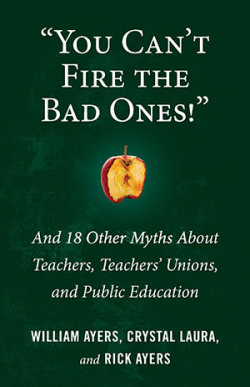
    Classroom“Anyone can be a teacher.” “Teachers’ unions are the biggest obstacles to improving education today.” “Teachers need to focus less on the arts, more on STEM.” These are some of the pernicious myths about teachers and public education that persist. Educators William Ayers, Crystal Paul, and Rick Ayers debunk these misperceptions in “You Can’t Fire the Bad Ones!” And 18 Other Myths About Teachers, Teachers’ Unions, and Public Education. By unpacking these myths, Ayers, Paul, and Ayers challenge readers—be they parents, community members, policy makers, union activists, or educators themselves—to rethink their assumptions about the role of education. In the following excerpt, they provide us with a reality check concerning the misinformation about how teachers are “poorly served by today’s teacher-education programs.”

    ***

    The journalist Fareed Zakaria notes, “Half of America’s teachers graduated in the bottom third of their college class,” in sharp contrast to countries that have more successful schools, such as Finland, South Korea, and Singapore, places that consistently draw 100 percent of their teachers from the top third of graduates. Finnish students are dependably at or near the top in international examinations, which makes sense since their teacher corps is drawn from the best and the brightest.

    Nancy Gibbs, editor of Time magazine, concludes that this discrepancy explains why “our kids’ performance falls below that of students in Estonia and why one-third of those who make it to college in the US need remedial education.” The well-qualified are denied access to the schools, and teacher-education programs enlist the halt and the lame. As a result—and is it any wonder?—our students are failing miserably compared to students in the rest of the world.

     Traditional teacher-education programs are a joke, an un-rigorous, cobbled-together amalgam of watered-down classes in psychology and philosophy and teaching methods, followed by “student teaching,” a lazy affair consisting of superficial classroom activities supervised by veteran losers who do little more than try to induct new teachers into the cynical culture of teachers’ unions, school failure, and complaint. Researchers Jason Richwine and Andrew Biggs say, “Given the relative lack of rigor of education courses, many teachers have not faced as demanding a college curriculum as other graduates.” And Joel Klein, former New York City Schools chancellor, claimed that poor training is part of the reason most graduates of traditional teacher-education programs don’t think that the experience was worthwhile nor the teaching credential of much value.

    REALITY CHECK

    When the corporate reformers came into our schools—testing and measuring, judging and sorting students, reducing the concept of an educated person to a single anemic metric on a high-stakes standardized test, all the while compounding the inequalities that have always plagued US public schools—conscientious teachers resisted. But teachers were also in the reformers’ sights, and the corporate reform group worked to reduce the reality of teaching actual children—complex, multidimensional, and challenging—to a simple matter of delivering rote lessons in test preparation to passive and obedient kids.

    As Kevin Kumashiro, former dean of the School of Education at the University of San Francisco, points out, “Under current reforms, the more students struggle, the less their schools are allowed to teach, and the less they are made to look like flourishing school systems in this country and to other nations.” Behind each of these moves lurked a deeper, ideologically driven goal: the replacement of the public education system with a private educational business. This is a recipe for inequality inflamed and would inscribe even more emphatically the reality of a high-quality education for the privileged and under-resourced schools focused on discipline for poor students and students of color.

    Education, no longer a common good nor a universal human right, would be fully transformed into a product to be traded in the marketplace like any other commodity, a hammer and a box of nails, say. The winners would be sorted out and separated from the losers, and significant profits would be made. For teacher-education programs, the reforms in the pipeline all pointed toward a resurgence of the privilege of white and male power.

    The corporate reform crowd—the marketeers, the banksters, the hedge fund billionaires, and their allies among the political class—have worked to steer the reform efforts and the privatization of public education for three decades. The corporate education agenda sits on a three-legged stool: test scores as a proxy for learning; teaching as little more than clerking; education as a commodity like any other.

    One current initiative from the federal government and the corporate sector is called the College Scorecard, a metric that ranks colleges based on post-graduation earnings of students. Surprise: Harvard graduates earn more than Howard graduates! This is social science in the service of the self-evident and the status quo.

    You Can't Fire the Bad OnesThe New York Times recently criticized university-based teacher education programs in an editorial ironically titled “Help Teachers Before They Get to Class.” Starting with an obligatory bow to the effective Finnish school system, the editorial hits the central tenets of the corporate reform agenda for schools, including the assertion that US schools of education should, like those of the Finns, raise admissions standards. This is an astoundingly narrow conclusion from the broad evidence of what makes Finnish schools work. In the first place, teachers in Finland receive much higher salaries and benefits than their counterparts in the United States, one that places them firmly in an economically secure position. Many US teachers can’t afford basic housing and living costs on their teaching salaries; a perhaps not unsurprising number moonlight as Uber drivers, bartenders, and clerks. Moreover, the respect and esteem with which teachers are held in Finland is a full 180 degrees from the national teacher-bashing narrative promoted by politicians and conservative pundits in the United States. Finally, Finland does not have nearly the income disparity and the massive poverty that plagues the United States and which stands behind so much school failure in this country.

    The result of these conditions is that applications to teacher education programs in the United States are down fifty-three percent from ten years ago. And many teachers are discouraged by what they find in the profession, from low pay to constricting regulations and intensive, sometimes obsessive high-stakes standardized testing. By five years in, fully fifty percent of teacher-education graduates leave the profession. If this kind of hemorrhaging appeared in the medical or legal professions, it would be declared a national crisis. In this context, for the Times to carp about low admissions standards would be laughable, if it weren’t so wrong-headed.

    The Times charges teacher education with another sin: preparing teachers for the humanities when there is a much greater shortage in math and science. This is either a cynical charge or an incredibly blinkered observation. Can you imagine teacher education programs not wanting to prepare math and science teachers? Again, the problem is that people with math and science degrees, especially advanced degrees, with the concomitant student debt, are drawn to much more lucrative professions.

    The forces of corporate education reform and their media followers who claim to believe so fervently in the market as the way to heal all ills refuse to see the ways that economic incentives and disincentives are driving this crisis. We have a teacher shortage across the country—San Francisco alone this year was looking for over four hundred teachers—and the Times is fiddling at the edges.

    The corporate reformers suggest that teaching teachers involves nothing more than the transmission of a narrow band of white middle-class attitudes and information into passive students whose mastery will be evaluated through standardized tests. Everything in this formula stands on faulty assumptions, including the erroneous idea that high-stakes standardized tests can measure effectiveness in the classroom or that a teacher’s work can be understood as the easy enactment of lesson plans removed from social or cultural context.

    When it’s all boiled down, the vision the reformers put forward is that teachers should be narrowly training students. And when we say schools are failing to teach African American, Latinx, immigrant, and other marginalized students, we must also interrogate the content and the “knowledge” we are supposed to be teaching. We can argue that it is not really education if the history is overwhelmingly European-centered history, if the literature is created by primarily white male authors. We need to examine and refocus what we call valid or important knowledge. This question goes beyond content too. It includes the kinds of discourse used in debate, the approach to science, the exploration of mathematical sense. Simply put, the finite amount of white middle-class knowledge should not be the gold standard for what is important. And the problem for oppressed communities is compounded when such knowledge is simply imparted by downloading information that will then be evaluated through standardized tests.

    We recall a standardized test for tenth graders that asked, “What were the reasons for US expansion in the Pacific after World War II?” The possible answers were a) to consolidate the defeat of Japanese expansionism, b) to counter the spread of communism, c) to expand market opportunities, and d) to spread Western values. What could a student possibly do when confronted with this question but try desperately to guess the perspective and point of view in the mind of the test writer? How would a Hawaiian youth read it? Someone from East Timor? A Vietnamese immigrant? The question and its assumptions drip with white Western positionality. And there was no space to write “all of the above” or “none of the above.”

    Everything in the corporate reform approach to education stands on faulty assumptions, such as the following:

    1. The task of public education is to help America defeat other countries in economic and military competition.
    2. Strong math and science skills will make the United States win this competition.
    3. Poor students need to be trained to obey rules and regulations unquestioningly.
    4. Education alone will end poverty.
    5. Success for Black and Brown people is measured in how much their knowledge and performance approaches white knowledge and performance.
    6. We know what skills and capacities will be needed fifty years from now.
    7. Standardized tests measure these skills and capacities.
    8. Competition, between students, teachers, schools, states, and countries, is the best way to advance social goals.

    The list goes on and on.

    Corporate reformers advocate basing teacher education on a utilitarian “competency” scheme rather than requiring students to complete a full university education. In this context, competency can be demonstrated through a series of online tests that allow education students to bypass or skip certain classes. It is an approach that foregrounds a mechanistic training while it eliminates the study of history or philosophy, an understanding of the psychology of learning, or the importance of raising the fundamental curriculum questions: What knowledge and experience is of most value, and how can students gain full and equitable access to that valuable knowledge and experience?

    Many of the other practices promoted by corporate reformers are entirely upside down: distance learning, including virtual avatars and virtual classrooms for student-teaching experiences, is not an adequate facsimile of classroom life; competition between students, teachers, schools, states, and countries is not the best way to advance intellectual and social goals; poor students will not be well served in an environment that demands their passivity and compliance; education alone will not end poverty. Corporate reformers display no grasp of teaching and learning, nor have the thinnest understanding of the complexity of teaching teachers, but they hurriedly gloss over their ignorance and cover up their glaring blind spots with mandates and regulations, rankings and bullying, in order to have their way in spite of evidence to the contrary.


    About the Authors 

    Bill Ayers is an author, activist, and educator whose previous books include To Teach: The Journey of a Teacher and Teaching Toward Freedom: Moral Commitment and Ethical Action in the Classroom.  Follow him on Twitter at @WilliamAyers and visit his website.

    Crystal Laura is an educator and the author of Being Bad: My Baby Brother and the School-to-Prison Pipeline.

    Rick Ayers is an educator and the author of An Empty Seat in Class: Teaching and Learning After the Death of a Student, and, with William Ayers, Teaching the Taboo: Courage and Imagination in the Classroom. Follow him on Twitter at @rick_ayers and visit his website.

  • Martin Luther King Jr National Historic Site

    Photo credit: National Park Service

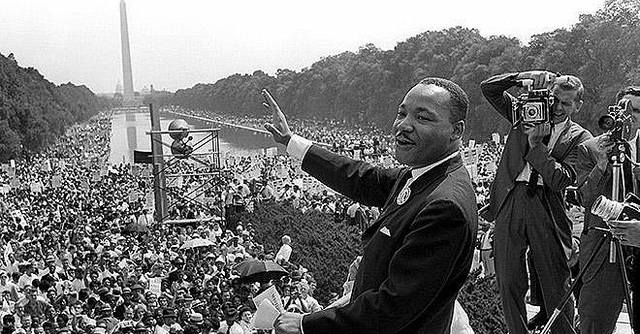
    “It is our common tragedy that we have lost [Martin Luther King, Jr.’s] prophetic voice but it would compound the tragedy if the lessons he did articulate are now ignored.” So wrote Coretta Scott King in the forward of Dr. King’s final book Where Do We Go from Here, his analysis of American race relations and the state of the movement after a decade of civil rights efforts. Each year, we honor his life and his legacy on his birthday. 2018 will mark the fiftieth anniversary of his death—a time for us to take account of our troubled times and truly pay attention to the message of his lessons.

    Dr. King gave his life to voice and fight for his prophetic and radical vision of liberation for America. His vision of justice extended beyond our nation’s borders and addressed the racism, poverty, war, and intolerance present in other countries. Through his words and demonstrations of direct nonviolent resistance, he articulated timeless lessons on how to achieve social justice. With this in mind, we put together a timeline of key moments from his life which highlight his commitment to the vision he had for America and the world.

    ***

    1955

    On December 1, Rosa Parks is arrested for refusing to give up her seat on a bus in Montgomery, Alabama, sparking city-wide boycott. Martin Luther King, Jr. becomes the spokesperson of boycott which continues for over a year and results in desegregation on city buses and the hiring of black bus drivers.

    1956

    On the evening of January 30, while Dr. King speaks at a mass meeting, his home is bombed. King addresses an angry crowd that gathers outside his house, pleading for nonviolence.

    1957

    Dr. King forms the Southern Christian Leadership Conference (SCLC) to fight segregation and achieve civil rights, and on February 14 becomes its first president.

    Stride Toward Freedom1958

    In September, Dr. King’s first book, Stride Toward Freedom: The Montgomery Story, is published. In it, he gives a comprehensive, revelatory, and intimate account of the first successful large-scale application of nonviolent resistance in America—the Montgomery Bus Boycott.

    “To accept passively an unjust system is to cooperate with that system; thereby the oppressed become as evil as the oppressor. Noncooperation with evil is as much a moral obligation as is cooperation with good.”
    —from Stride Toward Freedom

    1959

    In February, Dr. King travels to India, where he meets with Indian political leaders and activists, deepening his understanding of Gandhian principles of nonviolence. In July he publishes “My Trip to the Land of Gandhi” in which he draws parallels between Indian caste discrimination and US racial discrimination.

    1960

    On February 1,, four black students sit at a “whites only” lunch counter at Woolworth’s and refuse to leave until they are served, launching a sit-in movement that spread through the country. In his article, “The Burning Truth in the South,” Dr. King commends the young activists involved in the lunch counter sit-ins and frames their protests within a historical context of nonviolent direct action.

    “A generation of young people has come out of decades of shadows to face naked state power; it has lost its fears, and experienced the majestic dignity of a direct struggle for its own liberation. These young people have connected up with their own history—the slave revolts, the incomplete revolution of the Civil War, the brotherhood of colonial colored men in Africa and Asia. They are an integral part of the history which is reshaping the world, replacing a dying order with modern democracy.”
    —from “A Burning Truth in the South”

    1961

    On May 14, the first group of Freedom Riders was assaulted in Alabama.  Recognizing the work of young Black Americans pushing for social change and justice, Dr. King writes “The Time for Freedom Has Come,” in which he cites young people as one of the most significant catalysts in the freedom struggle.

    1963

    Relying on nonviolent direct action, the SCLC organizes the Birmingham campaign, which sought to desegregate the downtown shopping and government centers in Birmingham, Alabama, including public schools. On April 3, Dr. King is arrested for violating a city order against public protest during his participation in the Birmingham campaign. In his cell, King writes his “Letter from Birmingham Jail.”

    “We know through painful experience that freedom is never voluntarily given by the oppressor; it must be demanded by the oppressed.”
    —from “Letter from Birmingham Jail”

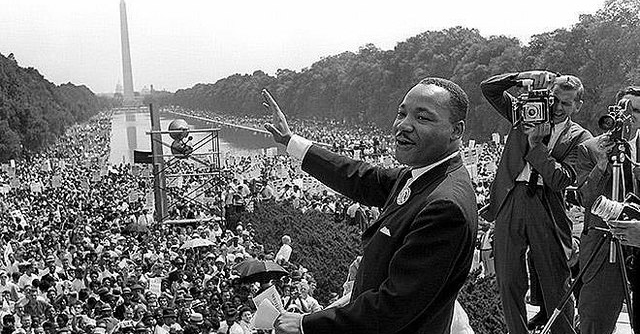
    On August 28, more than 250,000 people gather at the Lincoln Memorial in Washington, DC, for the March on Washington for Jobs and Freedom, one of the largest political rallies for human rights in US history. Dr. King delivers one of his most famous speeches, “I Have a Dream.”

    On September 15, four young girls are killed in Birmingham, Alabama, when their church is bombed in retaliation for the nonviolent protest of the summer. Three days later, Dr. King delivers his “Eulogy for the Martyred Children.”

    Why We Can't Wait1964

    On January 3, Dr. King appears on the cover of Time magazine as its Man of the Year for 1963.

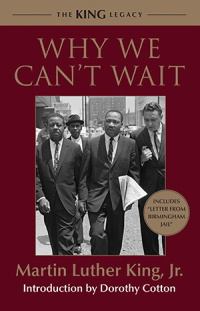
    In July, Why We Can’t Wait, his best-selling account of the civil rights movement in Birmingham during the spring and summer of 1963, is published.

    On December 10, at age thirty-five, Dr. King is awarded the Nobel Peace Prize. The honor reflects the global awareness and support for his commitment to human rights in the United States.  

    1965

    In March, Dr. King leads thousands of nonviolent demonstrators on a five-day, fifty-four-mile march from Selma, Alabama, to Montgomery, Alabama, to join a campaign for voting rights.

    On July 9, Congress passes the Voting Rights Act of 1965, prohibiting the states from using literacy tests and other methods of excluding African Americans from voting.

    1967

    On April 4, Dr. King delivers “Beyond Vietnam: A Time to Break Silence” at Riverside Church in New York City.

    “A genuine revolution of values means in the final analysis that our loyalties must become ecumenical rather than sectional. Every nation must now develop an overriding loyalty to mankind as a whole in order to preserve the best in their individual societies.”
    —from “Beyond Vietnam: A Time to Break Silence”

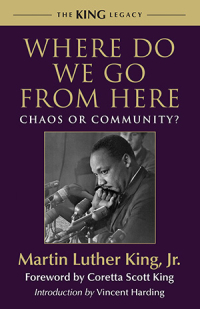
    Where Do We Go From HereIn June, Where Do We Go from Here: Chaos or Community?, a collection of Dr. King’s final reflections after a decade of civil rights struggles, is published.

    “Darkness cannot drive out darkness: only light can do that. Hate cannot drive out hate: only love can do that.”
    —from “Where Do We Go from Here”

    On October 26, Dr. King delivers “What Is Your Life’s Blueprint?” to students at Barratt Junior High School in Philadelphia. In his speech, he challenges students to the best one can be, regardless of one’s status in life.

    “[I]n your life’s blueprint, must be a commitment to the eternal principles of beauty, love, and justice….However young you are, you have a responsibility to seek to make your nation a better nation in which to live. You have a responsibility to seek to make life better for everybody. And so you must be involved in the struggle of freedom and justice.”
    —from “What Is Your Life’s Blueprint?”

    In November and December, Dr. King delivered five lectures for the renowned Massey Lecture Series of the Canadian Broadcasting Corporation. The collection was immediately released as a book under the title Conscience for Change.

    On December 4, Dr. King and the Southern Christian Leadership Conference announce the Poor People’s Campaign focusing on jobs and freedom for the poor of all races.

    1968

    On February 4, Dr. King delivers one of his most famous sermons, “The Drum Major Instinct”, at Ebenezer Baptist Church in Atlanta, Georgia.

    “[I]f you want to say that I was a drum major, say that I was a drum major for justice. Say that I was a drum major for peace. I was a drum major for righteousness. And all of the other shallow things will not matter.”
    —from “The Drum Major Instinct”

    On April 3, Dr. King delivers his final speech “I’ve Been to the Mountaintop” at the Mason Temple Church of God in Christ.

    “And whenever men and women straighten their backs up, they are going somewhere, because a man can’t ride your back unless it is bent.”
    —from “I’ve Been to the Mountaintop”

    On April 3, Dr. King returned to Memphis, Tennessee to support black public sanitation workers who striking for better wages. On April 4, he was assassinated on the balcony of the Lorraine Motel.

    In May, after Dr. King’s assassination, Conscience for Change is rereleased as Trumpet of Conscience and includes a foreword by Coretta Scott King in which she reflects on her husband’s legacy.

    *** 

    Find Dr. King’s books in The King Legacy Series.

    Some additional reading:

    Martin Luther King Jr National Historic Site

  • Talk therapy

    Photo credit: Jty33

    What has gone wrong in the field of mental health care? In recent decades there has been a decline in the quality and availability of psychotherapy in America that has gone unnoticed—even though rates of anxiety, depression, and suicide are on the rise. Many people struggle to find an available and affordable practitioner in their area, and if they do, they’re limited to restrictive short-term treatment options, sporadic appointment schedules, and prescriptions for medications they don’t want or need. On top of that, psychotropic drugs, if no longer thought of as a magical cure, are still over-prescribed. How do we bring back the days of patients sitting comfortably across from their therapists, talking through their thoughts, struggles, and desires?

    In Saving Talk Therapy: How Health Insurers, Big Pharma, and Slanted Science are Ruining Good Mental Health, leading clinical psychologist Dr. Enrico Gnaulati presents powerful case studies from his practice to remind patients and therapists alike how and why traditional talk therapy works. Using cutting-edge research findings, he also unpacks the problematic incentives in our health-care system and in academic psychology that explain its decline. The following list of facts about the current state of psychotherapy and mental health from Saving Talk Therapy highlight why Dr. Gnaulati makes his case that doctors and patients need to come together to create a more balanced and nuanced approach to therapy.

    Talk Therapy and General Mental Health Care

    • In the late 1950s, about 14% of Americans had visited a psychotherapist at some point in their lives. The number rose to 26% in the 1970s and to 50% in 2010
    • For most Americans who enter therapy for help with moderate anxiety and depression, one to two years of weekly therapy appears to be indicated for meaningful and lasting change to occur
    • 90% of people claim they would rather meet with a therapist to talk about their problems than take medications
    • Only about 3% of Americans ever enter psychotherapy, even though roughly half the population meet lifetime criteria for a serious emotional problem
    • In one study of consumer preferences in service delivery, choice of therapist ranked second in importance, leading the investigators to assert that selection of a compatible psychotherapist may be one of the most crucial decisions a prospective client can make given the well-established importance of the therapeutic relationship

    Medication Use

    • Of the approximately 49,000 psychiatrists in the United States, the overwhelming majority exclusively prescribe medications. Fewer than 11% now provide talk therapy to their patients
    • 58% of emotionally troubled people take medications only, with no psychotherapy. About 10% of such people attend psychotherapy only and opt out of medication usage
    • In 2010, approximately 40% of Americans seeking mental health treatment received psychotherapy, down from 71% before the advent of Prozac
    • Studies show that (SSRIs) selective serotonin reuptake inhibitors are no more effective in treating depression than the older, cheaper antidepressants; they dampen sexual functioning, they are linked to a risk for suicidality and violence. More large-scale studies have revealed that SSRI antidepressants are no more effective than sugar pills in the treatment of depression
    • The use of antipsychotics to treat ADHD and explosive or disruptive behavior in young children and teenagers accounts for about 38% of all sales

    Psych Industry and Pharmaceutical Industry

    • 50% of research articles in the field of psychiatry are ghostwritten in some shape or form, penned by outsiders and published under the names of prominent academics, all whom draw paychecks from pharmaceutical companies
    • The United States shells out about $113 billion a year on mental health treatment; approximately half of that covers the cost of psychiatric drugs. Expenditures on mental health care account for only 5.6% of the total health-care budget
    • In the past 10 years, psychotherapy referrals by physicians have fallen by nearly 50% even though figures confirm that mental health problems are on the rise
    • According to the 2014 article “Expanding the Lens of Evidenced-Based Practice in Psychotherapy: A Common Factors Perspective, ” therapist empathy is about 9x more effective than any other technique is in helping clients
    • In a 2004 Therapy in America poll, patients were asked what led to success in their treatment. The two top-ranked factors were “therapist’s listening skills” and “therapist’s personality,” endorsed by 63% and 52% of participants, respectively


    About Enrico Gnaulati 

    Enrico Gnaulati PhD is a clinical psychologist based in Pasadena, California. His work has been featured on Al Jazeera America, KPCC Los Angeles, KPFA Berkeley, and online at the Atlantic and Salon. He is a nationally-recognized critic of mental health practice and policy and the author of Back to Normal: Why Ordinary Childhood Behavior is Mistaken for ADHD, Bipolar Disorder, and Autism Spectrum Disorder. Visit his website.

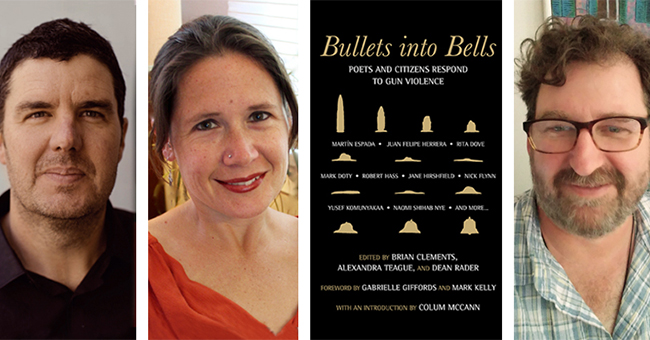
  • By Brian Clements, Alexandra Teague, and Dean Rader

    Left to right: Dean Rader (photo credit: Lisa Beth Anderson); Alexandra Teague (photo credit: Dylan Champagne); Brian Clements (photo credit: uncredited)

    Left to right: Dean Rader (photo credit: Lisa Beth Anderson); Alexandra Teague (photo credit: Dylan Champagne); Brian Clements (photo credit: uncredited)

    This essay appeared originally on Powells.com.

    All three of us are poets and professors. We all also write prose. Our jobs rely on and live in words. And yet, there are no real words to describe our complicated emotions about this anthology. On the one hand, we are grateful that it exists. On the other, we are mortified that it exists. We are pleased these amazing poems and responses are out there in the world; we are horrified there are increased reasons for them to be in this book.

    We feel similarly about the opportunity to write this essay. We are thankful Powell’s has given us this forum; we are saddened that just a few weeks before writing this, there was another deadly shooting in a church, making this anthology tragically relevant; we are saddened that while we were writing this essay, a man drove around rural Northern California shooting people on the road and shooting into a school.

    We thought we would take this chance to author a multi-voiced essay in which we speak collectively but also as individuals. So angry are we about so many things and so aligned are we about our commitment to this project that any of us could have written these sections. But, we also thought readers might be curious to hear a portion of how this book came to be in our own voices.

    Brian Clements

    This anthology is the first part of a three-part project; the second and third parts are supplemental web content (including more poems) and a nationwide series of events. In at least one event in every state and Washington, DC, poets and activists from the book will read and speak along with local poets, activists, and audiences about the gun violence problems that face us nationally and locally. In other words, this three-part project is merely a small part of a much larger project—the project of ending gun violence in this country, a project that already comprises dozens of organizations and millions of people.

    We expect to face a common question at most of those events: “What can poetry do to help end gun violence?” Our hope is that the poems and statements in this book will contribute to the ongoing conversation about gun violence in a way that hasn’t yet been done and that, therefore, this book will move some folks to action. If a poem ever moved anyone to act, then undoubtedly this book will have some impact. And if that impact saves a single life, then the book will have mattered.

    I honestly don’t see how anyone could read Nick Arnold’s “Jordan,” about his cousin, Jordan Davis, along with a statement from Jordan’s mom, Lucy McBath, without feeling moved at the very least to make a commitment to let their elected representatives and senators know in no uncertain terms how important it is that we stop this epidemic of gun violence. It is beyond me how anyone could read Dana Levin’s “Instructions for Stopping” along with Kate Ranta’s story of surviving being shot by her husband in front of her son without taking it upon themselves to understand and educate others about the connections between domestic violence and gun deaths. How is it possible to read Debra Marquart’s “Kablooey Is the Sound You Will Hear” alongside Jacob and Darchel Mohler’s recounting of their daughter’s negligent shooting death at a friend’s house without feeling the crucial importance of establishing laws that hold adults responsible for putting children into situations in which these things can happen?  

    Since the shootings at Sandy Hook on December 14, 2012, it has been difficult for me to think of any poem as merely “poetry.” My family, my brain, my body, my emotional being, my social being, my town, my job, my place in the universe all radically changed in a matter of minutes on that day—and those changes are minuscule next to the horror visited upon twenty-six other families in my home town. For me, this book is a small attempt to make some contribution to bettering what is left of the world; my lifetime in poetry may not have done much for the world up to this point, but I’ll be damned if I don't attempt to put that lifetime of training to some good use. Maybe this is what I was training for all along.

    Alexandra Teague

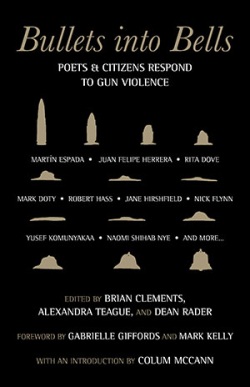
    Bullets into BellsAs I’ve read poet after poet responding to gun violence, tragedy after tragedy over the past few years, what I kept gravitating toward, and seeing others gravitate toward, was in large part the emotional catharsis and power of hearing the pain of the lost lives articulated. But an additional crucial power of these poems is the ways in which they reimagine and reprioritize how we tell these stories and the broader social narratives underlying them. Poetry is inherently concerned with form: in the interplay of line and syntax; the shaping of stanzas; the pacing and patterns and repetitions. And by allowing us to inhabit alternate forms, it allows us to inhabit alternate ways of conceptualizing. It helps us question what is normal and acceptable, what we pause to consider, what we conflate and do not. Freedom with freedom to own, rather than freedom for everyone to live without fear of being shot, for instance.
     
    One of the poems that strongly impacted me and became an impetus for the anthology was “In Two Seconds” by Mark Doty. When I first read it, I already knew about the heartbreaking and all-too-familiar police shooting that killed Tamir Rice. I knew Tamir was only a twelve-year-old child. I had read that the officer waited two seconds before firing. Doty’s poem didn’t add details or news—what it did, its long sentences spilling over, connecting lines and couplets, was suspend me in the experience of an entire life that should have moved forward, instead racing backwards into loss: as “the boy’s face / climbed back down the twelve-year tunnel / of its becoming.” It’s a poem about time that uses poetry’s formal capacities so “two seconds” become potently full of all the other seconds that were, and could have been, and will not be. It’s a poem that asks hard questions, implicating me, the police officer, Doty himself in reckoning with the tragedy. It is these capacities of poetry and these poems that I gravitated toward after each next shooting—as I found myself unable to think or write of anything else—that prompted me to envision an anthology that gathered their power together.   
    These are poems that help us to empathize more fully; to inhabit alternate experiences; to, as C. D. Wright put it, bring words’ “integrity to the fore.” Poems that help us conceptualize differently—and hopefully better. This is what I see as the fullest meaning of Kafka’s saying that writing “must be the axe for the frozen sea inside us.” In the same piece, Kafka said we need books “that affect us like a disaster.” I hope these poems affect us like a disaster and much more—that they help us to imagine our way out of disaster. 

    Dean Rader

    Throughout the difficult but wholly engrossing process of compiling this anthology, I have been thinking about a little-known quote by Langston Hughes. “A poet is a human being,” Hughes writes. “Each human being must live within his time, with and for his people, and within the boundaries of his country.” The poets in this anthology are very much living within their time and are living through their poetry with and for their fellow Americans.

    However, within our country are boundaries upon boundaries upon boundaries. Thankfully, poetry is migratory; the poems and the responses in this volume travel.

    I remember the first time I read Juan Felipe Herrera’s profound “Poem by Poem” about the massacre at the Emanuel African Methodist Episcopal Church in which nine people died and many others were injured. That poem moved across the country, from one culture to another, from one heart to countless others. It is still moving. Jameson Fitzpatrick’s “A Poem for Pulse” is going up and down the Atlantic seaboard. Liz Rosenberg’s “The First Child Martyr at Illinois Elementary” has gone from upstate New York to Illinois to Arizona and now back to you. Tarfia Faizullah’s “Aubade With Lemon and Sage” may not even take place within the boundaries of this country, yet it says everything about the boundaries of this country. 

    We are, to some extent, our worst policies. We are as weak as our weakest laws. But, we are as good as our best poems. We are as strong as our strongest voices. These poems intuit that; these responses demand that. 

    The great American poet Wallace Stevens writes, “Poetry is a response to the daily necessity of getting the world right.” These poems, these responses, are trying to do just that.


    About the Authors 

    Brian Clements is the author, most recently, of A Book of Common Rituals. He lives in Newtown, Connecticut, where his wife, a teacher, survived the Sandy Hook Elementary School shooting. Follow him on Twitter at @bri_clements.

    Alexandra Teague is the author of two books of poetry—Mortal Geography, winner of the California Book Award for Poetry, and The Wise and Foolish Builders.

    Dean Rader is the author of two books of poetry, most recently Self-Portrait as Wikipedia Entry, and editor of 99 Poems for the 99 Percent: An Anthology of Poetry. Follow him on Twitter at @deanrader and visit his website.

  • 20172017 has been ragged and turbulent, charged with a fraught political climate spawned by a divisive presidential election. 2017 witnessed assaults on progress in racial justice, backlashes against environmental protections, and more. When we needed perspective and lucid social critique on the latest attacks on our civil liberties, our authors were there. We couldn’t be more thankful for them. They make the Broadside, which reached its tenth anniversary this year, the treasure trove of thought-provoking commentary we can turn to in our troubling and uncertain times. As our director Helene Atwan wrote in our first ever blog post, “It’s our hope that Beacon Broadside will be entertaining, challenging, provocative, unexpected, and—maybe above all—a good appetizer.” We certainly hope that’s the case for the year to come. Before 2017 comes to a close, we would like to share a collection of some of the highlights of the Broadside. Happy New Year!


    “Beacon Authors Speak Truth to Trump on Inauguration Day”

    InaugurationThe election of Donald Trump as President of the United States and his approval rating spread doubts, fears, and concerns about what he and his administration would do during his term in the White House. For Inauguration Day, we reached out to a few of our authors, from Rev. Dr. William J. Barber II to Rafia Zakaria, to ask them to share what they wanted Trump to know, understand or beware of.


    Aviva Chomsky’s “A Day without Immigrants: How the Undocumented Keep America’s Job Economy Afloat”

    A Day Without ImmigrantsIn response to President Trump’s immigration agenda, which pledges to seal the US/Mexico border, “A Day without Immigrants” boycotts and strikes were organized nationwide. The protests called attention to the contributions immigrant communities make to US business and culture. The generally unacknowledged work that undocumented workers do is crucial to the standard of living and consumption enjoyed by virtually everybody in the US. Aviva Chomsky explains in this excerpt from her book Undocumented that as the rise in undocumented workers over the past decades goes on, the US economic system continues to exploit them.


    Lori Tharps’s “For Colored Girls Who Were Mistaken for the Nanny By a Public Who Didn’t Know Enough”

    Robert Kelly Jung-a Kim and their childrenRemember when South Korea expert Robert Kelly was being interviewed live on the BBC and his two children walked into his office as the camera was rolling? It was hilarious! And the video went viral. Yet it was assumed that Jung-a Kim, the woman who swooped in to haul the kids out of the room, was the nanny, not Kelly’s wife. Same Family, Different Colors author Lori Tharps unpacks the notion that in American society, families are supposed to match; and when they don’t, all kinds of problems and false assumptions can arise, both inside and outside the home.


    Christian Coleman’s “Her Eyes Weren’t Watching God: The Empathetic Secular Vision of Octavia Butler”

    Octavia E ButlerMacArthur fellow and multiple award-winning science fiction writer Octavia E. Butler would have turned seventy this year if she were still with us. Her fiction is still with us and stands the test of time, especially her classic novel Kindred. Our digital marketing associate and blog editor Christian Coleman paid tribute to her on her birthday in this piece about how her atheist outlook was just as important as her Black feminist perspective in developing the social justice consciousness of her work.


    Christopher Emdin: “Thoughts on Transformative Pedagogy for National Teacher Appreciation Week”

    Christopher EmdinChristopher Emdin’s For White Folks Who Teach in the Hood galvanized the field of urban education when it came out in 2016 and continues to do so today. It radically reframes the approaches to teaching and learning in urban schools by taking to task the perception of urban youth of color as unteachable and challenging educators to embrace and respect each student’s culture and to reimagine the classroom as a site where roles are reversed and students become experts in their own learning. This excerpt, posted last year on our blog in honor of National Teacher Appreciation Week, generated a lot of enthusiastic conversation on social media this year, most notably on Twitter. It lists some of Emdin’s key musings to motivate educators to keep going.


    “A Charlottesville Syllabus for Our Uncertain Times”

    End White SupremacyThe events in Charlottesville, Virginia, were a frightening and disheartening reminder of how hate and intolerance in the US resurface when bigots feel empowered to act on their prejudice. Discussions about hate and dismantling white supremacy need to continue in order for us to work toward inclusiveness and social justice. That’s why we put together this list of resources and continue to add to it in our troubled times.


    “Learning the Truth about Thanksgiving and America’s Origin Story”

    The First ThanksgivingThanksgiving is a time when the topic of our nation’s origins crops up again in our conversations. But much of the US’s widely accepted origin story is skewed by the lens of settler colonialism and has silenced the voices of Native Americans. Consequently, many fabricated myths about Native Americans remain with us today. Revered historian Roxanne Dunbar-Ortiz, author of An Indigenous Peoples’ History of the United States, and journalist Dina Gilio-Whitaker, coauthor with Dunbar-Ortiz of “All the Real Indians Died Off,” have debunked these myths and uncovered history that isn’t acknowledged or well known by the general public so that we can honor and reflect on the contributions of Indigenous peoples in America.


    Gayle Wald’s “Trailblazer Sister Rosetta Tharpe Inducted in Rock and Roll Hall of Fame, Class of 2018”

    Sister_Rosetta_TharpeAlthough guitar virtuoso Sister Rosetta Tharpe has long been recognized as the godmother of rock, she’s been shockingly overlooked in rock ‘n’ roll history—until now. This year, she was finally inducted in the Rock and Roll Hall of Fame. We wouldn’t have the likes of Elvis Presley, Little Richard, Eric Clapton, and Etta James were it not for Tharpe, who paved the way for them with her innovative, charismatic guitar technique and crossover appeal. We all agree with Gayle Wald, writer of Tharpe’s biography Shout, Sister, Shout!, that it’s about time she got her overdue recognition.

  • By Martin Luther King, Jr.

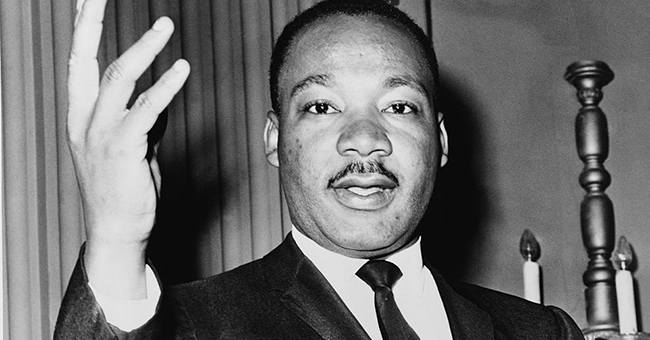
    MLK 1964Fifty years ago—on December 24, 1967—the Rev. Dr. Martin Luther King, Jr. delivered this Christmas sermon in Ebenezer Baptist Church at Atlanta, Georgia. It was broadcast by the Canadian Broadcasting Corporation as the fifth and final part of the 1967 Massey Lecture Series. In it, Dr. King articulates his long-term vision of nonviolence as a path to world peace. As Marian Wright Edelman wrote in her foreword to The Trumpet of Conscience, the book in which the sermon is collected, “we have made much but far from enough progress in overcoming the tenacious national demons of racism, poverty, materialism, and militarism Dr. King repeatedly warned could destroy America and all of God’s creation.” King’s vision remains eerily prophetic for our troubled times. To commemorate the anniversary of Dr. King’s sermon, we share selections of it with you here.

    ***

    This Christmas season finds us a rather bewildered human race. We have neither peace within nor peace without. Everywhere paralyzing fears harrow people by day and haunt them by night. Our world is sick with war; everywhere we turn we see its ominous possibilities. And yet, my friends, the Christmas hope for peace and goodwill toward all men can no longer be dismissed as a kind of pious dream of some utopian. If we don’t have goodwill toward men in this world, we will destroy ourselves by the misuse of our own instruments and our own power. Wisdom born of experience should tell us that war is obsolete. There may have been a time when war served as a negative good by preventing the spread and growth of an evil force, but the very destructive power of modern weapons of warfare eliminates even the possibility that war may any longer serve as a negative good. And so, if we assume that life is worth living, if we assume that mankind has a right to survive, then we must find an alternative to war—and so let us this morning explore the conditions for peace. Let us this morning think anew on the meaning of that Christmas hope: “Peace on Earth, Good Will toward Men.” And as we explore these conditions, I would like to and its strategy.

    We have experimented with the meaning of nonviolence in our struggle for racial justice in the United States, but now the time has come for man to experiment with nonviolence in all areas of human conflict, and that means nonviolence on an international scale.

    Now let me suggest first that if we are to have peace on earth, our loyalties must become ecumenical rather than sectional. Our loyalties must transcend our race, our tribe, our class, and our nation; and this means we must develop a world perspective. No individual can live alone; no nation can live alone, and as long as we try, the more we are going to have war in this world. Now the judgment of God is upon us, and we must either learn to live together as brothers or we are all going to perish together as fools.

    ~~~

    Now let me say, secondly, that if we are to have peace in the world, men and nations must embrace the nonviolent affirmation that ends and means must cohere. One of the great philosophical debates of history has been over the whole question of means and ends. And there have always been those who argued that the end justifies the means, that the means really aren’t important. The important thing is to get to the end, you see.

    So, if you’re seeking to develop a just society, they say, the important thing is to get there, and the means are really unimportant; any means will do so long as they get you there—they may be violent, they may be untruthful means; they may even be unjust means to a just end. There have been those who have argued this throughout history. But we will never have peace in the world until men everywhere recognize that ends are not cut off from means, because the means represent the ideal in the making, and the end in process, and ultimately you can’t reach good ends through evil means, because the means represent the seed and the end represents the tree.

    ~~~

    Now let me say that the next thing we must be concerned about if we are to have peace on earth and goodwill toward men is the nonviolent affirmation of the sacredness of all human life. Every man is somebody because he is a child of God. And so when we say “Thou shalt not kill,” we’re really saying that human life is too sacred to be taken on the battlefields of the world. Man is more than a tiny vagary of whirling electrons or a wisp of smoke from a limitless smoldering. Man is a child of God, made in His image, and therefore must be respected as such. Until men see this everywhere, until nations see this everywhere, we will be fighting wars. One day somebody should remind us that, even though there may be political and ideological differences between us, the Vietnamese are our brothers, the Russians are our brothers, the Chinese are our brothers; and one day we’ve got to sit down together at the table of brotherhood. But in Christ there is neither Jew nor Gentile. In Christ there is neither male nor female. In Christ there is neither Communist nor capitalist. In Christ, somehow, there is neither bound nor free. We are all one in Christ Jesus. And when we truly believe in the sacredness of human personality, we won’t exploit people, we won’t trample over people with the iron feet of oppression, we won’t kill anybody.

    ~~~

    In 1963, on a sweltering August afternoon, we stood in Washington, D.C., and talked to the nation about many things. Toward the end of that afternoon, I tried to talk to the nation about a dream that I had had, and I must confess to you today that not long after talking about that dream I started seeing it turn into a nightmare. I remember the first time I saw that dream turn into a nightmare, just a few weeks after I had talked about it. It was when four beautiful, unoffending, innocent Negro girls were murdered in a church in Birmingham, Alabama. I watched that dream turn into a nightmare as I moved through the ghettos of the nation and saw my black brothers and sisters perishing on a lonely island of poverty in the midst of a vast ocean of material prosperity, and saw the nation doing nothing to grapple with the Negroes’ problem of poverty. I saw that dream turn into a nightmare as I watched my black brothers and sisters in the midst of anger and understandable outrage, in the midst of their hurt, in the midst of their disappointment, turn to misguided riots to try to solve that problem. I saw that dream turn into a nightmare as I watched the war in Vietnam escalating, and as I saw so-called military advisers, 16,000 strong, turn into fighting soldiers until today over 500,000 American boys are fighting on Asian soil. Yes, I am personally the victim of deferred dreams, of blasted hopes, but in spite of that I close today by saying I still have a dream, because, you know, you can’t give up in life. If you lose hope, somehow you lose that vitality that keeps life moving, you lose that courage to be, that quality that helps you to go on in spite of all. And so today I still have a dream.

    I have a dream that one day men will rise up and come to see that they are made to live together as brothers. I still have a dream this morning that one day every Negro in this country, every colored person in the world, will be judged on the basis of the content of his character rather than the color of his skin, and every man will respect the dignity and worth of human personality. I still have a dream today that one day the idle industries of Appalachia will be revitalized, and the empty stomachs of Mississippi will be filled, and brotherhood will be more than a few words at the end of a prayer, but rather the first order of business on every legislative agenda. I still have a dream today that one day justice will roll down like water, and righteousness like a mighty stream. I still have a dream today that in all of our state houses and city halls men will be elected to go there who will do justly and love mercy and walk humbly with their God. I still have a dream today that one day war will come to an end, that men will beat their swords into plowshares and their spears into pruning hooks, that nations will no longer rise up against nations, neither will they study war any more. I still have a dream today that one day the lamb and the lion will lie down together and every man will sit under his own vine and fig tree and none shall be afraid. I still have a dream today that one day every valley shall be exalted and every mountain and hill will be made low, the rough places will be made smooth and the crooked places straight, and the glory of the Lord shall be revealed, and all flesh shall see it together. I still have a dream that with this faith we will be able to adjourn the councils of despair and bring new light into the dark chambers of pessimism. With this faith we will be able to speed up the day when there will be peace on earth and goodwill toward men. It will be a glorious day, the morning stars will sing together, and the sons of God will shout for joy.

    Excerpted from The Trumpet of Conscience, published by Beacon Press, 2010. Copyright © 1967 by Martin Luther king, Jr. Foreword copyright © 1968 by Coretta Scott King. All rights reserved. Foreword copyright © 2010 Marian Wright Edelman.


    Dr. Martin Luther King, Jr. (1929–1968), Nobel Peace Prize laureate and architect of the nonviolent civil rights movement, was among the twentieth century’s most influential figures. One of the greatest orators in US history, King also authored several books, including Stride Toward Freedom: The Montgomery Story, Where Do We Go from Here: Chaos or Community?, and Why We Can’t Wait. His speeches, sermons, and writings are inspirational and timeless. King was assassinated in Memphis, Tennessee, on April 4, 1968. 

  • Pentagon PapersWith the release of The Post, directed by Steven Spielberg and starring Meryl Streep and Tom Hanks, the story of the Pentagon Papers has rekindled public conversation about the importance of a free press. The papers divulged the history and facts of the United States’ political-military involvement in Vietnam from 1945 to 1967, which were kept a secret from the nation until Daniel Ellsberg leaked copies of the papers to the New York Times to publish as excerpts in June of 1971. The Washington Post began printing excerpts as well. The film’s release couldn’t have come at a more relevant time. Its historical dramatization of how an administration tried to stop the paper from printing parts of the reports speaks to what we see happening now: a president openly attacking news outlets and making accusations of “fake news.” It also highlights how necessary publishers are in “protecting an open, democratic society that is now under increasing threat,” as associate publisher Tom Hallock wrote in response to Donald Trump’s inauguration.

    While the film focuses on the Washington Post’s involvement in exposing the Pentagon Papers, the story doesn’t end there. In October 1971, Beacon Press released the Senator Mike Gravel edition of The Pentagon Papers: The Defense Department History of United States Decisionmaking on Vietnam as a four-volume set after other publishers opted not to take on the task. “I can only hope for the opportunity to do something as daring and courageous as publishing these critical documents,” said current director, Helene Atwan. “The story of the Pentagon Papers is one of my very favorites about this press and what Beacon stands for.”

    Indeed, it’s a story that attests to the civic courage Beacon has consistently shown—the kind of civic courage that Ellsberg said “we must have for our country to survive as a democracy.”

    Dozens of commercial and university publishing houses rejected Gravel’s proposal, citing near-guaranteed political persecution and a bleak bottom line. Gravel, one of just two Unitarian Universalists in the Senate, then tried Beacon, a department of the Unitarian Universalist Association. Beacon’s antiwar list in those days included Howard Zinn’s Vietnam: The Logic of Withdrawal, Jean-Paul Sartre’s On Genocide and Arlo Tatum and Joseph S. Tuchinsky’s Guide to the Draft. Ideologically, Beacon felt compelled to publish and agreed to take on the Pentagon Papers, despite financial and political risks.

    The following selection from Beacon Press and the Pentagon Papers, a chapbook history issued by Beacon originally on the thirtieth anniversary of the publication, explains how Beacon became the publisher of the papers. (For the entire chapbook, see here; for a video of a panel discussion with Daniel Ellsberg, Robert West, Mike Gravel, moderated by Amy Goodman, click here.)

    ***

    Beacon was brought to Gravel’s attention by his aide, Leonard Rodberg, a vocal antiwar activist “who reminded the Senator of his denominational press in Boston.” The Unitarian Universalist connection is important in that the senator and the press shared certain principles that were clearly outlined in a 1971 Unitarian Universalist World article:

    Why should the UU press take the risks and become involved in the most vicious battle for the free press since the Zenger trial? For the simple reason that freedom from bureaucratic censorship is one of the objectives of this denomination and of the press which represents it.

    With Gravel’s approval, Rodberg called Beacon’s editor in chief, Arnold Tovell. Tovell, in turn, discussed the proposal with Beacon’s director, Gobin Stair. The two men agreed to look at the papers. When Tovell phoned Rodberg to express interest in reading the papers, the senator’s aide invited a Beacon staff member to travel down to Washington. Tovell demurred and told Rodberg that “he had to bring [the papers] to Beacon’s offices, which was important to me, to be [there] both emotionally and physically.” Rodberg complied.

    While other houses measured Gravel’s proposal with profit and loss statements, Beacon took a different approach. Presenting the senator’s project in-house, Stair framed the debate in terms of a moral obligation to publish:

    Our previous order was to publish those good books which are important books which the commercial presses won’t publish . . . and we were evading it in every way we could! . . . I had to tell my trustees that this was a principle . . . . I thought we should do it. But they had to know that it would cost ’em. I stood up at that damned meeting and said it just as simply as that. 

    Beacon decided the senator’s proposal was a good fit. In an early letter to Gravel, Stair called catalog titles like Howard Zinn’s Vietnam: The Logic of Withdrawal to the senator’s attention, before concluding, “We feel that the combination of a United States senator and a nonprofit publishing house, well established, with a long history of controversial publications of a high standard is a good one.” In the same letter, Stair acknowledged that Beacon understood other publishers were still considering Gravel’s proposal, but noted, “Our basic attitude is that the materials should be published and only you can make the decision as to how they should be published.”

    On August 17, 1971, Beacon publicly announced that it would publish The Pentagon Papers. Nobody on staff was naive about what such a commitment entailed: “A Beacon spokesman said yesterday the Gravel book is the biggest venture in the history of the small publishing firm.” The papers represented the “biggest venture” in Beacon’s long history on many levels. For starters, the papers in their submitted form—a “great container full of stuff”—presented an editorial nightmare. The manuscript that Rodberg brought in was composed of more than 7,000 pages of “original transcripts.” Staring at the disorganized piles of xeroxes, Gobin Stair was pessimistic about the editing process:

    The pile of stuff that was the Pentagon Papers was so confused and so mixed up that everybody who got near it knew this wasn’t going to be a possible book, or series of books. It needed to stay in that manuscript form locked in some closet somewhere. Because it was an endless pile of notes. Nobody had shaped it.

    Edited, collated, and bound, the publication of the papers would spark an even larger problem: political persecution. This was a seasoned publishing team signing on for guaranteed headaches and possible criminal charges. Why, then, did Beacon accept Gravel’s incendiary proposal?

    In an article dated September 15, 1971, exactly three months to the day the presses stopped, Gobin Stair explained Beacon’s rationale: “Senator Gravel has performed a unique public service in making [the Pentagon Papers] available. The public, we feel is entitled to reasonable public disclosure of the material rather than sketchy journalistic synopses.” Stair also expressed his disdain for the producers of those “sketchy synopses”: “We are undertaking this vital project because we are concerned at how rapidly the American press lost interest in the Pentagon study once the Supreme Court confirmed the public’s right to this information.” Like Gravel, Beacon placed a premium on keeping the papers accessible in the fullest form possible.

    ***

    The road leading up to and following publication was rocky. The cost of producing the books combined with the associated legal fees was a huge financial burden for the press. Loans from the UUA and a significant donation from the Unitarian Universalist Veatch Program at Shelter Rock, combined with smaller donations from supporters and from other publishing houses (led by a $2,500 donation from Random House), helped allay the enormous expense. But the reasons for publishing the papers were never financial. In 2002, during an interview with Susan Wilson in preparation for Beacon’s 150th anniversary, Stair referred to The Pentagon Papers as “a test of our purpose,” before concluding, “We were publishing what needed to be published.”

    In addition to the financial burden of producing the four-volume set, Beacon faced daunting political pressure and FBI investigations. As a result of publishing the papers, President Nixon personally attacked the press, Stair was subpoenaed to appear at Daniel Ellsberg’s trial, and J. Edgar Hoover approved an FBI subpoena of the entire UUA’s bank records. Beacon Press and Senator Gravel lost their Supreme Court case, leaving the press vulnerable to prosecution. During the fallout, Beacon received an outpouring of support from UU congregations across the country, and from organizations ranging from the Association of American Book Publishers to the American Library Association.

    In June of 1972, the Watergate break-in drew the FBI’s attention, effectively ending the government’s campaign of intimidation against Beacon Press. Stair called the Pentagon Papers epic, “[a] watershed event in the UUA’s history and a high point in Beacon’s fulfilling its role as a public pulpit for proclaiming Unitarian Universalist principles.” Robert West, then-president of the UUA, said, “There is no question in my mind that our denomination performed a truly significant service.”

    Days before Beacon made the official announcement of publishing the Papers, Senator Gravel sent a letter to Stair about the proposal. In it, he wrote why it was important for the public to have access to the Papers: “I will cooperate with you in your efforts to publish because there is an urgent need for Americans to understand our past errors so that we may exercise informed judgment to end the war in Indochina and because we must begin the process of restoring the peoples’ faith in their leaders.” This statement is all the more poignant for us today, as we find it more difficult to have faith in the leaders of our current administration. He emphasized his point further in the introduction he wrote in the first volume of the Papers: “There is a yearning for a more free and open society, and the emerging recognition of repression of people’s lives, of their right to know, and of their right to determine their nation’s future. And there is a yearning for the kind of mutual trust between those who govern and those who are governed that has been so lacking in the past.” Publishing the Papers became an act of civic duty to hold our leaders accountable and uphold the democracy our country depends on.

    “Democracy is always a work in progress,” Ben Bagdikian wrote in The New Media Monopoly, “and unlike monarchies and dictatorships, free governments must change as public needs change. But leaders of democracies are not immune to the temptations of secrecy and deception of voters. If they succeed the results are abuses, arrogance and uncorrected errors. Publication of the Pentagon Papers, exposing White House secret cables and official lies, are a textbook of the penalties that follow secret government. They remain a warning that every generation must protect its own constitutional liberties.” In a time where we see our civil and constitutional liberties threatened by the current administration, we should heed Bagdikian’s words and never forget the power of civil courage. It may be a solitary road to walk, as Beacon saw when the other publishers declined Senator Gravel’s proposal to publish the Papers. It may be a dangerous road, too, with looming threats from the powers that be. But it’s a road we must tread time and again to fight for the truth the public deserves.

    The Post comes out in theaters in select cities on December 22 and everywhere else on January 12, 2018.