• Ayla Zuraw-Friedland

    In these times when readers are responding to our books “more than ever,” when our authors—such as Cornel West, Anita Hill, and Christopher Emdin—are appearing in the media, their ideas going viral on social media, their voices being heard on so many platforms, we thought it might be good to take a break to focus on some of the staff who work hard to find, shape, edit, produce, and promote those works. Our blog series “Beacon Behind the Books” introduces to you a member of our staff and gives you a behind-the-scenes look, department by department, at what goes on at our office.

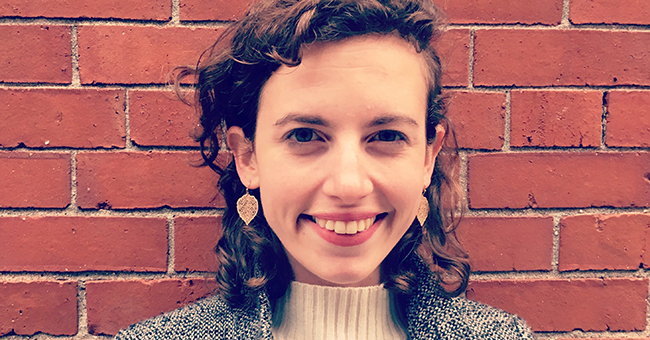
    For the month of December, meet our editorial assistant Ayla Zuraw-Friedland! 

    What drew you to publishing, Ayla? How did you find your way to Beacon?

    It’s a really corny thing to say, but I think I wanted to work in publishing before I even knew it was a thing. When I was about eight, my parents gave me a book for Hanukkah called Conversations with J. K. Rowling. In the front flap they wrote, “Maybe someday there’ll be a book called Conversations with Ayla Zuraw-Friedland!” And I (probably) said, “Yep, that’s it.” That book doesn’t exist, because I have not yet written a book, let alone a dozen-ish bestsellers, but I sure do like helping bring other peoples’ books into the world.

    I found my way to Beacon specifically with the help of a wonderful professor and activist at my alma mater. I was just wrapping up my senior year, and along with it, my tenure as Editor in Chief of my college newspaper. I so enjoyed getting to write about social justice issues on campus, and felt a little at a loss as to whether I could ever find a job that combined my love of editing with my love of talking about the evils of racism and capitalism at length with really smart people. Luckily, this professor noted and honed these compulsions, and helpfully forwarded along a job listing that turned out to be just the right fit.

    What’s a typical day in the life of an editorial assistant?

    It varies by the day. Sometimes you know exactly what needs to get done when you sit down for the day, and others it’s a total surprise. Maybe you’ll spend days reading proposals for potential book projects the editorial team is hoping to sign, and preparing to discuss making an offer at our weekly editorial meetings. Or maybe drafting flap copy to be used on the inside cover of a book or marketing copy to be sent to the representatives at Penguin Random House. Or maybe doing research for an editor you assist to determine whether the germ of a book idea they’ve been thinking about finding someone to write is viable based on what is already being written about that particular topic. Or maybe just bothering famous people until they agree to blurb a project you’re really excited about. Or maybe making sure your authors get their advance checks. Or maybe checking in over Zoom or phone with our editor, Rakia Clark, in the New York office, to see what needs doing in the Boston office. Or, if you’re really lucky, getting to edit a manuscript alongside an editor. A typical day can be any number of things—tasks ranging from purely administrative to intensely editorial. And it’s all good and necessary and important. But, regardless of the day, you are learning all the time.

    How much of what you learned in college and/or graduate school have you found vital to your work?

    Being an English major was helpful, of course. Learning how to read for both detail and overall structure is a must. Being steeped in language and literature really does develop a sense of how successful arguments are wrought, how to make them interesting. But, perhaps to my surprise, my background in Creative Writing has been just as important. Even though we don’t publish fiction at Beacon, the experience of being in a workshop, of learning how to offer helpful and constructive critiques, is invaluable when working with authors who really just want to make their books as good as they can possibly be. And beyond that, knowing what it feels like to be on the receiving end of those well-intentioned bits of wisdom and (sometimes devastating) tidbits of constructive criticism really can help make you a more generous editor.

    What current/upcoming projects are you excited about?

    In Sickness and In HealthI’m really looking forward to the publication of Ben Mattlin’s new book In Sickness and In Health. He writes about romantic, interabled relationships in such an honest and compelling way, and he’s really been a joy to work with. A little further down the road, I’m also thrilled to be working on An Xiao Mina’s forthcoming book Memes to Movements. I’ve loved memes since before Pepe the Frog had to get all white supremacist on us, and Mina weaves together the elements of politics and the “all in good fun” of memes, showing how even the goofiest of images or online trends hold the potential to exert a lot of social influence in oppressive regimes.

    More broadly, Beacon is starting to look at ways to slowly expand our Young Adult crossover list, which I’m glad to be working on. It’s exciting to think about putting these kinds of bottom-up histories into the hands of younger and middle-grade readers.

    What’s your advice to someone interested in entering the publishing field?

    Getting into publishing required me to demonstrate more than a love of reading and writing, which is a commonality among everyone who works in the industry, it seems. Working around books in some other capacity is a huge plus, I learned. If you can, I recommend working in bookstores. It’s like the parallel zone to working in publishing, and even shelving or inventorying books gives you a great sense of what’s out on the market and how it’s being used. I’m completely biased, but working for my college’s newspaper was also an excellent primer for understanding the rhythm of production schedules and even a micro-publishing environment. If you’re lucky enough to be an editor for a college paper, you learn how to hone other people’s writing. As I’m learning more and more, editing is an art in and of itself and requires as much practice as writing, if not more.

    Beyond that, be prepared to get rejected! I didn’t get the first job I applied to at Beacon. Or the second or tenth job or internship I applied to at other publishing houses. It can take a long time to break into publishing, especially if you don’t live in or near a city like Boston or New York. It can be frustrating; there are no ifs, ands, or buts about it. But, there is hope. Promise.

    What are you reading right now?

    I’m juggling about four different books: True History of the Kelly Gang by Peter Carey; A Feather on the Breath of God by Sigrid Nunez; The Agitator’s Daughter by Sheryll Cashin (a Beacon author, no less!); and War by Candlelight by Daniel Alarcón. I read a lot of fiction outside of work.

    In an alternate universe, what career would you have?

    Though I am loath to admit this to all the people who asked if I planned to use my English degree to become a high school English teacher, I’m almost positive that is what I would be doing if I didn’t work in publishing. Either that or a journalist. These universes I have in mind are curiously closely aligned to this one.

    Favorite book ever?

    Oof! Probably either Interpreter of Maladies by Jhumpa Lahiri or The Amazing Adventures of Kavalier and Clay by Michael Chabon. Or something totally different if you ask me on a different day.

    Name three non-office items on your desk and their significance to you.

    Pictures of friends and family—particularly my dear friend Anique, who passed away a few years ago. He was my first education in social justice movements, and I owe everything I’ve been able to learn since to him.

    Ayla's pictures of friends and family

    I Love Lucy license plate—I would not describe myself as peppy.

    Ayla's "I Love Lucy" license plate

    Typewriter poster and Banned Books mug—because, yeah. What else would an English major have at their desk?
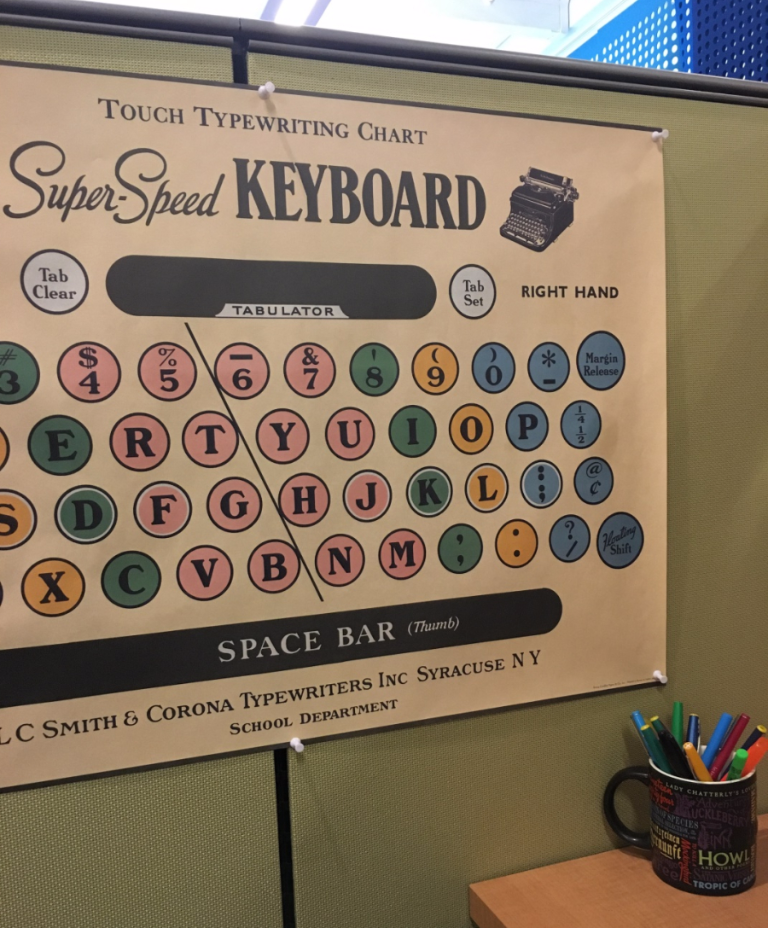
    Ayla's typewriter poster and Banned Books mug


    About Ayla Zuraw-Friedland 

    Ayla Zuraw-Friedland joined Beacon in 2015 as assistant to senior editors Joanna Green, Jill Petty, and Rakia Clark. Originally from Mansfield Center, CT, she is a graduate of Connecticut College where she studied Literatures in English and Creative Writing and served as Editor of the college newspaper.
  • By Frances Moore Lappé and Adam Eichen

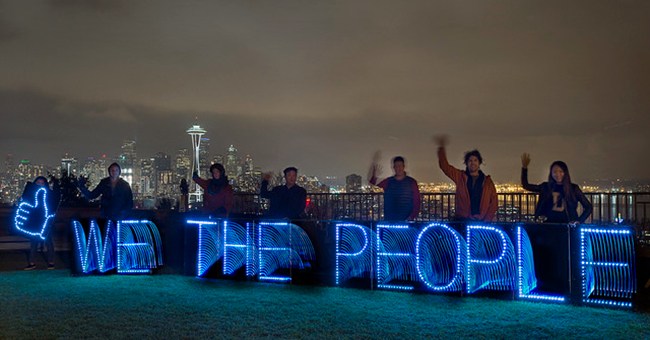
    Democracy Movement launches nationwide actions.

    Democracy Movement launches nationwide actions. Photo credit: Rick Barry of Broken Shade Photo

    This article appeared originally in The Huffington Post.

    In today’s fraught and frightened America, the word “democracy” could well evoke the rolling of eyes, a blank stare, or wide-eyed incredulity. Certainly not the pitter-patter of hearts.

    But what if Americans were convinced that all we care most about—from our kids’ future to the immediate need for a decent job or safe drinking water—depended on falling in love with democracy? Might more of us at least be open to the possibility of taking the leap?

    Something like that happened for us. When it truly sank in that democracy by and for the people is essential to what we most value, our emotions began to ignite. Yet, it’s tough to get to this place, as democracy is commonly cast as shabby—the best we flawed humans can do, but hardly worthy of devotion.

    We’ve come to see such an assumption as not just wrong but dangerous, for it dims our confidence in democracy just as it’s never been more necessary. So let’s reexamine additional faulty assumptions about democracy as if our life depended on it—because it does.

    Here are three.

    One, democracy is out of reach because it requires that humans overcome our self-centered nature.

    Think again. Our species evolved in tightly knit tribes in which we became by far the most social of primates, with a finely tuned sense of fairness as well as proclivities for empathy and cooperation. Our social nature shows up in research suggesting that humans are happier when giving rather than receiving and happier when outcomes for others are not extremely different from one’s own.

    Of course, humans are also capable of callous disregard, selfishness, and even unspeakable cruelty. But here is what’s now clear: Whether our pro-social capacities show up depends in large measure on the social rules and norms we together create and uphold.

    If all human behavior were innate and fixed, we certainly wouldn’t see the vast differences across cultures in crime rates or other anti-social behavior, or in the functioning of democracy. Yet, they are enormous. The US homicide rate is, for example, seven times that of other “high-income” countries. An annual ranking of perceptions of electoral integrity worldwide, by a scholarly project based in Harvard and the University of Sydney, puts the US 55th among more than 150 countries and almost dead last among western democracies.

    Surely, therefore, our country’s faltering democracy has nothing to do with fixed human nature, but rather everything to do with human culture, i.e. what we actively create.

    Authors of the US constitution seemed confident that we are equipped to create rules for the common good, those bringing forth the best and keeping the worst in check. Otherwise, surely these learned gentlemen would have considered it absurd to establish a republic “to promote the general Welfare,” as stated in the preamble of our constitution. (The question of who was included in the definition of “general welfare” is a huge question, of course, one that fortunately has not been static.)

    Two, we absorb in our culture the notion that democracy is a dull, burdensome duty—the bland spinach we must force down so we can get to what we really want, the yummy dessert of personal freedom to do as we please.

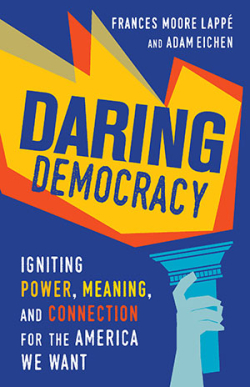
    Daring DemocracyBut freedom from interference is only the beginning. Stuck there, we could miss a much deeper aspect that only democracy can offer: citizens’ freedom to participate in power. As we move from the narrow, negative freedom of “Get out of my way” to the positive freedom of “I have a real say,” much changes.

    We can grasp that while rights and privileges protect us, it is in our duties and responsibilities that much of our power lies. We come to see that fixing America’s democracy deficits—with avenues for each of us—is all about realizing our power.

    Therefore, instead of democracy understood as a boring, annoying “you should,” the practice of “living democracy” becomes an exhilarating calling, often able to unlock parts of ourselves that we didn’t even know existed. In democratic engagement one discovers democracy’s inherent passion, dignity, and promise.

    Three and finally, a real downer is the lament that democracy is losing favor almost everywhere because, well, it’s failing.

    Worldwide, positive sentiment about democracy’s capacity to solve society’s problems is indeed waning. Voter turnout in almost all countries has fallen significantly in the past few decades. And in this country, one in six Americans has become so disillusioned with democracy as to approve of the idea of military rule. That’s up from one in fifteen in 1995.

    But is it democracy that’s failing? In our case, it is the lack of democracy that’s taking us down—the growing crisis of concentrated wealth controlling our political choices and its orchestrated efforts to rig rules through voter suppression and gerrymandering of electoral districts.

    So, the big threat is citizens’ lost hope for real democracy. But that we can tackle. We can stoke honest hope by committing ourselves to learning about and spreading stories of democracy breakthroughs in states and in cities—from victories against voter suppression to the enactment and success of public financing of elections.

    We can join efforts to stop money’s corruption of politics and anti-democratic policies like voter ID laws and other unnecessary barriers to voting. To make engaging easier, our Small Planet institute and our partner, the Democracy Initiative—made up of sixty national organizations representing issues from labor to racial justice to the environment—have created a new tool: the online Field Guide to the Democracy Movement. Here you’ll discover a rich array of organizations leading the way and learn about cutting-edge actions enabling all of us to find our democracy voices.

    Millions across the United States and the world are also fighting to claim and reclaim their democracies. In this historic moment, they are uncovering the truth about democracy—that in acting together we realize our species’ highest and proven potential as we replace isolation and a sense of futility with power, purpose, and connection.


    About the Authors 

    Frances Moore LappéFrances Moore Lappé, author of the multimillion-selling Diet for a Small Planet and seventeen other books, is a recipient of the Right Livelihood Award, the “Alternative Nobel.” Follow her on Twitter at @fmlappe and visit her website.


    Adam EichenAdam Eichen
     is a Democracy Fellow at the Small Planet Institute, cofounded by Lappé, and a board member of Democracy Matters, and he served as deputy communications director for Democracy Spring. Lappé and Eichen, separated by generations, are united in the movement for a living democracy and work together in Cambridge, Massachusetts. Follow him on Twitter and @AdamEichen.

  • By J. A. Mills

    Elephant“Trump administration to reverse ban on elephant trophies from Africa,” read an ABC News headline on November 15.

    The first thing I thought—and tweeted—was, “Of course, President Trump lifted the US ban on import of elephant ‘trophies’ from Zimbabwe and Zambia! Don Jr. is a big game hunter!” Apparently, Eric Trump is, too.

    The next thing I thought was, “Zimbabwe? Are you kidding me? Where President Robert Mugabe dismisses wildlife conservation as “neocolonialism” and once celebrated his birthday with an elephant barbecue in a display of his disdain? Does the Trump administration really think the Mugabe government puts hunting fees back into conserving wild elephants?”

    Then both presidents surprised me. Trump hit pause on elephant trophies and Mugabe resigned after nearly forty years as Zimbabwe’s dictator, albeit reluctantly—and it remains to be seen whether his successor will be much better for wildlife.

    “Put big game trophy decision on hold until such time as I review all conservation facts,” Trump tweeted on November 17. “Under study for years. Will update soon with Secretary Zinke. Thank you!” Secretary of Interior Ryan Zinke, boss of the US Fish and Wildlife Service, later confirmed he had spoken with the president and the “the issuing of permits is being put on hold.” 

    Since then, I have taken time to read the November 17 Federal Register notice announcing the elephant trophy decision for Zimbabwe. Similar decisions were made on elephant trophies from Zambia and lion trophies from both countries. “The US Fish and Wildlife Service has made a finding that the killing of African elephant trophy animals in Zimbabwe, on or after January 21, 2016, and on or before December 31, 2018, will enhance the survival of the African elephant,” it reads. The rest goes onto to explain that issuance of import permits was suspended in April 2014 “due to…insufficient information on the status of elephants in Zimbabwe and on Zimbabwe’s current elephant management program,” which Zimbabwe government officials apparently addressed to the satisfaction of Fish and Wildlife Service officials in the interim.

    “This review established that both Zambia and Zimbabwe had met…strict international conservation standards that allowed Americans to resume hunting in those countries,” White House Press Secretary Sarah Huckabee Sanders told reporters. The Obama-era ban on trade in elephant ivory remains in place, she also said. Furthermore, it is important to note that the United States allowed the import of hunting trophies, with proper permits, long before Trump sought the White House. So, there was no “ban” in this case. There was only a hiatus.

    Given all of the above, what follows is not what I expected to write. I overreacted. I wrongly slammed President Trump. There appears to have been no collusion or self-dealing between the Trumps and Zinke or the Fish and Wildlife Service on elephant and lion trophies.

    That is not to say I agree with allowing the import of trophies—a.k.a. prizes or mementos—from gunning down wild mega fauna in Africa or on any other continent. I do not.

    I understand that in some places where the rule of law is strictly enforced and obeyed, revenues from hunting permits do sometimes support conservation. I also understand that there are times when shrinking wildlands cannot support growing wildlife populations, so I get the logic of allowing high-roller hunters to execute the population control method known as “culling.” And, yes, I know that making more room for wildlife is not an option in this human-dominated world.

    Spare me the argument about the poor locals whose livelihoods depend on big game hunters. Adam Roberts, a trusted colleague who is now with The Elephant Project, says only about two percent of profits from big game hunting in Africa trickles down to the local people who need it most. “There’s much more money made by ecotourism…[than] hunting tourism,” Roberts recently told WGN Radio. “Studies have shown [that] more than ninety-eight percent of all tourism revenue across the entire African continent comes from wildlife tourism that’s not hunting-based. If we really care about investing in these local economies, we want to do it in a sustainable way, and that’s ecotourism.”

    Putting humane considerations aside, my objection to trophy hunting is the same as my objection to killing wild elephants for their ivory, wild bears for their gall bladders, or wild lions and tigers for their bones. These are all just variations on commodifying our world’s most magnificent and threatened species. I have seen firsthand, over many years of investigating illegal wildlife trade, that commodification too often leads to the slippery slope toward extinction.   

    Here is the bottom line as I see it: If we want to stop the extinction of wildlife, then we need to stop the commodification of wildlife altogether—not on a case-by-case basis. One man’s “trophy” might be an elephant’s head on the wall of his den, while another’s might be an intricately carved ivory tusk in a glass display case, or medicines made from elephant skin to treat his teenager’s runaway acne.

    Chinese ivory carvers have every right to ask why rich people from the United States are allowed to shoot down elephants for wall décor while their centuries-old craft is dying because of the prohibition on commercial trade in ivory tusks. For decades, traditional Chinese medicine (TCM) practitioners have been asking me why hunters can kill bears legally in North American forests while TCM doctors can’t legally buy gall bladders from wild bears to treat dying patients. These are valid and pivotal questions.

    One answer could be that there aren’t that many people who want to shoot elephants for sport, while there are millions, perhaps billions, of people who covet objects made from ivory or medicines made with elephant parts. The first is sustainable, while the other two are not. That’s why some Asian countries started farming bears to harvest the bile in their gall bladders. However, despite the fact that there are now tens of thousands of farmed bears producing a glut of bile, some consumers with enough cash still insist on the highest quality bile, which can only be found in wild bears. In the end, bear farms just sustained—and even enlarged—demand, and every wild bear on Earth continues to have a handsome price on its head.

    You can argue who should be allowed to kill wildlife and why in dozens of different ways. People have been doing so for years. And during all those years of debate, only one thing has proven true: Double standards don’t work for wildlife. The only thing that will work is if everyone in our increasingly globalized human community plays by the same rules, just as we all will have to do if we are to prevent catastrophic climate change. If we want any one form of commodification of wildlife to stop, then it must all be stopped, for everyone—even rich white guys.


    About the Author 

    J. A. MillsJ. A. Mills has worked for TRAFFIC, World Wildlife Fund, Conservation International, and Save the Tiger Fund. She is now a consultant to the MacArthur Foundation and lives in Washington, DC. Visit her website at jamillsauthor.com. Follow her on Twitter at @JAMillsAuthor.

  • By Linda K. Wertheimer

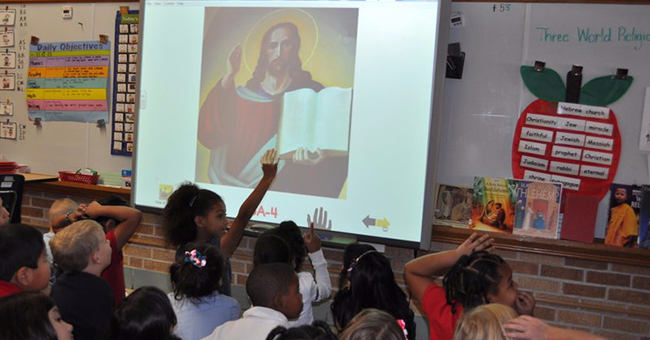
    Children in a first-grade class in Wichita, KS field questions from their teacher in a lesson about the origins of Christianity as part of a unit on three world religions: Judaism, Christianity, and Islam.

    Children in a first-grade class in Wichita, KS field questions from their teacher in a lesson about the origins of Christianity as part of a unit on three world religions: Judaism, Christianity, and Islam. Photo credit: Linda K. Wertheimer

    Public school teachers, particularly those in elementary classrooms, face the same challenge every December. Do they pay homage to Christmas and maybe Hanukkah in a class party or activity? Or do they ignore the holidays altogether?

    Public school educators often look at the “December dilemma” as a question about how to recognize the holidays the majority of families in their communities celebrate. They miss a more important question. How can schools teach students of all ages about different world religions, reduce religious ignorance and ideally, make a dent in religious bigotry, too?

    Schools do not belong in the business of holiday celebrations. When educators celebrate holidays in the classroom, they promote a religion and step over the line that separates church and state. Instead, teachers, even in the earliest grades, should view religion as a topic to teach as part of social studies and geography.

    Children can and should learn about religions’ different holidays, but not in isolation and not necessarily at Christmastime. Having children do math worksheets with dreidels and Christmas trees does not teach them anything about Hanukkah or Christmas. Nor does handing them pictures of Christmas or Hanukkah items to color when December rolls around. That veers into celebration, not education. But reading the Christmas story as part of a broader lesson on Christianity and world religions is okay. In that same unit, teach them about Easter and other Christian holidays. Teach them, too, about how Christianity grew out of Judaism, a religion that has numerous holidays. Teach them that Hanukkah, while celebrated around Christmas time, is not equal in importance to the major Christian holiday. Yom Kippur and Rosh Hashanah, which happen in the fall, are the holiest days for Jews. Ramadan, too, does not fall in December, but it is the holiest month for Muslims. Don’t try to make December a catch-all for religious holidays when the month simply does not carry the same weight for different religions.

    Often, elementary teachers ask parents to come in and share family cultural traditions in December as a way of showing students that not everyone celebrates Christmas. Typically, depending on a school system’s makeup, Jewish parents will come in with menorah and dreidels and talk about Hanukkah. Sometimes, Hindu parents will share something about Diwali, the Hindu festival of lights. Rarely do Christian parents feel that the invitation includes them and their Christmas traditions. The problem is the word ‘cultural.’ While Hanukkah and Diwali are part of families’ cultures, they are also a part of religions, too. So is Christmas.

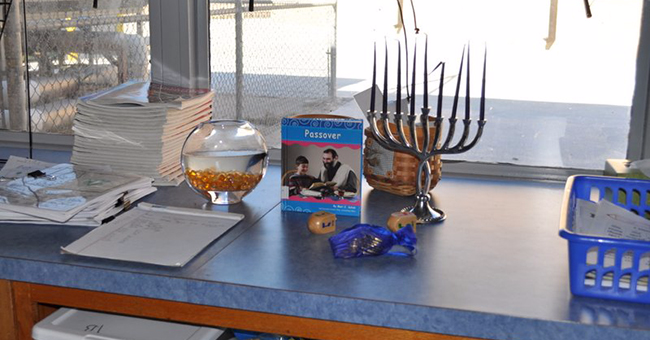
    A Hanukkah menorah, dreidel, Hanukkah gelt, and children's book on Passover on display during a world religions unit on Judaism, Wichita, KS.

    A Hanukkah menorah, dreidel, Hanukkah gelt, and children's book on Passover on display during a world religions unit on Judaism, Wichita, KS. Photo credit: Linda K. Wertheimer

    There is no easy solution. But as teachers sort out how they are or are not going to handle the holiday period in the classroom this December, they can find plenty of resources. Here are some links to articles and resources:

    I appreciate schools which take a hands-off approach to Christmas and Hanukkah in December and instead try to educate children throughout the school year on different religions, countries and cultures. It’s more inclusive, and it educates children better in the long run.

    Note: Author Linda K. Wertheimer provides talks and workshops for teachers on teaching about the world’s religions and ways to avoid controversy. To book her, contact her directly by email at linda@lindakwertheimer.com.


    About the Author 

    Linda K. Wertheimer, a former Boston Globe education editor, is the award-winning author of Faith Ed: Teaching About Religion In An Age of Intolerance. During her nearly thirty-year journalism career, she was a reporter at The Dallas Morning News and The Orlando Sentinel as well as for other publications. Her work has appeared in the Washington Post, the New York Times, the Boston Globe Magazine, USA Today, Time, and many other publications. Faith Ed in 2016 won a national book award—second place in the Religion News Association nonfiction religion book contest. She has also won awards for her writing from the Education Writers Association and other organizations. She was a 2014 finalist in the Massachusetts Cultural Council artist fellowship awards. A graduate of Northwestern University’s Medill School of Journalism, she lives in the Boston area with her husband and son. Follow her on Twitter at @Lindakwert and visit her website.

  • Jean Leon Gerome Ferris's, The First Thanksgiving, 1621 (image altered)

    Jean Leon Gerome Ferris's The First Thanksgiving, 1621, is a popular image of the first Thanksgiving. This is NOT how it happened.

    With the anticipation of a mouth-watering feast and time away from the office to lounge with family and friends, Americans come together for Thanksgiving. It’s the holiday where conversations about our national origins abound. But much of the US’s widely accepted origin story is skewed by the lens of settler colonialism and has silenced the voices of Native Americans. With Native American Heritage Month, observed every November since 1990, we can reflect on the history and contributions of Indigenous peoples. “Writing US History from Indigenous peoples’ perspective requires rethinking the consensual narrative,” historian Roxanne Dunbar-Ortiz tells us in An Indigenous Peoples’ History of the United States. “That narrative is wrong—not in facts, dates and details—but rather in essence.”

    That very consensual narrative has fabricated myths about Native Americans that remain with us today. “We believe that people are hungry for a more accurate history and eager to abandon the misperceptions that result in racism toward Native Americans,” Dunbar-Ortiz and journalist Dina Gilio-Whitaker state in “All the Real Indians Died Off.” That’s why they’ve cast a sobering light on the national fables and miseducation we’ve inherited about the birth of this country and its treatment of its Indigenous peoples. They’ve also uncovered history that isn’t acknowledged or well known by the general public.

    Here are some examples.

    Thanksgiving is a US holiday that celebrates the national origin myth. The purported celebratory meal of the “Pilgrims” did not entail the giving of food as a gift between the Native Americans and the colonizers. Native Americans were there as servants, and their foods—the corn, squash, pumpkin, sweet potatoes, and turkey that have become staples in today’s holiday meal—were confiscated. The idea of the gift-giving Indian helped establish what would become the United States, which Dunbar-Ortiz calls “an insidious smoke screen meant to obscure the fact that the very existence of the country is a result of the looting of an entire continent and its resources.” Protesting against the holiday, the United American Indians of New England have held a “National Day of Mourning” at Plymouth Rock since 1970.

    Of course, we can’t forget about Christopher Columbus. The fallacy of Christopher Columbus discovering America is the United States’ foundational myth that celebrates European imperialism. Moreover, it omits Columbus’s role as the originator of the transatlantic slave trade. As Dunbar-Ortiz explains, the national holiday that honors his arrival to the Americas actually celebrates settler colonialism, not Columbus per se. That’s why, in an open letter she wrote to former President Obama, petitioning him to change the holiday to Indigenous Peoples’ Day, she states that “it’s time for the United States government to make a gesture toward acknowledgment of its colonial past and a commitment to decolonization.”

    Reservations are creations of a foreign legal system, not gifts to Native Americans from the US government. Indigenous peoples ceded their lands to the United States, (often under duress, or had them forcibly taken through treaties), reserving large tracts for themselves. Some were reserved by executive order or congressional acts. We saw the continuation of the US’s colonial land-grabbing legacy in action in last year’s occupation of the Malheur Wildlife Refuge in Oregon. As Dunbar-Ortiz points out, the “public lands” occupied by Ryan and Ammon Bundy and the other militiamen are in fact annexed Indigenous sacred sites that “need to be returned to the stewardship of Native nations from whom they were illegally seized.”

    Europeans considered Indigenous peoples savage before they’d even encountered them, by virtue of the fact that they weren’t Christians. Yet studies of military tactics reveal far greater brutality among Europeans than among Native Americans. This mindset justified settler violence, with the language of Native American savagery encoded by Thomas Jefferson into the Declaration of Independence. One of the military tactics used against Native Americans was scalp hunting. The term ‘redskins,’ as Dunbar-Ortiz explains, comes from the name settlers gave to “the mutilated and bloody corpses they left in the wake of scalp hunts…This way of war, forged in the first century of colonization—destroying Indigenous villages and fields, killing civilians, ranging, and scalp hunting—became the basis for the wars against the Indigenous across the continent into the nineteenth century.”

    Is Bob Marley’s “Buffalo Soldier” one of your favorite songs? Dunbar-Ortiz has the back-story of another genocide campaign against Native Americans that informs his lyrics. “In 1866, Congress created two all–African American cavalry regiments that came to be called the ‘Buffalo Soldiers.’ Their explicit purpose was to invade Indigenous lands in the West and ethnically cleanse them for Anglo settlement. The haunting Bob Marley song ‘Buffalo Soldier’ captures the tragedy of the colonial experiences in the US: “…said he was a buffalo soldier win the war for America.”

    Today there are over 500 federally recognized Indigenous communities and nations, comprising nearly three million people. These are the descendants of the once fifteen million people who inhabited this land. These numbers speak to the settler colonial agenda that sought to eliminate Native Americans from this country. In spite of all attempts throughout the centuries against their lives and livelihood, Native Americans have been resilient and dynamic. 

    Dunbar-Ortiz and Gilio-Whitaker have done us an invaluable service, providing us with the history and resource material we need to disabuse ourselves of the false narratives that have distorted our understanding of American history. Our knowledge of the past helps us understand our present.

    For those interested in learning more about Indigenous history, culture, and resistance movements, take a look at these recommendations from Dunbar-Ortiz and Gilio-Whitaker.

    Roxanne Dunbar-Ortiz’s list

    Dina Gilio-Whitaker’s list


    About the Authors 

    Roxanne Dunbar-Ortiz grew up in rural Oklahoma, the daughter of a tenant farmer and part-Indian mother. She has been active in the international Indigenous movement for more than four decades and is known for her lifelong commitment to national and international social justice issues. After receiving her PhD in history at the University of California at Los Angeles, she taught in the newly established Native American Studies Program at California State University, Hayward, and helped found the Departments of Ethnic Studies and Women’s Studies. Her 1977 book The Great Sioux Nation was the fundamental document at the first international conference on Indigenous peoples of the Americas, held at the United Nations’ headquarters in Geneva. Dunbar-Ortiz is the author or editor of seven other books, including Roots of Resistance: A History of Land Tenure in New Mexico. She lives in San Francisco. Follow her on Twitter at @rdunbaro. 

    Dina Gilio-Whitaker (Colville Confederated Tribes) is an award-winning journalist and columnist at Indian Country Today Media Network. A writer and researcher in Indigenous studies, she is currently a research associate and associate scholar at the Center for World Indigenous Studies. She lives in San Clemente, CA. She is the co-author (with Roxanne Dunbar-Ortiz) of “All the Real Indians Died Off” And 20 Other Myths About Native Americans. Follow her on Twitter at @DinaGWhit and visit her website.

  • A Q&A with Marcus Rediker

    Abington Friends Meeting House and Benjamin Lay

    Abington Friends Meeting House. Photo credit: Montgomery County Planning Commission. William Williams, Portrait of Benjamin Lay, 1750-1758, courtesy National Portrait Gallery, Washington, DC.

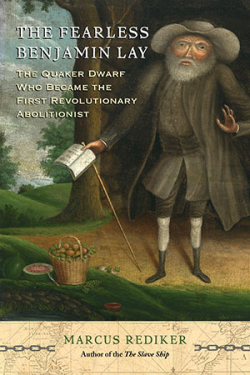
    In 1738, radical abolitionist and Quaker dwarf Benjamin Lay was disowned by the Quaker community. He was well known for his uncompromising and confrontational stance against slavery and his commitment to convince his fellow Quakers to completely denounce and abolish it. Nearly three hundred years later, history is finally looking up for Lay.

    This month, the Abington Quakers of Pennsylvania have recognized him as “a Friend of the Truth” and reclaimed him as a Quaker in an official statement. Shortly afterward, the North London Quakers followed suit and declared their own “unity” with his spirit. These are astounding decisions that restore Lay’s pivotal role in activist, abolitionist, and Quaker history. Beacon Broadside editor Christian Coleman caught up with Marcus Rediker, historian and author of Lay’s biography, The Fearless Benjamin Lay: The Quaker Dwarf Who Became the First Revolutionary Abolitionist, to ask what they mean for Lay’s place in history.

    Christian Coleman: What was your reaction when you found out that Benjamin Lay was recognized as a “Friend of the Truth?”

    Marcus Rediker: I was, quite frankly, moved to tears. The recognition represented a profound, heartfelt act of retrospective justice, because Lay had been unjustly disowned in the first place. It was a symbolic rejection of what a previous slave-owning generation of Quakers had done and it was simultaneously an affirmation that Benjamin Lay’s values matter to the Abington and North London communities. I learned during my research that Lay dearly loved his fellow Quakers—at least those who did not own slaves—and that his exclusion was terribly painful to him. It was therefore deeply touching, 279 years later, to know that he has been brought back into the fold. This act would have meant everything to him.

    The Fearless Benjamin LayCC: Can you tell us a little bit about why Benjamin Lay was disowned by the Quaker community back in 1738?

    MR: Lay was disowned primarily for his protests against slavery, which were aimed at wealthy Quaker slave-owners. He believed that slave-owning was “the greatest sin in the world” and that it was destroying both his beloved faith and the larger society. He refused to cooperate with slave-owners in any way, disrupting meeting after meeting to protest their presence and participation in the religious life of the Society of Friends. He performed spectacular acts of guerrilla theater in public to shame slave-owners and to dramatize how Quakers and the world must change. As a matter of deeply help principle, Lay always spoke truth to power; he was punished for it.

    CC: Was the recognition an easy decision for them to make?

    MR: Quakers use a consensus model for making decisions, so every reservation must be heard and discussed before a conclusion is reached. Whether and how to recognize a controversial, long-deceased former member of the community are complex questions. In the end the decision was unanimous and enthusiastic.

    CC: Did The Fearless Benjamin Lay play a role in the decision?

    MR: I spoke about Lay at the Abington Meeting House on two occasions, in February 2015 and again in October 2017, to large and seriously engaged audiences. I think my research may have helped people to understand Lay’s historical importance and the nature of the conflicts that led to his disownment. But I would emphasize that this recognition was entirely the result of internal processes among the Abington and North London Quakers.

    CC: How else is Lay being commemorated by the Abington Quakers?

    MR: As it happened, the bodies of Benjamin and his wife Sarah are buried, like all other Quakers of their era, in an unmarked grave in the Abington Quaker Burial Ground, which is adjacent to the Meeting House. (Sarah was buried as a member of the congregation, Benjamin as a non-member.) The meeting has now decided to create an engraved stone grave-marker for Benjamin and Sarah, which is another important acknowledgment of their place in local history.

    CC: What is the significance of this extraordinary decision?

    MR: The significance is two-fold. First, this is a major step by Quakers to reckon with their own slave-owning past. As such, it is exemplary for the US and the UK as nations. Second, the decision advances the process of restoring Benjamin Lay to his rightful, important place in the history of Quakerism. This, in turn, feeds a larger effort to restore him to his proper position in American, British, and world history.


    Read the official minutes declaring Lay a “Friend of the Truth” by the Abington Quakers and the North London Quakers.


    About Marcus Rediker 

    Marcus RedikerMarcus Rediker is Distinguished Professor of Atlantic History at the University of Pittsburgh and Senior Research Fellow at the Collège d’études mondiales in Paris. His books have won numerous awards and been translated into fourteen languages. They include The Many-Headed Hydra (Beacon Press, 2000; with Peter Linebaugh), Villains of All Nations (Beacon Press, 2004), The Slave Ship (2007), The Amistad Rebellion (2012), and Outlaws of the Atlantic (Beacon Press, 2015). Rediker is also the producer of the prize-winning documentary film Ghosts of Amistad: In the Footsteps of the Rebels (Tony Buba, director), about the popular memory of the 1839 Amistad rebellion in contemporary Sierra Leone. He lives in Pittsburgh, Pennsylvania. Visit his website.

  • A Q&A with Bill Fletcher, Jr.

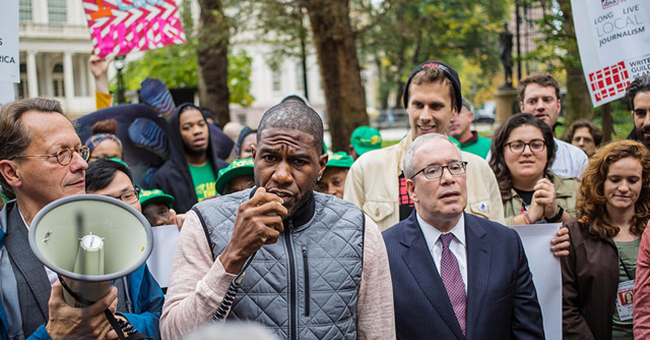
    Writers from DNAinfo and Gothamist, along with elected officials and Writers Guild of America, East members, and staff, at a rally on Monday, November 6, 2017, to fight for the unionized editorial employees at DNAinfo and Gothamist.

    Writers from DNAinfo and Gothamist, along with elected officials and Writers Guild of America, East members, and staff, at a rally on Monday, November 6, 2017, to fight for the unionized editorial employees at DNAinfo and Gothamist. Photo credit: Iryna Yafimchyk for Working Families

    Earlier this month, a week before New York City news websites DNAinfo and Gothamist were shut down, the journalists of both newsrooms had voted to unionize with the Writers Guild of America, East. Joe Ricketts, the sites’ owner, was responsible for the shutdown: news of the journalists’ unionizing efforts had reached him, and thus he put a stop to them. His decision put 115 staffers out of work and will leave New Yorkers without the local-news reporting they’d come to depend on. His decision also reflects one of the many misconceptions about unions covered in labor activist Bill Fletcher, Jr.’s book “They’re Bankrupting Us!” And 20 Other Myths about Unions. Beacon Broadside editor Christian Coleman caught up with Fletcher to give us context about the shutdown and what this means for our politically fraught times.

    Christian Coleman: What was your initial reaction when you heard the news of Joe Ricketts pulling the plug on his newsrooms’ unionization efforts? 

    Bill Fletcher, Jr.: I was not at all surprised. Employers see little to lose by threatening workers and breaking the law. The penalties are minimal. They can simply assert that there was a business reason for the closing and that it was mere coincidence that the closing took place after the union referendum. Employers regularly threaten such closures. It is called the “credible threat.”

    CC: Why would Ricketts write on his blog that “unions promote a corrosive us-versus-them dynamic that destroys the esprit de corps businesses need to succeed”? Where does this idea come from?

    BF: The idea comes from the notion that the union is allegedly a third party separate from the workers. If you fail to remember that the union is the organization of the workers, then you can think about the union as the equivalent of a non-profit advocacy group. The aim of the employer class is to always make the union a “third party” and claim that the workers are better off appealing to the good-will of the employer. What this does is takes power out of the equation and leaves the situation to one of the employer—with its power—standing over the individual worker—who has no power.

    CC: Ricketts’s statement appears to stem from the myth that unions make unreasonable demands that result in a lot of strikes. You cover this myth in your book. Why would he view unionizing as unreasonable? 

    BF: He views unionizing as unreasonable because it stands in the way of his absolute, totalitarian domination of the workplace. The union is the only voice that workers can possess. The union makes demands based on the needs and desires of their members. The employer is expected to negotiate in good faith. There is no assumption that the negotiations will necessarily result in an agreement but that they will be taken seriously. Most of the employer class wants nothing that results in the diminishing of their absolute power over the workplace, regardless of the consequences.

    CC: Why is this myth still pervasive today? 

    BF: As practiced by the Nazi Party in the 1930s, a myth repeated over and again can be believed, especially when it is not challenged. The employer class repeats the myth in television shows, films, on the radio, etc. Though it is challenged at times, usually by organizations that are much weaker than those serving the employer class.

    CC: Later on in his blog, Ricketts writes that “the essential esprit de corps that every successful company needs can’t exist when employees and ownership see themselves as being on opposite ends of a seesaw. Everyone at a company—owners and employees alike—need to be sitting on same end of the seesaw because the world is sitting at the other end.” Don’t employers and workers have different interests? 

    BF: Employers and workers do not have the same interests. Their interests diverge. If Ricketts means what he says, is he prepared to share ownership with the workers? If we are all one big family, will he sit down with the workers and share the decision-making? Highly unlikely. This is what demonstrates the sophistry in their arguments.

    CC: What does Ricketts’s opposition to unions mean for us in our politically fraught times and what can we learn from it? 

    BF: This opposition is not at all surprising. Employers such as Ricketts have to be challenged not only by their existing workforce but also by allies in the larger community. The problem is that employers carry out these atrocious actions largely in silence and isolation. The covers need to be ripped away for all to see. There need to be real penalties for bad behavior. This might mean protests, boycotts, or other expressions of nonviolent opposition to the efforts to suppress the worker’s right to self-organization and collective bargaining.


    About Bill Fletcher, Jr. 

    Bill Fletcher, Jr. is a talk show host, writer, and activist.  His book from Beacon Press, “They’re Bankrupting Us!” And Twenty Other Myths about Unions, addresses many of the misconceptions about unions and unionism. Follow him on Twitter, Facebook, and at www.billfletcherjr.com.

  • A Q&A with Gayle Brandeis

    The Art of Misdiagnosis

    Image credit: Bob Kosturko

    “After my mom hangs herself, I become Nancy Drew. I am looking for clues, for evidence.” So begins poet and novelist Gayle Brandeis’s wrenching memoir The Art of Misdiagnosis: Surviving My Mother’s Suicide. After Brandeis had given birth to her youngest child, the body of her mother, Arlene, was found in the utility closet of a Pasadena parking garage where she had hanged herself. Brandeis’s memoir weaves together the story of her mother’s suicide and her family’s complicated history with mental and physical illness. The title comes from the name of a documentary her mother was producing about the rare illnesses she believed afflicted her family. While investigating her mother’s history mental illness, Brandeis had to manage the conflicting feelings of mourning a parent and becoming a new mother.

    We caught up with Brandeis to ask her about the inventive structure of her memoir, her experiences with motherhood and misdiagnosis, and what she hopes readers will gain from reading her book.

    Jennifer Canela: The Art of Misdiagnosis is formatted in a documentary style with dates and sections of informational research. Was mimicking a documentary like your mother’s “Art of Misdiagnosis” important to the overall telling of this story? How has telling this story in this way helped you understand your mother’s life and death?

    Gayle Brandeis: I hadn’t consciously thought about mimicking a documentary in form, but I love that you saw it that way. It makes sense—the book is very much a conversation with my mother’s film. And it ultimately became a conversation with my mother, herself, a much more satisfying one than I ever had with her when she was alive. I started writing the book from a place of trauma, with a lot of anger toward her, and I ended it with so much love and admiration for her in my heart. It’s a gift I hadn’t anticipated, even though I knew writing about her would be the best way for me to try to make sense of her death (and her life). I am grateful that writing about her helped me see what a remarkable, creative woman she truly was. 

    JC: The book is also comprised of personal anecdotes including your mother’s paintings, interviews with doctors, poetry, emails, and letters that further let the reader into the dynamic between not only you and your mother but also between her and the world around her. What was your process of choosing these excerpts? How important was it for you to address your mother in letter form as well as in the present tense?

    GB: The letter to my mother was suggested by my therapist at the time, and it was such an important and powerful process for me. When I first started writing the letter, I didn’t think about publishing it—I was writing it for myself—but at some point, it became clear to me that this letter could be a way to weave my history with my mom into the present-tense narrative around her death and create a deeper context for the story. The other pieces came into the process in a very intuitive way—as I dug through my mom’s files, old emails, etc., certain pieces jumped out and struck me as being especially illuminating and important to include. Quilting the pieces together—sometimes quite literally, spreading pages on the floor and figuring out what went where—was a way of shifting the process from my heart and gut to my head; it became a puzzle, an intellectual challenge instead of a process that flayed me every time I sat down to write. I was grateful for that shift, but I’m also grateful to have written from those deeper places, as painful as it was. 

    JC: Your mother did not grow up in an artistic home; her love for the opera, acting, and overall performance went against her “blue collar upbringing.” How much of her drive for the arts do you feel influenced you to become an artist?

    GB: I’m sure it influenced me profoundly. I’m so thankful that my mom gave me a childhood full of books and music and art and theater, things she did not grow up with herself. She showed me that art was a way of bringing more beauty and meaning to our lives, a way of allowing our quirky individuality to shine through. I was a very shy kid, but I always felt brave and alive when I wrote or danced or made up creative games with my sister—I knew this was where my truest self lived.

    JC: The book beautifully lays out concepts like life, death, and womanhood. Motherhood, however, is one of the larger themes that thread all these together. How has motherhood changed for you after losing your mother? Are there ways in which being a mom has helped you see your mother in a different light?

    GB: I felt more grounded in my own authority as a mother after I lost my own mom. I was fairly young—twenty-two—when I had my first baby, and my mom would say diminishing things like “You’re such a cute little mother,” which made me feel as if I wasn’t a “real” mother in her eyes, which made me less confident in my status as a “real” mother in the world (even though I wholeheartedly loved motherhood from the very start). Having a baby at forty-one is very different from having a baby at twenty-two, of course, so I felt more grounded in my own authority in general, but losing my mother really drove home the fact that I was it; I was the mom, and she couldn’t make me feel otherwise. 

    Some of my mothering has been a sort of protest against aspects of her parenting—I may have under-reacted to some of my kids’ illnesses because I didn’t want to over-react like her, for example—but I also felt surges of great tenderness toward her when I nursed and bathed and read to my youngest baby after she was gone, knowing she had done the same for me. And I understand now, in every cell of my body, that we mothers are human and fallible and trying to figure things out ourselves, and that makes it much easier to be forgiving of her.  

    JC: You talk about the fact that you played the role of “the sick girl” and your mother the role of “mother of the sick girl.” After you revealed to your mother that you had faked your illness, she refused to believe you. Why do you think she remained convinced that you were ill? What do feel this did to your mother’s sense of “diagnosis”? How has your experience with misdiagnosis allowed you to reconcile with illness?

    GB: I think she had a set narrative in her mind about our relationship as “the sick girl” and “mother of the sick girl,” one she didn’t want to disrupt, so she simply refused to hear me. She needed to hold on to her identity as a noble crusader for her daughters much longer than I needed to hold on to my own identity as “the sick girl” (although as you see in the book, it did take a long time for me to let go of that role). My mom was convinced she had all the answers when it came to diagnosis and misdiagnosis, at least for the disorders she covers in her film (which is why she thought I was lying when a very precise test showed I did not in fact have the acute intermittent porphyria she was convinced ran through our family). She really saw herself as the one person who could help others get a correct diagnosis, which is of course a noble goal (it often takes people with rare diseases seven or eight years to get properly diagnosed), but not necessarily a realistic one. No one ever accused my mom of being realistic. 

    My own journey with illness has been such a complex one. Getting a firm diagnosis a few years ago after years of varying misdiagnoses was such a relief: it helped me feel much clearer about myself and my body (even though it was weird to come to terms with the fact that I do indeed have the disease my mom was so adamant I didn’t). It took me a long time as a young woman to stop letting illness define me—it’s much easier now to know that chronic illness is just another aspect of my life, not the very core of my identity (although during my last hospitalization, I really did have to check in with myself to make sure I was sharing my journey as a way to bear witness, to be honest about my life, not as a way of gaining special attention as “the sick girl” again).

    JC: What are you hoping people will take away from reading this real and raw account of mental illness? How do you hope this book will change the stigmas around it?

    GB: I don’t want to prescribe a reader’s journey; I want readers to take away whatever speaks to them the most. That said, I very much hope it will help reduce stigma around both mental illness and suicide loss, that it will empower people to share their own stories, break their own silences, release their own shame. That would be the absolute best, if reading the book could help liberate others the way writing it helped liberate me.


    About Gayle Brandeis 

    Gayle Brandeis is the author of Fruitflesh: Seeds of Inspiration for Women Who Write and the novels The Book of Dead Birds, which won the Bellwether Prize for Fiction of Social Engagement (judged by Toni Morrison, Maxine Hong Kingston, and contest founder Barbara Kingsolver), Self Storage, Delta Girls and My Life with the Lincolns, which received a Silver Nautilus Book Award and was chosen as a Read on Wisconsin pick, as well as a collection of poetry, The Selfless Bliss of the Body. Her essays, poems and short fiction have been widely published and have received numerous honors, including a Barbara Mandigo Kelly Peace Poetry Award, the QPB/Story Magazine Short Story Award, and a Notable mention in The Best American Essays 2016. She teaches in the low residency MFA programs at Antioch University, Los Angeles and Sierra Nevada College, where she was named Distinguished Visiting Professor/Writer in Residence. Gayle served as Inlandia Literary Laureate from 2012-2014 and was called a Writer Who Makes a Difference by The Writer Magazine. Follow her on Twitter at @gaylebrandeis and visit her website. 

    Jennifer Canela is the Publicity Intern at Beacon Press. Originally from Boston, MA, she earned her Bachelor of Arts degree in English and Creative Writing, as well as Philosophy from the University of Massachusetts Boston.

  • By Lynn Hall

    Flags on Veteran's Day

    Photo credit: Southern Arkansas University

    Last month, the Iraq and Afghanistan Veterans of America (IAVA) released the results of their annual member survey, and the statistics regarding military sexual assault were, as always, alarming. Of the women who responded, thirty-five percent said they had been the victim of sexual assault while serving. Of those survivors, sixty percent did not report the crime. It’s easy to understand their reluctance when, of those who did report, seventy-one percent of the survivors said they experienced retaliation because of their accusations.

    I’m going to repeat that last figure: more than two thirds of the survivors who reported to their chain of command that they had been raped by a fellow soldier experienced retaliation.

    Another recent study said that of the women who report a rape in the military, one third have lost their careers by the following year.

    While these figures are shocking, they are not new. I’m reminded of the Harvey Weinstein story which broke last month. Those of us who pay attention to sexual assault allegations had already known Harvey Weinstein was a serial predator, and yet there wasn’t broad public outrage until The New Yorker exposed the extent of his crimes in one horrific article. For both the military and Hollywood, it is an open secret that there are widespread abuses against women with little to no accountability.

    Since 2012, there has been a near constant trickle of media coverage surrounding military sexual assault. That’s progress, yes, but the outrage against the military hasn’t stuck as it has recently against Hollywood. We haven’t yet reached a tipping point where the Department of Defense (DOD) is held accountable for these abuses. Each time the public looks away, the DOD reverses forward progress.

    Since Beacon published my memoir about rape at the Air Force Academy, Caged Eyes, last February, I’ve had my finger on the pulse of this dialogue in far greater ways than I have in the past.

    For starters, I’ve heard from numerous women who have told me their stories of having been raped while serving. Many of those women were veterans, but I’ve also heard from a substantial number of women actively serving, including current Air Force Academy cadets. I’ve sat with them and heard the details of their stories with coffees in our hands and tears on our faces.

    Since my memoir’s publication, I’ve also had the privilege of being invited to serve on the Advisory Board for Protect our Defenders, the nation’s leading nonprofit fighting sexual assault within the military. Protect Our Defenders connects survivors with pro bono lawyers, serves in an advisory capacity to Congress, and weighs in on cases in the media. I’m honored to be among their voices.

    One legislative effort Protect Our Defenders has been deeply involved with has been Senator Kirsten Gillibrand’s Military Justice Improvement Act (MJIA). Currently, commanders hold decision-making power in criminal cases. They get to decide if a case proceeds to a court martial, and they can even overturn convictions. The MJIA would transfer this power to military prosecutors. Unfortunately, the Senate has filibustered against the MJIA repeatedly, but Gillibrand and Protect our Defenders remain undeterred.

    The fact is the military is not doing enough to protect survivors and prosecute perpetrators. Of the IAVA survey respondents I referenced above, sixty-eight percent of women and forty-two percent of men think the DOD is not addressing military sexual assault effectively enough.

    It’s no wonder that troops do not have confidence in the command structure when last week USA Today reported that since 2013, the military has seen more than 500 cases of serious misconduct among its generals and admirals. These cases include many instances of sexual harassment.

    Abuses have also been reported in the Sexual Assault Prevention and Response Offices (SAPRO). In other words, the very offices overseeing victim services have been charged with criminal misconduct. The Washington Post recently reported that in the past year alone, the Army has investigated rape allegations by ten of its SAPRO officers.

    I’m going to repeat that statistic too: In one year, ten Army officers who are responsible for victim care have themselves been charged with rape.

    Last year, the deputy director of the Air Force’s office of sexual assault prevention at the Pentagon resigned after complaints that he was creating “an intimidating and offensive working environment” with sexually inappropriate comments. This isn’t the first time the media has blown the whistle with SAPRO misconduct, and yet, the criminal behavior continues.

    Let’s not forget that the military is built upon hierarchy, adherence to commands, and—ostensibly—integrity. If the DOD wanted to crack down on these offenses and hold officers accountable for sexual harassment and assault and retaliation from these cases, they could. Yet, news article after news article reports on these heinous crimes—all the while victim’s lives continue to be destroyed—without any signs of true change.

    As it has been widely reported, the shooter in Sutherland Springs last Sunday was a former Air Force airman who had been convicted of domestic violence and child abuse, and had been accused repeatedly of sexual assault and sexual harassment. Yet, he was discharged from the military in 2012 without the information of his convictions being relayed to the FBI. Evidence is emerging that this was not an oversight in his case alone, and that the DOD routinely fails to communicate to civilian criminal databases. This week Stars and Stripes recounted that the Pentagon has known of reporting lapses for twenty years. Again, if cracking down on criminal behavior were of high regard to the military, these oversights wouldn’t occur.

    The Sutherland Springs shooter has not been the only criminal to be discharged from the military emboldened to perpetrate on the civilian population. I know this first hand. In 2002, my own perpetrator violently raped a disabled teenage civilian. Reports of these cases, now in combination with the horrific shooting in Sutherland Springs, gives us even further reason to find outrage with the DOD.

    This Veteran’s Day, support the work of organizations like Protect Our Defenders and politicians such as Senator Gillibrand. Read and share books like my memoir, Caged Eyes, or fellow Beacon Press author Helen Benedict’s book The Lonely Soldier. Most, of all, care. The public’s demands for justice resulted in Harvey Weinstein’s demise. The same can happen if we decide to hold the DOD responsible as well.


    About the Author 

    Lynn Hall is a memoirist, essayist, and activist in the movement to end sexual violence. She is also a mountaineer who has summited each of Colorado’s 14,000-foot-tall peaks and a runner who has completed a 100-mile ultramarathon. She lives in Boulder. Follow her on Twitter at @LynnKHall and visit her website.

  • Chris Emdin - For White Folks Who Teach in the Hood

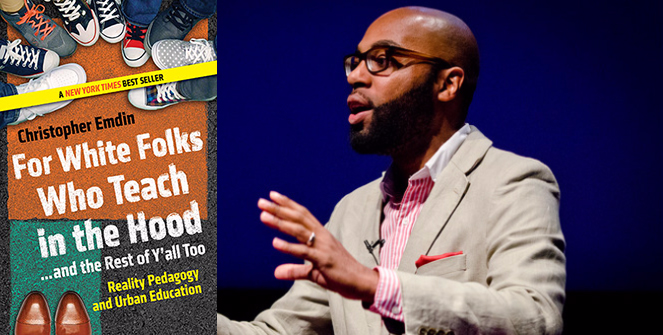
    Christopher Emdin speaking at TEDxNYED. Photo credit: Wayne K. Lin.


    University Press Week runs each year in November and was first established by President Jimmy Carter in 1978 to recognize “the impact, both here and abroad, of American university presses on culture and scholarship." This year’s theme is “#LookItUp: Knowledge Matters” celebrating the value of knowledge and expertise that University Presses bring to the world. As a member of the Association of American University Presses, Beacon Press is proud to be a participant of this year's blog tour. In our contribution, we look at how social media has contributed to the success of one of our recent titles.

    Dr. Christopher Emdin's For White Folks Who Teach in the Hood…and the Rest of Y’all Too: Reality Pedagogy and Urban Education is one of Beacon Press's best-selling books of 2016 (in hardcover) and 2017 (in paperback). Word-of-mouth quickly spread to educators across the country as more and more had a chance to read the book and hear Dr. Emdin speak. It's not just individual teachers who see the value in Emdin's theory of "reality pedagogy" in creating transformative classroom experiences for urban youth of color, we also see school districts  buying the book for professional development as well as adoptions in education departments at colleges and universities. In its first year, we were thrilled to have it appear on two New York Times’s bestseller lists—Race & Civil Rights and Education—for multiple weeks!

    Part of the success of For White Folks can be traced to enthusiastic online conversation by educators around Emdin and the book, especially on Twitter. The enthusiastic and thoughtful commentary demonstrates how the book has filled a definite hole in the conversation around urban education. Below are some of the kinds of responses Emdin and his book continually receive on Twitter that help spread the word and keep the conversation about how we can transform urban education for teachers and students going.

    The San Francisco Unified School District Office shares that they are using the book for professional development with their teacher.

    https://platform.twitter.com/widgets.js

    Aaron Brengard, a principal at San Jose’s Katherine Smith Elementary School, is using For White Folks as a resource and book club with his staff.

    https://platform.twitter.com/widgets.js
    https://platform.twitter.com/widgets.js

    Kevin Winebold, a musical director in NYC, is a big fan of the cover of the book.  

    https://platform.twitter.com/widgets.js

    It also helps to have an active and impassioned author—both online and offline. Emdin's events always draw significant social media responses from attendees energized by his talks.

    https://platform.twitter.com/widgets.js
    https://platform.twitter.com/widgets.js

    Readers, inspired by passages in the book, often share them online, which can often spread beyond Twitter and reach new audiences when shared on Facebook pages and groups or Listservs for educators.

    https://platform.twitter.com/widgets.js

    https://platform.twitter.com/widgets.js
    https://platform.twitter.com/widgets.js

    The Beacon blog, with original pieces by Emdin and excerpts from the book, also provides content for educators to find online and share. In addition to teacher enthusiasm online, Emdin’s own large social media following and his weekly #HipHopEd Twitter chats provide a large and active audience for ongoing promotion of the ideas set forth in For White Folks.

    As Race, Education, and Democracy Series editor Theresa Perry wrote in the book’s Series Note: “[For White Folks] is filled with wisdom, theoretical and practical knowledge that has been formed in praxis. It is required reading for teachers, teacher educators, and community activists…it is smart, compelling, filled with emotions, and brimming over with commitment.”

    – – – - 

    Head on over to these other university press blogs to read their contributions: Harvard University Press, Johns Hopkins University Press, Athabasca University Press. Visit the AAUP website for a list of contributions from the rest of the week.