• By Joseph Rosenbloom

    Demonstrators participating in the Poor People's March at Lafayette Park and on Connecticut Avenue, Washington, DC.

    Demonstrators participating in the Poor People's March at Lafayette Park and on Connecticut Avenue, Washington, DC, June 18, 1968.

    As a graduate student at Crozer Theological Seminary in Upland, Pennsylvania, Martin Luther King, Jr. wrote about the social ill of poverty and vowed to do something about it. He put the resolve on hold. For his first decade as a civil rights leader, he dedicated himself to ending racial segregation and discrimination against African Americans, not poverty.

    By the mid-1960s, however, the idea to grapple with the issue of poverty had seized him with a fierce urgency. “What does it profit a man,” he often quipped, “to be able to sit at an integrated lunch counter if he doesn’t earn enough money to buy a hamburger and a cup of coffee?” So he devised a bold, comprehensive, multiracial strategy to attack poverty head on.

    In December of 1967, he unveiled what would become known as the Poor People’s Campaign. It was a plan to mobilize thousands of poor people from around the country to join him in staging massive nonviolent protests in Washington, DC, during the spring and summer of 1968. His army of poor people would engage, he said, in “militant” civil disobedience and pressure lawmakers to pass sweeping antipoverty legislation.

    King did not live to put the plan into action. He was murdered in Memphis, Tennessee, on April 4, nineteen days before the scheduled launch of the Poor People’s Campaign. The bright hope to end poverty once and for all seemed to die with him. A patched-together version of the Washington campaign under King’s top aide, Ralph Abernathy, sputtered to a halt after six chaotic weeks in the spring of 1968.

    Half a century later, another African-American civil rights leader, the Reverend Dr. William J. Barber II of the Greenleaf Christian Church in Goldsboro, North Carolina, seeks to rekindle King’s antipoverty crusade. Rev. Barber, a fifty-four-year-old former president of the North Carolina chapter of the NAACP, borrows from King’s example (his initiative is the Poor People’s Campaign: A National Call for Moral Revival) and tactics (he is urging civil disobedience and “direct action” in at least twenty-five states and the nation’s capital for six weeks during the spring of 2018).

    The scourge of poverty is still very much with us. In 1968, twenty-five million Americans, or 12.8 percent of the population, were living in poverty according to the US Census Bureau. Its most recent survey, in 2016, showed more than forty thousand poor or 12.7 percent impoverished Americans. Rev. Barber defines the scope of the problem more broadly. “Today one in every two Americans is poor or low income,” he says. Those are the people whom he aspires to rescue from poverty.

    Rev. Barber, bearded and broad-shouldered, is an imposing presence and passionate orator with a booming, baritone voice. Like King, he has a PhD—in Rev. Barber’s case, a degree in public policy and pastoral care from Drew University at Madison, New Jersey. He has drawn public attention in North Carolina as the leader of the “Moral Mondays” protests in Raleigh. Begun in 2013, the protests countered the policies of a conservative Republican governor and legislature. To build a national following for their antipoverty cause, Rev. Barber is partnering with the Reverend Liz Theoharis, a teaching fellow at the Union Theological Seminary in New York City and longtime activist on behalf of poor people.

    For all their good intentions, neither Rev. Barber nor Rev. Theoharis has the standing of a Nobel laureate and impresario of a civil rights movement as King did in 1968. At the core of his Poor People’s Campaign, King identified specific legislative goals: guaranteed employment or income for those who were not able to work, plus billions in federal investments in housing and education for poor communities. The call to protest issued thus far by Rev. Barber lacks specific targets of that kind. But the cause he is embracing seems well timed in an era when a living wage is beyond the reach of a growing number of Americans. Perhaps that downward spiral will fuel the kind of broad political support for the kind of change that King hoped to achieve fifty years ago.

    Like King, who acknowledged that Washington might not adopt his antipoverty agenda quickly, Rev. Barber seems to know that success may not come fast for his initiative either. As he rolls out his campaign, Rev. Barber is quoting an adage that King also favored: “The arc of the moral universe is long, but it bends toward justice.”


    About the Author 

    Joseph RosenbloomJoseph Rosenbloom is an award-winning investigative journalist. He has been a staff reporter and editorial writer for The Boston Globe; an investigative reporter for Frontline; and a senior editor and features writer for Inc. magazine. He’s written for magazines and newspapers, including The Boston Globe Magazine, International Herald-Tribune, The Wall Street Journal, The New York Times, The American Lawyer and The American Prospect. Rosenbloom has a B.A. in history from Stanford University and a J.D. from Columbia University Law School. He lives in West Newton, MA. His upcoming book, Redemption: Martin Luther King, Jr.’s Last 31 Hours, comes out in March 2018. Follow him on Twitter at @joerosenbloom and visit his website.

  • By José Orduña

    Teenage Mutant Ninja Turtle wallet

    Teenage Mutant Ninja Turtle wallet. Photo credit: Kaleb Fulgham

    This year’s National Hispanic Heritage Month runs from September 15 to October 15. To kick off the occasion, we’re sharing an excerpt from José Orduña’s The Weight of Shadows: A Memoir of Immigration and Displacement. Orduña’s memoir chronicles his process of becoming a US citizen in a post-9/11 America. In the following passage, he recaptures the moment of receiving his first green card at the age of ten and describes how the governmental entity behind the green card changed drastically after the September 11 attacks.

    ***

    When I was ten my dad gave me my first wallet—it was green, with the Teenage Mutant Ninja Turtles on the outside. Then he handed me my identification card, my first green card, which was actually pink. He said we’d gotten it when we’d gone to Juárez but that he didn’t think I was ready to carry it then. I remembered we’d gone very suddenly and that I missed my third­grade class trip to an amusement park, that a man I’d never seen showed up at our door in Chicago, and that my dad let him into our house. The next day we were on a Greyhound bus that took three days to get to El Paso, Texas, and then we immediately took a cab across a bridge into Juárez. We stayed in a strip mall motel where the television in the next room played straight through the night. I remember lying awake with my eyes open, watching my dad go to the window to peer out through the blinds several times and also going to the door to stand silently in the darkness listening. He got up at four o’clock to hold a place in a line across the road, and later that morning I watched my mom fix me breakfast with a mini cereal box that was on the dresser, powdered milk she’d gotten at a gas station, and a bottle of water. I remember being enthralled by the powdered milk.

    At age ten I looked at my new card. Just above my three-quarter­angle bust was a term I hadn’t known: “RESIDENT ALIEN.”

    “Ha,” I laughed. “I’m an alien.”

    I remember my dad staring back at me with a grim look, the one he used to shoot me when he needed me to know something serious was happening. I remember him telling me I was a man now, despite my crooked flattop and wiry frame.

    “A man never leaves home without his wallet.”

    Then he asked if I remembered Jorge.

    “Who?”

    “Jorge, the fat guy with a limp that used to work with me at the hotel.”

    Yes. I’d seen him hobbling around after a soccer ball at one of the rare social gatherings my father had time off work for.

    “Jorge didn’t have his green card with him.”

    I’d gotten distracted by Michelangelo’s orange mask, so he gently raised my head with his fingers.

    “He’s gone now.”

    I didn’t really understand. I’d never really understood what it meant that we lived in Chicago but had come from Mexico because it was never explained to me in explicit terms. Like most children I took things as they came, assimilating almost everything into my milieu and assuming it was all normal. I did recognize that this thing he’d given me meant something important, though, because it came with my own wallet, which was an accessory I’d seen all my uncles, my dad, and my friends’ dads handling. It’s where they kept the things that tied them to the adult world of obligations, transactions, and identifications. I remember thinking it would be impossible to keep track of this object at all times, but that’s exactly what I did.

    My dad smiled at me, patted me on the head, and told me to put it in my pocket.

    “Don’t lose it.”

    Years later, my new green card, this one actually green, is in my wallet as I enter the Department of Homeland Security office. It says “PERMANENT RESIDENT CARD” at the top, a slightly nicer iteration to carry around. It displays the Department of Homeland Security seal, not the Department of Justice seal, because the “War on Terror” birthed this hungry new entity that absorbed and restructured twenty-two federal agencies. The US government reacted to the events of 9/11 by creating a top-secret architecture whose growth was so unmitigated that it’s still impossible to know how much it costs to operate, how many people it includes, and exactly how many programs fall under its rubric. Another result was the increased privatization of counter terrorism, homeland security, and intelligence. In 2004, Accenture, an offshore “global management consulting, technology services and outsourcing company,” became the well­paid brain behind US­VISIT, the United States Visitor and Immigrant Status Indicator Technology program. According to the DH website,

    US­VISIT systems provide identity verification and analysis services and data­sharing capabilities to multiple stakeholders, including the Departments of Justice, Defense, and State; DHS components; the Intelligence Community; State and local law enforcement agencies; and a growing list of foreign government partners.

    In 2013 the program was renamed the Office of Bio­metric Identity Management (OBIM), but its mission will remain essentially the same: to capture the unique human body characteristics of as many people as possible, link it to their biographical information, and make it easily accessible to “stakeholders.” By now the OBIM database, the Automated Biometric Identification System (IDENT), must circulate millions if not hundreds of millions of biometric identities, and the goal is to “accommodate the storage, extractions, and matching of new modalities, such as face and iris, and to integrate biographic and biometric data more effectively.”

    There is no doubt that IDENT has helped the Obama administration reach record­breaking deportation figures year after year.

    The juridical presence in the walls.


    About the Author 

    José Orduña was born in Córdoba, Veracruz, and immigrated to Chicago when he was two. He is a graduate of the Nonfiction Writing Program at the University of Iowa and active in Latin American solidarity. He is the author of The Weight of Shadows: A Memoir of Immigration and Displacement.

  • By Laura A. Jacobs

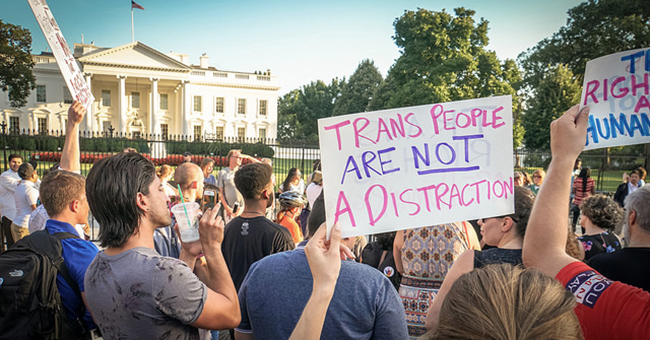
    Protest Trans Military Ban, White House, Washington, DC, USA

    Protest Trans Military Ban, White House, Washington, DC, USA, July 26, 2017. Photo credit: Ted Eytan

    I am trans. And apparently a threat to the social order and defense of our nation.

    I awoke to read that the nonsensical ban on transgender individuals serving in the military is being forced through.

    I saw Texas’s efforts to restrict bathroom use for transgender people.

    I followed the Secretary of Education’s refusal to protect transgender students.

    And I’ve long been aware that many states still limit transgender people’s ability to obtain proper identification documents and have no protections against discrimination in housing, employment, law, healthcare, or much else.  

    It’s as though many in public office are afraid and feel the need to legislate us—by overt acts of law or by intentional acts of omission—out of existence, despite the data.

    ~~~

    MYTH: Transgender people are a threat to others in public restrooms. It is imperative that women and children be safeguarded from our perversions.

    REALITY: There have been no documented cases of transgender people victimizing others in public restrooms. None. Ever. Actually, our community has been a victim of high rates of physical and sexual abuse in such spaces. And laws criminalizing misconduct in public restrooms have long existed and cover acts committed by anyone, trans or otherwise. The proposed laws only put additional burden on an already stigmatized community.


    MYTH: Transgender students are a risk to the development of other students, and insisting trans youth live and use the bathrooms matching the gender of their chromosomes causes minimal harm.

    REALITY: According to articles in The Atlantic and elsewhere, countless schools have integrated trans youth without incident. Even the American Psychological Association advocates inclusion, not merely for the trans students themselves, but to demonstrate tolerance and to promote better mental health to all students. And again, no sexual violence upon others has ever been found.  

    But most convincing is that national surveys1 detail transgender youth have high rates of depression, anxiety, suicidal ideation, and do poorly in school as a result of intolerance. To cope, trans students ‘hold it in’, ‘grit their teeth’ and withdraw inward, even avoid school altogether—inhibiting these youth from living joyful and successful lives as adults. But numerous studies also show poor outcomes are not because these youth are trans: a 2016 analysis, and many others since, make clear that when supported by their families, schools, peers, and others, these youth do just as well as everyone else.


    MYTH: Laws exist to protect transgender people, so additional protections constitute “special treatment”.

    REALITY: Many legislatures (New York, California, recently New Jersey, and even many of the ‘flyover’ states) recognize our basic humanity. But as Jenny Boylan clearly outlined in the New York Times, we demand the passing of such regulations, not to be placed above others, but because our absence in current law positions us beneath everyone else. 


    MYTH: Incorporating transgender people into the armed forces will cause upheaval, inhibit camaraderie, and be a financial burden.

    REALITY: This would be interesting to study if it did not rely on outdated, narrow-minded rhetoric. Identical arguments were made against inclusion of gay, lesbian, and bisexual soldiers, but the repeal of ‘Don’t Ask, Don’t Tell’ has not decayed our troops. Nor did the integration of people of color generations before.  

    Transgender troops serve in the militaries of at least eighteen other world powers, according to a 2014 paper coauthored by Jocelyn Elders, former US Surgeon General, and overwhelmingly without incident, disruption in force effectiveness, or cost. The paper wrote that there is “no compelling medical reason for the ban”, and that removal of the ban “…would improve health outcomes, enable commanders to better care for their troops, and reflect the military’s commitment to providing outstanding medical care for all military personnel.”2

    Additionally, even now our own military leaders do not support the ban, stating in August that trans people in the armed forces are serving with distinction and not affecting unit cohesion or military readiness, and just two weeks ago Navy researchers found that the full cost of the ban, including replacing and training new personnel would actually cost $960 million. “American taxpayers should ask the president, who is proud of his business savvy, why he’s spending a dollar to buy a dime.” said Aaron Belkin, a co-author of the above report.

    ~~~

    But these policies are not about the military, any more than this pattern of exclusion has been about bathrooms, schools or anything else. And is it clearly not about data.

    So what are the ultimate goals?  

    First, these are efforts to erode the advances made by the LGBTQ+ community, and to coerce us into lives that are more traditional. Many are uncomfortable with LGBTQ+ visibility and would rather have our society return to an ideal that was rigidly ordered and where all lived in accord. Sadly, that never truly existed.  

    But mostly, these represent attempts to restrict our ability to exist in the public sphere. If we cannot use the bathroom in public without fear of violence, or attend school, or serve our country openly, or obtain proper identification, or have stable housing, or be treated fairly under the law, or have access to healthcare, then we cannot exist in public. These are attempts to constrain us back to the shadows. To marginalize us into oblivion. To make us cease to be.

    But we will not be legislated into nonexistence. We will not accept faulty logic, or discriminatory speechifying, or even the violence used against us. We’ve been there, we’ve done that. We’ve seen the harm.

    Falling victim to bombast and falsehoods are what weakens our society, not diversity. And the trans community refuses to be the next scapegoat.


    Notes

    1. Kosciw, J. G., Greytak, E. A., Bartkiewicz, M. J., Boesen, M. J., & Palmer, N. A. (2012). The 2011 National School Climate Survey: The experiences of lesbian, gay, bisexual and transgender youth in our nation’s schools. New York: GLSEN. GLSEN (the Gay, Lesbian & Straight Education.
    2. Elders, M.J.  Brown, G. R., Coleman, E., Kodlits, T. A., Steinman, A.M. Medical Aspects of Transgender Military Service. Armed Forces and Society.  (2014).


    About the Author 

    Laura A. Jacobs, LCSW-R is a psychotherapist, activist, author, and public speaker in the NYC area.  She is co-author of “You’re In The Wrong Bathroom!” and 20 Other Myths and Misconceptions about Transgender and Gender-Nonconforming People, and Chair of the Board of Directors of the Callen-Lorde Community Health Center, one of the largest LGBTQ+ health centers in the nation. Follow her on Twitter at @LauraAJacobsNYC and visit her website.

  • Benjamin Lay

    Benjamin Lay painted by William Williams in 1790

    He sounds like a fascinating nonfiction character—too quirky to be true—but radical Quaker dwarf Benjamin Lay truly lived, and historian Marcus Rediker has brought his virtually unknown story to life in The Fearless Benjamin Lay: The Quaker Dwarf Who Became the First Revolutionary Abolitionist. Mocked as “the little hunchback” and written off by his contemporaries as “cracked in the head,” Benjamin Lay was uncompromising in his stance against slavery, and wholly committed himself to convince his fellow Quakers to denounce and abolish it. In many ways, he was prescient and ultra-modern for his time, the eighteenth century. Lay’s worldview was an astonishing combination of Quakerism, vegetarianism, animal rights, opposition to the death penalty, and abolitionism. Until his death in 1759, he lived a life of resistance.

    Rediker has done us an incredible service by moving Lay from a minor figure to his long-deserved place in the larger drama of American history. It’s high time we got to know Lay better! Here are some remarkable facts about this man who, according to Rediker, “embodies a higher set of American ideals and is a more suitable hero for a society that values democracy, diversity, and equality.”

    ***

    Fact 1: Benjamin Lay was born a dwarf in 1682, growing to be a little over four feet tall, with an over-curvature of the thoracic vertebrae. By some definition “disabled,” he never saw himself impaired or diminished in any way. In fact, his life as a dwarf was key to his empathy with enslaved Blacks, the poor, with animals, and with all the natural world.

    Fact 2: Benjamin Lay wasn’t formally educated or “enlightened,” which could account for the fact that he’s been neglected in abolitionist history. He was self-educated. The men of his era who were educated and literate were often the ones who supported slavery or owned slaves, such as Thomas Jefferson. This is exactly what Benjamin Lay rallied against.

    Fact 3: Benjamin Lay worked several trades, including shepherd, sailor, glover, petty merchant, and commoner. His ideas about abolitionism stem from his background of an ordinary working man. The history of antislavery has been largely associated with such “Enlightened” elites such as Voltaire.

    The Fearless Benjamin LayFact 4: From 1718 to 1720, Benjamin Lay saw firsthand the atrocities of slavery during his experience in Barbados, where he developed personal relationships with the enslaved. He would see the same atrocities in Pennsylvania.

    Fact 5: Benjamin Lay drank only water and milk and embraced vegetarianism, subsisting largely on fruits and nuts.

    Fact 6: Benjamin Lay was married to Sarah Smith, also a little person, who shared his strong social justice beliefs.

    Fact 7: Benjamin Lay’s record of troublemaking in Quaker communities was highlighted by dramatic displays of guerrilla theater. During a Quaker meeting in 1738, he stood up, stabbed a hidden animal bladder filled with pokeberry juice with a sword, and splattered the “blood” over the heads and bodies of congregants who kept slaves. “Thus shall God shed the blood of those persons who enslave their fellow creatures,” he thundered.

    Fact 8: Benjamin Lay lived in a cave where he kept two hundred books, cultivated his own food, and made his own clothes. As Rediker writes in the book, “He lived the principles that today animate a global movement against sweatshops, whose logo-adorned clothing and shoes disguise the horrific conditions under which workers produce them. By boycotting slave-produced commodities, Lay pioneered the politics of consumption and initiated a tactic that would become central to the ultimate success of abolition in the nineteenth century.”

    Fact 9: Benjamin Lay wrote a book demanding the complete abolition of slavery, All Slave-Keepers That Keep the Innocent in Bondage, Apostates. Part autobiography and part prophetic Biblical polemic against slavery, the book was published in 1738 by his friend and printer Benjamin Franklin. This book is a founding text of Atlantic antislavery.


    About Marcus Rediker 

    Marcus RedikerMarcus Rediker is Distinguished Professor of Atlantic History at the University of Pittsburgh and Senior Research Fellow at the Collège d’études mondiales in Paris. His books have won numerous awards and been translated into fourteen languages. They include The Many-Headed Hydra (Beacon Press, 2000; with Peter Linebaugh), Villains of All Nations (Beacon Press, 2004), The Slave Ship (2007), The Amistad Rebellion (2012), and Outlaws of the Atlantic (Beacon Press, 2015). Rediker is also the producer of the prize-winning documentary film Ghosts of Amistad: In the Footsteps of the Rebels (Tony Buba, director), about the popular memory of the 1839 Amistad rebellion in contemporary Sierra Leone. He lives in Pittsburgh, Pennsylvania. Visit his website.

  • By Lynn Hall

    Caged Eyes

    Photo credits: Lynn Hall

    This post appeared originally on The Debutante Ball.

    Publishing Caged Eyes has changed the surface of my life as dramatically as the events of the actual memoir. When you stand in your authentic truth, powerful things happen—hard things, sad things—but ultimately all positive.

    I have no idea how many copies I have sold, and frankly, I try hard not to care. As an author, those numbers matter, but as an advocate, they are completely irrelevant. I will brag, however, the highlight of this year has unequivocally been the publication of an op-ed in the New York Times the week of the book launch. I will never forget the pure elation and pride I felt holding the newspaper in my hands that morning.

    The biggest challenges and changes have been in my relationships. Caged Eyes has touched nearly every friendship I have in some way—friends either reading it or specifically not reading it, relating to it in more ways than they thought they would or not at all, and reacting with the full spectrum of emotions. Many of my friends who thought they knew the story have been shocked; some of my friends who thought they would be able to read it easily have been deeply affected.

    Too many of my acquaintances have told me that they have been sexually abused or raped too. Or they tell me that someone they love has been. Caged Eyes fights a culture of shame and silence, so it should come as no surprise that these conversations are usually in private, and all too often with people whom I never would have expected.

    There have been those who have misunderstood. A few friends have reacted poorly either to the attention Caged Eyes has received or to their perception of my actions—one went so far as to badmouth me on Facebook. (Ouch.) There have been the few who think my aim in publication has been healing or something in that vein. Overall, though, since publication date, friends have understood so much better what I have been trying to do—what I am doing.

    There have been even steeper costs: at least two of the relationships that I have in the past considered my most important ones haven’t survived this process. It’s hard to write about this publicly, and yet I feel like my honesty here is important. Both my sister and my (soon to be ex) husband have had major qualms about the ways in which I’ve talked about my story. The most pain has been in the unraveling of these two relationships.

    Lynn Hall's op-ed in the New York Times

    Lynn Hall's op-ed in the New York Times

    I imagine this publication process has been similar to any major life event in that it has been like taking a sieve to all of my relationships. Some relationships have been exposed for their inability to withstand the telling of my truth; others—the most authentic—have risen to the top.

    That’s exactly where I have found redemption: in the ways Caged Eyes has connected me more fully to other human beings.

    For instance, my friends in the mountaineering world who have stepped up in surprising ways. A few, for instance, by telling me their own stories. Another by driving four hours round trip with his wife in order to make my initial book reading. These are friends (mostly men!) whom I never would have expected to latch on to my memoir, and yet they have. A few of them cheer for me even harder than those who also write about violence against women or also work in the advocacy world.

    Veterans reach out to me often. Women who were raped years ago but still find themselves in throes of PTSD. Other women who are still active duty. A few women current Air Force Academy cadets in the midst of their own hellacious stories.

    These current cadets have impacted me by far the most. I find myself wanting to save them in some more tangible way, but alas, all I have is my truth and my words and the realization that they don’t need my saving because they are so strong all on their own.

    Last semester, a class at Front Range Community College sent a package of personal letters (some pages long!) telling me how deeply Caged Eyes moved, and in some cases inspired, them.

    One woman, a veteran, posted two words on my Facebook timeline which almost mean the most because they say everything. She simply wrote, “Thank you.”

    At first, I felt like maybe I didn’t need these accolades from readers. But the further I’ve gotten, the more I acknowledge and accept that in many ways, I do. I need to know that my truth—as destructive as it has been in some cases—has in most other cases connected for people and has acted as a force for greater good in their lives. Messages from readers affirm for me that my truth has been worth something. And maybe that has been the biggest lesson in this whole process: Truth is always worth even more than you think it will be.


    About the Author 

    Lynn HallLynn Hall is a memoirist, essayist, and activist in the movement to end sexual violence. She is also a mountaineer who has summited each of Colorado’s 14,000-foot-tall peaks and a runner who has completed a 100-mile ultramarathon. She lives in Boulder. Follow her on Twitter at @LynnKHall and visit her website.


  • By Margaret Regan

    Joe Arpaio

    Joe Arpaio. Photo credit: Gage Skidmore

    Mariana Rodriguez is one of the hundreds of thousands of Latinx victimized by Joe Arpaio, former sheriff of Arizona’s Maricopa County. Recently pardoned by President Trump for his crime of criminal contempt of court, Arpaio had been found guilty of disobeying a court order to stop racially profiling Latinx drivers and stopping them in the streets.

    An undocumented immigrant brought to the US from Mexico as a baby, Mariana, a devout young Christian, was locked up in Arpaio’s notorious Maricopa County jail system when she was a teenager. When her mother fell ill with leukemia, Mariana went to work at fifteen to support the family, while still going to high school. At eighteen, she was arrested and slapped with two felonies—one for using a fake name to work, the other for forgery, for signing the fake name on a county food-worker card. Mariana was incarcerated in the Arpaio hellhole known as Estrella to await trial. In 2010, two years before Mariana was jailed, the US Appeals Court of the Ninth Circuit declared that conditions in the Arpaio jails constituted cruel and unusual punishment. In fact, the conditions were so egregious that undocumented immigrants often gave up their right to a trial, pled guilty and risked deportation, just to escape the horrors. That’s what happened to Mariana, as Margaret Regan describes below in an excerpt from Detained and Deported: Stories of Immigrant Families Under Fire.

    ***

    On her first day in an Arpaio jail, in the short-term holding pen at Fourth Avenue Jail, Mariana was locked up with twenty other women, most of them older than she was and a lot tougher. None of them had been convicted: they were being held for trial, innocent until proven guilty, but no one would guess that by the treatment they got. Mariana was in the packed cell from ten in the morning until eleven that night, and the only food she and the others got all day was a small bag of peanut butter—an Arpaio specialty—and bread and juice, delivered at 6:00 p.m. There was a single toilet, in a bathroom that had no door. The walls and floor were concrete, and the only furnishing was a concrete bench that was part and parcel of the wall. The bench wasn’t big enough for all the women, and many of them spent the day shivering on the cold floor, chilled by AC in overdrive.

    Mariana and sixteen of the others eventually were chained hand and foot, marched into a bus, and driven to Estrella, the jail that would be their long-term home. Its name—the lovely Spanish word for “star”—was no match for its harsh conditions. Estrella sat on a vast tract of land in southwest Phoenix, along with three other Maricopa County jails. One of them was the notorious Tent City, where Arpaio housed up to 2,126 inmates in outdoor tents, in the cold of the winter and in the heat of the Phoenix summer. Estrella held a thousand inmates, most of them women, divided up into dormitory-style pods, ruled by a cadre of tough guards.

    Their first order: strip. The women were ordered to “take off everything,” underwear included. “It was something so embarrassing to me,” Mariana said. “I don’t even change in front of my mom. It was four girls all naked.” But it got worse. The guard barked, “Turn around. Bend over and open up your cheeks and cough.”

    The women next donned the striped prison garb worn by all Arpaio prisoners. Designed for maximum mortification, the black-and-white-striped tops and pants look like old-fashioned jailhouse wear. (Male prisoners, famously, are given pink boxer shorts.) The women were assigned to beds segregated by the seriousness of their criminal charges. The prisoners in “minimum” were accused of nonviolent offenses; “medium” was for violent crime; and “maximum was if you killed somebody,” Mariana said. “I stayed with the minimum girls.”

    Mariana’s K dorm was a single large room, lined with sixty double bunk beds. Eighty-seven women were packed into the place, watched over by guards who sat in a space that was more wire cage than office. The toilets were in a separate room that had no doors—and no privacy—and the showers blasted out water that was unbearably hot. The prison issued soap, “bad toothpaste,” and menstrual pads. Tampons were forbidden, and if women were caught fashioning them out of toilet paper “they’d get in trouble,” Mariana said. Twice every day the women were required to clean up their quarters: mop, sweep, clean the bathroom, showers, and wipe down the sinks.

    The Estrella food was both skimpy and bad, and Mariana was hungry all the time. Breakfast was at eight: two pieces of hard bread, a bag of peanut butter, and two small milks. There was no lunch. Dinner was colorless “slop,” Mariana said, “maybe soy meat stew with something else hard. Maybe there’d be one stalk of broccoli, rice or beans, or mashed potatoes. But no salt or flavor.” One day a reporter turned up and tried and failed to eat the evening meal. He declared it the “nastiest” thing he’d ever tried.

    Sometimes family or church friends would put money into Mariana’s account so she could buy chips or tuna at the jail canteen. When she was flush, she’d save the hard bread from breakfast and feast on a tuna-fish sandwich for lunch.

    Though Maricopa County asserts that Estrella has “outside areas for recreation,” the “rec yard” adjacent to K dorm wasn’t a yard at all. It was a small, walled, windowless room with no ceiling or roof; wires were strung across the top to prevent escape. The prisoners were allowed there briefly at 7:00 a.m. each day. They could look up through the wires, Mariana said, and “sometimes see the sky.”

    At first, Mariana was too scared to talk to any of her fellow prisoners. She was the youngest, and she kept to herself. Eventually she ventured to speak to some of the other Latinas; plenty of them had also been jailed—and charged with a felony—for using a fake name to work.

    Her bunkmate below couldn’t stop crying, and Mariana often tried to calm her. “As a Christian, I’d ask, ‘Are you OK? Do you want me to pray for you?’ She’d say, ‘Yeah.’ I held her hand and prayed.”

    One night, when she saw a circle of women standing together, Mariana joined them. Holding hands, together they walked into the little TV room, turned off the noise, and prayed.

    From then on, Mariana was part of the prayer circle; eventually she led two groups every night, praying with women in English and in Spanish. Even the toughest women started softening around her. A prisoner who looked like a gangbanger—all tattoos and attitude—began to pray with the others, and from time to time she let a smile creep across her hard face.

    In one of the few breaks to the oppressive monotony of the Estrella days, clergy came to minister on Tuesdays. Her faith brought her comfort, but Mariana suffered in the jail. It was a hellhole where guards were forever shouting. “They yelled and screamed every day,” Mariana said. Even a command as simple as “Move down the hallway” was delivered at high volume and wrapped in anger.

    They leveled punishments for the slightest of infractions. One time, all the prisoners had been ordered to stay in their beds. Mariana sneaked out from under the covers to go to the bathroom, and made the mistake of flushing the toilet. “It was really loud. The officer yelled, ‘All of you! You’re going to be on lockdown all day.’” Mariana had triggered the punishment of all eighty-seven women.

    The guards routinely checked the beds for contraband, and on one occasion they told all the women to put their property on their bunks. When some prisoners yelled in protest, the whole dorm was put on lockdown. “We had to stay in bed, no talking, no showers, for three days,” Mariana said. “Everybody got punished.”

    Some prisoners were addicts going through a tortured withdrawal from heroin and meth. “They were kicking, vomiting, shaking,” Mariana said. “I’d never seen anything like that.” Even then, the guards were cruel. Mariana saw one young addict lying in her bed, looking “like a zombie. The officer was screaming, ‘You have to get up. You think I feel bad for you? This is what you wanted. You took that stupid decision to take drugs.’”

    Worse than all of it—the confinement indoors, the lousy food, the verbal abuse, the lack of privacy—was the painful separation from her mother and siblings They couldn’t visit, because they were undocumented themselves, and phone calls were expensive: three dollars for just fifteen minutes.

    Around the time that Marianna marked her nineteenth birthday in jail, her mother’s chronic illness suddenly turned critical. The pain in her back grew so intense that the family rushed her to the hospital. Mariana knew something was wrong, but no one told her how bad off her mother really was. On the phone from the hospital, her mom would tell her, “It’s nothing bad.”

    With so little to go on, Mariana prayed. “I told God, ‘Lord, you keep it under control.’”

    ~~~

    The Maricopa County prosecutor was refusing to budge on Mariana’s legal case; he wouldn’t hear of a plea deal that would reduce her felony charges to misdemeanors. Mariana’s public defender, Christopher E. Manberg worked hard to persuade him, arguing that her statements to police officers the day of her arrest should be considered involuntary, given her youth and lack of familiarity with the law. And he emphasized that the only reason she used a fake ID was to support her family after her mother fell ill.

    The attorney collected a sheaf of character testimonials—from everyone from Mariana’s Subway boss and a higher-up Subway exec to her minister, her apartment manager, and a fellow inmate at Estrella. A Subway manager, Jesse Vasquez, wrote that Mariana was one of the top five employees among the hundred he supervised. “Our customers loved to see her,” he said; she “always greeted them with a smile.”

    Wendy Wang, Mariana’s immediate boss, called her exceptional, a hard worker who was always reliable. Wendy had planned to promote her to assistant manager, she wrote. “If I could, I would rehire her.”

    The prosecutor was unmoved both by evidence of Mariana’s character and the suggestion that her actions were undeserving of a felony conviction. The most he would do was drop the felony forgery charge and downgrade her impersonation charge to a Felony 6—the lowest level of felony.

    Chris told Mariana that if she pled not guilty and tried to fight her case, she’d have to stay in Arpaio’s purgatory another year awaiting trial. Mariana was trapped. She knew she couldn’t stand a whole year of the screaming guards, the revolting food, the confinement indoors, the crying women, a year of not seeing her mom.

    So she gave up and pled guilty to the felony, which made her automatically eligible for deportation.

    Four days before Christmas, Mariana was sentenced to time served. She’d been in prison three and a half months, one hundred and seven days, to be precise, already well over the ninety days normally meted out for a Felony 6.

    “Chris told me, ‘Game over. You signed the paper. You’re going to get deported right away.’”


    About the Author 

    Margaret Regan is the author of two award-winning books: Detained and Deported: Stories of Immigrant Families Under Fire, a 2015 Southwest Book of the Year; and  The Death of Josseline: Immigration Stories from the Arizona Borderlands, a 2010 Southwest Book of the Year and a Common Read for the Unitarian Universalist Association of Congregations. A longtime writer for the Tucson Weekly, Regan has won many regional and national awards for her immigration reporting, including the 2016 Matthew Freeman Social Justice Lectureship at Roosevelt University, Chicago. She lives in Tucson, Arizona.

  • Viktor Frankl in 1945

    Viktor Frankl in 1945

    Today marks the twentieth anniversary of the passing of neurologist, psychiatrist, and Holocaust survivor Viktor Frankl. He left us an incredible gift, his book Man’s Search for Meaning, whose message of finding hope and greater meaning in the midst of suffering has touched the lives of many. Such celebrities as Jimmy Fallon, Michael Phelps, Chris Martin, Emma Watson, Jenny Slate, and Dan Rather have paid homage to the power the book has had on their lives.

    Dan Rather Frankl TweetWith the original version and a young readers’ edition available to the public, his influence will continue to live on across the generational divide. In honor of the twentieth anniversary of his passing, we’d like to take the occasion to commemorate his life and legacy.

    ***

    When Francine and David Wheeler lost their son Ben in the Sandy Hook tragedy nearly five years ago, one book they turned to for guidance was Viktor Frankl’s Man’s Search for Meaning. Speaking with Oprah Winfrey last year, David Wheeler said he connected with Frankl’s message because “so much of what he writes resonates with me . . . . Because man’s salvation—and he means that not only in the religious sense, but actual survival—is found in and through love.” The Wheelers were able to take that spirit of love, and turn it into force that nurtured them through immense grief. It is a story as powerful as it is familiar to followers of Frankl’s teachings.

    Fifty-eight years after the original US publication of Man’s Search for Meaning, Frankl’s timeless wisdom has helped generations of readers cope with hardship and overcome adversity, and his life-affirming vision continues to resonate today. In 1991, the book was listed by the Library of Congress as one of the top ten most influential books in the US, while more recently, Amazon listed it as one of its 100 Books to Read in a Lifetime. Writing in The Atlantic, Emily Esfahani Smith notes that Frankl, an Austrian Jew who survived a prolonged ordeal in Auschwitz and other Nazi concentration camps, devised wisdom there, “in the middle of unimaginable human suffering, [that] is just as relevant now as it was then.”

    Like the Wheelers and many others who come to Frankl’s writings, Frankl himself experienced devastating personal loss. In a letter written to friends shortly after his liberation, Frankl reveals the extent of his grief:

    I have only sad news to communicate: shortly before my departure from Munich, I learned that my mother was sent to Auschwitz a week after me. What that means, you know all too well. And I had scarcely arrived in Vienna when I was told that my wife is also dead . . . . So now I’m all alone. Whoever has not shared a similar fate cannot understand me. I am terribly tired, terribly sad, terribly lonely. I have nothing more to hope for and nothing more to fear.

    Remarkably in the same letter, Frankl not only finds a way to carry on, but reasserts his belief in attaining meaning at all cost:

    I take nothing away from my former affirmation of life, when I experience the things I have described. On the contrary, if I had not had this rock-solid, positive view of life—what would have become of me in these last weeks, in those months in the camp? But I now see things in a larger dimension. I see increasingly that life is so very meaningful, that in suffering and even in failure there must still be meaning.

    To celebrate Frankl’s enduring legacy, and the powerful impact his ideas still bear, we have collected several photographs that provide a glimpse into Frankl’s extraordinary life—both public and personal.


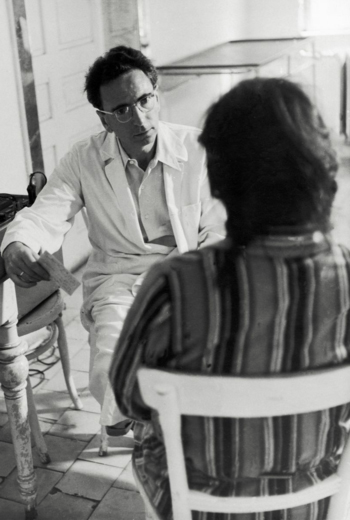
    Frankl treating a patient at the Vienna Neurological Polyclinic

    Frankl treating a patient at the Vienna Neurological Polyclinic, which he directed from 1947 to 1971.


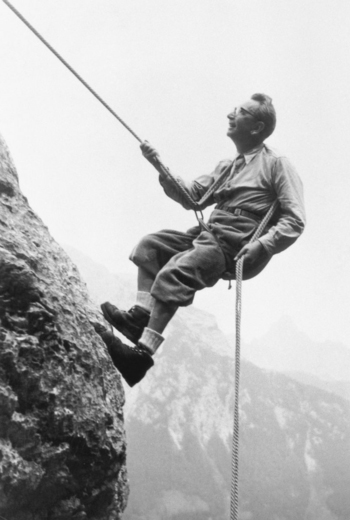
    Frankl mountain climbing in the Alps  1960

    Frankl mountain climbing in the Alps, 1960.


    Frankl giving a lecture in the United States in 1967

    Frankl giving a lecture in the United States in 1967.


    Frankl with his wife Eleonore; daughter Gabriele; and granchildren Alexander and Katharina

    Frankl with his wife Eleonore; daughter Gabriele; and granchildren Alexander and Katharina, in Vienna, 1978.


    About Viktor Frankl 

    Born in Vienna in 1905, Viktor E. Frankl earned an MD and a PhD from the University of Vienna. He published more than thirty books on theoretical and clinical psychology and served as a visiting professor and lecturer at Harvard, Stanford, and elsewhere. Frankl died in 1997.

    For further information on logotherapy and other works by Frankl, visit www.viktorfrankl.org.

  • Maya Fernandez

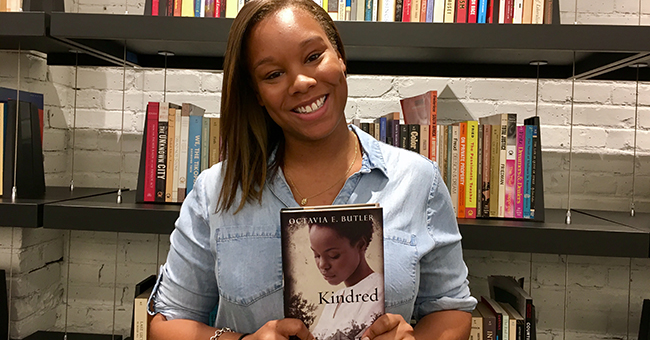
    You’ve read our classics, such as Viktor Frankl’s Man’s Search for Meaning, Octavia Butler’s Kindred, the work of Martin Luther King, Jr., and James Baldwin’s Notes of a Native Son; and many of you know our current list, featuring books by Cornel West, Lani Guinier, Anita Hill, and Christopher Emdin—books that speak to the condition of the world, and add to our understanding of urgent social issues. Whether it’s the environment or race, cultural or class dynamics, we publish all our books with a purpose. Now you can meet the people who work at Beacon Press in our blog series “Beacon Behind the Books.” Each month, we’ll introduce to you a member of our staff and give you a behind-the-scenes look at what goes on at our office.

    For the month of September, we introduce you to our Assistant to the Director, Maya Fernandez!  

    What drew you to publishing, Maya? How did you find your way to Beacon?

    Oddly enough, I hated reading as a child. In elementary school I was placed in lower level reading groups because I read at a slower pace than other students. Sometime around sixth grade, my teachers realized that it wasn’t that I had trouble reading; it was that I didn’t enjoy the books I was reading. I distinctly remember going to my school’s book fair and being overjoyed at that I was able to choose books to read. Today, I am an official book nerd (why else would I be in publishing?). I now read books quite quickly and love discovering new stories that relate to my personal experiences. My love of reading and of diverse books drew me to publishing, and Beacon happens to be one of the best places to work on such books.

    Now I shall set the scene: picture a fresh-out-of-college graduate, working as part-time intern at a digital education company and full-time job application hunter. Like most millennials, I struggled to find the perfect entry-level position after college. By chance, my father ran into a family friend who mentioned that Beacon had an opening for the Assistant to the Director, and I quickly applied. I was fortunate to not only find a publisher to work for that appeals to my love of literature and social justice, but also a position where I am constantly learning the ins and outs of independent publishing.

    What’s a typical day in the life of an Assistant to the Director?

    As the Assistant to the Director, I have a range of both administrative and editorial duties that let me see two different departmental aspects of independent publishing. I start my day by checking both my email and the Director’s email and marking anything important to go over together. Then, I look over both of our schedules for the day and write out a “To Do” list. The rest of my day consists of either author meetings, editorial projects, or depending on the time of year, planning events, such as our Board of Advisors meeting. If someone happens to find me at my desk, I am often writing flap copy, reading a proposal, or researching potential authors.

    What upcoming projects are you excited about?

    In the fall of 2018, we are publishing Some of My Friends Are…: The Untapped Benefits of Cross-Racial Friendships by Deborah L. Plummer. Through interviews, analysis, and personal anecdotes, Plummer examines how cross-racial friendships function within American society, while also exploring the benefits of these friendships. I am excited to be working on this project, because I think this book will be very important for understanding race relations within the United States, and how interracial friendships play an important role in bettering these relations. The book is both analytic and personable, and Plummer’s writing grabs the reader with thought-provoking insight. This is a must read!

    What helps you focus when you’re at work?

    Music! I love to listen to music at my desk. While many people have trouble listening to music with lyrics while they work, I find that it helps me focus on the task at hand. My music choice tends to consist of trap music, hip-hop, rap, R&B, neo-soul, and anything Beyoncé. Because I listen to such exciting music, a few coworkers have had the pleasure of finding me “dance-typing” at my desk.

    Favorite food?

    Mac & Cheese. I used to be allergic to all dairy products, so now I make sure I savor every bit of this cheesy masterpiece.

    What are you reading right now?

    I am currently reading The Misadventures of Awkward Black Girl by Issa Rae. It is hilarious and engaging. As I said before, I love reading books that I connect to my personal experiences. This is definitely one of them.

    In an alternate universe, what career would you have?

    In an alternate universe I would be a superstar celebrity. I know this is a broad statement, but I can see myself as some type of amazing actress, singer, dancer, influencer, etc. Unfortunately, my current talents are limited to binging Netflix series, but I am certain I would thrive in stardom.

    Hobbies outside of work?

    I have a secret obsession with playing The Sims 3. I try to play at least three to five hours every weekend and squeeze in an hour or two during the week. If I go too long without playing I tend to get a little irritable. Besides living in a virtual world, I enjoy spending time with my family and friends, shopping, traveling, cuddling with my dog, and sleeping.

    Maya's deskName three non-office items on your desk and their significance to you.

    I have two framed photos on my desk. The first is of my very fabulous, slightly overweight Beagle named Maggie. In my opinion, she is one of the most spectacular creatures to walk the earth. The other is of my two nephews, Ryan and Charlie. My nephews live in a different state, so I love to keep their photos nearby.

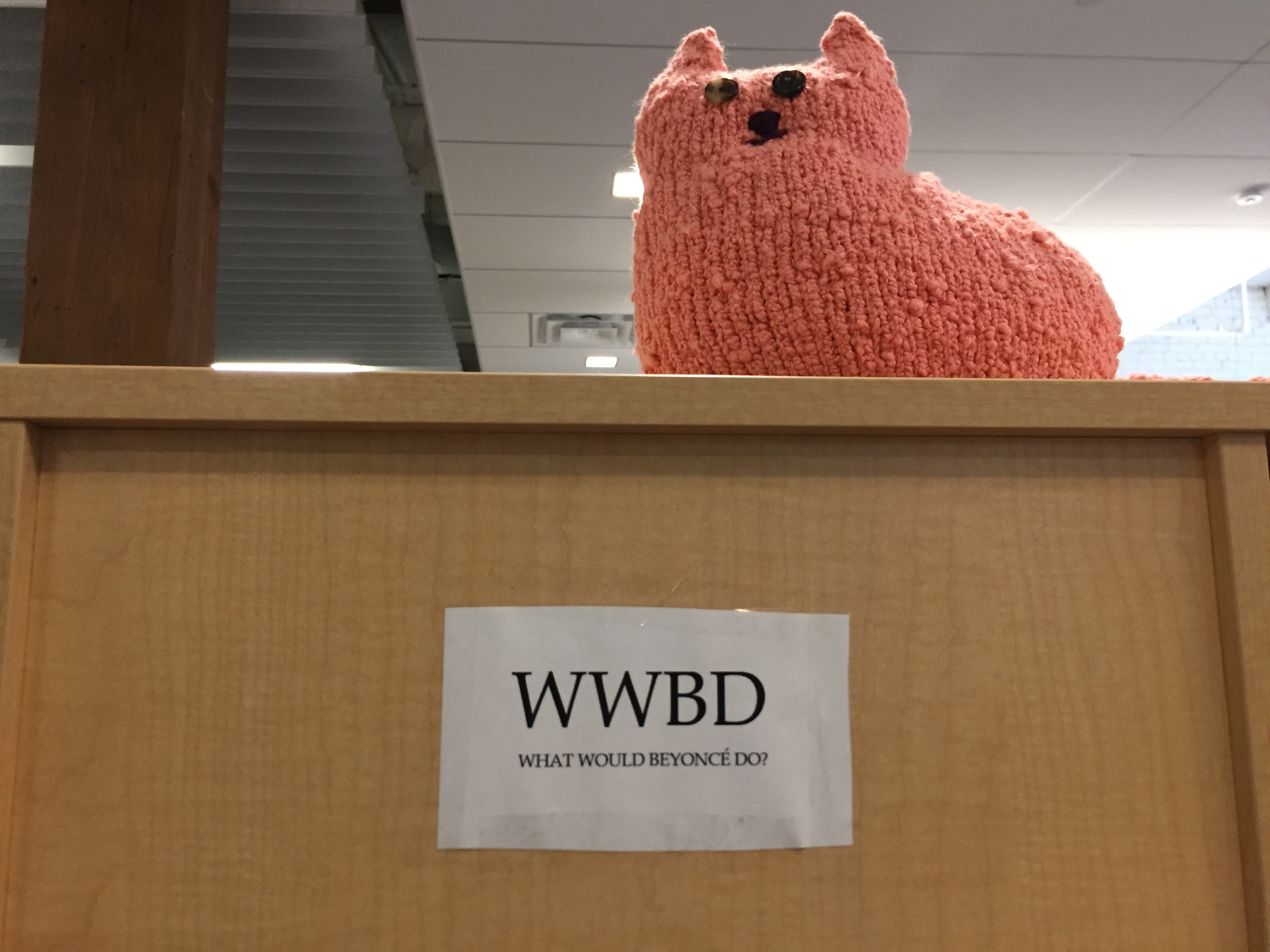
    Above my desk is a bright pink cat, knit by our Contracts Director, Melissa Nasson. There are a few cats spread out amongst the office cubes, and I’m lucky enough to have one watch over me as I work. I call her Beyoncé the Cat. She is great company.

    Lastly, I have the statement “WWBD: What Would Beyoncé Do?” taped above my computer monitor. It is a wonderful reminder to ground myself when I am stressed and think, “What would Beyoncé do in this situation?” The answer is usually “Dance.”


    About Maya Fernandez 

    Maya Fernandez joined Beacon Press in 2016 as the Assistant to the Director. Originally from Medford, MA, she earned a Bachelor of Arts from American University in Washington, D.C., where she studied Literature, Creative Writing, and Sociology.

  • By Fran Hawthorne

    Whole Foods

    Image credit: Glyn Lowe Photoworks

    I tried not to buy anything from Amazon or Whole Foods when they were (relatively) smaller, independent companies that treated their employees horribly, fought unions, forced local merchants out of business, and (in Amazon’s case) were destroying the companies that publish my books. So why would I shop at the merged version now?

    Amazon’s promise of (probably temporary) lower prices at the overpriced Whole Foods is hardly a reason. That’s like Prada declaring a ten-percent-off sale.

    Is it, maybe, more energy-efficient to order from Amazon, rather than purchasing the same stuff in person at a store? This is a question that environmentalists have been debating for more than a decade, and the answer is always: It depends on how heavy the item is, how you would get to the store, how many errands you might combine on that shopping trip, and how many other packages the UPS or FedEx truck is delivering to locations near you. Since I live in New York City and thus walk or take the subway for every shopping spree, my personal answer is that I almost always help the planet best by shunning Amazon delivery. The calculation may be different for people who live in more spread-out locales, but please do your research first and try to combine orders and errands.

    Should we give Whole Foods a little credit—and thus, our dollars—for bringing organics into the mainstream in the 1980s, so that we now have the luxury of buying healthful produce at lots of rival stores? Fair enough, to a degree. (Maybe, a degree of ten percent?) But keep in mind that most of those other grocery stores are unionized, while Whole Foods has fought organizing drives so viciously that the National Labor Relations Board has investigated its tactics. For instance, when employees in Madison, Wisconsin, voted to join the United Food and Commercial Workers International Union in 2002, Whole Foods fired two leaders of the effort and then dragged its feet on negotiating. Do we want to further weaken one of the last bastions of the private-sector labor movement in the US?

    True, sometimes you’d like to send a book to someone who lives out of town. Far be it from me, as an author, to discourage people from buying books for any reason! In that case, however, I go to my local bookstore if the store will ship the book, or else I order directly from the publisher’s website or from Barnes & Noble’s online arm, bn.com, so that I’m at least keeping that bricks-and-mortar chain a bit more alive. 

    I confess that on rare occasions, I’ve been forced to turn to Amazon, when it’s the only source of some obscure item that a friend or relative requested (cf the Vin Diesel action figure for my son … oh, never mind). Still, I refuse to join Amazon Prime, because I know that would make it too easy to continue purchasing from the Amazon monopoly. (Free shipping!)

    There is, nevertheless, one factor that tempts me to use my consumer power to support the enlarged Amazon-Whole Foods monolith: Donald Trump.

    Trump has repeatedly Tweeted bombasts against Amazon founder and CEO Jeff Bezos, usually because he’s angry at investigative reporting by The Washington Post, which Bezos owns as an individual (separately from Amazon). Among other great examples, the Post broke several stories about the questionable Russian ties of Trump’s first National Security Advisor, Michael Flynn.

    In these days of attacks—including physical attacks—on the press, I sure want to support solid journalism like the work of the Post. I’m thrilled that Bezos is willing to invest hard cash to keep a newspaper alive. And if the enemy of my enemy is my friend, well then, anyone that Trump hates, like Bezos, must by definition be a good guy.

    So where should an ethical consumer buy books or organic apples?

    While I try to be open to new insights, basic values don’t usually change. Local stores and struggling publishers need our dollars more than multi-billionaire Bezos does. So I would still go to the farmers’ market, my food coop, indie bookstores, and similar outlets first; then small, unionized chains (like C-Town grocery stores in the Northeast) and Barnes & Noble. But if I need to buy something from Amazon, I won’t feel guilty.


    About the Author

    Fran HawthorneFran Hawthorne is the author of the award-winning Ethical Chic: The Inside Story of the Companies We Think We Love and The Overloaded Liberal: Shopping, Investing, Parenting, and Other Daily Dilemmas in an Age of Political Activism. Follow her on Twitter at @hawthornewriter and visit her website.


  • By Michele Lent Hirsch

    Zoe Kazan and Kumail Nanjiani in “The Big Sick”

    Zoe Kazan and Kumail Nanjiani in “The Big Sick”

    “What are these scars?” the female lead, Emily, asks the guy she’s just slept with, Kumail, in an early scene in The Big Sick. I perk up in my seat when I hear the line. When the film first came out, I avoided it for weeks, afraid to see yet another slick Hollywood version of what illness supposedly looks like. But one of the most indelible memories I have—one that features prominently in my forthcoming book, Invisible: How Young Women with Serious Health Issues Navigate Work, Relationships, and the Pressure to Seem Just Fine—is a similar question posed to me on a first date.

    In my case, the scar was a bright slash across my throat: the kind of mark that makes people nervous. And the reason for my scar—cancer surgery—was the kind of phrase that makes people downright scared. So I avoided answering. I avoided unloading the complex story of my body, at least for another few dates. In that moment, I wanted to seem like a buoyant young woman, not a medical calamity.

    As I learned by interviewing all kinds of women whose stories now appear in my book, this tension between wanting to be yourself and yet not wanting to seem like a “downer” about your health is fairly common. Young women are already up against a lot in the realm of relationships, career, and generally being taken seriously. Sometimes even the most body-positive feminists don’t want to start talking about their bodies.

    The scars in the film, we learn, aren’t harbingers of a taboo discussion of cancer, or anything as dramatic as what will soon befall Emily’s own health (the sudden illness and subsequent coma that constitute the “big sick”). In this case, the marks are simply from the smallpox vaccination that Kumail got while growing up in Pakistan. The opposite of a health issue, in a way.

    Still, the question about scars is a nod to anyone who’s had to explain the particulars of their body to another person. (A nod to anyone with a body, really.) Especially those of us who worry that our skin or wig or foot or cane or insulin pump or crutch or brace will betray something we’re not yet ready to share with a date or a new friend.

    More of these intimate body moments pop up in the true-story film, which was written by Emily V. Gordon (played by Zoe Kazan) and Kumail Nanjiani (who plays himself). Toward the beginning of the protagonists’ relationship, Emily sees a photo of Kumail when he was young and a “dweeb,” and she and Kumail share a laugh at his expense. Then she admits that in high school she was not how she appears today, either: she was a goth who had acne, and her classmates called her Beetlejuice.

    On another date at Kumail’s place, Emily wakes up in the middle of the night. We watch as she frantically tries to get dressed. Kumail stirs.

    “It’s three a.m.,” he says.

    “Is that, uh, diner around the corner open?” Emily asks.

    “It’s twenty-four hours—why, you want an old lemon meringue pie?” Kumail says. But Emily is clearly in a rush about something else.

    “You’re so funny,” she says in a quick breath. “No, actually, um, I just, I really need to, uh, get a cup of coffee.”

    “I can make you coffee,” Kumail says.

    “I love diner coffee,” Emily says. “I just love that burnt taste.” When Kumail says he’ll come with her, she protests. “No no no no. No, why would you do that?” she asks. She says a few more things that sound somewhat out of character, until Kumail realizes something must be up.

    “Why are you being so weird?” he asks.

    After some more cursing and arguing, Emily seems on the brink of losing her cover.

    “This is normal!” she says. “Girls go to get coffee in the middle of the night! Have you never had a girlfriend before? This is what it’s like!”

     “Are you okay?” Kumail asks.

    “Everything is not okay,” Emily says, and starts to sound even more upset.

    “Hey hey hey, you can tell me anything, you know that, right?” Kumail says, until finally Emily admits what the problem is.

    “I have to take a shit, okay?! I have to take a huge fucking dookie.”

    Kumail laughs, perhaps relieved that it’s not something more serious. Meanwhile, Emily is so mortified that she’s practically in tears. “I can’t [go] in your bathroom because you don’t have any matches and you don’t have any air freshener! [. . . ] Please stop laughing,” she says. “Please, please, please.”

    InvisibleHere again, even though this scene takes place before Emily’s much more significant emergency begins, we have a moment that parallels what many young women with health issues experience. It’s both deeply funny and deeply sad to watch Emily feel so bad about her regular bodily functions, ones that are normal but that we tend to deem gross. Her diner-trip cover-up is an example of the way we often attempt to seem “fine”—to seem The Opposite Of Gross—even when our bodies are in need of something. And while being afraid to go to the bathroom at your partner’s house pales in comparison to the health issues that will strike just a few scenes later, the scene reminds the audience of the everyday fact of having a body, of being a body—and the fear of disclosing any “weirdness” to someone else.

    Later, a short, moving scene hints again at the way we all carry shame about our physical selves. Emily’s mother (a hilarious Holly Hunter) asks if it’s okay to get into bed next to her husband, who has been sleeping separately from her because of relationship issues. After she gets in, her husband (played with quiet pathos by Ray Romano) is immediately worried.

    “See, I should have brushed my teeth,” he says in a small voice. He’s self-conscious about not being perfectly ready for the woman he loves to be this near to the animal of him. But instead of being grossed out by her husband’s un-brushed teeth or his breath, Holly Hunter’s character stays close.

    “I like it,” she says.

    Scenes like this charm me because I constantly worry about my body’s medical weirdness and what it signifies to others—and because I constantly try to stop worrying about it around the people I love.

    There is, however, one scene concerning bodies that falls flat. Throughout the film, Kumail’s mother orchestrates meetings between her family and a stream of Pakistani-Muslim women she’s trying to get Kumail to marry. In one such scene, we watch the family react with boredom and annoyance. Why? The woman auditioning on this particular night is drily listing all the foods that she can’t eat. The message is clear: we’re supposed to think this woman sucks.

    Yes, the filmmakers are right about one thing: making others listen to you list every single food you can’t eat while you speak in a dull voice isn’t the most exciting of dinner conversations. But out of infinite comedic possibilities that the writers could have chosen, I don’t know why they chose something health-related to show that this woman is a drag. In doing so, they leaned on a tired trope: Woman Listing Foods She Can’t Eat For Medical Reasons is often used in movies and on television as a lazy shorthand for “this chick’s no fun / don’t hang out with her.” So it surprised me to see it in an otherwise thoughtful film about how health issues can strike anyone out of nowhere. The character could have, say, drily listed all seventeen dog accounts that she follows on Twitter, or presumptuously listed the many cardstock varieties she wants to consider for her wedding invitations. There were many other subjects she could have been annoying about.

    Still, in its honesty about acne, giant shits, and un-brushed teeth, not to mention the “big sick” itself, the film succeeds at capturing the everyday grit of being a body. The things that, if we all shifted our thinking a little, we might not need to be as embarrassed about.

    Various scenes showing the main elements of the film—that Kumail loves Emily, that Emily is in the intensive care unit, and that both Emily’s and Kumail’s families have strong personalities with their own cultures to contend with—made me guffaw at some points and tear up at others. I left feeling that I’d watched something much more substantive about illness than I’d expected. And it was the small moments that resonated with me—and with stories from the women I’ve interviewed—the most.

    After Emily has (spoiler alert) emerged from her coma and is just starting to venture outside on her own, she says something uncannily similar to a passage in my book:

    “When something like this happens, there’s this sort of expectation that you’re gonna have this completely, like, new lease on life, and feel totally different about everything, and, like, cherish every sunrise,” she tells Kumail. “And like, for the most part I just feel like, ‘Ooouugh, I can’t get up that early,’ you know?”

    Emily delivers the line slowly, as if just starting to come to terms with her post-coma life—and how surprisingly mundane that life can be. Her words closely echo a section of Invisible in which someone asks how I feel after a near-death medical experience. Like Emily, I became acutely aware that life doesn’t necessarily feel epic every moment just because you almost lost it. I didn’t need to go climb every mountain and start everything in my life over again. For many of us, that “new lease on life” feeling can illuminate some things, certainly. But at other times, we simply feel like we’re people trying to get through the day.

    The real story of Emily’s health, and the film version she and her husband have created, may at first seem epic to viewers: a sudden illness, a medically-induced coma, hanging on by a thread; love, family, existential drama, realizing what matters to you. But as the film accurately shows, dealing with a major illness isn’t always a grand or sweeping tale. Sometimes, like teenage acne or the way you smell to your partner, it’s just part of being a body in the world.


    About the Author 

    Michele Lent Hirsch is a writer and editor whose work has appeared online in the Atlantic, the Guardian, Smithsonian magazine, where she is a former weekly contributor, and Women Under Siege, where she is a former editor, as well as in print in Psychology Today, Natural Health, and the Bellevue Literary Review. She has also published poetry in a number of journals, and been nominated for a Pushcart Prize. With a specialty in science, gender, and health, she has been an adjunct professor of journalism at Manhattanville College, a guest lecturer at the New School, and a writer-in-residence at the New York Public Library. She is a member of Columbia University’s Neuwrite program, a selective group of writers and scientists. A native New Yorker, she lives in Brooklyn, NY. Follow her on Twitter at @Lent_Hirsch.