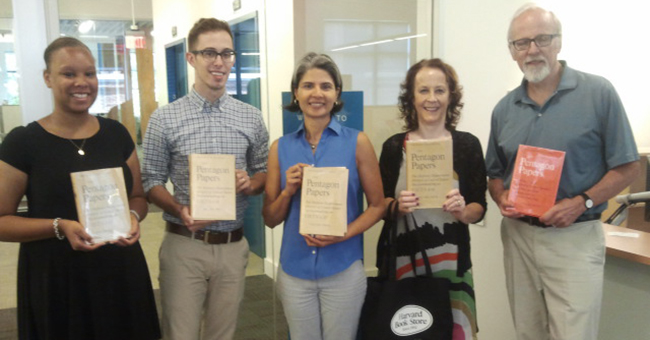
• Beacon staff and Pentagon Papers

    Beacon Press staff members posing with the historic volumes of The Pentagon Papers
     

    It was announced this month that Steven Spielberg will direct The Post, a drama centered on the Washington Post’s role in exposing The Pentagon Papers. Declassified and publicly released in June 2011, the papers give the history of the United States’ political-military involvement in Vietnam from 1945 to 1967. Tom Hanks will be playing Ben Bradlee, the Post’s editor, and Meryl Streep Post publisher Kay Graham. The Post, though, wasn’t the only player in the history of the papers.

    Back in 1971, Beacon Press edited and bound all the documents that became The Pentagon Papers after three dozen publishers declined Senator Mike Gravel’s proposal to publish them. Though it was no easy task, Beacon’s then director Gobin Stair saw a moral obligation to make them available to the public—which wasn’t without risk. As you’ll read below, Beacon came under investigation. President Nixon called Stair to voice his disapproval and, literally, stop the presses. Members of the Defense Department soon showed up at the office. In our humble opinion, this would also make for an exciting movie drama. 

    ***

    On August 17, 1971, Beacon publicly announced that it would publish The Pentagon Papers. Nobody on staff was naive about what such a commitment entailed: “A Beacon spokesman said yesterday the Gravel book is the biggest venture in the history of the small publishing firm.” The papers represented the “biggest venture” in Beacon’s long history on many levels. For starters, the papers in their submitted form—a “great container full of stuff”—presented an editorial nightmare. The manuscript that antiwar activist Leonard Rodberg brought in was composed of more than 7,000 pages of “original transcripts.” Staring at the disorganized piles of xeroxes, Gobin Stair was pessimistic about the editing process:

    The pile of stuff that was the Pentagon Papers was so confused and so mixed up that everybody who got near it knew this wasn’t going to be a possible book, or series of books. It needed to stay in that manuscript form locked in some closet somewhere. Because it was an endless pile of notes. Nobody had shaped it.

    Edited, collated, and bound, the publication of the papers would spark an even larger problem: political persecution. This was a seasoned publishing team signing on for guaranteed headaches and possible criminal charges. Why, then, did Beacon accept Senator Mike Gravel’s incendiary proposal?

    In an article dated September 15, 1971, exactly three months to the day the presses stopped, Gobin Stair explained Beacon’s rationale: “Senator Gravel has performed a unique public service in making [the Pentagon Papers] available. The public, we feel is entitled to reasonable public disclosure of the material rather than sketchy journalistic synopses.” Stair also expressed his disdain for the producers of those “sketchy synopses”: “We are undertaking this vital project because we are concerned at how rapidly the American press lost interest in the Pentagon study once the Supreme Court confirmed the public’s right to this information.” Like Gravel, Beacon placed a premium on keeping the papers accessible in the fullest form possible.

    Never one to mince words, Stair selected some choice ones for other book publishers, calling to account the industry trend of waning editorial independence and waxing corporate control: “In a time when most houses are selling out to larger industrial conglomerates, the corporation and not the publisher is controlling the book trade. We may consider ourselves very fortunate that our press takes a different attitude.” Thirty years after making the decision to publish the papers, Stair’s sense of the project’s scope remained vibrant: “Other publishers had turned down the manuscript both for commercial reasons and out of fear, and as a free press we felt we had a responsibility to publish needed information when others would not.” In terms of professional ethics, Beacon adhered to an unrivaled standard.

    Beacon didn’t stake its decision to bring out The Pentagon Papers solely on principle; President Nixon’s opinion was also taken into consideration. As Stair remembers:

    I got a phone call at home from Richard Nixon . . . he said, “Gobin, we have been investigating you around Boston, and we know you are apparently a pretty nice and smart guy . . . I hear you are going to do that set of papers by that guy Gravel” . . . The result was that as the guy in charge at Beacon, I was in real trouble. Before we had decided yes or no, we were told not to do it. We were publishing books we like and that we think we can sell, and to be told by Nixon . . . not to do it, convinced me before I had [completely] decided, that it was a book to do.

    Although he took a certain puckish delight in Nixon’s disapproval, Stair confessed to feeling a similar anxiety to Arnold Tovell, admitting, “I very much wish somebody else were publishing this.”

    Nixon wasn’t the only one contacting Beacon. On September 17, two men from the Defense Department outfitted with “hats and coats and cigarettes” arrived at press headquarters, asking to see Gobin Stair. Secretary Burnell O’Brien was shaking when she walked into the director’s office and announced, “The FBI are here.” Stair replied, “Tell them to come back in a half an hour.” To buy time for Stair to rally Beacon’s lawyers and staff, and to call the newspapers, O’Brien sent the FBI agents on a tour of Old North Church. When the agents returned, they demanded that the Pentagon Papers be returned. Beacon did not accommodate them. In addition to making demands, the agents also ran paper “through all of Beacon’s photocopiers” to see if they could determine whether Ellsberg had used those machines to copy the Pentagon studies. The men departed after making an appointment for Pentagon officials to meet with Beacon staff one week later. Stair called the whole ordeal “ominous and intimidating.”

    J. Fred Buzhardt, general counsel of the Defense Department, later canceled the meeting set up by the FBI agents. Buzhardt’s actions seemed odd, given that Beacon and Senator Gravel were open to discussing the contents of the forthcoming volumes; as Gravel put it, “If they see something that is sensitive to national defense that we haven’t, we are amenable to discussion.” By way of explanation, Buzhardt cited the recent court ruling in favor of the New York Times: “The Supreme Court has ruled no prior restraint on these documents. I can’t try to do indirectly what the court has said can’t be done directly.” Behind Buzhardt’s withdrawal was a veiled threat—if the Times hadn’t broken ground on prior restraint, one of the most important trials for a free press could have been Beacon Press v. United States.


    Read more about Beacon Press’s story of publishing The Pentagon Papers in our chapbook and on our website.

  • By Lori L. Tharps

    Robert Kelly, Jung-a Kim, and their children

    Robert Kelly, Jung-a Kim, and their children. Photo credit: YouTube

    By now you’ve probably seen the video. The one of White American South Korean expert Robert Kelly being interrupted by his two children while he was in the middle of a live interview on the BBC. The video immediately went viral because it was just so funny seeing not one, but two kids photo bomb dad’s very important and very serious television appearance, followed by a harried woman literally swooping in to save the day by hauling the kids out of the room and slamming the door behind her. Oh, it was funny indeed. And Kelly’s four-year-old daughter, whom we now know is named Marion, became an instant Internet star.

    In true twenty-first-century fashion, the video has also spawned a slew of copy cat versions of the BBC interview where people have made commentary on everything from our current commander in chief and his toddler-like behavior, to the challenges of working from home with kids under foot. But the conversations I’ve been following in the wake of this video are those surrounding the identity of the woman in the video.

    Initially, it was assumed and even printed in some national publications that the Asian woman who burst into the room and hustled those kids out of the room was the nanny. Some online commenters suggested she was the “hero” of the video, while others insinuated that the poor nanny was surely going to lose her job after that major error. But the thing is, the woman in the video isn’t the nanny. Ms. Jung-a Kim is Kelly’s wife.

    Same Family Different ColorsLate last year, Beacon Press published my fourth book, Same Family, Different Colors: Confronting Colorism in American’s Diverse Families. In the book, I examine the effects of skin color differences on family dynamics in African American, Latino, Asian American, and Interracial families. One of the key concepts I try to unpack in this book is the notion that in American society, families are supposed to match. And when they don’t match, all kinds of problems can occur, both inside and outside of the home. One common problem for families that don’t match, as witnessed by this video, is that the public literally cannot see the familial bond. They see nannies instead of mothers or kidnappers instead of fathers.

    As the Black mother of three Mixed-Race children, two of whom do not look particularly Black or even Black-ish, I am often mistaken for the nanny. When my pale husband is out alone with our eldest child, who apparently sucked up all the melanin before his younger siblings could get their fair share, he is often asked which country he adopted his son from. These are mild disturbances in our daily lives, but this lack of recognition of how we are related can also pose real challenges as parents and as people who want to have their family unit recognized by a visually-oriented public who still can’t see past color.

    Some people might think all of the think pieces about mommy vs nanny are excessive and pointless. So, some people thought the Asian woman was the nanny. It was an honest mistake. After all, statistics show interracial marriages, while on the rise, are still the exception, not the rule. The video quality wasn’t the best and it wasn’t obvious at first glance that Kelly’s children were Mixed. There are so many reasons why a person might not have assumed that Ms. Kim was Kelly’s wife and none of them have to indicate that racism was a motive. But for the colored girl who marries a White man and gets mistaken for the nanny, that all too common assumption always feels like an insult. Not good enough to be the White man’s wife. Not white enough to be the light child’s mother. And just not enough to be seen for who we are.

    Clearly, this issue shouldn’t be argued on the basis of this one particular video. It was merely fifty seconds of reality TV-style entertainment, but it is an excellent opportunity to check our biases and assumptions, no matter who we are. Personally, I know many people of color, woke-as-hell activists included, who assumed Kim was the nanny. The point is we all have a particular lens with which we see the world and process information. That is not an excuse to keep making those assumptions; on the contrary, it is a wake-up call that we all bring baggage to the table. And when it comes to the family unit, most of us still probably assume families should match.

    Real progress will be made when, collectively, we learn to look beyond skin color to see how families are connected; when we all learn a little bit more about how genetics work; and when a woman of color is seen caring for light-skinned children, she can be more than hired help.*

    *(Note: The author is in no way implying that being a nanny or caregiver is inherently a bad thing or that someone should be ashamed to be a nanny. It is the assumption that a woman of color could only be domestic help rather than a child’s parent that is at issue. )

    *(Note 2:  The author is also aware that White women who have Mixed-Race children can also be mistaken for the nanny.)


    About the Author 

    Lori L. TharpsLori L. Tharps is an associate professor of journalism at Temple University and the coauthor of Hair Story: Untangling the Roots of Black Hair in America and Kinky Gazpacho: Life, Love & Spain. Her writing has also appeared in the New York Times, Washington Post, and Glamour and Essence magazines. She lives in Philadelphia with her family. Follow her on Twitter at @LoriTharps and visit her website.

  • By Arlene Stein

    Statue of Liberty and NY skylineThis essay appeared originally on the feministische studien blog.

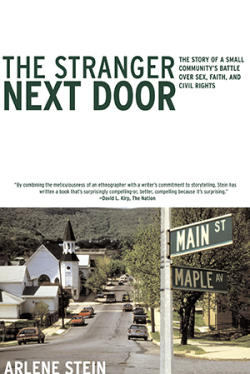
    Over fifteen years ago I studied a local Christian right campaign against gay/lesbian rights in the Pacific Northwest for my book The Stranger Next Door. I spent a year interviewing people in a small timber community to try to understand why the issue of sexuality emerged there. They were white working and middle class people, mainly evangelical Christians.

    I met people who believed gays and lesbians are sexual predators who were out to convert their children. Who considered teachers to be untrustworthy representatives of the liberal secular humanism, who were destroying the family. Who believed that multiculturalism is a bad word. And who saw themselves as victims. They felt that their power as Christians, small town Americans, and as white people, was slipping away.

    After the book was published, I moved to New Jersey and focused my attention on other things. I assumed the world of politicized Christian conservatism had become increasingly marginal, and largely irrelevant to Republican Party politics.

    But then came the Trump campaign. Even though Trump did not run as a Christian conservative, his campaign, and the issues it raised, echoed many of the themes I saw in my research in small-town America. His slogan “Make America Great Again” was tailor made for those sectors of society who believe their power is slipping away, who long for the “good old days.” Trump’s election prompted me to revisit my research on the rightwing, to try to make sense of the political universe we are now dealing with.

    The fact that Trump seemed, at least during this campaign, like more of an opportunist than an ideologue fooled many of us. He may be an opportunist, but he has surrounded himself with ideologues, a governing coalition that reaches across the spectrum of the American right. It is an unstable coalition, as we’ve seen from the leaks coming out of the White House. But it is a ruling coalition that brings together different sectors of the rightwing. And it is important for us to understand it.

    Analysts often divide the American rightwing into the Secular Right, Christian Right, and the Xenophobic Right. Collectively, the right stands for the reinforcement of racial, ethnic, class, gender, sexual hierarchies and the belief that these hierarchies are natural and/or God-given. But different hierarchies are of greater or lesser importance for different sectors of the American rightwing.

    The secular right is mainly concerned with relationship between state and economy. It wants to unleash capitalism and minimize government regulation. The Christian right concerns itself with the relationship between church and state. It wants to fight against what it sees as the secularization of American culture. And the xenophobic/far right is concerned primarily with preserving whiteness and national dominance. All sectors champion male dominance and white/Christian supremacy. Some do so very explicitly, others in coded ways.

    The Stranger Next DoorUntil now, the Republican Party has mainly drawn its leadership from the secular right. The Christian right has been a powerful presence during the past few decades, but mainly at the local and state level. And it has distanced itself from the xenophobic right, at least publicly. Trump is changing all of that.

    Trump, the presidential candidate, was basically a “paleoconservative.” He adhered to nationalism, free markets, and moral traditionalism. He supported a strident form of anti-immigrant politics, an isolationist foreign policy, and a deep skepticism toward economic globalization that put him at odds with an important element of the business agenda.

    Trump, the president, has assembled an administration comprised of a coalition of the secular, Christian and xenophobic right. Some say it is the widest rightwing coalition ever assembled by an American president. And it is far more radical than anyone would have believed after the election.

    The Trump administration has welcomed Christian conservative influence (Betsy DeVos and Mike Pence). It has has placed white supremacists such as Steve Bannon—a former spokesperson for the so-called “alt-right.” That means that Islamophobia is likely to be central driver of foreign policy—hence the recent effort to implement a Muslim ban. For Trump’s different constituencies on the right, Islam is a perfect target, encapsulating beliefs in American and Christian superiority, evoking fears of terrorism, and playing into clash of civilizations-preservation of Christian nation; nationalism. It targets Jews in coded, less explicit ways.

    In terms of Trump’s cabinet appointees, a Tea Party libertarianism is ascendant: a Secretary of Education who doesn’t believe in public education, a Secretary of State who believes that foreign policy should be run by Exxon, and so forth. They basically want to destroy the Federal Government. And despite all of Trump’s campaign talk about “draining the swamp” of crony capitalists, he has assembled a cabinet that is more pro-business than any other before it, and which includes Wall Street bankers and corporate globalists like Steve Mnuchin and Rex Tillerson.

    I’ve heard some liberals reassure us, saying that in four years we will take back Congress and the Presidency. But that’s far too optimistic. The basic operations of our democracy are now under threat. What are we likely to see within the coming months? A massive attempt to roll back the last fifty years of liberal social reforms and an undermining of democratic institutions. The disruption and destruction of the Federal Government and privatization of many of its basic functions.

    Will more moderate Republicans push back? Will mass mobilizations push Democrats to the left? Will apolitical Americans rise up when they realize they will lose their health insurance, and when they defund their kids’ schools? Or will they direct their wrath against the most vulnerable members of our society? The answer depends, in part, upon how quickly and effectively we can mobilize to defend the institutions that Trump is trying to destroy.

    The Yale historian Tim Snyder, who has written extensively about the rise of fascism, says, “we have at most a year to defend the republic.” What we do in the next weeks and months is thus of vital importance.


    About the Author 

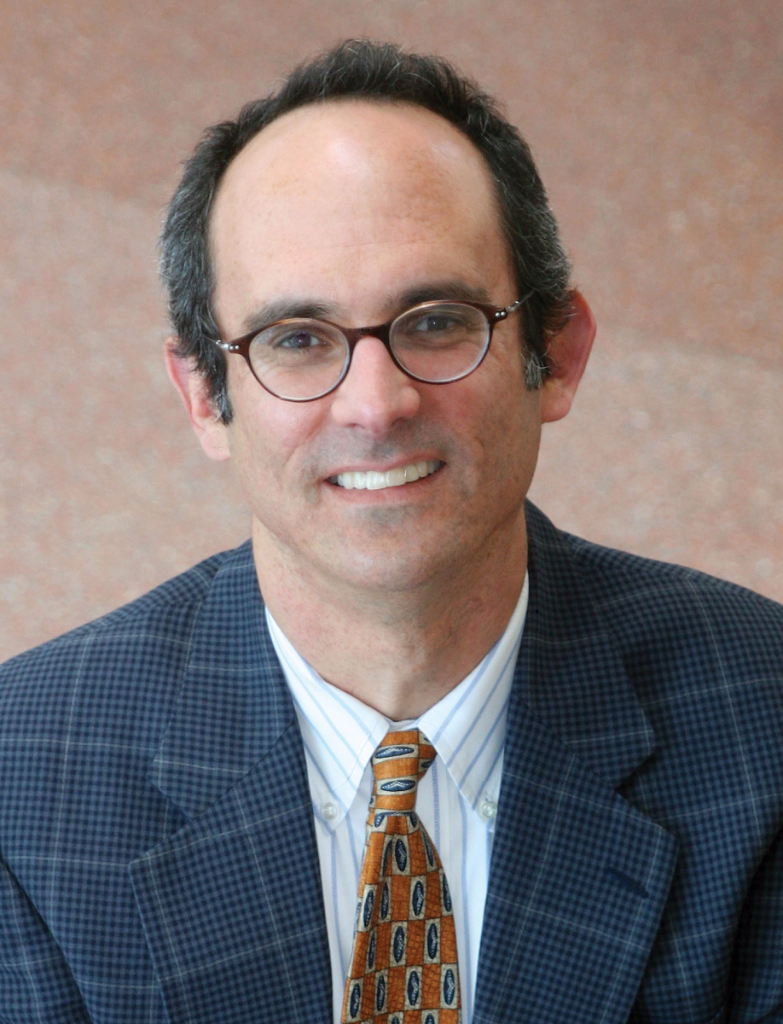
    Arlene Stein is professor of sociology at Rutgers University. She has written for The Nation, The Oregonian, and Newsday, among other publications, and is the author of The Stranger Next Door: The Story of a Small Community’s Battle over Sex, Faith, and Civil Rights, Sex and Sensibility: Stories of a Lesbian Generation and editor of Sisters, Sexperts, Queers. Follow her on Twitter at @SteinArlene and visit her website.

  • By Carlos A. Ball

    Gavin Grimm Speaks at Title IX Protest

    Gavin Grimm Speaks at Title IX Protest. Photo credit: Geoff Livingston

    The Supreme Court recently decided not to hear the case of Gavin Grimm, a transgender male student who was prohibited by his Virginia high school from using boys’ bathrooms. The question raised by Grimm’s lawsuit is whether federal law protects the ability of transgender students to use school bathrooms that correspond to their gender identity. The Supreme Court sent the case back to the lower court given the federal government’s changed legal position—while the Obama Administration contended that denying transgender students the ability to use bathrooms that match their gender identity violated federal law, the Trump Administration now claims that federal law does not prevent school districts from requiring students to use bathrooms according to their biological sex as assigned at birth.

    Grimm’s lawsuit, and other cases like it such as the challenge to North Carolina’s so-called transgender bathroom law (also known as House Bill 2), is of great importance because it addresses the question of whether transgender individuals are legally entitled to do something that everyone else is permitted to do, namely to use bathrooms (and similar facilities such as changing rooms) that match their gender identity. But cases like Grimm’s raise an even more fundamental and important question: whether federal law protects sexual and gender-identity minorities from discrimination to begin with.

    Federal civil rights statutes do not explicitly prohibit discrimination on the basis of sexual orientation or gender identity. Multiple efforts through the decades to amend the laws in ways that would provide such explicit protection have failed to make it through Congress. Nonetheless, in the last few years, a growing number of courts have held that discrimination against LGBT people constitutes a form of discrimination on the basis of sex. These courts have concluded that federal statutes that prohibit discrimination “because of sex” provide significant protection to LGBT people. (The Equal Employment Opportunity Commission has reached the same conclusion.)

    Although these courts’ reasoning has varied depending on the particular facts of the disputes before them, their conclusions are sound and correct. It is the case that much of the discrimination aimed at sexual minorities is linked to issues of gender: many women, for example, who are discriminated against because they have intimate relationships with other women, would not be subject to that discrimination if they were in intimate relationships with men. The gender of the parties, in other words, is inextricably linked to the discrimination.

    Similarly, employers sometimes fire transgender individuals once the latter identify as members of another gender. When an employer is willing to hire someone who identifies as male, for example, but then fires that same individual after she identifies as female, it constitutes a paradigmatic instance of discrimination “because of sex.” The employer was willing to employ the worker as long as she identified as male but not when she identified as female.

    It is also the case that sexual minorities and transgender individuals are often discriminated against because they fail to act in ways that correspond with gender stereotypes. For example, employers frequently discriminate against gay men and transgender men because they believe them to be too “feminine.” As far back as 1989, the Supreme Court, in a case involving a female executive who was denied a promotion because the male partners at her firm thought she was too “masculine,” ruled that Title VII of the Civil Rights Act of 1964 prohibits employers from making employment decisions based on gender stereotyping.

    Much to its credit, the Obama Administration, in cases such as Gavin Grimm’s, took the position that when schools prohibit transgender students from using bathrooms that correspond to their gender identity, they engage in sex discrimination in violation of Title IX of the Education Amendments of 1972. The fact that the Trump Administration has rejected that view is a serious blow to efforts to prevent the physical and psychological harm to transgender people caused by being prohibited from using the bathrooms of their choice. But even more problematically, the federal government’s changed position on bathroom access by transgender individuals strongly suggests that the Administration will oppose interpretations of current federal civil rights statutes as providing any protections for LGBT people against discrimination.

    The early steps taken by the Trump Administration on LGBT rights indicate that the federal executive branch is no longer committed to LGBT equality. Furthermore, the Republicans who control Congress seem to be more concerned with the right of religious conservatives to discriminate against sexual and gender-identity minorities than with protecting LGBT people from discrimination. As a result, the extent to which federal civil rights laws can be used to remedy discrimination against LGBT people will likely depend on how the Supreme Court rules on the first case to reach it raising the question of whether such discrimination constitutes a form of sex discrimination. That issue might reach the Court in a bathroom access case, whether Gavin Grimm’s or that of another transgender litigant. In deciding the bathroom question, the Court may decide the even more fundamental question of whether federal civil rights statutes apply to LGBT people.

    All of this means that we are at a peculiar and potentially troubling crossroad on LGBT rights in this country. On the one hand, same-sex couples have a constitutional right to marry. On the other hand, nationwide equality in crucial areas beyond marriage, including those of employment and housing, could depend on whether the Supreme Court follows the lead of several lower federal courts in holding that discrimination against LGBT people is a form of sex discrimination. The Trump Administration has signaled its views on that question by refusing to side with transgender students on issues of bathroom access. Whether the Supreme Court ultimately agrees with the Administration will determine whether LGBT people in our society remain, in crucial ways, second-class citizens. 


    About the Author 

    Carlos A. BallCarlos A. Ball is Distinguished Professor of Law at Rutgers University. He has written several books on LGBT Rights, including From the Closet to the Courtroom: Five LGBT Rights Lawsuits that Have Changed Our Nation. He lives in Brooklyn, New York, with his husband and two sons.

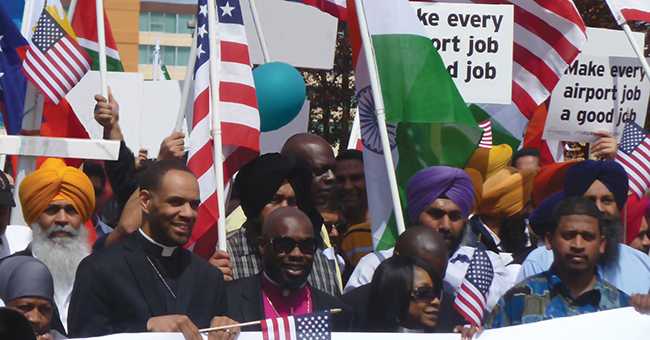
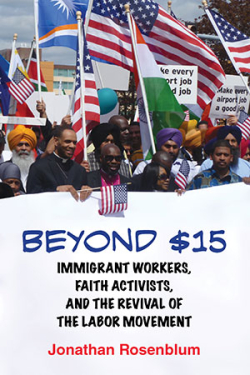
  • Beyond 15Happy publication day to labor organizer and journalist Jonathan Rosenblum and Beyond $15: Immigrant Workers, Faith Activists, and the Revival of the Labor Movement! As recently as 2013, the call for a $15/hour minimum wage became a resounding rally cry against growing income inequality in the US. In Beyond $15, Rosenblum captures the inside story of the first successful fight for a $15 minimum wage. Just outside Seattle, an unlikely alliance of Sea-Tac Airport workers, union and community activists, and clergy staged face-to-face confrontations with corporate leaders, uniting a diverse, largely immigrant workforce in a struggle over power between airport workers and business and political elites. The workforce was made up of employees from Somalia, Ethiopia, Ukraine, Mexico, the Philippines, Iran, Iraq, India, and other countries who joined forces with Christian and Muslim leaders. Rosenblum was director of the Sea-Tac campaign for the Services Employees International Union.

    In light of a Trump presidency, Rosenblum offers a blueprint for a new kind of all-inclusive labor movement, which he calls a “social movement union.” He argues there are three steps that unions must take to forge this newly empowered movement: Aim higher with a bolder vision of a just society that stands as a stark counterpoint to capitalism; reach wider by redefining who constitutes the “labor movement” to include all workers, not just those holding union cards; build deeper by cultivating the ideas and leadership of ordinary workers. Below you will meet some of the key players who took these steps to reclaim their power in the new economy.

    • Abdinasir Mohamed, the former ANC youth organizer who came to America and was shocked by the poverty he saw on the streets. Mohamed arrived in Seattle and played a pivotal role connecting workers and area Muslim leaders in the Sea-Tac fight.
    • Iraqi refugee Mohamed Kadhim, a trained computer programmer who escaped two wars before arriving in Sea-Tac, where as a baggage handler he helped his coworkers form unions and win fair pay.
    • Somali refugee Yasmin Aden, who as a janitor in Seattle led a successful wildcat strike and went on to become one of the main organizers in the Sea-Tac campaign.
    • Omar Mumin, a Somali Muslim and Sea-Tac Airport worker who was ordered to shave his beard off after 9/11. Mumin helped organize other Muslims in the community and create a video in Somali that explained the ballot initiative and voting procedures for first-time voters.
    • Alex Hoopes, the Alaska Airlines baggage handler who, along with nearly 500 coworkers, was fired in 2005 when the airline contracted out the work to a poverty-wage employer. For Hoopes, the Sea-Tac campaign offered an opportunity to avenge the damage Alaska had inflicted on him and his coworkers.
    • Sarah Mohamoud, the Somali refugee who went door-to-door throughout the Sea-Tac community registering new voters and challenging them to stand up to the big corporations that opposed the ballot initiative.
    • Beyond $15Ethiopian immigrant Mulat Ayalew, who along with thousands of other Sea-Tac workers won huge back-pay settlements totaling millions of dollars from the airline contractors as a result of the ballot win. With fair wages now assured, Ayalew and his coworkers were able to return to school, reduce their work hours, purchase homes, and enjoy a measure of economic stability.
    • Reverend Jan Bolerjack, troubled by seeing hungry airport workers at her church’s food pantry, led protests along with other clergy at Alaska Airlines as a way of bringing the living Gospel into the airport community.
    • Reverend John Helmiere, the minister who, along with other clergy, stunned Alaska corporate executives by commandeering their annual shareholders meeting and challenging them with a prayer for worker justice at the airline.
    • Sheikh Abduqadir Jama, a local imam and school director, who overcame his deep skepticism of unions when he saw unions stand up for the rights of Muslims to pray at work.
    • Peace activist and civil disobedience practitioner Reverend Lauren Cannon, who brushed aside threats of arrest by airport authorities when she lobbied airline passengers about Sea-Tac’s poverty wages and unsafe working conditions.
    • Socialist political activist Kshama Sawant, who backed the Sea-Tac movement and in the same election as the Sea-Tac ballot win scored a stunning upset over a sixteen-year incumbent to win a seat on the Seattle City Council. Following Sawant’s win, her Socialist Alternative party led demonstrations in Seattle and threatened a ballot initiative to force the political establishment to agree to a phased-in $15 minimum wage.


    About Jonathan Rosenblum

    Jonathan RosenblumJonathan Rosenblum has been a labor organizer for more than thirty years, playing key roles including SeaTac Airport campaign director. His writing has been featured in Tikkun, In These Times, and Yes! Magazine. His upcoming book, Beyond $15: Immigrant Workers, Faith Activists, and the Revival of the Labor Movement, will be released in March 2017. He lives in Seattle, WA. Follow him on Twitter at @jonathan4212. 

  • By Jay Wexler

    Neil Gorsuch, nominee for Associate Justice to the U.S. Supreme Court, and President Donald Trump

    Neil Gorsuch, nominee for Associate Justice to the U.S. Supreme Court, and President Donald Trump

    By all accounts, it would seem that when hearings begin this month on Neil Gorsuch’s appointment to the Supreme Court, the American people will once again be subjected to a charade. Democratic Senators will ask probing questions of the nominee, seeking to understand his approach to constitutional interpretation, and Judge Gorsuch will decline to answer them, claiming that he cannot signal how he will vote in cases that might come before the Court. A couple of days will go by, and at the end, nobody will know anything more about the nominee than what they can already learn from his Wikipedia page.

    This will not be solely Judge Gorsuch’s fault. Nominees of both Republican and Democratic presidents have consistently engaged in this form of theater for decades now. Hiding behind dubious claims of judicial impartiality, they have even refused to explain how they would have ruled in cases that have already been decided by the Court; after all, who knows when the same issue might return to the Marble Palace in a somewhat different guise, or even the same guise. In a way, it is hard to blame these nominees for their caginess. The last person to come clean on how he would interpret key provisions of the Constitution was Robert Bork, and we all know what happened to him.

    Still, these silly shenanigans serve nobody. Wouldn’t we all benefit from a real hearing, one in which Judge Gorsuch explains his approach to constitutional questions so both the Senators who must decide on his appointment and the American people who will have to live with it (or not) actually learn something about him? Is there a way to break through this stalemate? Perhaps not. But here is one idea.

    Although the Constitution contains hundreds of clauses and provisions, most of the cases that come before the Court involve only a handful of them—the First Amendment (religion and speech), the Fourth Amendment (searches and seizures), the Eighth Amendment (cruel and unusual punishment), the Fourteenth Amendment (due process and equal protection), and a few others. These are the clauses that get the most attention from the media and are most well-known among the public. If the Constitution were a zoo, in other words, these would be its lions, pandas, and giraffes. But what if the Senate instead asked Judge Gorsuch about some of the lesser known creatures in the constitutional zoo—its shrews, wombats, and bat-eared foxes?

    Many of these odd clauses pose the same type of interpretive questions that the more well-known ones do, but for a variety of reasons, including procedural rules that bar courts from hearing challenges under them, they are almost never subjected to judicial interpretation. Since Judge Gorsuch will never have to decide a case about these clauses, he will have no plausible rationale to evade questions about them. As a result, the public will have the opportunity to learn about how the nominee approaches constitutional interpretation, and our Senators will get at least some good information on which to base their up or down votes. With a President who is openly hostile to the judicial branch of government, such information is more important than ever.

    For example, what if the Senate asked Judge Gorsuch about the Ineligibility Clause? The who’s in the what now, you ask? This provision of Article I, section 6 of the Constitution prohibits members of Congress from being appointed to an executive office if that office has been created or its salary been increased during the member’s term in Congress. The clause serves an obvious anti-corruption purpose, preventing members of Congress from voting to create or make more attractive an office that they hope to occupy. But what would happen if a Senator voted to increase the salary of an office and was then appointed to that office but before she actually took the office, the Congress reduced the office’s salary back to its original level? Could the Senator take the office or not?

    Although no court has ever considered whether this fix would solve the constitutional problem, executive branch lawyers have considered the issue several times. The Reagan Justice Department decided that the fix would not solve the problem, while the Obama Justice Department, in an opinion concerning Hillary Clinton’s appointment to be Secretary of State, came out the other way. The issue raises fundamental questions about how the Constitution should be interpreted, including whether we should look only to the text of the document and its original meaning or whether interpretation should be more flexible and pragmatic. 

    The chances that Judge Gorsuch would ever be called on to decide this question as a sitting Justice is somewhere in the neighborhood of a gazillion-bazillion to one. If a Senator asked the judge to explain in some detail how he would approach this particular question, the nominee would presumably have to answer (if he didn’t, then the Senate could certainly hold him accountable for the failure), and the entire body would learn important information about the judge’s view of the Constitution and how it ought to be interpreted. This exercise could be repeated with other odd clauses, from the Letters of Marque and Reprisal Clause to the Third Amendment to the Natural Born Citizen Clause. The hearing that would result might not be the most typical trip to the zoo we’ve ever seen, but it would sure be a lot better than the circus to which we’ve become accustomed.


    About the Author 

    Jay WexlerJay Wexler is a professor at the Boston University School of Law, where he has taught environmental law and church-state law since 2001. He is the author of three previous books, including Holy Hullabaloos, The Odd Clauses,and When God Isn’t Green. Follow him on Twitter at @SCOTUSHUMOR and visit his website. 

  • Womens History Month Books 2017Today is International Women’s Day, a global day to honor and celebrate the social, economic, cultural, and political accomplishments of women. Observed since the early 1900s, it marks a call to action for accelerating gender equality. This year’s campaign theme, #BeBoldForChange, implores us to help build a more inclusive, gender-equal world. It also coincides with the “Day Without a Woman” general strike, organized to bring attention to the inequalities women still face, including lower wages, vulnerability to discrimination, sexual harassment, and job insecurity. Women in thirty-five countries are participating in the strike.

    We at Beacon Press publish works by and about women who have envisioned a better world and rose up to make it a reality, books that highlight the contributions women have made throughout history and today. In solidarity with the strike and the movement, we’re offering the following list of titles from our catalog. This list is by no means exhaustive. Make sure to check out all our other titles in Feminism and Gender.


    Beyond the Miracle Worker: The Remarkable Life of Anne Sullivan Macy and Her Extraordinary Friendship with Helen Keller
    Kim E. Nielsen

    This is the first ever biography to unearth the fascinating relationship between Anne Sullivan Macy and Helen Keller.

    Caged Eyes: An Air Force Cadet’s Story of Rape and Resilience
    Lynn K. Hall

    Lynn K. Hall gives us an insider’s account of misogyny and rape in the US military and her extraordinary path to recovery and activism.

    Dirt Work: An Education in the Woods
    Christine Byl

    This is Christine Byl’s lively and lyrical account of her unlikely apprenticeship on a national-park trail crew and what she discovers about nature, gender, and the value of hard work.

    Faith Ed: Teaching about Religion in an Age of Intolerance
    Linda K. Wertheimer

    Veteran education journalist Linda K. Wertheimer takes us on a cross-country trip to look at the debate over religion in the public school system.

    Household Workers Unite: The Untold Story of African American Women Who Built a Movement
    Premilla Nadasen

    Telling the stories of African American domestic workers, scholar and activist Premilla Nadasen resurrects the little-known history of domestic worker activism in the 1960s and 1970s, offering new perspectives on race, labor, feminism, and organizing.

    In Defense of Women: Memoirs of an Unrepentant Advocate
    Nancy Gertner

    “Human Rights Hero” Judge Nancy Gertner looks back on her illustrious career litigating groundbreaking cases when she was one of few women in a stubbornly male profession.

    Kindred
    Octavia E. Butler

    Novelist and MacArthur Fellow Octavia E. Butler was the first African American woman to make a name for herself in the field of science fiction. Kindred, her time-travel classic about confronting the visceral realities of slavery, was the novel that put her on the map.

    Like One of the Family: Conversations from a Domestic’s Life
    Alice Childress

    Featuring a foreword by bestselling author Roxane Gay, Alice Childress’s classic novel is an incisive portrait of working-class African American women in 1950’s Harlem

    The Lonely Solder: The Private War of Women Serving in Iraq
    Helen Benedict

    Helen Benedict’s The Lonely Soldier—the inspiration for the documentary The Invisible War—vividly tells the stories of five women who fought in Iraq between 2003 and 2006, and of the challenges they faced while fighting a war painfully alone.

    Morning Haiku
    Sonia Sanchez

    This volume by much-loved poet and leading writer of the Black Arts Movement Sonia Sanchez is a collection of haiku that commemorates the lives of revered African American figures in the worlds of music, literature, art, and activism.

    The Only Woman in the Room: Why Science Is Still a Boys’ Club
    Eileen Pollack

    Eileen Pollack was one of Yale’s first two women to earn a Bachelor of Science degree in physics. This book is a bracingly honest exploration of why there are still so few women in the hard sciences, mathematics, engineering, and computer science.

    Powered By Girl: A Field Guide for Supporting Youth Activists
    Lyn Mikel Brown

    Drawing from a diverse collection of interviews with women and girl activists, professor of education Lyn Mikel Brown explores how girls have embraced activism and provides a guide for adults who want to support their organizing.

    The Rebellious Life of Mrs. Rosa Parks
    Jeanne Theoharis

    Professor of Political Science Jeanne Theoharis examines Rosa Parks’s six decades of activism in this definitive political biography, challenging perceptions of her as an accidental actor in the civil rights movement.

    Reimagining Equality: Stories of Gender, Race, and Finding Home
    Anita Hill

    From the heroic lawyer who spoke out against Clarence Thomas in the historic confirmation hearings, Anita Hill details how the current housing crisis imperils every American’s ability to achieve the American Dream.

    Sex Workers Unite: A History of the Movement from Stonewall to SlutWalk
    Melinda Chateauvert

    Activist and university professor Melinda Chateauvert traces the provocative history that reveals how sex workers have been at the vanguard of social justice movements for the past fifty years while building a movement of their own that challenges ideas about labor, sexuality, feminism, and freedom.

    Shout, Sister, Shout!: The Untold Story of Rock-and-Roll Trailblazer Sister Rosetta Tharpe
    Gayle F. Wald

    Professor Gayle F. Wald tells the untold story of the flamboyant musical prodigy Sister Rosetta Tharpe, America’s first rock guitar diva who paved the path for Elvis Presley, Little Richard, Eric Clapton, and Etta James.

    Storming Caesars Palace: How Black Mothers Fought Their Own War on Poverty
    Annelise Orleck

    Professor of history and women’s and gender studies Annelise Orleck tells the inspirational and little-known story of how welfare mothers in Las Vegas, America’s Sin City, built one of this country’s most successful anti-poverty programs—from the ground up.

  • A Q&A with Tanya Erzen

    PenitentiaryHappy publication to professor of religion and gender studies Tanya Erzen and her book God in Captivity: The Rise of Faith-Based Prison Ministries in the Age of Mass Incarceration! God in Captivity is an eye-opening account of how and why evangelical Christian ministries are flourishing in prisons across the United States. Evangelical groups have over twenty-thousand volunteers who oversee programs in 334 US prisons, jails, and detention centers, and forty-one percent of prisons operate or are developing faith-based residential programs where prisoners sleep, work, and study in an area of the prison dedicated to adherence to religious ideals. The prison seminary programs have taken the place of secular state and federal programs that have been eliminated by funding cuts. Erzen gained inside access to many of these programs, spending time with prisoners, wardens, and members of faith-based ministries in six states, at both male and female penitentiaries, to better understand how these ministries and the people who live in prison grapple with the meaning of punishment and redemption.

    In this Q&A with Beacon Broadside editor Christian Coleman, Erzen tells us about her inspiration for writing the book; the dual role faith-based programs play in serving the punitive regime of prison while providing prisoners a lifeline for self-transformation and dignity; and the potential of these programs to promote the ethical grounds for questioning our country’s concept of imprisonment.

    Christian Coleman: Tell us about what led you to explore why evangelical Christian ministries are flourishing in prisons across the United States.

    Tanya Erzen: I taught a college course on women and citizenship in US History in a women’s prison in 2003 in New York City, Bayview Correctional Center. The prison has since closed and will house a women’s organization that works on global women’s issues. I noticed that during that time, the majority of people I saw coming into the prison, aside from family members and loved ones of those incarcerated, were religious volunteers, and I became curious about the presence of religious groups inside. It was around that time that a colleague sent me an article about Florida transforming its state prisons into faith-based character institutions. Since I write about evangelicalism and religion in general, I wanted to explore how people in prison experience the presence of so many religious groups.  

    CC: What was it like speaking with the inmates you interviewed for the book?

    TE: As a director of a college program in prison, I am around people in prison all the time. However, I’ve known the women I work with in Washington state for years, whereas I didn’t have that history with many of the men and women I talked to in Louisiana, Texas, and elsewhere. People are eager to tell their stories, but they are always aware that we are in a prison where the ability to speak with complete freedom is circumscribed. I was fortunate to get to know many people who had been in Angola prison for decades and were now out, and they were an invaluable source of information about what life was like there. I was also always aware that I wanted to tell people’s stories and capture the complexities of how they experience incarceration and faith in prison, and to give them space to express this in their own words, which is why I use very long quotes in the books.

    CC: As you explain in God in Captivity, faith-based ministries actually support imprisonment rather than addressing the system that perpetuates mass incarceration or why people ended up in prison in the first place. Why is this?

    TE: The majority of faith-based ministries where I did my research are evangelical, Baptist, or generally nondenominational Christian. They are focused on evangelism or converting people. The volunteers’ and ministries’ primary reason for coming to prison was to save a person’s soul or to enable them to have what ministries call a “heart change.” One of the men who had spent twenty-eight years in Angola told me to ask the ministries a simple question: Why are you here and are you giving people the help they need or the help you think they need? Instead of asking broader questions about the people they serve, such as why are so many people serving life without the possibility of parole, they accept mass incarceration and often view it as a way to proselytize to a captive population. Their assumption is that grace and transformation are possible because punishment is ordained by God and manifested in incarceration. Discipline and redemption go hand in hand. The prison is necessary for redemption and change. The meaning of freedom is to live a life “with God” rather than to have autonomy outside of prison.

    CC: If these faith-based programs aren’t working to establish a plan for re-entry into society, how do inmates conceive of any idea of freedom?

    TE: One person in prison told me that when you’re serving twenty-five, fifty, or a life sentence, you build a life inside. People I met in prison were focused on how, as a student in the Baptist seminary or a member of a faith-based group, they believed freedom came from a relationship with God. One woman explained that she possesses an inner freedom from heart change. She belongs somewhere, and her life has purpose and value to others despite the length of her sentence and the state’s verdict that she is a murderer. She has found a way to justify her existence, not just to others but herself.

    Despite the prospect of a life behind bars, Cynthia, another woman I interviewed, protests that becoming a Christian and finding God liberated her. “You’re not free until you have Christ in you. And I’m more free than I have ever been in my life.” On the outside, she wouldn’t have been a missionary, college student, counselor, mother to many, and leader. Cynthia claims she is free, loved by God and her sisters in the ministry even in a space of punishment. She feels, then, that her mind is outside the punishment regime of the prison, while still her body is still captured inside it. She makes her own time even if she is denied the space and place of freedom. There is comfort in her sense of certainty, in a closed belief system in which doubt plays no part. Even so, she still realizes that it is a circumscribed freedom. She said, “I thank God every day that I came to prison. Do I still want to come home? Yes. God gives us a second chance and third chance and a fourth chance. It doesn’t matter if you find God in prison or if you find Him in a church on the outside. I think He is building an army inside here. And these walls are going to fall down. And that army is going to go out.”

    CC: Inmates serving life sentences can get caught in the existential dragnet of prison life and endless captivity. One outstanding part of the first chapter is the description of the prisoners in Louisiana Correctional Institute for Women “goose-picking” already shorn grass with their hands simply for the sake of having something to do. What are some of the benefits of these programs?

    TE: Even if faith-based ministries understand their work within an individualistic notion of conversion that focuses on reforming the soul, people inside forge networks and community through participation in faith-based groups, if they are Christian. Within the prison, they provide a sense of belonging, kinship, and new identities for prisoners. Being part of a ministry also means having a connection with outside volunteers, especially for the many people who no longer have contact with family and friends after decades in prison. Given the options of captivity versus religious redemption, most prisoners choose the latter, which is evident in the large numbers who apply for the faith prisons and programs. Men and women have complex relationships to the faith-based programs and articulate their religious identities and practices as transformative in various ways. Some spoke of how a religious or spiritual identity could alleviate the anonymity and de-personalization of the prison.

    They claimed that religious affiliation offered an alternative social identity that removes them from the authority of the state and places them figuratively under the dominion of a supreme being. Many prisoners spoke of faith metaphorically restoring their sense of freedom and dignity. The ministries provide some of the only programming and structure within prisons, and the only option for community, self-transformation, or education in the desolate space of prison, and provide solace for those serving life or long sentences.

    CC: One of the reasons why faith-based volunteers and ministries are able to flourish in prisons is because they save the punishment industry money. What does this mean now that the federal government isn’t going to phase out its contracts with private prisons?

    TE: The rationale for private prisons is to continue to fill beds, because that is what keeps them profitable. In this situation, there is no motivation for rehabilitation programs to keep people out of prison. A state or federal prison offers counseling, education, and some programs even if they are performed by outside volunteers like faith-based groups. Private prisons don’t have to allow outsiders in the prison, and having outside people be able to speak to people inside and view what it’s like in the prison is essential for accountability. In private prisons, you may not even have a faith-based presence, and that is frightening because we’re already seen the abuses and abysmal conditions of so many private prisons.

    CC: With the knowledge that our country continues to incarcerate more people in proportion to our population than anywhere else in the world, what would you like readers to take away from your book?

    TE: Faith-based groups could begin to imagine their role not as saviors of individuals but as providing the ethical grounds for questioning the way we punish in the United States. Christian theology, rather than emphasizing retribution and vengeance, could be harnessed to promote a movement that works to abolish prisons and talk about redemption in real ways. Why do people in the US serve the longest sentences? What do we do about violent crime? Elderly in prison?

    Over two-hundred years ago, in many of the same states where faith-based prisons seek to transform men and women in prison, millions of African Americans were enslaved by landowners who professed to be Christians. Christians justified their ownership of slaves in reference to the Bible. For most abolitionist Christians, ending the slave trade and evangelizing non-Christians were complementary activities. Dynamic Evangelical movements like the Methodists and Baptists were at the forefront of British antislavery from the 1780s to the 1830s. Just as Christian slaveowners were converted to anti-slavery efforts, so might conservative churches involved in prison ministry begin to conceptualize their role in the prison as one of spreading faith and justice.


    About Tanya Erzen 

    Tanya Erzen is an associate professor of religion and gender studies at the University of Puget Sound and the executive director of the Freedom Education Project Puget Sound, a nonprofit that provides college education for incarcerated women. A former Soros Justice Media Fellow, she is the author of Straight to Jesus, Fanpire, and Zero Tolerance. Follow her on Twitter at @tanyaerzen and visit her website.

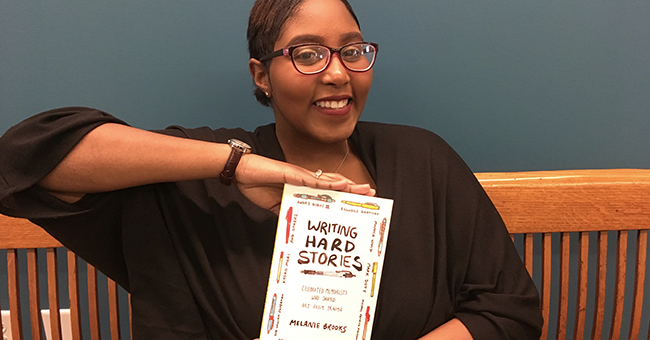
  • Kennia JosephYou’ve read our classics, such as Viktor Frankl’s Man’s Search for Meaning, Octavia Butler’s Kindred, the work of Martin Luther King, Jr., and James Baldwin’s Notes of a Native Son; and many of you know our current list, featuring books by Cornel West, Lani Guinier, Anita Hill, and Christopher Emdin—books that speak to the condition of the world, and add to our understanding of urgent social issues. Whether it’s the environment or race, cultural or class dynamics, we publish all our books with a purpose. Now you can meet the people who work at Beacon Press in our blog series “Beacon Behind the Books.” Each month, we’ll introduce to you a member of our staff and give you a behind-the-scenes look at what goes on at our office.

    For the month of March, we introduce you to Kennia Joseph, our assistant to the associate publisher! 

    What drew you to publishing, Kennia? How did you find your way to Beacon?

    Well, I vividly remember sitting on my bed my sophomore year in college trying to figure out what I wanted to do with my life, because law school didn’t seem like an amazing option at that time. I remember asking myself, “Self, what do you want to do? What do you like to do?” Insert long story about how I’m a reader/writer and I exhausted most options because I couldn’t see myself doing anything besides being around books and helping them—help in the sense that I thought books weren’t being marketing to their full potential online or in bookstores, and the industry needed help with diversity in both literature and staffing. I found Beacon after I finished my publishing program. I really just wanted a change and to work for a company whose mission I could get behind and one that would help me continue learning after graduating. 

    What are some of the challenges of being an assistant to the associate publisher? What do you find most rewarding?

    Some challenges of being the assistant to the associate publisher are that there are often many many balls in the air at once and I only have two hands. The most rewarding thing is finishing something…anything. But, it’s rewarding to able to help. I love helping people, and if at the end of the day I can do anything to make someone’s job a little bit easier, I'm rewarded. 

    What is one book on our list that has influenced your thinking on a particular issue?

    Spare the Kids, which is about spanking in the black community. It really had me thinking about social construction and how things we don’t think can affect our lives can have a huge effect on our lives.  

    What are you reading right now?

    I’m currently reading Uninvited by Lysa TerKeurst, When People are Big and God is Small by Edward T. Welch, and What if?: Serious Scientific Answers to Absurd Hypothetical Questions by Randall Munroe

    Favorite song/album/type of music?

    Naming my favorite song and type of music is way too hard, because I listen to everything. But! My favorite album would have to be The Eminem Show. My favorite song on that album would be “Till I Collapse.”


    About the Author 

    Kennia Joseph recently graduated with honors from Rutgers University, where she earned her bachelor’s degree in English. She also completed the Columbia Publishing Course in July 2016, and hopes to use her experience to continue pursuing a career in book marketing. She joined Beacon Press in 2016.

  • By Jonathan Rosenblum

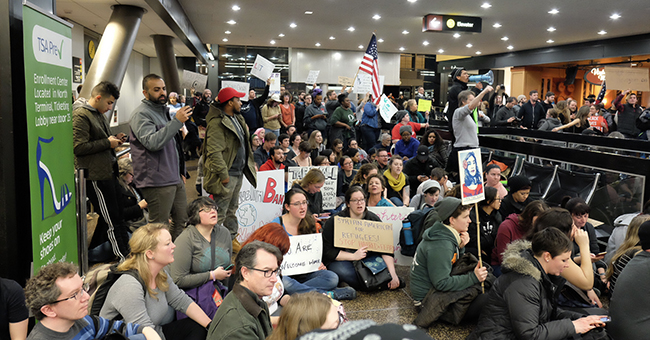
    SeaTac Airport protest against immigration ban

    SeaTac Airport protest against immigration ban. Photo credit: Dennis Bratland

    This article appeared originally in Labor Notes.

    When I first heard the good news on February 3 that U.S. District Court Judge James L. Robart had slapped a restraining order on Trump’s travel ban, I texted a labor attorney friend: “Goodness—Judge Robart! Am I obliged to like him now?”

    You see, while millions of people are applauding Judge Robart for upholding the Constitution and blocking xenophobia, some of us have had a very different experience in his Seattle courtroom.

    Back in 2012, SeaTac Airport workers were hauled before him by attorneys for Alaska Airlines and the Port of Seattle. By the time they left Robart’s court, they had been stripped of basic workplace rights.

    The eighty aircraft fuelers were part of the famous SeaTac Airport campaign, which in 2013 won the first $15 minimum wage initiative in the nation. But a year before that momentous vote, the fuelers had grown sick and tired of shoddy and abusive working conditions: leaky fuel nozzles, broken ladders, faulty brakes on 10,000-gallon fuel trucks, doors and windshield wipers that didn’t work, and in one case a transmission gearshift that was held together with duct tape.

    The fuelers testified about these appalling conditions before the airport commission and to the media. After the fueling company, ASIG, suspended the most outspoken fueler, Alex Popescu, the workers marched into their boss’s office. Flanked by local religious leaders, they announced they were ready to go on a one-day protest strike.

    Denied the Right to Strike 

    ASIG, supported by Alaska Airlines and the Port of Seattle, promptly filed for an emergency restraining order against any strike. Their lawsuit named Popescu, the workers, Working Washington—the labor coalition leading the SeaTac campaign—and me as the campaign director. The companies asked the judge to ban any fueler strike because it would “have the effect of disrupting the commercial airline operations at Sea-Tac—and throughout the country—on a massive scale.”

    Judge Robart wasted little time in issuing his restraining order, and he didn’t stop at banning strikes. Robart also barred workers from other collective action, even things they hadn’t yet considered, such as a work-to-rule campaign where workers would assiduously follow ASIG’s precise work rules and procedures.

    Robart’s ruling cast a pall over SeaTac and beyond, raising doubts about the basic rights of airport workers in the US. Thankfully, the decision didn’t stand. But it took two and a half years of legal appeals before his damage to airport workers’ rights was undone by an appellate court.

    So it’s ironic to read report after report extolling Judge Robart for his compassion, insightful jurisprudence, and respect for the legal rights of the downtrodden. Was that really what motivated him? I believe that as he read out his decision on February 3, Robart was keenly aware of the remarkable events of the prior week.

    Spontaneous Direct Action 

    Like many of you, I was not expecting the sudden flurry of social media messages on Saturday evening, January 28, the first full day after Trump’s travel ban order: “Get down to the airport for the rally.”

    Rally? Nothing had been scheduled. But as word leaked out across the country that travelers were being detained at US airports, stripped of their visas, and sent back to foreign countries, people mobilized.

    My wife and I hopped into our car and headed for SeaTac, with our daughters sketching handmade signs in the backseat. We got to the Arrivals Hall shortly after five p.m. and joined a circle of about 150 people. As people poured in from all directions, within minutes the crowd swelled to 500, then 1,000, then a few thousand. Then we stopped trying to estimate.

    Passengers merged in, towing their wheeled luggage. Seattle City Councilmember Kshama Sawant arrived and led a boisterous, chanting march through the terminal, culminating in a mass sit-down in front of the security line—in direct violation of the airport’s rules, of course.

    Congresswoman Pramila Jayapal joined the rally briefly to announce that two passengers detained at SeaTac had been given legal counsel and wouldn’t be deported. People checked their Twitter feeds and announced the spontaneous rallies at airports across the country: Denver, Philadelphia, Houston, LAX, and JFK, (where taxi workers also went on strike, shutting down traffic at the international terminal).

    What happened that day is that thousands of people dropped their plans for dinner, movie night, work, or study to mass at transportation centers in defense of people they had never met. They came out because of what was at stake—not just the status of foreign travelers, but our society’s core values. In the echoing halls of airport terminals from coast to coast, a spirit of resistance and humanity came alive.

    Combined with the fast actions of civil rights and immigration lawyers, it was these protests surging into the national news that secured the weekend release of detained travelers and set the Trump administration back on its heels.

    Disruption Moves Judges 

    Did Judge Robart watch the TV coverage of the unfolding drama at SeaTac and other airports? I suppose we’ll never know for sure. But it’s hard to imagine he was unaware.

    We’re taught that justice is blind, that judges reach their conclusions only by examining the facts presented in court. That’s rubbish. Judges are people too, with their own biases. They know their place in the power hierarchy, and they reliably side with big business over labor.

    Faced with the threat of airport fuelers creating turbulence for travelers and airlines in 2012, Robart—appointed to the bench by President George W. Bush—ruled emphatically that “the law does not permit these employees to strike.”

    But the demonstrations on January 28 were different. We didn’t just threaten disorder at the airport—we went ahead and created disorder. By stepping out in such large numbers, by sitting down in front of the security lines, by breaking laws and upsetting normal operations, we showed the White House, Congress, federal judges, and airport commissioners that we would disrupt commerce with mass civil disobedience.

    It’s easy to imagine why Judge Robart, seeing the spreading uprising, would conclude that a restraining order against the Trump travel ban was needed—not just for the sake of the Constitution, but to tamp down the insurgency and restore stability for airport businesses.

    The eighty workers who threatened to cease fueling aircraft at a single airport in 2012 were a problem that Robart could solve with the legal powers at his disposal. But he couldn’t temper the moral force of thousands of people united in disruptive actions at airports around the country.

    His decision to restrain Trump shows that civil disobedience and mass resistance still have power. That’s an important lesson as activists debate plans for work stoppages or other disruptive actions on International Women’s Day, on May Day, or beyond.

    I’m glad Judge Robart reached the right conclusion. But I’m even more grateful that outraged people across the country stopped whatever they were doing and came together in a sudden, militant mass movement. Those airport marches showed us all the kind of fight we will have to wage against Trump—and our tremendous power when we do.


    About the Author 

    Jonathan RosenblumJonathan Rosenblum has been a labor organizer for more than thirty years, playing key roles including SeaTac Airport campaign director. His writing has been featured in Tikkun, In These Times, and Yes! Magazine. His upcoming book, Beyond $15: Immigrant Workers, Faith Activists, and the Revival of the Labor Movement, will be released in March 2017. He lives in Seattle, WA. Follow him on Twitter at @jonathan4212.