• By Carole Joffe

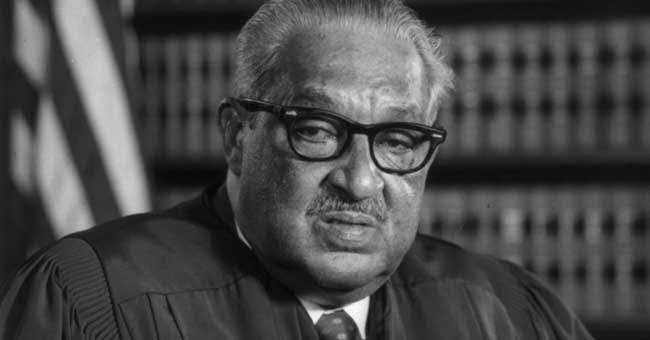
    Thurgood Marshall

    This article appeared originally on Rewire.

    Many who celebrated the success of the recent worldwide Women’s Marches—record-breaking numbers, wonderful esprit, and their peacefulness—were also gratified by the significant participation of men in the women-led events. This widely noted involvement of men in the marches prompted me to think of another important example of men supporting the aspirations of women, but one less noted today: the role of Black men in the struggle for abortion rights before Roe v. Wade legalized abortion nationwide. These men played crucial roles in key legal cases, introduced pioneering pro-choice legislation, and as doctors, made sure women could get this essential care.

    Consider the case of Thurgood Marshall, the first Black person appointed to the U.S. Supreme Court. He was a towering figure in the civil rights movement. As a lawyer for the NAACP, he successfully argued the landmark 1954 Supreme Court case Brown v. Board of Education, which outlawed school segregation in the United States, and he argued a host of other key civil rights cases throughout his career. But while celebrated for his role in civil rights law on and off the nation’s highest court, Marshall arguably has not been adequately recognized for his progressive and influential role in crafting the Roe v. Wade decision.

    As the journalist Juan Williams wrote in his 1998 biography of Marshall, the Supreme Court justice was very sympathetic to abortion rights, based on his awareness of the numerous impoverished Black women who died or who were injured at the hands of inept illegal abortion providers. Williams argues that Marshall saw legal abortion as a matter of social justice, since rich women could get around laws against abortion and obtain the procedure safely (leaving the country, if necessary) while poor women could not.

    The most interesting revelation from Williams’ account was Marshall’s role in pushing Justice Harry Blackmun, the author of the majority opinion in Roe, in a more liberal direction with respect to the permissible time frame of legal abortion. As Williams writes:

    Marshall was openly aggressive in trying to shape Blackmun’s opinion. The initial draft limited abortions to the first three months of a pregnancy. Justice [William] Brennan, however proposed that the three-month limit be replaced with a new standard—when a fetus was “viable” outside the mother’s body …. Marshall sent a memo to Blackmun in support of Brennan’s idea. “Given the difficulties which many women may have in believing that they are pregnant and in deciding to seek an abortion, I fear that the earlier date may not in practice serve the interests of these women.”

    In 1977, when the Maher v. Roe case about the constitutionality of using Medicaid to fund abortions came before the Court, Marshall again spoke on behalf of the poorest women in society—albeit unsuccessfully, as his side lost 6 to 3. In an unusually harsh dissent, Marshall wrote: “The enactments challenged here brutally coerce poor women to bear children whom society will scorn every day of their lives…I am appalled at the ethical bankruptcy of those who preach a ‘right to life’ that means, under present social policies, a bare existence in utter misery for so many poor women and their children.”

    Marshall was only one of a number of Black men to advocate for the legalization of abortion. As the sociologist Nicola Beisel has pointed out, in the years leading up to Roe, “Black politicians (nearly all of them men) introduced legislation to repeal or reform state abortion laws in New York, Illinois, Oklahoma, Michigan, Tennessee and Wisconsin. These men, acted, in part, because of the suffering illegal abortion disproportionately inflicted on Black women.”

    Indeed, the first bill in any state legislature to propose repealing a state abortion law was introduced by Lloyd Barbee, a Black legislator in Wisconsin. Similar to Justice Marshall, whose strenuous legal advocacy for abortion is largely unremarked upon, Barbee is not known today for his pioneering work on that issue but rather for his leadership in the fight to desegregate Milwaukee’s schools.

    Black doctors also played a significant role in safe abortion provision before Roe v. Wade. One of the most important of these was a Chicago physician, T.R.M. Howard, who worked with the Clergy Consultation Service network of religious leaders who referred women for safe abortions before Roe. Howard later transitioned to providing legal abortions immediately after the decision in 1973.

    That March, just months after Roe was announced, Dr. Howard appeared on the cover of Jet magazine, one of the most popular publications in Black communities. In an effort to convey the medical legitimacy of the newly legalized procedure, he was portrayed performing an abortion in a spotless clinic. As the historian and Rewire editor Cynthia Greenlee wrote, Howard was also a very active civil rights leader both in Chicago and in the South: He led efforts calling for a thorough investigation into the murder of Emmett Till, a 14-year-old Black youth who was kidnapped and murdered by a white mob in Mississippi in 1955 after false allegations of “sexual crudeness” toward a white woman (allegations only recently recanted after some sixty years).

    But today Howard is little remembered for either his civil rights activity or his abortion work. As Greenlee wrote, “Howard is one of the most significant civil rights leaders to fly under the history radar.” But in reminding us of the doctor’s legacy, she aptly argued, “Howard didn’t just belong to the civil rights movement. Like Black physicians and midwives before him, he belonged also to the abortion rights movement. In his inimitable and controversial way, Howard pointed out in Jet that abortion could be safe, legal, and even convenient.”

    As I have noted in my own work on abortion provision before legalization, Detroit’s Edgar Keemer was another Black doctor who was very active as an abortion provider in the pre-Roe era. He was also a prominent member of the socialist and civil rights movements of his day, and was outspoken about the higher death and injury rates that Black women suffered from incompetently performed illegal abortions. Keemer was convicted and jailed for a brief period in the 1950s for performing an illegal abortion, but after his release he continued this activity, and like Dr. Howard, worked closely with the Clergy Consultation Service.

    None of the men in this piece ever used the term “intersectionality,” a term coined years after the events mentioned here. Yet each man demonstrated by his actions that he had a visceral sense of the connection between the situations of the most vulnerable women in the United States and the need for reproductive justice—another term created after their work, but, clearly, one that they intuitively understood. 


    About the Author 

    Carole JoffeCarole Joffe is a professor in the Advancing New Standards in Reproductive Health (ANSIRH) Department of Obstetrics, Gynecology & Reproductive Sciences at the University of California-San Francisco and a professor emerita of sociology at the University of California-Davis. She is the author of several other books, including Doctors of Conscience and Dispatches from the Abortion Wars. Follow her on Twitter at @carolejoffe.

  • Coretta Scott King

    Photo credit: The White House

    We at Beacon Press would like to thank Senator Elizabeth Warren for quoting Coretta Scott King’s statement during the debate on Jefferson Sessions for attorney general. King’s full 1986 statement about Sessions follows below.

    ***

    Thursday, March 13, 1986

    Mr. Chairman and Members of the Committee:

    Thank you for allowing me this opportunity to express my strong opposition to the nomination of Jefferson Sessions for federal district judgeship for the Southern District of Alabama. My longstanding commitment which I shared with my husband, Martin, to protect and enhance the rights of Black Americans, rights which include equal access to the democratic process, compels me to testify today.

    Civil rights leaders, including my husband and Albert Turner, have fought long and hard to achieve free and unfettered access to the ballot box. Mr. Sessions has used-the awesome power of his office to chill the free exercise of the vote by black citizens in the district he now seeks to serve as a federal judge. This simply cannot be allowed to happen. Mr. Sessions’ conduct as U.S. Attorney, from his politically-motivated voting fraud prosecutions to his indifference toward criminal violations of civil rights laws, indicates that he lacks the temperament, fairness and judgment to be a federal judge.

    The Voting Rights Act was, and still is, vitally important to the future of democracy in the United States. I was privileged to join Martin and many others during the Selma to Montgomery march for voting rights in 1965. Martin was particularly impressed by the determination to get the franchise of blacks in Selma and neighboring Perry County. As he wrote, “Certainly no community in the history of the Negro struggle has responded with the enthusiasm of Selma and her neighboring town of Marion. Where Birmingham depended largely upon students and unemployed adults [to participate in non-violent protest of the denial of the franchise], Selma has involved fully 10 per cent of the Negro population in active demonstrations, and at least half the Negro population of Marion was arrested on one day.” Martin was referring of course to a group that included the defendants recently prosecuted for assisting elderly and illiterate blacks to exercise that franchise. In fact, Martin anticipated from the depth of their commitment twenty years ago, that a united political organization would remain in Perry County long after the other marchers had left. This organization, the Perry County Civic League, started by Mr. Turner, Mr. Hogue, and others, as Martin predicted, continued “to direct the drive for votes and other rights.” In the years since the Voting Rights Act was passed, Black Americans in Marion, Selma and elsewhere have made important strides in their struggle to participate actively in the electoral process. The number of Blacks registered to vote in key Southern states has doubled since 1965. This would not have been possible without the Voting Rights Act.

    However, Blacks still fall far short of having equal participation in the electoral process. Particularly in the South, efforts continue to be made to deny Blacks access to the polls, even where Blacks constitute the majority of the voters. It has been a long up-hill struggle to keep alive the vital legislation that protects the most fundamental right to vote. A person who has exhibited so much hostility to the enforcement of those laws, and thus, to the exercise of those rights by Black people should not be elevated to the federal bench.

    The irony of Mr. Sessions’ nomination is that, if confirmed, he will be given life tenure for doing with a federal prosecution what the local sheriffs accomplished twenty years ago with clubs and cattle prods. Twenty years ago, when we marched from Selma to Montgomery, the fear of voting was real, as the broken bones and bloody heads in Selma and Marion bore witness. As my husband wrote at the time, “it was net just a sick imagination that conjured up the vision of a public official, sworn to uphold the law, who forced an inhuman march upon hundreds of Negro children; who ordered the Rev. James Bevel to be chained to his sickbed; who clubbed a Negro woman registrant, and who callously inflicted repeated brutalities and indignities upon nonviolent Negroes peacefully petitioning for their constitutional right to vote.”

    Free exercise of voting rights is so fundamental to American democracy that we can not tolerate any form of infringement of those rights. Of all the groups who have been disenfranchised in our nation’s history, none has struggled longer or suffered more in the attempt to win the vote than Black citizens. No group has had access to the ballot box denied so persistently and intently. Over the past century, a broad array of schemes have been used in attempts to block the Black vote. The range of techniques developed with the purpose of repressing black voting rights run the gamut from the-straightforward application of brutality against black citizens who tried to vote to such legalized frauds as “grandfather clause” exclusions and rigged literacy tests.

    The actions taken by Mr. Sessions in regard to the 1984 voting fraud prosecutions represent just one more technique used to intimidate Black voters and thus deny them this most precious franchise. The investigations into the absentee voting process were conducted only in the Black Belt counties where blacks had finally achieved political power in the local government. Whites had been using the absentee process to their advantage for years, without incident. Then, when Blacks, realizing its strength, began to use it with success, criminal investigations were begun.

    In these investigations, Mr. Sessions, as U.S. Attorney, exhibited an eagerness to bring to trial and convict three leaders of the Perry County Civic League including Albert Turner despite evidence clearly demonstrating their innocence of any wrongdoing. Furthermore, in initiating the case, Mr. Sessions ignored allegations of similar behavior by whites, choosing instead to chill the exercise of the franchise by blacks by his misguided investigation. In fact, Mr. Sessions sought to punish older black civil rights activists, advisers and colleagues of my husband, who had been key figures in the civil rights movement in the 1960’s. These were persons who, realizing the potential of the absentee vote among Blacks, had learned to use the process within the bounds of legality and had taught others to do the same. The only sin they committed was being too successful in gaining votes.

    The scope and character of the investigations conducted by Mr. Sessions also warrant grave concern. Witnesses were selectively chosen in accordance with the favorability of their testimony to the government’s case. Also, the prosecution illegally withheld from the defense critical statements made by witnesses. Witnesses who did testify were pressured and intimidated into submitting the “correct” testimony. Many elderly blacks were visited multiple times by the FBI who then hauled them over 180 miles by bus to a grand jury in Mobile when they could more easily have testified at a grand jury twenty miles away in Selma. These voters, and others, have announced they are now never going to vote again.

    I urge you to consider carefully Mr. Sessions’ conduct in these matters. Such a review, I believe, raises serious questions about his commitment to the protection of the voting rights of all American citizens and consequently his fair and unbiased judgment regarding this fundamental right. When the circumstances and facts surrounding the indictments of Al Turner, his wife, Evelyn, and Spencer Hogue are analyzed, it becomes clear that the motivation was political, and the result frightening—the wide-scale chill of the exercise of the ballot for blacks, who suffered so much to receive that right in the first place. Therefore, it is my strongly-held view that the appointment of Jefferson Sessions to the federal bench would irreparably damage the work of my husband, Al Turner, and countless others who risked their lives and freedom over the past twenty years to ensure equal participation in our democratic system.

    The exercise of the franchise is an essential means by which our citizens ensure that those who are governing will be responsible. My husband called it the number one civil right. The denial of access to the ballot box ultimately results in the denial of other fundamental rights. For, it is only when the poor and disadvantaged are empowered that they are able to participate actively in the solutions to their own problems.

    We still have a long way to go before we can say that minorities no longer need be concerned about discrimination at the polls. Blacks, Hispanics, Native Americans and Asian Americans are grossly underrepresented at every level of government in America. If we are going to make our timeless dream of justice through democracy a reality, we must take every possible step to ensure that the spirit and intent of the Voting Rights Act of 1965 and the Fifteenth Amendment of the Constitution is honored.

    The federal courts hold a unique position in our constitutional system, ensuring that minorities and other citizens without political power have a forum in which to vindicate their rights. Because of this unique role, it is essential that the people selected to be federal judges respect the basic tenets of our legal system: respect for individual rights and a commitment to equal justice for all. The integrity of the Courts, and thus the rights they protect, can only be maintained if citizens feel confident that those selected as federal judges will be able to judge with fairness others holding differing views.

    I do not believe Jefferson Sessions possesses the requisite judgment, competence, and sensitivity to the rights guaranteed by the federal civil rights laws to qualify for appointment to the federal district court. Based on his record, I believe his confirmation would have a devastating effect on not only the judicial system in Alabama, but also on the progress we have made everywhere toward fulfilling my husband's dream that he envisioned over twenty years ago. I therefore urge the Senate Judiciary Committee to deny his confirmation.

    I thank you for allowing me to share my views.

  • By Lynn Hall

    Mt. Aconcagua

    Photo credits: Lynn Hall

    Last fall, when my friend and long-time mountaineering partner asked if I would join him for an attempt on Mt. Aconcagua in Argentina, I thought he was nuts. I immediately dismissed the idea. Summiting Mt. Aconcagua seemed like an impossible goal, and for me, maybe even a foolish one.

    At 22,841 feet, Aconcagua is one of the Seven Summits, the highest peak in both the southern and western hemispheres. It’s a simple climb, technically speaking, but the high altitude often causes climbers—even experienced climbers—to develop high-altitude pulmonary edema or high-altitude cerebral edema, both life-threatening conditions. I have a chronic daily headache syndrome with migraines, so for me to spend two weeks above 14,000 feet in pursuit of climbing to nearly 23,000 feet would be risking the altitude and exacerbating the pain to an extreme level I possibly hadn’t ever before reached.

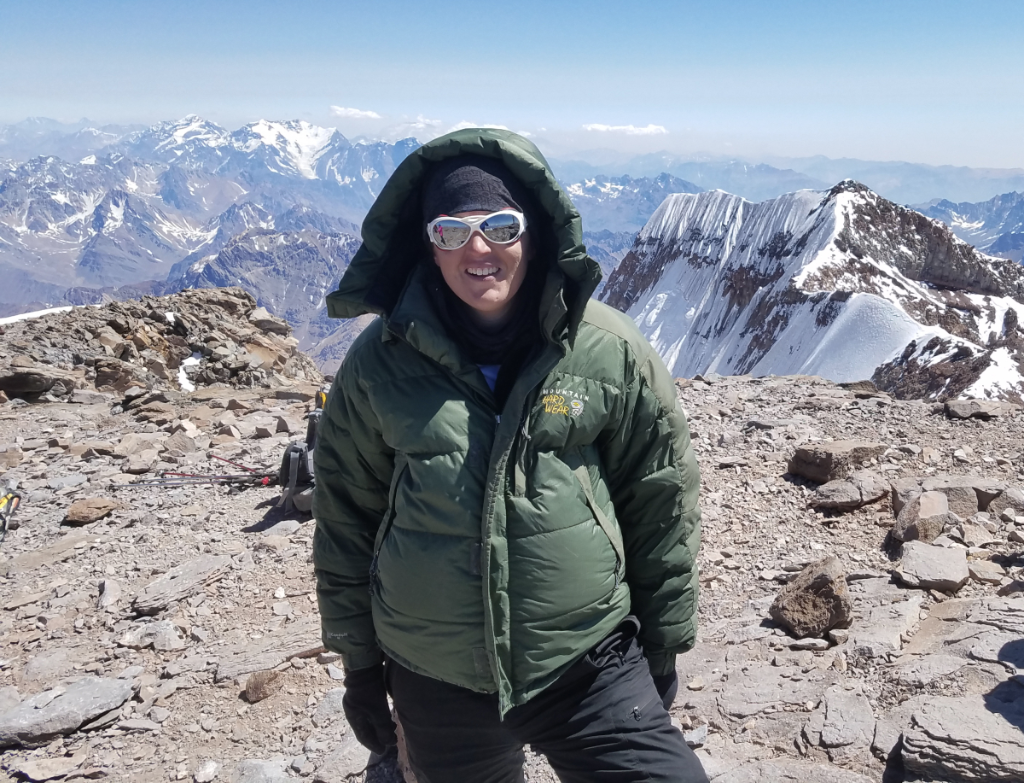
    Lynn Hall and MattYet, I wanted to go with Matt. Badly. One of my favorite quotes is one by T.S. Eliot: “Only those who risk going too far can possibly find out how far one can go.” I live by that ethos, and my longing to climb the highest peak in the Americas just might be worth the risk.

    Climbing Mt. Aconcagua wasn’t the only event looming on the horizon which made me wonder if I was pushing too far. When I decided to go on the trip to South America, I was only three months away from my memoir’s on-sale date. At the time, facing publication felt even more perilous to me than extreme altitude.

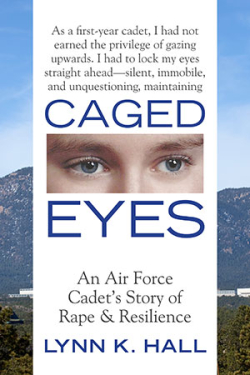
    Besides the obvious vulnerability created by publishing Caged Eyes: An Air Force Cadet’s Story of Rape and Resilience—the exposure in making so many aspects of private life public, in becoming the first person to write a traditionally published memoir about rape within the military, and in criticizing one of America’s beloved institutions—this act was testing for me because it challenged everything I was taught for the first twenty years of my life. To publish Caged Eyes was to shatter two decades of messaging which programmed me into silence.

    As a child, I was an emotional caretaker for my mother. I managed her feelings and hid my own. My role was to bury any injury or illness, hurt or sadness, so that my pain wouldn’t exacerbate hers. Life was far easier that way—for both of us. As an Air Force Academy cadet, the messaging deepened. The advice book to future cadets quoted an upperclassmen’s warning: “Just take whatever comes your way and shut up about it.” I may not have been able to do any pull-ups initially, and I didn’t excel at push-ups or rifle runs. But shutting up and taking it? That I could do. That was no problem.

    I come from two disparate worlds which mirror each other in this one aspect: bad things happen when you express your truth. If you are a child and you cry, your mother spirals into sobs, sometimes even suicidal ones. If you are a cadet and you report a rape, you are punished for fraternization, sometimes even expelled.

    Cognitively, I’m ready to give that messaging the ultimate shove. But unconsciously, the expectation to remain silent lingers deep within me.

    Caged EyesSix months ago, Beacon Press mailed the Caged Eyes galleys to me. Holding the book in my hands filled me with the full range of feelings. Excitement that the book was finally forthcoming. Gratitude for my editor, Gayatri Patnaik, and all of Beacon. Pride that I had accomplished my dreams. And then fear. Panic. Terror even. Staring into my seventeen-year-old eyes on the cover drew me back into that world and into my younger self’s mindset. There were moments in those first several weeks after receiving the galley during which I would look at my own eyes on the cover, and earnestly wonder what the hell I was doing. I’d think I was doing an impossible thing. A foolish thing. Maybe even a wrong thing?

    The incongruence between the expectation to remain silent and the publication of my memoir often made me feel physically ill. Somatically, I felt this stress most sharply. I was dizzy and nauseous, and my heart would race for no reason. It was almost like my thirty-three-year-old self and my seventeen-year-old self were in a tug-of-war inside my chest. The battle within paralyzed me.

    I’d remember T.S. Eliot’s quote, and think, “That’s it. I finally pushed too far. I broke myself.” I sincerely wondered if I made a mistake by taking on this book. I questioned if I could handle the memoir’s release, if I was pushing myself too far and would cross some line into territory that would destroy me.

    Maybe that’s why I said “yes” to my friend. It wasn’t just the thrilling pull of high altitude; it was because I had internal work to do if I were to survive the coming months.

    Spoiler alert: I summited Mt. Aconcagua. The climb didn’t destroy me. Not even close.

    We made smart decisions, taking plenty of rest days as we moved up and down the mountain to help our bodies acclimatize. Miraculously, only two days of the eleven we spent above 14,000 caused my headache to become much worse than usual.

    On summit day, I took eleven hours to reach the top from our high camp. Each time I grew dizzy without oxygen, I’d slow my pace. I’d take one step, breathe, another. As a joke, I’d mentally congratulate each leg for each step: “Good job left leg!” “Good job right leg!” And then I’d laugh at myself. That went on for hours. It was completely silly, but it worked for me. The mantra kept me positive, and helped me to celebrate each tiny foot-long accomplishment. It was a way for me to prevent my mind from focusing on what hurt or what felt weak. I didn’t leave myself room for self-doubt. There wasn’t a single moment in those eleven hours during which I questioned the outcome. I knew I would summit.

    During my ascent of Mt. Aconcagua, I recognized and celebrated my strength—both physical and mental. The climb redefined what is possible for me.

    Lynn Hall Mt. AconcaguaThe accomplishment of climbing one of the Seven Summits changed my entire psyche going into the publication of Caged Eyes. During the three weeks between summiting and book publication, my outlook has been very different. There have been a few harder days of panic and somatic upheaval, but overall I’m much more focused on my successes and the journey which brought me to this destination. I’m much more focused on my original intention of the book: dismantling cultures of shame and silence.

    Now when I look at the eyes on the cover, I remember the inner strength of that seventeen-year-old girl. She might not have known it was there, and she may not have known she had the capacity to shatter her silence, but I do.

    Today is my publication day, and I no longer think my memoir will destroy me. Somehow, a climb of South America’s tallest peak made all the difference, as now I model what I practice on summit day. I celebrate each small step of strength, and I’m not giving myself space for self-doubt. Rather than cowering in fear and shame, I have the opportunity today to stand in the light of my accomplishment and the hope that Caged Eyes will create pathways for others to break their silences as well.


    About the Author 

    Lynn HallLynn Hall is a memoirist, essayist, and activist in the movement to end sexual violence. She is also a mountaineer who has summited each of Colorado’s 14,000-foot-tall peaks and a runner who has completed a 100-mile ultramarathon. She lives in Boulder. Follow her on Twitter at @LynnKHall and visit her website.

  • By Sharon Leslie Morgan

    Black History Month 2017
    When Dr. Carter G. Woodson created “National Negro Week” in February, 1926, my oldest uncle was a newly conceived embryo. Louis Nicholson would emerge into the world in October of that year, born into a society in which African Americans were a mere six decades into freedom from 264 years of enslavement. “Jim Crow” was the law of the land. Black people were being segregated, terrorized, and lynched—even in his hometown of Chicago.

    Louis B. Nicholas Jr.

    Louis B. Nicholas, Jr. (1926-1997)

    Woodson chose February as the celebration date for “Negro History Week” because it coincided with the birthdays of abolitionist Frederick Douglass and “The Great Emancipator” Abraham Lincoln. In 1858, Lincoln delivered a speech in Chicago that said: “Let us discard all this quibbling about this man and the other man—this race and that race and the other race being inferior, and therefore they must be placed in an inferior position…Let us discard all these things, and unite as one people throughout this land, until we shall once more stand up declaring that all men are created equal.”

    In 1972, Dr. Woodson’s child was renamed “Black History Week.” In 1976, it grew to adolescence as “Black History Month.” That was the year Uncle Louis was the father of six who were adults like me. I was the twenty-five-year-old mother of a seven year old child of my own.

    My Uncle Louie once told me that “History is HIS-story” because the victor writes the books. That could not be more evident as we witness America collapsing under the weight of ignorance and fear—fueled by a “book” of Twitter rants.

    We are living in perilous times, indeed, but must remember that WE write history every day. ALL of us. Let’s stop allowing the victor to control the narrative with HIS-story and start writing something new. Let’s write a story that emerges from hearts and minds unwilling to let the evils of the past be the bane of the future.

    In Douglass’ words: “A battle lost or won is easily described, understood, and appreciated, but the moral growth of a great nation requires reflection, as well as observation, to appreciate it.”

    This year, my family will commemorate the twentieth anniversary of Uncle Louis’ passing. I am now the grandmother of two who have no concept (yet) of the history I inherited. It is for them that I am on a quest to build a new narrative in which they are included, not just during one month of the year, but every day of their lives.

    The story I would like to write is one where people are not “colorblind” but “color conscious”—seeing EVERYONE for the beauty and value they represent. One where ALL members of society are respected and treated as EQUAL, with “inalienable rights” as championed by the US Constitution.

    I am proud to see people marching in the streets TODAY to make that history possible. 


    About the Author 

    Sharon Leslie Morgan is a nationally recognized pioneer in multicultural marketing, a founder of the National Black Public Relations Society, and co-author of Gather at the Table: The Healing Journey of a Daughter of Slavery and a Son of the Slave Trade. An avid genealogist, she blogs extensively, leads workshops on African American family history, and is the webmaster for OurBlackAncestry.com.

  • Alyssa HassanYou’ve read our classics, such as Viktor Frankl’s Man’s Search for Meaning, Octavia Butler’s Kindred, the work of Martin Luther King, Jr., and James Baldwin’s Notes of a Native Son; and many of you know our current list, featuring books by Cornel West, Lani Guinier, Anita Hill, and Christopher Emdin—books that speak to the condition of the world, and add to our understanding of urgent social issues. Whether it’s the environment or race, cultural or class dynamics, we publish all our books with a purpose. Now you can meet the people who work at Beacon Press in our blog series “Beacon Behind the Books.” Each month, we’ll introduce to you a member of our staff and give you a behind-the-scenes look at what goes on at our office.

    For the month of February, we introduce you to Alyssa Hassan, our senior marketing manager! 

    What drew you into publishing, Alyssa?

    Oh, you know, I followed the usual path; I was pre-vet in college, decided that wasn’t my dream after all, moved toward studying natural resources and the environment, got an internship at an environmental nonprofit in DC doing legislative affairs, made my way into urban and environmental studies with a focus on nonprofits in grad school, and then—thanks to a good friend who was an editor there—found myself working at South End Press when they needed someone to help on the marketing side. So, I never thought of a life in publishing for myself until it happened. My desire to keep working in nonprofits, have a role in lifting up important voices speaking on issues I care about, and my experiences growing up are the kinds of things that guided me to where I am today.

    So, all of this is to say: you don’t have to be an English major to get into publishing!

    As a longtime member of the Beacon publishing team, what has changed and what has stayed the same?

    I’ve been in publishing since about 2000, so a lot has changed! At that point, company websites were just becoming the norm, but direct sales on those sites and content management systems definitely weren’t. Remember a time when social media didn’t exist? I do. We’re much more connected to readers than ever before. I spend a lot of my time working online, so these are some of the things that really stand out for me. There’s so much that has stayed the same, too, but one thing that really sticks out right now is that people continue to turn to books to fulfill basic needs, like finding comfort and solace in others’ experiences. Or to understand a different point of view or find ways to move forward in a difficult time. I worked in publishing in the post-9/11 world, and now we’re in the Trump era, and books continue to matter.

    What are you reading right now?

    • The Gunslinger, book one of Stephen King’s Dark Tower series. I grew up reading a lot of horror/supernatural authors, including Stephen King, and in recent years, have come back to these books again, especially King. With the movie coming out this year, I wanted to make sure I read the series before I saw it.
    • Writing Hard Stories by Melanie Brooks. It's one of our new February releases, and if you are a writer or have dreams of being a writer, this book is a must-read. I think people who are struggling through complex feelings and need an outlet for getting them out would find Melanie’s book helpful, too. I’ve read so many of the authors she profiles in the book, so it was great to get the inside story of their writing process.
    • Toddler 411. I can’t get through a whole parenting book, but when I think something like, “it’s probably wrong for me to keep feeding my son a snack at midnight after he wakes up crying just because it gets him to settle back down quickly, isn’t it?” I grab this book and get a few tips on what I really should be doing.

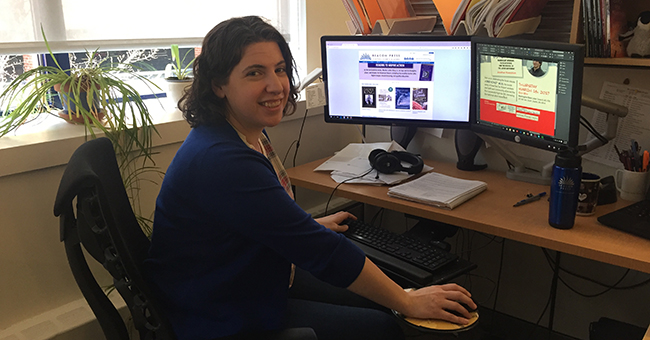
    Alyssa Hassan's deskName three non-office items on your desk and their significance to you.

    • My Supernatural bobble-head dolls. See above about my horror/supernatural genre love. It extends to television and movies too! My home and workspace is filled with pop culture gifts from my husband. Do I need flowers? No. A Supernatural coloring book? YES. I’m Team Dean Winchester by the way.
    • A picture of two chimpanzees crossing a road. Nancy Merrick, author of Among Chimpanzees, brought in different pictures of chimps she’s observed in her work for some of the staff. She is a former student and colleague of Jane Goodall and works on conservation efforts to protect them. When I look at the picture, it helps remind me why I work here.
    • Many pictures of my son, who’s now two and a half. When I returned to work after maternity leave, I thought I’d never get through the day without looking at his face. Then I realized I can just go to my Facebook photo album. So, I haven’t updated the pictures lately, but they make my space feel homey!

    How has work changed for you since you became a mother?

    I’ve been really lucky to have a supportive work environment where I don’t have to stick to a nine-to-five work schedule every day, and I can work at home a couple days per week. It gives me the ability to juggle crazy daycare schedules with my husband, spend a little extra time with my son on days I’m home because I don’t have the two-to-three hours total/day commute (and I live just outside of Boston with this commute!), and sometimes even get some chores done around the house. Pre-child, I didn’t think anything of getting in early and staying late when I was really busy. That’s not so much of an option anymore, because I want to spend time with my family, so if I need some extra time to get work done, those hours before my son wakes up and after he goes to bed have become productive times for me. It’s also helped prioritize my work, and I think I’m finally starting to realize I just can’t do everything anymore. By the time he graduates high school, I’m sure I’ll have this whole working parent thing figured out.

    What upcoming projects are you excited about?

    Haroon Moghul’s How to Be a Muslim. Given today’s climate, Haroon’s perspective is really necessary. But, I also tend to gravitate toward books like this, because my grandfather is from Palestine and was Muslim. I don’t know much about the Muslim side of my family, and stories like these help me feel like I am learning something about a part of where I come from.

    What was the last song you listened to?

    “Thirteen,” by this ’90s Boston-area indie rock band, Lump. I basically have them on non-stop rotation every single day. And I’m not just saying that because my husband was the bass player and wrote that song.

    But really, the last song I played before I walked into the office this morning was Dear Leader’s “Nightmare Alleys.” I listen to it a lot right now. Aaron Perrino sings the hell out of that song. It’s ten years old and feels so timely again with the new administration and all the fear and anger and anxiety and desperation and the need to respond somehow to all of that.

    Favorite sports team?

    The Celtics. (My husband is only making me say that a little.)  I’m from upstate New York. My teams were the Yankees and the Giants.

    My husband is from central Massachusetts, so he’s all about the Celtics, Red Sox, Patriots, Revolution, and every other Boston-area team. I guess you could say I converted to these teams too. And our son will be raised a New England sports fan.

    When we go back to my hometown, we’ll pick up gear for our local minor league baseball team, which has recently changed its name from the Binghamton Mets to the Binghamton Rumble Ponies (I come from the carousel capital of the world!), and we’ll still proudly wear that. So, I didn’t give up all NY sports!

    Favorite food?

    The chocolate chunk cookies from Cookie Monstah. Favorite chocolate chip cookie ever. I buy them sometimes and don’t tell my husband because I don’t want to share. I don’t share them with my son either. They’re that delicious.

    What is one thing people don’t know about you?

    I hated my middle name so much growing up, I lied to our priest when we were preparing for First Holy Communion (I went to a Russian Orthodox Christian church) and told him my middle name was Renée. I liked it better and I figured since it started with an R, like my actual middle name, it wasn’t such a bad lie. At my first confession, I told the truth. In junior high, classmates found out about my middle name—and turns out it’s not such an awesome-sounding name to other kids either. It became kind of a nickname, and that is why in my senior high school yearbook, my nickname is listed as Rosemary. I don’t mind it so much anymore, but I look at myself and still don’t feel like much of a Rosemary.

    What’s your advice to someone interested in entering the publishing field?

    If you’re interested in a career in publishing, use your school’s alumni community to find people in the industry who may be willing to do an informational interview with you. Apply for internships to explore all the options publishing has to offer. Look for opportunities at bookstores, libraries, literary agencies, and other book-related organizations too.

    As someone who has done a lot of hiring in my 10+ years at Beacon, I have so much advice to offer to young people applying for jobs or internships. I could do a whole Q&A just on that! But here are three things:

    1) Do your homework on the company you want to work for and make sure that reflects in your cover letter and in your interview.

    2) Come prepared with questions to ask. I never like hearing, “No, I think you’ve already answered all my questions.” Ask about work culture, how they got into publishing, what a typical day is like, how new staff adjust to work life, anything. Just come with some questions!

    3) I can’t emphasize this one enough—proofread your cover letter and resumé then have someone else do it too!


    About the Author 

    Alyssa Hassan joined Beacon Press in 2006 after five years at South End Press. She has also worked with Z Magazine, Dollars and Sense, and other progressive non-profit organizations. She is a graduate of Cornell University. Follow her on Twitter at @alyssahassan.

  • By Nicholas DiSabatino

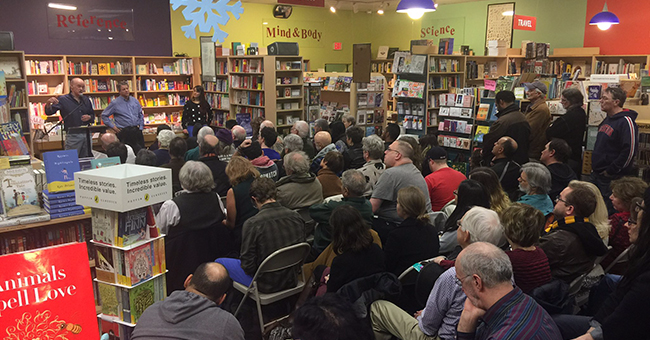
    Steve Early speaks at Porter Square Books

    Steve Early speaks at Porter Square Books, Cambridge, MA.

    “Is there anybody out here tonight still feeling the Bern?” 

    Labor journalist Steve Early called out this question to a group of over eighty-five people at his Porter Square Books event in Cambridge, Massachusetts, on the evening of January 25, coyly referring to the foreword from Senator Bernie Sanders for his new book, Refinery Town: Big Oil, Big Money, and the Remaking of an American City.

    In the book, Early explores how Richmond, California—once a prototypical company town with one of the highest homicide rates per capita in the country—transformed itself over a decade into a progressive city through the power of local municipal reform. He documents how a largely non-white working class community of 110,000 people spawned a vibrant culture of resistance to corporate power after more than a century of political dominance by the Chevron Corporation.

    Refinery TownIn his foreword, Senator Bernie Sanders writes, “Our country obviously needs a great deal of change at the state and federal levels. But laying a solid local foundation, like activists in Richmond, California have done, is an important first step toward overcoming working-class alienation from politics and resulting low voter-turnout rates. Refinery Town is based on one city’s experience, but it reflects the lessons of grassroots organizing elsewhere.”

    Crowds came from Boston, Cambridge, Somerville, Milton, and Chelsea, Massachusetts. The following groups co-sponsored (and many members attended) the event, including: Massachusetts Jobs with Justice, Labor Notes, Solidarity, Socialist Alternative, CWA Local 1400,  IBEW Local 2222, and Greenroots, a youth-run Chelsea environmental organizer task force devoted to protecting the community from local industrial hazards. Union organizer and labor communicator Rand Wilson helped moderate the event. There was even a surprise appearance from Democratic Representative Mike Connolly of the 26th Middlesex district.

    Throughout the talk and Q&A with the audience, Early discussed what we can all do on the local level to combat the Trump presidency, and used Richmond, California and the Richmond Progressive Alliance as an example of how progressive politics at the municipal level can make real change.

    Early’s event resulted in an inspiring call-to-action for all involved.


    About the Author 

    Nicholas DiSabatino graduated from Kent State University and has an MA in Publishing and Writing from Emerson College. He joined Beacon in 2012. Follow him on Twitter at @NDiSabat.

  • By Enrico Gnaulati

    Talk therapy

    Photo credit: Bliusa

    With Trump’s ascendancy to the White House, I have become inundated with clients using therapy time to process their shock, disbelief, dismay, and outrage. I live and practice in perhaps the bluest of the blue states, California. Many of my clients are liberally-minded writers, artists, college students, professors, and movie-industry folks who typically are drawn to therapy as a cherished space to address questions of personal meaning, value, and purpose in their lives. In the consulting room, they prefer to keep the focus on their personal lives and refrain from discussing politics. However, given Trump’s personae and policies, “the political” has truly become “the personal” for many of my clients, and therapy a place to confront the emotional effects of his rise to power, as well as realize the need to get more politically involved.

    In the days after the election, several clients presented with the type of shock clinicians generally associate with trauma—numbness, disbelief, obsessional reliving and retelling of events as if to retrospectively convince themselves that what was completely unlikely, was indeed possible: “Why did I not see this coming?” One general definition of trauma is the sudden, unexpected onset of a disturbing event where a person is psychologically unprepared for its occurrence. Based on this definition, Trump’s election was quasi-traumatic for those clients who wrote him off as unelectable for all the usual reasons: his “shoot-first-ask-questions-later” rhetorical style; questionable business dealings and refusal to release his tax returns; pandering to right-wing causes; and crude, dismissive treatment of women, immigrants, and the press—to name but a few. Being able to use therapy time just to acknowledge their disbelief and express anger, sadness, and confusion seemed valuable just to de-numb themselves and absorb the reality that the unbelievable had just occurred. If Trump was still not going to be their president, at least they could grasp the basic reality that he was going to be the president!

    Knowing the political twinship between myself and these clients was palpable, I offered some of my own formulations as to why I also was traumatized by Trump’s election: “Perhaps you are feeling like I am, that your value system just got assaulted and you are in shock. When so many of the hard-won virtues and values that make up your identity are derided and dismissed by none other than the President of the United States, I think it’s normal to feel deeply bewildered.”

    As the weeks leading up to the inauguration wore on, many clients confessed to me that they constantly checked the news  to see what new controversy had erupted based on Trump’s Tweets. There was embarrassment admitting to finding it all comical and entertaining. There was the new wave of astonishment and outrage realizing that the pre-election Trump, true to style, was the selfsame post-election Trump. There was irritation that their obsessional interest in news bites was becoming a giant distraction at work and unwittingly playing into Trump’s perceived insatiable appetite for attention.

    For some clients there was a new-found urgency to use therapy to speed up the attainment of a goal based on the implications of a Trump presidency. One young couple seeing me to address the boyfriend’s slowness to propose marriage (even though there was every indication that marriage was in the cards) had a rude awakening the day after the election. As an Iranian national in fear of deportation, the boyfriend softened his position overnight and no longer used therapy to address his resistance to marrying his American girlfriend, but to think aloud about how best to plan the quickest marriage!

    For other clients, appreciating the absurdity of it all—a businessman/TV personality with no background in politics, brazenly bragging about sexually grabbing women, Tweeting on trivial matters, becoming the next President—allowed them to avoid paralyzing disillusionment and cynicism.

    By far, the greatest concern about the Trump presidency voiced by my clients involves parents who worry that indecency is the new norm in our culture. These are parents who devote themselves to raising children to speak respectfully of others, refrain from lazy use of profanity, and act and speak thoughtfully and tolerantly. These parents fear that, given Trump’s track record of mocking the disabled, sexualizing women, being vain, self-referential, and boastfully materialistic, the general public might find these inexcusable attitudes and behavior somehow excusable. If the President of the United States can mock a disabled person, make lewd comments about women, speak disparagingly about dissenting journalists, and the like, doesn’t this work in the direction of normalizing shameful behavior? Concerned parents worry that their job of raising decent, sensitive, inclusive-minded children just got a lot tougher under a Trump presidency. Therapy has become an important venue for such parents to remain strong in the face of new cultural pressure giving license to boorish, arrogant, provocative, dogmatic attitudes and behavior.   

    My parent clients seem to benefit from the viewpoint that maybe their kids need to be reminded of the difference between true and false confidence. A truly confident person is not unduly reliant on outside praise and recognition to feel self-assured; acknowledges and learns from mistakes; is not threatened by periods of self-doubt; tolerates, if not invites, dissent; is not inclined to conspicuously act superior to others; does not need to surround him or herself with material signs of success; refrains from over celebrating a victory. Trump’s overreliance on outside admiration to maintain his sense of self-importance; quickness to shame and blame others when his plans and projects run into trouble; seeming fullness of conviction and lack of self-doubt; and need to surround himself with material signs of success, all smack of false confidence. Knowing that Trump seems to embody false confidence might just be the disincentive kids need to act like him.


    About the Author 

    Enrico Gnaulati Ph.D. is a clinical psychologist based in Pasadena, California. His work has been featured on Al Jazeera America, KPCC Los Angeles, KPFA Berkeley, and online at the Atlantic and Salon. He is a nationally-recognized critic of mental health practice and policy and the author of Back to Normal: Why Ordinary Childhood Behavior is Mistaken for ADHD, Bipolar Disorder, and Autism Spectrum Disorder. His new book, Saving Talk Therapy: How Health Insurers, Big Pharma and Slanted Science are Ruining Good Mental Health Care, will be released by Beacon Press in January, 2018. Visit his website.

  • By Louis Roe

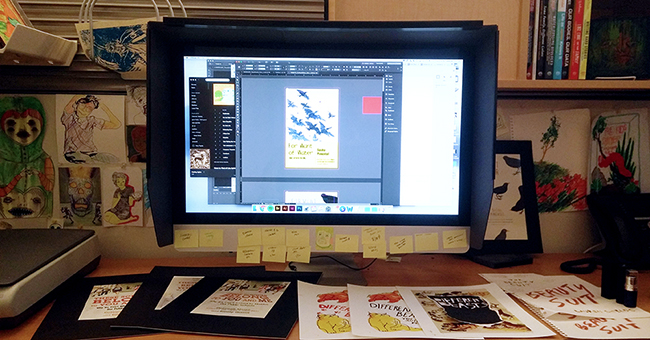
    Louis Roe desktop

    Photo and image credits: Louis Roe

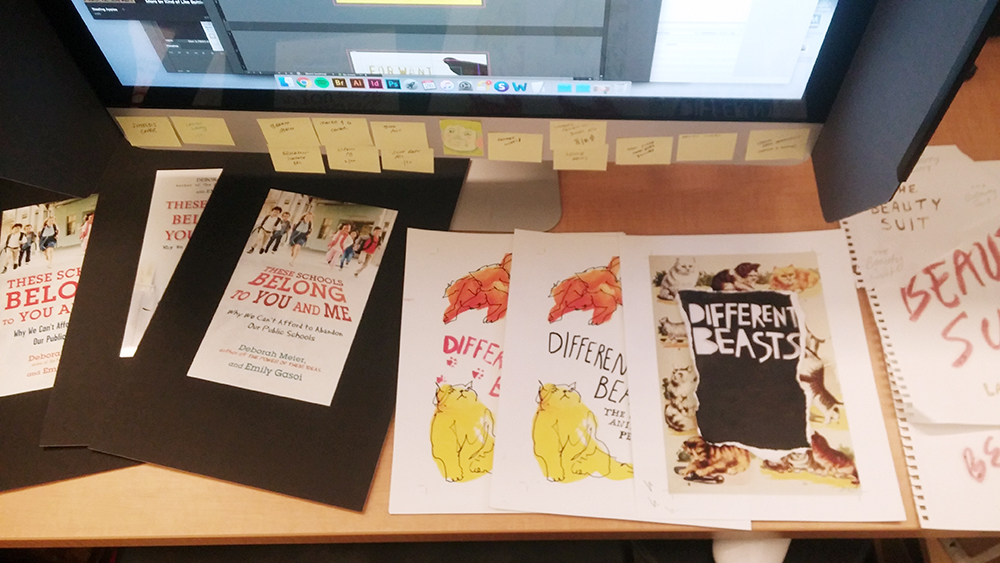
    Bookbuilder’s New England Book Show, an annual juried event celebrating book design and production, is just around the corner. Now seems an appropriate time to peek out from behind the curtain! I’ve been Beacon’s Assistant Designer for a little over a year, and in that time, Art Director Bob Kosturko and I have been working hard to create thoughtful, attractive packages for our 2016 and 2017 titles. Here are a few that I’ve particularly enjoyed working on.

    Berube comps

    Life as Jamie Knows It by Michael Bérubé 

    Life as Jamie Knows It is one of the first covers I designed for Beacon, and still one of the covers I’ve presented the most ideas for (only a handful are pictured here). Michael Bérubé’s memoir provides his reflections on raising his son, Jamie, who has Down syndrome, as his son transitions into adulthood. Several important moments in their relationship take place at a public pool, which is why I was drawn to a blue palette. I also wanted to convey a sense of peeking into this young man’s life and identity; he isn’t summed up by any single part of him, least of all an irregularity in his chromosomes. One of my favorite elements of this cover is a sample of Jamie’s art in the bottom-right corner of the cork board. He’s quite prolific in his artistic output, and you can find more of his work at Michael Bérubé's website.

    Range comps

    Scriptorium by Melissa Range 

    This was my first attempt at using my own hand-painted illustration for a cover and, dramatically, the last cover I completed for the Fall 2016 list. I spend a lot of my time outside of work drawing and painting, so this felt very personal—considerably more nerve-wracking than being judged for someone else’s typeface and photos I’ve arranged on a page—which turned out to be just what the poetry collection called for. I’d never tried my hand at illuminated lettering before, and found myself obsessively churning out dozens of S’s before I felt confident enough to propose the one pictured here. It’s notably rougher around the edges than the illuminated letters you’d find in a medieval manuscript, but I think this speaks in its own way to the relationship between beautification and experience you’ll find in Range’s poems.

    Collins comps

    At the Broken Places by Mary Collins and Donald Collins 

    We handle a lot of sensitive, personal topics in the books we publish, but no book I’ve worked on has hit me closer to home than At the Broken Places.  Co-written by a mother and son as a series of letters to each other, this book explores the challenges of coming out as a young transgender man, and of being a loving but very concerned parent to that man. While designing this cover, I was having similarly fraught conversations with my parents while making plans for top surgery this past fall. Some of the comps I developed focused on the grief of this experience; others, the effort of maintaining a dialogue. Ultimately, it seems appropriate to me—and accurate to the Collins’ story—that we went with something more celebratory: two family members giving each other room to experience their feelings freely and fully, in the interest of staying together.

    Titles to comeThese days, I’m working on covers for our Fall 2017 list, including books about animal personalities, public school funding, and Western conceptions of feminism, as well as another poetry collection. Each one becomes its own lesson in perspective, strategy, and materials. (Before working on text design for Lauren Shields’ The Beauty Suit, I had no idea how lipstick interacted with paper—so oily!) I’m also learning constantly about how to receive and interpret feedback. You never know what sort of comment or visual stimulus is going to influence the final outcome of a cover, which brings its share of excitement, challenges, and inspiration to the job. In this way, each cover is comprised of its own small stories, which are then poetically printed onto a medium weight paper, laminated, and wrapped around the most important story in the book.


    To read about how Louis Roe designed the cover for the new edition of Alice Childress’s classic novel Like One of the Family, check out the profile piece about him on Publishers Weekly.


    About the Author 

    Louis Roe has been an assistant designer at Beacon Press since 2015, after graduating from Emerson College’s Writing, Literature, and Publishing program and a brief stint in content marketing. Though he has momentarily been permitted to infiltrate this blog, he typically prefers to communicate in the medium of post-it note doodles.

  • By Jay Wexler

    Trump International Hotel, Las Vegas

    Photo credit: Glyn Lowe Photoworks.

    As someone who has written a book about the “odd clauses” of the Constitution, I always find it exciting when some weird and heretofore unnoticed clause starts grabbing some of the nation’s headlines. This time it’s the so-called Emoluments Clause of Article I, Section 9 (I think it should be called the “Presents Clause,” but I’ll get to that), which prohibits anyone holding “any Office of Profit or Trust” from accepting “any present, Emolument, Office, or Title, of any kind whatever, from any King, Prince, or foreign State.” The news media has been reporting for well over a month that Donald Trump’s extensive business network puts him in danger of violating this clause; and on Monday a group of extremely prominent legal experts filed suit in federal court claiming that Trump has already violated this constitutional provision.

    One of the recurring arguments that has popped up in Trump’s defense has been what I term the “fair market value” defense—namely, that if a foreign state pays market value for a good or service provided by the Trump empire, then it is not in fact providing Trump with a “present” or an “emolument.” For example, if a foreign dignitary stays for a night in a Trump hotel and pays the market rate for the room, then how can that really be a constitutional problem? The Morgan, Lewis “White Paper”, written by lawyers working for Trump, for example, argues that “the Constitution does not forbid fair-market-value transactions with foreign officials.” And Professor Andy Grewal, writing for the Yale Journal on Regulation blog, contends that: “[T]hough a precise, universal definition of gift may remain elusive, that term does not include the purchase of a good or service at the market price. In fact, a quid pro quo market exchange is the precise opposite of a gift transaction.”

    I think the “fair market value” defense misses the point. Of course, if it were the case that a foreign state paid above-market-value for a room in the Trump hotel or for a thick juicy Trump steak, that would be a clear instance of the foreign state offering the president a gift. But in my view, even a fair-market-value transaction can equally violate the Constitution. The problem is not just that a foreign state may give Trump money for his goods or services, but that Trump’s extensive business network raises the extremely real risk that a foreign state may choose to purchase a Trump good or service in a competitive market despite the fact that what Trump is offering might not be as high quality or value as his competition, for the express purpose of courting Trump’s favor and obtaining reciprocal treatment from the president.

    Take a simple example. Imagine that the Chinese government is planning a large and elaborate state dinner. The planners want to serve a delicious sparkling wine with the scallop appetizer. Obviously they have hundreds of possibilities to choose from. France makes some really great sparkling wine, you know! But because they would like to get on Trump’s good side—or, perhaps more appropriately, avoid getting on his bad side (“China chooses French Wine,” Trump might tweet. “So overrated. So sad!!!”)—they decide to buy one thousand bottles of 2010 Trump Blanc de Blanc, with its “green apple nose” and “citrus notes on the mouth” at $34 per bottle. That’s $34,000 for Trump. Now, I admit to never trying a glass of Trump Blanc de Blanc, even though I know it pairs well with “mild cheeses,” so perhaps it is the best wine in the entire world for its price. Let’s assume, however, that it’s not, and that were Trump not the President of the United States and the most powerful person in the entire world, the Chinese government would have chosen some other wine. Isn’t the decision to go with Trump wine basically a present to Trump? I think it is.

    (That’s why I’m saying the clause should be called the “Present Clause.”)

    Okay, you’re saying, maybe this is not such a big deal. A little wine, so what? Well, there are a few answers to this. One is the text of the Presents Clause, which is about as categorical an exclusion as one can find in the Constitution. There are not one but two “any”s in there, and then, for further emphasis, a “whatever”! Martin Van Buren wouldn’t accept a couple of horses and some rosewater from a foreign imam without Congressional approval because of the clause. And of course, we all know that Trump favors a strict construction of the Constitution. 

    The most important answer to the objection, however, is that we’re not just talking about a little wine. As the complaint filed Monday lays out in great detail, Trump’s business interests are enormously extensive and reach all over the world, from China to India to Russia (Russia!) to Scotland and Indonesia. Every time a foreign government decides to favor a Trump business instead of a similarly situated non-Trump business, whether it is buying a bottle of Trump wine or hosting a Hanukkah party at a Trump hotel (as Azerbaijan did in 2016, according to the complaint) or expediting a trademark application or an operating permit or whatever, it’s giving Trump a present. And that raises the very real possibility that our president may reciprocate by giving the foreign government a gift of his own—a gift that has nothing to do with governing in the public interest and everything to do with rewarding those who have courted his favor.


    About the Author 

    Jay Wexler is a professor at the Boston University School of Law, where he has taught environmental law and church-state law since 2001. He is the author of three previous books, including Holy Hullabaloos, The Odd Clauses,and When God Isn’t Green. Follow him on Twitter at @SCOTUSHUMOR and visit his website. 

  • By Meryl Streep

    Back to school

    Photo credit: US Department of Education

    Born in the mid-nineteenth century, the public school as we know it has contributed greatly to shaping American society. It has been a major battleground in the fight for equality for minorities and women. In many ways, the history of American public education mirrors the history of American democracy. And in this moment in history, under the new administration, we see public education and everything it stands for under attack.

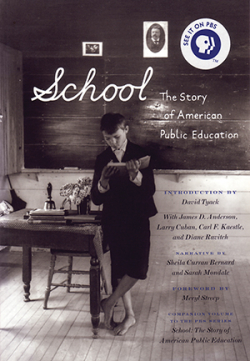
    In School: The Story of American Public Education, esteemed historians of education trace the historical trajectory and the inspiring story of a great American experiment. This collection of essays is the companion to the PBS documentary of the same name. Actress Meryl Streep, who narrates the documentary, wrote a foreword for the book. As you will read below, she shares with us what public schools have meant to her and their invaluable worth to all generations.

    ***

    When we think about our days in school, we often recall a particular teacher who made the most difference in our lives. For me, it was my music teacher, Claire Callahan. I was in high school and thought she was inconceivably old—something like twenty-four. She was a guitar student of Andrés Segovia. She didn’t have enough money for her lessons, so she came to my suburban school in New Jersey and taught music. She was absolutely amazing.

    Teachers perform major miracles in America, daily. My interest in public education comes from the respect I have for what teachers do and is very personal. My brother teaches in a New York City public high school, and I’m really proud of him. He has made me aware of the issues that our teachers face, a lot of them having to do with the lack of attention that they receive and their low salaries. I went to public schools in New Jersey as a child and have sent my children to public and private schools on over four continents and two coasts. They’ve been in every kind of school you can imagine—in Africa, England, Australia, Texas, California, New York, and Connecticut.

    SchoolOnce I became a parent, it confounded me that the school in my district in Connecticut was always underfunded. First we couldn’t get uniforms for our band. Then we couldn’t get instruments. Then, well, perhaps we wouldn’t have a music program at all. And the school needed a lot of money that was raised, and contributed, by parents. I thought back to when I was growing up. In our school we had had a band. We had had an enormous hot lunch served in the cafeteria. We had had a new school with an auditorium where plays were staged. When I sent my kids to public school, I had to pack lunch for them. My kids held plays not in an auditorium, but in the gym. Why is this? Why, after World War II when everybody was coming out of the army and didn’t have a lot of money, a time when everyone on my street lived in small houses, did we have fabulous schools? Somehow, when I was growing up, we were able to have a wonderful music teacher. And a fantastic art department. And a drama department in which I got my start, as Marian the Librarian in The Music Man, and for which I’m very grateful.

    I wonder at the reasons behind the differences in public schools then and now. An evident one is that money was spent on public schools after the war because they were deemed important. Another reason is that at the time, many very bright women had no other place to put their intelligence and ambition except in the school system. Those women now are in law school; they are doctors; they have other kinds of lives that give them other advantages, including better pay. We’ve lost some great teachers. To keep this from continuing to happen, we need to pay more to people who teach. I think that if we were to make the positions in inner-city schools more valuable, we would immediately draw people to teach there.

    We’ve reached a controversial moment in the history of public education, a time when we must pay attention to our schools and invest in the specific school systems that need help. This book takes a history look at public education while keeping an eye on the present. It teaches us that all the questions we ask about public education today have been considered at some point before. And it reminds us that public education for all Americans is relatively new, and something we cannot afford to take for granted.


    Click here to learn more about the PBS documentary School: The Story of American Public Education. To read about Betsy DeVos’s confirmation hearings as Secretary of Education and her history with public schools, check out these articles from NPR, the New York Times, and CNN Politics.


    About the Author 

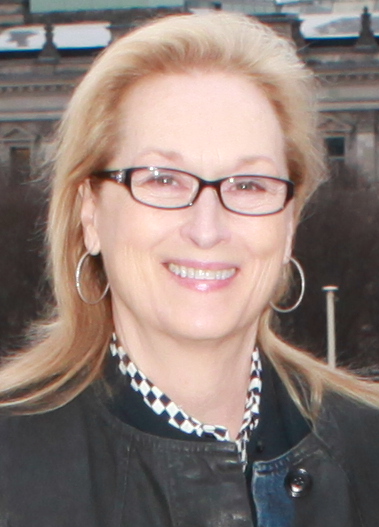
    Meryl StreepActress Meryl Streep has been nominated for the Academy Award nineteen times, and has won it three times. She is also the spokesperson for the National Women’s History Museum. In 2014, she established two scholarships for students at the University of Massachusetts Lowell: the Meryl Streep Endowed Scholarship for English majors; and the Joan Hertzberg Endowed Scholarship for math majors. In April 2015, Streep funded a screenwriters lab for female screenwriters over forty years old, the Writers Lab, to be run by New York Women in Film & Television and the collective IRIS.