• By Kay Whitlock

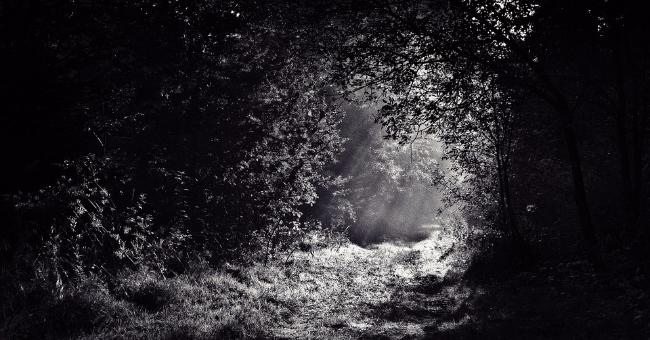
    Night pathEditor’s Note: Fear—one of humankind’s primal emotions. Nothing rouses fear like perceived darkness and the unknown. From the shadowy recesses of the imagination to the deep of the woods, fear can distort our thinking and our reality, beguiling us to see phantasms and monsters that aren’t there. It can send us running in the direction of safety or entice us with the call to danger and adventure. But once you engage your fears head-on, without aggression or arrogance, you learn more about yourself than you could ever expect and begin to experience perceived darkness on new terms. 

    Writer and activist Kay Whitlock has spent much of her life inquiring into and writing about the roots of fear and the systems/structures of oppression, violence, and injustice that stem from it. In the second part of her four-part series, she roams more deeply into the shadows of her hometown streets.

    Part 1 is here.

    *** 

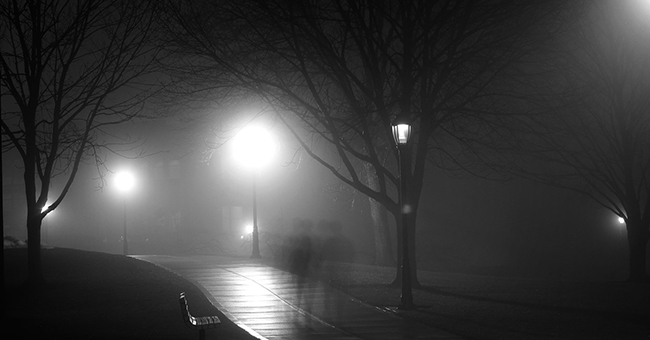
    Magic was afoot and on the move in the darkness when I was young; that much is certain. The night air, clear and deliciously cooler, even in the dog days of summer, flowed in long, almost riparian, currents of pleasure, carrying the scents of mown grass, starlight, and anticipation. In those liminal hours, everything slowed down: the passage of time, sound, movement, and perception. It is possible that time ceased to exist at all. Except for an occasional cop and the usual weekend complement of barflies, the streets remained virtually empty of traffic until 3:30 or 4:00 a.m. In that hour, a handful of people roused themselves from their beds and drove slowly though traffic lights blinking red to jobs as bakers, milkmen, janitors, and other odd-hour laborers.

    Sounds were revelatory. When a wind came up, the sudden, rippling flap! of unseen bed sheets left outside on a clothesline suggested the presence of a giant raptor. The faint shhhhhhsh of a sprinkler mistakenly left on overnight gave rise to other kinds of waking dreams: a desperate little whirligig on the lam, maybe, or a cluster of tiny librarians moving relentlessly through the grass. Even hoary auditory clichés—crickets chirping, owls hooting, and dogs barking in the distance—became fraught when they suddenly ceased. Sometimes it was possible to creep up to an open window, and crouch silently below it. There we harvested shards and splinters of information from the low voices, angry words, tubercular coughs, and fits of weeping that tumbled out.

    Hearing the measured scuff of leather shoes on the sidewalk or whenever the crunch of automobile tires or headlight beams turned in our direction, we darted into recessed doorways or alleys, swallowed by shadows which themselves, owing to slight shifts of light, seemed not only alive, but aware. Underneath and in the spaces between these small sounds, the darkness became tangible. It shifted and whispered, but though I strained to listen, there were never any words. There was only the slight shivery sense of something else. In those days, at least in my hometown, my pals and I weren’t worried about small armies of security guards on edge, armed and eager to shoot. We were afraid of being busted by the police—and once nearly were. But we were white, female, and from “intact” homes, so it never occurred to us to regard cops as life-threatening. Had we been caught, they only have delivered a blistering lecture and taken us home.

    Apart from an inventive prank or two—we were capable of efforts far more imaginative than flinging rolls of toilet paper into trees—prowling was almost always improvised. Avoiding yards where we knew dogs were left out at night, we wound our way through residential streets and alleys, through faintly lit parks and schoolyards, past an old red brick mill that exuded a fragrant blend of dreams mixed with straw and stock and animal feed. Breathing it in, I sensed a possible future, populated with horses, in which I never had to wear anything but jeans, checkered shirts, and cowboy boots.

    How exhilarating to cross a broad intersection empty of cars and pedestrians at a still-dark hour of morning, suffused with the intoxicating illusion that we were free to wander at will forever. Occasionally we stood at one end of the Union Avenue Bridge, one site where, according to local lore, vigilantes hanged people. A “hanging tree,” a towering old cottonwood that once also stood somewhere in this area, had long since been cut down. Gruesome to imagine, it nonetheless appealed to that exuberant but nonspecific bloodlust harbored by many children—an old-time story about the deliciously horrific deaths inflicted on nameless, disposable people with no discernible resonance in our own lives. Death to the Bad Guys! Lynch mobs were not, so far as we knew then, part of our communal histories. So we gave no thought to who those luckless people were (beyond knowing they were considered “wretches,” “thieves,” and “desperadoes”). Who cared about about why they were murdered, or who was in the mob that strung them up—much less why the authorities let them do it?

    Once, feeling especially daring, we crossed the bridge partway to peer down at the levee and river flowing on the far side of the railroad yard. Mysterious things might be drifting downstream on the nighttime current of the Arkansas River: perhaps surly escapees from the Canon City prison or bodies or even a ghostly, out-of-century showboat.

    And we kept going into the night, replete with signs and wonders. Though we didn’t get there often, the train yard offered a dramatic payoff. The harsh clamor and clank of engines and boxcars being switched out sounded like a city constructing itself when nobody is watching.

    In its heyday, built of red sandstone in Romanesque Revival style, the imposing Union Depot served by five railroads, each bearing an enchanted name sure to ignite wanderlust: Denver & Rio Grande; Chicago, Rock Island & Pacific; Missouri Pacific; Colorado & Southern; and best of all, the fabled Atchison, Topeka & Santa Fe. By the time I was growing up, those vibrant days were well on the wane. While a few passenger trains still rumbled through, more and more engines hauled only freight. But that hardly mattered.

    A train was still a portal between Hell on Earth (Here) and Anywhere Else (There). Like so many restless kids in smaller towns over so many generations, I longed to be transported out of my awkward past and misfit present into a future filled with some authentic sense of belonging. Maybe even into the idyllic realm of Judy Garland movies, like the park, filled with happy families, in which she strolls at the end of In the Good Old Summertime. The world in those movies was more real than the one in which I was growing up—or so I wanted to believe.

    Sometimes we headed over to Main Street, which in those long-ago years anchored a thriving downtown. After dark, all those buildings that consumed so much of our daylight lives—stores, banks, public buildings—transmuted into ghost structures, silently watching and waiting until the authority of daylight permitted them to resume feeding. Once, the mysterious aura of the Catholic diocesan cathedral on Grand Avenue drew us in. Were its doors always so generously open during the night? Or only when someone forgot to lock them? Does anyone remember? In the end, the only thing that matters is that once they opened in the predawn darkness to admit errant kids as well as a small scattering of lonelyhearts and derelicts. In my memory, the cathedral is forever a place of opaque stained glass windows, shadowy niches, forlorn statues with blank eyes and uplifted or outstretched hands, and tiers of flickering votive candles. All enveloped in a dim haze of sorrow and loss.

    Our daring wasn’t boundless. The scandalous 85 Club featuring Hot-Cha Hinton with Her Pussycat Revue, was, sadly, too far away. The steel mill, with its roaring blast furnaces that in those years still defined the cityscape was more than we could manage. We stayed away from the sprawling grounds of the state insane asylum and the less kempt Pioneer Cemetery where, in the 1920s, according to my mother and grandmother, the Ku Klux Klan presided over member burials. We visited these places often in the daylight, and even at twilight, on our bikes with a gang of pals, during raucous games of “ditch ’em.” But never in the deep darkness. When it was just two of us.

    As for real danger, I want to think that we never encountered it. It’s impossible to know for sure. We were never harmed or obviously threatened in any way. Yet memory is selective, and so many things happen in the darkness that may be sensed but go largely unseen. And there was that one night . . . A friend and I were heading home, walking single file along a residential sidewalk. I was in front. Thick privet hedges lined the front yards of two or three homes. Suddenly she hissed something like, “Run! Don’t turn around! Just run!”

    And oh, we ran, we ran, we ran, skinny stick legs flying, and did not stop until, blocks later, we reached my yard, bent over, gasping for air, chests heaving, hands on thighs. I have no recollection of what it was we fled, or if it was anything at all. Maybe my friend was just having a little joke at my expense. I didn’t think so at the time; still don’t. We lost touch for many years, and when we finally reconnected, she couldn’t dredge up a clear memory, either. So it’s all consigned to the great psychic landfill of Things Not Remembered from Childhood. Still, for the sake of argument, let’s assume she did see or hear something that filled her voice with such chilling urgency. What on earth was it? A flasher? Our school principal up to no good? The spectral emanation of Bobby Greenlease?

    My pre-dawn rambles did not continue long after that night. New hairline fractures in my burgeoning courage constellated old jitters. And we were entering our teens, a time when the lives of newly-menstruating girls were more closely monitored by just about every possible authority figure. More than fifty years later I still wonder what I would have seen had I turned around. Maybe something really was watching us, following us, not only that night but also on other nights, and we just remained unaware of it.

    More to the point: What did my own fear distribute and conceal among all those hedges and houses, among all those structures and graveled alleyways, along all those empty streets on all those nights?


    Stay tuned for Part 3 where Kay’s fears usher her into the realm of the horror story. Catch up with Part 1.

    To be sure you don’t miss an installment of ‘The Haunting: On Fear and Seeing Differently in the Dark’ series, you can follow Kay (@KayJWhitlock) or Beacon Press (@BeaconPressBks) on Twitter or follow/like Beacon Press on Facebook. You can also subscribe to the Beacon Broadside blog email. 


    About the Author 

    Kay WhitlockKay Whitlock is a writer and activist who has been involved with racial, gender, queer, and economic justice movements since 1968. She is coauthor of Considering Hate: Violence, Goodness, and Justice in American Culture and Politics with Michael Bronski, the award-winning Queer (In)Justice: The Criminalization of LGBT People in the United States with Joey L. Mogul and Andrea J. Ritchie, and cofounder and contributing editor for the weekly Criminal Injustice series at CriticalMassProgress.com. She lives in Missoula, Montana. Follow her on Twitter at @KayJWhitlock.

  • A Q&A with Adrienne Berard

    Lum Family

    Lum family. Photo courtesy of the Lum family.

    In 1924, in the Mississippi Delta, thirty years before Brown v. Board of Education, a Chinese immigrant and father of three filed what would become the first U.S. Supreme Court case to challenge the constitutionality of segregation in Southern public schools. The case of Gong Lum v. Rice was lost to history until journalist Adrienne Berard, who was visiting the Delta State University archives to research her own family’s connection to the region, stumbled upon this ground-breaking case, the implications of which can still be felt today.

    In Water Tossing Boulders: How a Family of Chinese Immigrants Led the First Fight to Desegregate Schools in the Jim Crow South, Berard uncovers the story of the Lum family whose daughters, Martha and Berda, were forced out of the school they had attended through fourth grade, when it was suddenly decided that, as Chinese-Americans, the girls were “colored” and therefore no longer welcome at the newly accredited, all white school. Through meticulous research, Berard reconstructs the experience of day-to-day life for the Lum family living as outsiders in their small Mississippi town, and explores how the racial and economic climate of the time compelled further segregation in Southern schools. Beacon Broadside editor Christian Coleman caught up with Berard to ask her about her research, her personal connection to the family’s story, and how her book illuminates stark similarities to many race and class tensions that still exist today.

    Christian Coleman: What drew you to the Lums’ case and why did you think their story was important to tell?

    Adrienne Berard: I found the Lums’ case completely by accident. I was visiting the archives at Delta State University, researching my own family history in Mississippi, and happened upon a meeting of members from the Mississippi Delta Chinese Heritage Museum. The museum was just an idea at the time. The thought was that the archives would serve as a repository for the history of Chinese immigration in the Mississippi Delta. Years later, that museum now exists at Delta State, but at the time the members were just throwing around ideas about how to make it happen. I immediately sensed that there was an important piece of history in that legacy, so I spoke with Emily Jones, the head archivist at Delta State, and she set me on the course of research that would eventually become a book about the Lum family and their fight to integrate a white school in the Delta.

    CC: Your prose makes Rosedale, Mississippi so vivid and tangible. How much research went into recreating the lives of the Lum family and this time in history?

    AB: I spent about four years on the research. It was a real challenge to find historical records on the Lum family, because the father was an undocumented immigrant and the mother came under the capacity of a servant. Writing history about minorities and people of color, you are constantly confronted with the value system of the societies in which they lived. Some crucial records were never kept, and the accuracy of the records that exist is questionable. The racism of their time affected how their story was remembered, or in this case, not remembered. There is only one white male character who is central to the book, the Lums’ lawyer, and I had access to decades of letters, family histories, multiple biographies. I spent a lot of time pulling every detail I could from what remains of the Lum family so they would not be overshadowed by the wealth of material preserved on their lawyer.

    CC: Can you tell us about your personal connection with this story?

    AB: Personally, my family goes back at least four generations in the Mississippi Delta. My grandmother went to school in the same district as the case I explore in the book. I still have a lot of reckoning to do with my own history there. My ancestors never managed to accumulate wealth. We were what were referred to at the time as “river rats,” people who survived on whatever they could pull from the banks of the Mississippi River. My ancestors would have been in the county at the time the Lum family brought the case, but they likely would not have supported their efforts. That’s just the reality of the white working class experience in the Delta, and the South as a whole. I love my family, but we come from a legacy of racism that was intrinsic to white Southern culture.

    CC: What bearing do you think the Lum family’s case has on today’s issues?

    AB: Currently, the district Martha Lum fought to integrate in 1924 is under a federal court order to integrate its school system. The district is now in the process of fighting the federally mandated integration by proposing their own solutions. The problem is far bigger than Bolivar County, Mississippi. It’s an American problem—and I hope for the sake of this nation’s future that they are able to step up and make the district’s integration program a success.

    In terms of the Lum family’s experience in America, the rhetoric surrounding immigrants today, the efforts of entire political parties to stoke a fear of immigrants, mirrors the kind of xenophobia and racism the Lum family would have experienced in the 1920s. It would be great to say that the issues brought forward by the Gong Lum v. Rice case have no relevance today, but unfortunately the case is more relevant than ever.


    About the Author 

    Adrienne Berard is an award-winning journalist and graduate of Columbia University’s Graduate School of Journalism. She has been the Writer-in-Residence at Delta State University in Mississippi and now resides in Williamsburg, Virginia. Follow her on Twitter at @AdrienneBerard and visit her website. 

  • By Kay Whitlock

    Night forestEditor’s Note: Fear—one of humankind’s primal emotions. Nothing rouses fear like perceived darkness and the unknown. From the shadowy recesses of the imagination to the deep of the woods, fear can distort our thinking and our reality, beguiling us to see phantasms and monsters that aren’t there. It can send us running in the direction of safety or entice us with the call to danger and adventure. But once you engage your fears head-on, without aggression or arrogance, you learn more about yourself than you could ever expect and begin to experience perceived darkness on new terms. 

    Writer and activist Kay Whitlock has spent much of her life inquiring into and writing about the roots of fear and the systems/structures of oppression, violence, and injustice that stem from it. In this four-part series, she whisks us to the start of her fascination with fear…to her childhood in her southern Colorado hometown. 

    ***

    No live organism can continue for long to exist sanely under conditions of absolute reality; even larks and katydids are supposed, by some, to dream. Hill House, not sane, stood by itself against its hills, holding darkness within; it had stood for eighty years and might stand for eighty more. Within, walls continued upright, bricks met neatly, floors were firm, and doors were sensibly shut . . .

                —Shirley Jackson, The Haunting of Hill House, 1959

    As a child, I was the classic scaredy-cat; in some respects, I still am. 

    And yes, I’m afraid to admit it. It’s embarrassing, and I hate to embarrass myself, especially in public. But it occurs to me that, in part, I write so much about fear and its structural forms in public and private institutions because I have so often been afraid.

    It’s not my dilemma alone. Along with many individuals and families, the lives of entire societies may in some measure—and never to good end—be distorted, manipulated, even dominated by fear. The inevitable results are varied combinations of repression, displacement, brutality, and tragedy. How is it possible, then, not to be done in, led astray, or paralyzed by fear, but rather be usefully transformed by it in more imaginative ways?

    In lieu of an answer, I have a story to tell. 

    In the 1950s and 1960s, as a child growing up on the southern Colorado plains just east of the front range of the Rockies, I was tormented by frequent, sometimes repetitive, nightmares and an abiding fear of the dark. I imagined disturbed men with vacant eyes crouched by outside doors, looking for ways in. Occasionally I sleepwalked, sick with apprehension when I awakened to find myself standing outside in the front yard or in some other part of the house, having unconsciously opened and closed doors to get there. I lived in heart-thrumming dread of the unlit emptiness at the bottom of the narrow stairs to the cold basement and the gloom that pooled each night outside my bedroom window.

    Much of my fear was anchored in my family’s struggles with our individual and collective demons and disillusionments—and with the confusion produced by whiplash shifts between happiness and hurt. There were other factors, too. I was haunted by whispers of “what happened to Bobby Greenlease.” A six-year-old boy from Innocent Child Land—probably a local kid I thought at the time, but actually from a well-to-do Kansas City suburb—Bobby was kidnapped in 1953, held for ransom, and killed anyway after it was paid. My folks made it clear that careless, disobedient kids might well suddenly vanish into strange cars, the ether, and death. And just like Bobby Greenlease, we would have brought it on ourselves.

    Fear didn’t have to be plausible to colonize my imagination. It had only to promise something bigger than me, surprising, and awful; to reinforce my secret terror of inconsequentiality by shattering anything that made me feel safe, special, or good. Sharks, for instance. Long before Jaws began its relentless swim across America’s movie screens, and despite growing up in a landlocked, semi-arid, overgrazed prairie, I dreaded the unseen presence of sharks. I told anyone who would listen—a rapidly dwindling audience—that most shark attacks occurred in less than three feet of water (not true, but I thought it was then). A budding Cassandra, I repetitively sounded the same warning: Danger is Always Closer Than You Think and Will Almost Always Drag You Under When You Least Expect It.

    To illustrate: one summer night my dog Trixie, her nose pressed to the window screen, awakened me with frantic barking. Groggy, I tried to hush her and found myself staring into the unblinking eyes of a peeping Tom standing outside the window, only inches away. Screaming bloody murder, I sent my father and the perpetually splenetic man next door—a pest exterminator—into the driveway in their boxer shorts, both brandishing guns. Police never found the guy, probably because he’d already taken up permanent residence in my psyche. Even now, whenever I am alone at home and look out a window at night, I half expect to see his eyes looking back at me.

    Even so, roughly between my eleventh and fourteenth years, I arose from my bed well after midnight on occasional Saturday mornings in the late spring and summer. Throwing off the pajama top that covered my t-shirt and still wearing jeans, I shoved my feet into red canvas Keds, and sneaked out of the house. A chum spending the night—not always the same girl—was always in tow; once there were three of us. And for two or three hours, blessedly unsupervised, we disappeared into darkness.

    In the wee small hours, everything is in some way familiar and evocative of what is already known. Yet nothing is the same. The earth relaxes and reimagines it all. The darkness reveals unseen aspects of itself that are rendered invisible or incomplete in the light of day. The terms of daytime logic are often so narrow; there is incessant effort to whittle things down to size, to manage them, to set them in orderly rows and arrange them at predictable right angles. But in the dark, things are not managed; they are only encountered. Nothing is linear, fixed, or certain. Shapes and textures constantly transmute into that which is almost…but not yet…recognizable. Under the slow movement of granite clouds in a moonlit sky, everything rearranges itself in almost imperceptible ways. These are the trickster hours, necessarily disrupting the ways most of us usually experience the world.

    Trees no longer simply line the streets; they loom, huge and indistinct, and their branches vanish into a vast, indigo web. But who or what created that web? Houses—stucco, vinyl-sided, wooden, and brick—recede into the gloom, save for an occasional muted light behind a curtained window, almost invariably only one. Who is awake at this hour, and why?

    Such earthy forms of alchemy stir curiosity and invite intriguing questions that are never spoken aloud, either by children or adults, or even fully formed in the moment: What is this? Am I seeing what’s really here? Or only what I want to see? Is there something out here that I am afraid of or refuse to see? Deep shadow is often disorienting; it feels intensely alive and vital even as it amplifies loneliness and uncertainty. It provides hiding places for whatever a person would rather not know while simultaneously offering the possibility of examining what is tucked away in those places, out of sight and out of mind.

    But I did not understand that then.


    Stayed tuned for part 2 of this series, in which Kay Whitlock takes us with her more deeply into the darkness and shadow of her hometown streets. 

    To be sure you don’t miss an installment of ‘The Haunting: On Fear and Seeing Differently in the Dark’ series, you can follow Kay (@KayJWhitlock) or Beacon Press (@BeaconPressBks) on Twitter or follow/like Beacon Press on Facebook. You can also subscribe to the Beacon Broadside blog email.


    About the Author 

    Kay WhitlockKay Whitlock is a writer and activist who has been involved with racial, gender, queer, and economic justice movements since 1968. She is coauthor of Considering Hate: Violence, Goodness, and Justice in American Culture and Politics with Michael Bronski, the award-winning Queer (In)Justice: The Criminalization of LGBT People in the United States with Joey L. Mogul and Andrea J. Ritchie, and cofounder and contributing editor for the weekly Criminal Injustice series at CriticalMassProgress.com. She lives in Missoula, Montana. Follow her on Twitter at @KayJWhitlock.
  • By Maya Fernandez

    Maya Fernandez

    Maya Fernandez as a toddler. Photo credit: Maya Fernandez

    I have always believed I’m Black. Both of my parents are Black, the majority of my immediate family identifies as Black, so essentially, I am Black. While race was a continuous topic of discussion in my household, colorism—discrimination or prejudice based on skin color—was left unattended. Similar to racism, colorism establishes a hierarchy in which lighter skin is treated with higher regard than darker skin. My father, a cultural proficiency consultant, made sure my sisters and I understood how society would see us as black women, but somehow forgot to give us the tools to navigate a world also plagued by colorism. It wasn’t until I stepped outside the comfort of my front door that I was fully able to grasp the concept of colorism.

    I am a Black woman of a lighter complexion who is now very aware of my status and privilege as someone with a lighter skin tone. Though my own parents refrained from talking about skin-color bias, relatives and other adults of different races were quick to tell me that I was beautiful because my skin was light. During simple activities such as going grocery shopping with my mother, a woman at the checkout counter would often tell me how beautiful I was with my light skin and light brown hair. What felt like a harmless compliment at the time soon became a reoccurring experience, and the repeated message was that light skin is synonymous with beauty.

    As a child, I didn’t understand that this was colorism. Both of my parents are also of a light brown complexion, as well as my middle sister. But my oldest sister is much darker than all of us. We were considered to be a blended family, comprised of two daughters from a previous marriage and me as the product of this unconventional family. I assumed we didn’t discuss skin-color bias in my family, because my parents believed we would understand that people, specifically Black people, come in varying shades, as proven by our own immediate family.

    I soon learned in my daily experiences how having a lighter complexion provided me with certain privileges and preferential treatment that would not be afforded to my darker peers. Prior to entering high school, I spent the majority of my life as the only black girl in the room, so I wasn’t able to compare my experiences with other black students. By the age of fourteen, I was instantly aware of how differently I was treated in comparison to my darker friends. White students would tell me I was “less threatening” than the other black girls in school because I wasn’t like a real black person. They were excited to tell me that they liked to be around me because they forgot I was black.  And other Black people told me I was beautiful because I was light. Meanwhile, my darker friends were told, “You’re pretty, but I don’t date dark skin girls.”

    Along with these privileges I was forced to understand that my blackness would be a constant topic for debate. Regardless of the fact that I view myself as black, others may not. “What are you?” and similar inquiries about my ethnic and racial makeup are questions I am very familiar with. The question is often phrased in a positive tone, as if I should feel special to present with some form of racial ambiguity. Once again, language coded in the idea that being less black, or less of color, is better. But for me, the question is rooted in an invalidation of my identity as a Black woman. The feeling of others questioning and scrutinizing your identity is something I continue to find difficult to articulate.

    Same Family Different ColorsJournalist Lori Tharps explores how colorism affects family dynamics and society in her book Same Family, Different Colors: Confronting Colorism in America’s Diverse Families. When I read her book, I found myself repeatedly thinking, “I’m reading my own story.” My experiences with colorism were scattered throughout the different stories of Tharps’ diverse interview subjects. I particularly identified with the section about the isolation of light-skin. Tharps interviews people with light skin who describe their experiences struggling to fully connect with other Black people and also feeling out of place within White settings. As a teen, this was often my reality, as White and Black classmates told me that I wasn’t black enough. I resented my privilege of having light skin and began to seek out validation for my Blackness. Tharps acknowledges this common internalization of colorism within the story of Lisa, a woman who grew up struggling to find validity in her light skin tone. I found myself nodding along as Lisa described her desire to be darker to prove her Blackness. As I continued reading, I understood the families who discussed the difficulty for people to believe their relation when they are of different skin colors, relating it back to my own experiences with my sister. I connected to the countless people who discussed how hard it is to feel confident in your self-identity when others force you to question it. I became engrossed in the stories of people who found themselves victimized by the color hierarchy and denied opportunities because of their dark skin.

    Tharps’ book not only validated my experiences, but also provided me with tools to properly speak about skin-color bias. Same Family, Different Colors identifies how a lack of overt discussion regarding colorism is common in many households where racism is often considered to be a central issue. Similar to many of the people interviewed in Tharps’ book, I was puzzled as to why my parents never discussed colorism at home, and furthermore, why I never thought to bring it up. The book prompted me to start conversations about colorism with my parents. My mother told me that her father, a dark skinned Black man, specifically married her mother because he wanted to pass on her light skin to his children. My father told me that in college he insisted on dying his hair black so that people would see him as a “real Black man,” but instead was mistaken for being Latinx. My mother expressed her resistance to discuss color with my sisters and me, because she wanted us to understand that we were equal, regardless of complexion. She didn’t want color to become an issue by bringing it up. Instead, she, like many of the other people interviewed in Tharps’ book, thought that by abstaining from talking about color we would be able to focus on the universal issue we would all face: racism. The absence of discussion was affective until I exited the confines of my family.

    Tharps addresses the fact that these discussions need to be had alongside conversations of race, and that is so important. Her book prompts readers to understand that conversations about colorism are crucial as skin color continues to be a deciding factor of how we are perceived and judged by others. Her exploration of colorism with in Black, Latinx, Asian, mixed-race, and White families confirms that regardless of racial category, light skin is still seen as superior, and this hierarchy is not going away anytime soon. Remaining silent about colorism does not help to end this hierarchy, but rather allows it to continue to exist without addressing the issue. By starting conversations about color at home we can begin to identify and deconstruct colorism from childhood onward.


    About the Author 

    Maya Fernandez, Assistant to the Director, recently joined Beacon Press after graduating from American University in 2016.

  • By Thich Nhat Hanh

    Meditation

    In this passage from The Miracle of Mindfulness: An Introduction to the Practice of Meditation, Thich Nhat Hanh instructs beginners in the practice of meditation that mindful awareness leads not only to alertness and inner peace, but also self-recognition without judgment. Afterwards, you will find a few of his exercises to try out. Whether you’re washing the dishes, having a conversation, or peeling an orange, he reminds us that each moment is an opportunity to work toward greater self-understanding and peacefulness. Nhat Hanh’s wisdom is especially useful now in a time fraught with the politics of division and fear. Mindfulness can help us relieve stress and clear through the clutter in our minds, which is important now more than ever. 

    ***

    Sitting in mindfulness, both our bodies and minds can be at peace and totally relaxed. But this state of peace and relaxation differs fundamentally from the lazy, semi-conscious state of mind that one gets while resting and dozing. Sitting in such lazy semi-consciousness, far from being mindfulness, is like sitting in a dark cave. In mindfulness one is not only restful and happy, but alert and awake. Meditation is not evasion; it is a serene encounter with reality. The person who practices mindfulness should be no less awake than the driver of a car; if the practitioner isn’t awake he will be possessed by dispersion and forgetfulness, just as the drowsy driver is likely to cause a grave accident. Be as awake as a person walking on high stilts—any mis-step could cause the walker to fall. Be like a medieval knight walking weaponless in a forest of swords. Be like a lion, going forward with slow, gentle, and firm steps. Only with this kind of vigilance can you realize total awakening.

    For beginners, I recommend the method of pure recognition: recognition without judgment. Feelings, whether of compassion or irritation, should be welcomed, recognized, and treated on an absolutely equal basis; because both are ourselves. The tangerine I am eating is me. The mustard greens I am planting are me. I plant with all my heart and mind. I clean this teapot with the kind of attention I would have were I giving the baby Buddha or Jesus a bath. Nothing should be treated more carefully than anything else. In mindfulness, compassion, irritation, mustard green plant, and teapot are all sacred.

    When possessed by a sadness, an anxiety, a hatred, or a passion or whatever, the method of pure observation and recognition may seem difficult to practice. If so, turn to meditation on a fixed object, using your own state of mind as meditation’s subject. Such meditation reveals and heals. The sadness or anxiety, hatred or passion, under the gaze of concentration and meditation reveals its own nature—a revelation that leads naturally to healing and emancipation. The sadness (or whatever has caused the pain) can be used as a means of liberation from torment and suffering, like using a thorn to remove a thorn. We should treat our anxiety, our pain, our hatred and passion gently, respectfully, not resisting it, but living with it, making peace with it, penetrating into its nature by meditation on interdependence. One quickly learns how to select subjects of meditation that fit the situation. Subjects of meditation—like interdependence, compassion, self, emptiness, non-attachment—all these belong to the categories of meditation which have the power to reveal and to heal.

    Meditation on these subjects, however, can only be successful if we have built up a certain power of concentration, a power achieved by the practice of mindfulness in everyday life, in the observation and recognition of all that is going on. But the objects of meditation must be realities that have real roots in yourselves—not just subjects of philosophical speculation. Each should be like a kind of food that must be cooked for a long time over a hot fire. We put it in a pot, cover it, and light the fire. The pot is ourselves and the heat used to cook is the power of concentration. The fuel comes from the continuous practice of mindfulness. Without enough heat the food will never be cooked. But once cooked, the food reveals its true nature and helps lead us to liberation.

    Exercises in Mindfulness

    Half-smile during your free moments

    Anywhere you find yourself sitting or standing, half-smile. Look at a child, a leaf, a painting on the wall, anything which is relatively still, and smile. Inhale and exhale quietly three times. Maintain the half smile and consider the spot of your attention as your own true nature.

    Half-smile when irritated

    When you realize you’re irritated, half-smile at once. Inhale and exhale quietly, maintaining the half smile for three breaths.

    Washing the dishes

    Wash the dishes relaxingly, as though each bowl is an object of contemplation. Consider each bowl as sacred. Follow your breath to prevent your mind from straying. Do not try to hurry to get the job over with. Consider washing the dishes the most important thing in life. Washing the dishes is meditation. If you cannot wash the dishes in mindfulness, neither can you meditate while sitting in silence.

    Deep breathing

    Lie on your back. Breathe evenly and gently, focusing your attention on the movement of your stomach. As you begin to breathe in, allow your stomach to rise in order to bring air into the lower half of your lungs. As the upper halves of your lungs begin to fill with air, your chest begins to rise and your stomach begins to lower. Don’t tire yourself. Continue for 10 breaths. The exhalation will be longer than the inhalation.

    Counting your breath

    Sit in the half or full lotus or take a walk. As you inhale, be mindful that “I am inhaling, one.” When you exhale, be mindful that “I am exhaling, one.” Remember to breathe from the stomach. When beginning the second inhalation, be mindful that “I am inhaling, two.” And slowly exhaling, be mindful that “I am exhaling, two.” Continue on up through 10. After you have reached 10, return to one. Whenever you lose count, return to one.

    Breathing to quiet the mind and body to realize joy

    Sit in the full or half lotus. Half-smile. Follow your breath. When your mind and body are quiet, continue to inhale and exhale very lightly, mindful that, “I am breathing in and making the breath-body light and peaceful. I am exhaling and making the breath-body light and peaceful.” Continue for three breaths, giving rise to the thought in mindfulness, “I am breathing in and making my entire body light and peaceful and joyous.” Continue for three breaths and in mindfulness give rise to the thought, “I am breathing in while my body and mind are peace and joy. I am breathing out while my body and mind are peace and joy.”

    Maintain this thought in mindfulness from 5 to 30 minutes, or for an hour, according to your ability and to the time available to you. The beginning and end of the practice should be relaxed and gentle. When you want to stop, gently massage your eyes and face with your two hands and then massage the muscles in your legs before returning to a normal sitting position. Wait a moment before standing up.

    The pebble

    While sitting still and breathing slowly, think of yourself as a pebble which is falling through a clear stream. While sinking, there is no intention to guide your movement. Sink toward the spot of total rest on the gentle sand of the riverbed. Continue meditating on the pebble until your mind and body are at complete rest: a pebble resting on the sand. Maintain this peace and joy a half hour while watching your breath. No thought about the past or future can pull you away from your present peace and joy. The universe exists in this present moment. No desire can pull you away from this present peace, not even the desire to become a Buddha or the desire to save all beings. Know that to become a Buddha and to save all beings can only be realized on the foundation of the pure peace of the present moment.


    About the Author 

    Thich Nhat Hanh is a Vietnamese monk, a renowned Zen master, a poet, and a peace activist. He was nominated for the Nobel Prize by Martin Luther King, Jr., in 1967, and is the author of many books, including the best-selling The Miracle of Mindfulness. Follow him on Twitter at @thichnhathanh and visit his website.

  • By Steven Hill

    Broken piggy bank

    Photo credit: Jacob Edward, http://www.seniorplanning.org.

    During the third and final presidential debate in Las Vegas, Hillary Clinton and Donald Trump addressed issues ranging from who they would nominate for the Supreme Court to their stances on abortion and women’s health. In the portion of the debate dedicated to the national debt, moderator Chris Wallace stated: “Social Security is going to run out of money in the 2030s, and at that time, recipients are going to take huge cuts on their benefits.”

    Trump claimed that in order to avoid disaster, he would cut taxes and repeal Obamacare. By contrast, Clinton reasserted that under her plan, she would put more money in the Social Security Trust Fund by increasing taxes on the wealthy.

    But, in the end, the question remained: is it really true that our Social Security fund, as it stands, will be bankrupt by the 2030? In this excerpt from Expand Social Security Now!, author Steven Hill rebuts that notion and tells us what it will really take to keep social security (and Medicare) from going broke.

    ***

    Social Security is not going broke, not by a long shot. The Social Security Board of Trustees released its annual report to Congress in July 2015, and among all the tables, charts, and graphs in that big fat report, it would be easy to miss the most important take-home message: Social Security is one of the best-funded federal programs in US history. That’s because it has its own dedicated revenue stream, which is composed of the insurance premiums paid by every worker (deducted from our paychecks by what is called “payroll contributions”), which are automatically banked into the Trust Fund. Even the Pentagon and the defense budget do not have their own dedicated revenue stream.

    In fact, Social Security has not one dedicated revenue stream, but three. Besides the payroll contributions, Social Security is also funded by income generated from investing all those set-aside wages into US treasuries. That money earns a sizable return on the investment. And Social Security is also funded by revenue that comes from levying income tax on Social Security recipients (yes, your Social Security check and that of other Americans is treated as income and taxed—and it brought in $756 billion to the Trust Fund in 2014). Those three revenue streams combined have banked $2.8 trillion in the Trust Fund and resulted in a $25 billion surplus in 2014.

    Bankrupt? That charge does not even pass a good laugh test.

    Expand Social Security Now!Indeed, because Social Security has its own funding source, and by law is not allowed to spend any money it does not have, it is actually impossible for Social Security to add to annual operating deficits or the national debt. Moreover, the Social Security Board of Trustees is required by law to report to Congress every year about the financial fitness of the program. The annual trustees report projects its revenues and payouts, not just for the next five, ten, or twenty years, but for the next seventy-five years. It’s one of the few programs anyone can identify that has had the wisdom to plan for the future, rather than planning around short-term political calculations and the next election cycle.

    Pensions expert Nancy Altman analyzed the trustees’ report in 2015 and concluded, “Over the next 5 years, Social Security has sufficient funds to pay every penny of benefits and every penny of associated administrative costs. That is true for the next 10 years. And also the next 15 years.” However over the next twenty years, as more and more of the huge population bloom known as the baby boomers continues to retire, Social Security is projecting a modest shortfall of just 0.51 percent of gross domestic product (GDP). If nothing is done to plug that gap, sometime in the 2030s the Trust Fund will have enough to cover only 75 percent of benefits. But there are so many budgetary ways to cover that shortfall, it becomes clear that the problem is not the finances of finding the money but the politics of partisanship and paralysis. No other government program can claim that it is fully funded for almost the next quarter century. What government critics ever say that the Defense Department or the Departments of Energy or Education are going bankrupt? Yet those programs don’t have dedicated revenue streams, and certainly no one plans or projects costs for those programs over the next seventy-five years.

    No, these sorts of charges are leveled by the Peter G. Petersons of the world for political reasons, not economics or finances. And even in terms of the shortfall that will emerge in a couple of decades, that gap could be covered with a few minor tweaks. For example, simply removing the payroll cap and taxing all income brackets equally would not only be fairer to all Americans, it would also raise all of the money and then some to plug any Social Security funding shortfalls twenty years from now. So we would have lots of time to phase in a fair reform like that. Opinion polls have demonstrated that most Americans think if they pay Social Security tax on their full salary, others should as well. So removing the income cap and making all income levels pay according to the same rules would be a very popular reform, and would safeguard the nearly $3 trillion Trust Fund for decades to come. That’s just one example of the many adjustments we can enact that would make the US retirement system more fair, robust, and stable, and better adapted to the realities of today’s economy.

    (In Chapter 5 of Expand Social Security Now!, Steven Hill explores several funding options that not only stabilize Social Security, but will double its monthly payout.)


    About the Author 

    Steven HillSteven Hill is a Senior Fellow with the New America Foundation and a Holtzbrinck Fellow at the American Academy in Berlin. He is the author of six books, including Raw Deal: How the “Uber Economy” and Runaway Capitalism Are Screwing American Workers, which was selected by The Globalist as one of the Top Ten Books of 2015. His op-ed’s, articles and media interviews have appeared in the New York Times, Washington Post, Wall Street Journal, The Atlantic, Politico, CNN, C-SPAN, BBC, Financial Times,Guardian, Bloomberg News, Fox News,National Public Radio, The Nation,Salon,Slate,Observer, Fast Company, Business Insider, HuffingtonPost, Le Monde, Die Zeit, Al Jazeeraand many others. His other books include Europe’s Promise: Why the European Way Is the Best Hope in an Insecure Age and 10 Steps to Repair American Democracy. He is a co-founder of FairVote/Center for Voting and Democracy. Follow him on Twitter at @StevenHill1776 and visit his website.

    Save

  • By Richard Hoffman

    Donald Trump

    Photo credit: Gage Skidmore

    The question isn’t mine but my son Robert’s, when he was six or seven years old. He came home from school one day and asked his mother, “Do bullies have Mommies?” It’s easy for me to picture him at that age, his lower lip pouting, his brow knit, his voice androgynous and sweet.

    “Of course,” Kathi answered, “everybody has a Mommy.”

    “Well, they don’t act like they have Mommies!” Robert said, and folded his arms across his chest.

    All these many years later, with so many of our fellow citizens rallying around just such a bully, I might answer that boy’s question differently. I might say, “Bullies have Mommies, but they don’t matter.”

    Although we have heard plenty about his father, the previous iteration of the Trump slumlord brand, we haven’t heard a word during this long and ugly presidential campaign about Donald Trump’s mother. Maybe that’s because, as it turns out, she arrived here from Scotland, penniless, a fact that runs counter to his demagogic anti-immigrant narrative. But it is more likely that he just doesn’t consider her important to the formation of his character. Women, in his macho bully’s world, contribute nothing of substance to the world of men they move in, a world where men make deals, dominate or surrender, win or lose. Women are beauty queens or else they are disgusting. Women are merchandise, a commodity akin to livestock.

    Consider an archival video making the rounds on Twitter and Facebook: it is 1994, just after the birth of Trump’s daughter Tiffany to his second wife, Marla Maples. In a television interview, Trump is asked, “What does Tiffany have that’s Marla’s and what does she have that’s yours?”

    “I think she has a lot that’s Marla’s,” Trump responds. “She’s a beautiful baby. She has Marla’s legs. We don’t know whether or not she’s got”—he cups his hands as if holding ample breasts—“this part yet, but time will tell.”

    I’m not citing this exchange to play “Well, I never!” In fact, the worldview it evinces is all too familiar: one in which women’s fetishized bodies, evidently beginning at birth, are their only worth. An ideology in which women are body parts, pronouns, and slurs. The point here is not outrage, feigned or otherwise. The point is that everything we profess to be disgusted by is in fact the deep root, the rhizome, of the existing arrangement of wealth and power: call it patriarchy or capitalism or rape culture or pimp culture or exploitation, it is all about extracting value from the feminine. The “hidden curriculum of boyhood” as I have called it elsewhere, teaches boys that to be a man means to keep your distance from any aspect of the feminine that remotely suggests there is any other relation between these strictly enforced gender binaries except sexual relations—and cartoonish, pornographic ones at that.

    Love & FurySo when my son asked his question, his little brow furrowed in consternation, he had just encountered this ethos, and its attempt to halve him, for the first time. Writing this, I feel pretty sure he had been called a “Mama’s boy”—and was wondering what could possibly be wrong with belonging to his mother! I suspect he was also trying to grasp why he’d been sneered at and why it felt so awful. Mama’s boy. Sissy. Girl. These taunts, among others, are tools of enforcement, designed to shame boys into rigid gender compliance. All are accompanied by a sneer and, of course, the implied threat of violence. Most men in our culture have moved on from this post-WWII version of masculinity. And yet, that tangle of anxieties we were taught to identify as our manhood remains and remains raw and vulnerable. Some years ago, in the early days of the Internet, a short essay of mine was posted on a website. The novelty of that, and of being able to see pretty quickly what readers thought about it, had me scrolling through the comments until I came to one that read: “Mr. Hoffman is a mama’s boy. Any man who uses the words complex, relationship, and culture in the same sentence is nothing but a SISSY.”

    I was surprised to find how the word still stung. I tried to deny the feeling, the heat in my chest, my ears reddening. The only difference between that response in boyhood and now is that I can watch myself trying to deny, unsuccessfully, the impact of the word. That tripwire, that adrenaline trigger, that shame—it doesn’t go away.

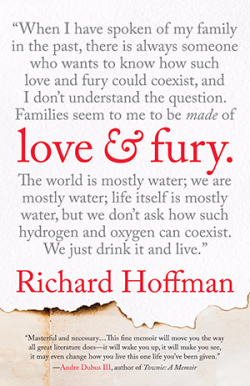
    Most men these days have friends of both genders and real relationships with women that involve give and take, affection that isn’t sexual, and respect. In my recent memoir, Love & Fury, I write about my father’s version of manhood:

    My father preferred the company of men. He felt that he understood men. In fact, it would have been impossible for him, in his time and place, class and circumstance, to have ever been friends with a woman. My own coming-of-age coincided with the rise of second-wave feminism, and my friendships with women have been a crucial part of my life. Once, I mentioned to my father that I was having dinner with my friend Suzanne, a fellow writer, and frowning, he asked, “Does Kathi know about this?”

    Clearly, there could be only one reason I would be meeting, at that time of day, with a woman not my wife. But my father was a man of his era, one that is thankfully not our own. So I have to ask, “Why would men ever want to go back to a sexist segregation that impoverishes them? And why would we feel the need to get together and snicker about women’s bodies as if they were something other than our mothers and sisters and friends?”

    In his 1985 essay, “Freaks and the American Ideal of Manhood,” published, incidentally, in Playboy, James Baldwin writes:

    …there is a man in every woman and a woman in every man. Sometimes this is recognized only when the chips are, brutally, down—When there is no longer any way to avoid this recognition. But love between a man and a woman, or love between any two human beings, would not be possible did we not have available to us the spiritual resources of both sexes.

    When an ideology is dying, its final throes include a ferocious and defiant last stand. I believe we are witnessing that right now, the last stand of a discredited idea of masculinity that was long in the making but took its most rigid and brutal form amid the atrocities of the last century of warring bullies.

    Standing up to a bully like Trump might begin, for men, with the simple declaration that we are our mothers’ sons as well as our fathers’, a declaration that acknowledges our original wholeness. And then we ought to think hard about what that really means and what it might require of us.


    About the Author 

    image from www.beaconbroadside.comRichard Hoffman is the author of Love & Fury: A Memoir, Half the House: A Memoir; the poetry collections Without Paradise, Emblem, and Gold Star Road, winner of both the 2006 Barrow Street Press Poetry Prize and the 2008 Sheila Motton Award from the New England Poetry Club; and the short story collection Interference and Other Stories. He is senior writer-in-residence at Emerson College and lives in Cambridge, Massachusetts. Follow him on Twitter at @rhoffman49 and visit his website.

  • By Melissa Range and Tracy K. Smith

    Scriptorium

    Illustration: Louis Roe

    Pulitzer Prize-winning poet Tracy K. Smith selected a gem of a poetry collection as one of the National Poetry Series winners. Praised by Library Journal as “a collection not to be missed,” by Booklist as a “book [that will] dazzle a lot of poetry readers,” and by poet Jay Parini as “revelatory poetry of a high order,” Melissa Range’s Scriptorium explores questions of religious and linguistic authority through the way language is used or abused. She mingles the historical with the personal in meditations on medieval art, theology, and verse, as well as personal struggles with faith and doubt. To give you a taste of Range’s linguistic talent, we’re sharing three poems from her collection, published on October 18, and introduced here with Tracy K. Smith’s glowing foreword from the book.

    ***

    Each of the poems in Scriptorium is a marvel. What may likely strike you on the first read is Range’s remarkable facility with form. She moves nimbly, naturally, with com­fort and acrobatic delight through the rigors of sonnets, villanelles, anagrams, cento, and the like. She submits joyfully to the whims of rhyme, allowing music to ex­ert its will upon her train of mind, and she does so with such virtuosic ease that you may not even detect it on a first read. But what you will feel more than any of this, I am certain, is an urgent usefulness. These are poems for which form is not an end in itself.

    All the many formal commands to which Range’s po­ems gladly bend are in service of something urgent, some­thing having to do with a view of language as a means of survival. In this sense, Range’s work reminds me of the phrase “the Living Word,” the very thing that ignited the piety of medieval monks; only here it is made up of words that fit in the mouths of “drunkards, / bruisers, goaders, soldiers, / braggers” and their kind. What we say and how we say it, Range urges her readers to see and claim, tells us who we are and who we’ve been. Our voices mark our time, but they also guard a place for us in time, which is to say, they keep us alive.

    Among the things this particular voice seems entrusted with keeping alive is the voice of Appalachia, what the poet claims as her “hillbilly” legacy. Not academically or anthropologically, but as a kind of earnest commemoration, a claiming of kin. And that’s not all. Range reani­mates Old English, which she assures us “has a word for our kind / of people.” And she initiates us into the lan­guage of the brightly colored illuminations once meant to serve as vehicles for Christian belief. She casts her eye and ear in every direction, asking, “Must one sing of this?” And answering, “One must.”

    Traditionally, a scriptorium was a room where monks sat copying manuscripts. The word calls to the sense of what is precious, what must be made and remade, what one could give one’s entire life to preserving. How elegant a corollary for the work of the poet, and of this poet in particular, whose most sacred text—the one inspiring the most rapt devotion—is the very vernacular we live, love, grieve, fumble, and forgive in.

    —Tracy K. Smith

    ***

    VERDIGRIS

    Not green as new weeds or crushed juniper,

    but a toxic and unearthly green, meet

    for inking angel-wings, made from copper sheets

    treated with vapors of wine or vinegar,

    left to oxidize for the calligrapher.

    When it’s done, he’ll cover calf-skin with a fleet

    of knotted beasts in caustic green that eats

    the page and grieves the paleographer.

    There’s copper in my brain, my heart of hearts;

    in my blood, an essential mineral.

    Too much is poison. Too much air imparts

    sickness to the script—once begun, eternal,

    its words forever grass in drought. Nor departs

    my grief, green and corrosive as a gospel.

    ———

    KERMES RED

    Called crimson, called vermilion—“little worm”

    in both the Persian and the Latin, red

    eggs for the carmine dye, the insect’s brood

    crushed stillborn from her dried body, a-swarm

    in a bath of oak ash lye and alum to form

    the pigment the Germans called Saint John’s Blood—

    the saint who picked brittle locusts for food,

    whose blood became the germ of a crimson storm.

    Christ of the pierced thorax and worm-red cloak,

    I read your death was once for all, but it’s not true:

    your kings and bishops command a book,

    a beheading, blood for blood, the perfect hue;

    thus I, the worm, the Baptist, and the scarlet oak

    see all things on God’s earth must die for you.

    ———

    SHELL WHITE

    The monk grinds bleach from mollusk-carapace,

    pestles his basket of beach-combed sea-crumbs

    so limed hides might beam brighter for the Lamb.

    Before he paints incipit, interlace,

    he blenches before the page as if it were the face

    that he might hope to glimpse in prayer, numb

    within the blizzard of love that strikes dumb

    the heart, shell-shocked before the story’s grace.

    Eyefull of Snow, Dazzling Blank—

    I believed you once the union of all light

    and pled the searing of my eyes. Then I blinked.

    My wool-puller, my white-hot blind spot,

    I’m washed up, shelled out, your thankless monk,

    or else the page you’d scour, whitewash, illuminate.

    —Melissa Range


    About the Authors 

    Melissa Range is the author of the poetry collection Horse and Rider (Texas Tech University Press, 2010) and the recipient of awards and fellowships from the National Endowment for the Arts, the American Antiquarian Society, the Sewanee Writers’ Conference, the Fine Arts Work Center (Provincetown, MA), and the Rona Jaffe Foundation. Originally from East Tennessee, Range currently lives in Wisconsin and teaches at Lawrence University. Find out more about Melissa Range on her website.

    Tracy K. Smith is the author of three books of poetry: The Body’s Question (2003), Duende (2007), and Life on Mars (2011), which won the 2012 Pulitzer Prize for Poetry.

  • Election 2016

    Photo credit: DonkeyHotey

    Throughout this election cycle, we’ve seen the rise of the radical right reminiscent of the pull of ultraconservative organizations from the past; increasing calls to prevent new immigrants from entering our country; increased calls to improve gun control legislation; a resurging wave of religious intolerance against Muslim Americans; and nationwide protests imploring racial justice and economic progress. These issues and others that have made headlines in the news have become focal points in this year’s presidential debates. To help inform the conversation about these topics, we’re recommending a list of titles from our catalogue.


    The Third ReconstructionThe Rev. Dr. William J. Barber II with Jonathan Wilson-Hartgrove: The Third Reconstruction

    The Reverend Dr. William J. Barber II is one of our modern-day civil rights champions and the twenty-first century’s most effective grassroots organizer. Over the summer of 2013, he led the largest state government-focused civil disobedience campaign in American history in North Carolina to protest restrictions to voting access and an extreme makeover of state government. These protests became known as Moral Mondays, an embryonic Third Reconstruction in America. This has grown into a coalition uniting people across race, class, sexual orientation, and creed. His memoir, The Third Reconstruction, written with Jonathan Wilson-Hartgrove, tells the stirring story of how he helped start a movement to bridge America’s racial divide and provides a blueprint for movement building.


    Faith EdLinda K. Wertheimer’s Faith Ed.

    Courts long ago banned school teachers from preaching of any kind. But how much should schools teach about the world’s religions? In Faith Ed., veteran education journalist Linda K. Wertheimer takes us across the country to hear the voices on all sides of the new debate over religion that has pitted schools against their communities. Her fascinating investigation, which includes a return to her rural Ohio school that once ran weekly Christian Bible classes, reveals a public education system struggling to find the right path forward and offers a promising roadmap for raising a new generation of religiously literate Americans.


    Guns Don't Kill PeopleDennis A. Henigan’s “Guns Don’t Kill People, People Kill People”

    Is it true that when guns are outlawed, only outlaws will have guns? Is it true that gun control doesn’t work because criminals don’t follow the law? Is an armed society really a polite society? For decades, the gun lobby has succeeded in blocking lifesaving gun legislation by framing the gun control debate with this bumper-sticker logic. Gun law advocate Dennis A. Henigan shoots down the myths and misguided notions at the core of these pro-gun slogans in “Guns Don’t Kill People, People Kill People.” By debunking these fallacies with the most compelling current research, Henigan hopes to end the American nightmare of gun violence.


    What We're Fighting For Now Is Each OtherWen Stephenson’s What We’re Fighting for Now Is Each Other

    There is no denying that catastrophic climate change, by any humane definition, is upon us. The fossil-fuel industry, unfortunately, has doubled down on business as usual. The scale and urgency of the catastrophe has roused journalist Wen Stephenson to confront what he calls “the spiritual crisis at the heart of the climate crisis.” He walked away from his career in mainstream media and became an activist, joining those working to build a transformative movement for climate justice in America. What We’re Fighting for Now Is Each Other is Stephenson’s on-the-ground look at some of the “new American radicals” who are laying everything on the line to build a stronger climate justice movement—a movement he argues is more like the great human-rights and social-justice struggles of the nineteenth and twentieth centuries and less like environmentalism.


    Sacred GroundEboo Patel’s Sacred Ground

    In the decade following the attacks of 9/11, suspicion and animosity toward American Muslims has grown rather than subsided, stoking the Islamophobic rhetoric that has now become frighteningly mainstream. In Sacred Ground, interfaith leader Eboo Patel says this prejudice is not just harmful to Muslims but also detrimental to the very idea of America. Pluralism, he argues, has been at the heart of the American project. Time and again it has defeated the forces of prejudice. In fact, leaders such as George Washington and Martin Luther King, Jr. were “interfaith leaders.” Now it’s up to the new generation to confront the anti-Muslim prejudice of our era.


    Dispatches from the Abortion WarsCarole Joffe’s Dispatches from the Abortion Wars

    After thirty years embedded in reproductive-health research, sociologist Carole Joffe brings together surprising and compelling firsthand accounts from doctors, health-care workers, and patients who struggle against the persistent cultural, political, and economic hurdles to access to abortion provision. Abortion has been legal for over thirty-five years in America, yet in Dispatches from the Abortion Wars, Joffe shows how the stigma still upholds barriers to access post-Roe v. Wade.  Along with these portraits, Joffe’s book also offers hope for change, pointing the way to a more compassionate standard of women’s health care that responds to the needs of the individual and trusts women to make their own moral choices.


    Wrapped in the FlagClaire Conner’s Wrapped in the Flag

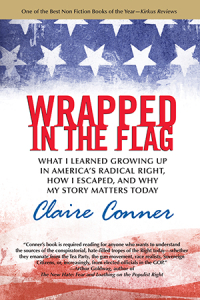
    Long before the rise of the Tea Party movement and the prominence of today’s religious Right, the John Birch Society, established in 1958, championed many of the same radical causes touted by ultraconservatives today. The daughter of one of the society’s first members and a national spokesperson about the society, Claire Conner grew up surrounded by dedicated Birchers and was expected to abide by and espouse Birch ideals. Forced to join at age thirteen, she became the youngest member of the society. It would take momentous changes in her own life before Conner finally freed herself of the legacy in which she was raised. Wrapped in the Flag is her intimate account of one of the most radical right-wing movements in our history and its lasting effects on our political discourse today.


    Enabling ActsLennard Davis’s Enabling Acts

    The American with Disabilities Act (ADA) is the widest-ranging and most comprehensive piece of civil rights legislation ever passed in the United States, yet the surprising story of how it came to be is little known. Acclaimed disability scholar Lennard Davis has written the first significant book on the history and the impact of ADA. Far from a dry account of bills and speeches, Enabling Acts recreates the dramatic tension of a story filled with indefatigable disability groups, advocates, and political heavyweights on the front lines of bringing about a truly bipartisan bill. This behind-the-scenes and on-the-ground narrative will make readers realize why the ADA has become the model for disability-based laws around the world.


    They Take Our JobsAviva Chomsky’s “They Take Our Jobs!” and 20 Other Myths About Immigration

    “Immigrants take Americans’ jobs, are a drain on the American economy, contribute to poverty and inequality, destroy the social fabric.” History professor Aviva Chomsky dismantles these common assumptions and others in “They Take Our Jobs!” and 20 Other Myths about Immigration. By debunking these myths, Chomsky shows how the parameters and presumptions of today’s immigration debate distort how we think and have been thinking about immigration. The notion that non-citizens are created equal is absent from the public discussion. This myth-busting book argues that the dividing line is citizenship.


    Rescuing JesusDeborah Jian Lee’s Rescuing Jesus

    Frustrated by its conservative politics and its culture wars, journalist Deborah Jian Lee left the evangelical world. She, however, has stayed close to those in the movement over the years and came to find that a new generation of evangelicals—LGBTQ and straight; white, black, Asian, Hispanic, and indigenous—are reclaiming the movement by pushing it in a more progressive direction. Women are rising in the ranks despite familiar sermons about female submission. Today’s young evangelicals are more likely than their elders to accept same-sex marriage. Lee’s Rescuing Jesus unpacks the diverse and complex strands of this movement, and argues how important it is for the future of evangelicalism and for the future of our country.


    Hunting SeasonMirta Ojito’s Hunting Season

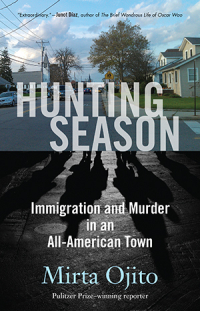
    Latinos, primarily men and not all of them immigrants, have become the target of hate crimes in recent years as the nation wrestles with swelling numbers of undocumented immigrants and the prevalence of anti-immigrant rhetoric. Marcelo Lucero, a thirty-seven-year-old undocumented Ecuadorean immigrant who worked at a dry cleaner’s, was one of the victims, murdered by a group of Long Island teenagers in the village of Patchogue. In Hunting Season, journalist Mirta Ojito draws from firsthand interviews and on-the-ground reporting to provide and unflinching and invaluable look at one of our most pressing issues.

  • By James W. Russell

    TIAA-CREF Building in Downtown Denver

    TIAA-CREF Building in Downtown Denver. Photo credit: Brian Papantonio.

    The ad from TIAA-CREF, the company that administers university and other retirement plans, which ran alongside my Yahoo inbox was too enticing to ignore. I clicked on the bait: “You could get ninety percent of your income and maintain your lifestyle in retirement.” The click brought me to another eye-catching claim: “On average, participants in TIAA-administered plans are on track to replace over ninety percent of their income in retirement.”

    These were eye-catching claims because I had been in TIAA for over thirty-five years and would be replacing nowhere near ninety percent of my preretirement income. Nor would anyone else I knew who was in TIAA. They were also eye-catching because according to Federal Reserve data, the average family approaching retirement in 401(k)-like plans that TIAA and other financial service companies administer has only accumulated $104,000. That amount is only sufficient to generate an annual retirement income of $4,000 to $6,000, depending on how it is distributed—hardly enough to replace ninety percent of their preretirement income, that is, unless they were living on a sub poverty income of $7,000 or less.

    How then could TIAA make such a claim? The advertisement included a footnote to its claim, literally in fine print. Being a researcher, I read the footnote.

    TIAA based its claim on a study of “641,895 actively contributing participants from 450 TIAA record-kept plans.” (It does not tell us whether those were all participants in all TIAA plans or a sample, and if the latter how it was drawn.)

    Besides the usual caveat that individual results may vary, according to the footnote, the study result contained a huge qualification. The ninety percent replacement rate included projected Social Security income. The participant would be on track not to receive ninety percent of preretirement income from the TIAA plan alone but from it combined with Social Security income. How much would come from each component was not stated.

    As significant, to arrive at the ninety percent result TIAA changed the meaning of what is commonly taken to be replacement income. In its words, “the projected retirement income stream (including estimated Social Security benefits) [is] in current dollars as a percentage of current salaries.” To use current rather than projected ending salaries, which is the common benchmark for income replacement studies, represents a huge methodological sleight of hand.

    Actively contributing participants are at all different ages and stages of their careers. Current salaries are ending salaries for only the oldest. Most others will be able to expect raises in future years to make their ending salaries much higher than their current ones. As written, the footnote indicates that future raises are not factored into calculating the income replacement ratio. The average current salary of this group will thus be far under what projected ending salaries would be. To achieve a ninety percent replacement ratio of the average current salary requires far less savings and investment returns than to achieve a ninety percent replacement ratio for the average ending salary.

    If participants range equally in age from twenty-five to sixty-five, then the average current salary would be for a forty-five year old. It is like telling a sixty-five year old retiree that she will have ninety percent of the salary she had twenty years ago—hardly a financially comforting thought.

    This is deceptive advertising that replicates what the financial services industry did in the 1980s when it first began replacing traditional pension plans with 401(k)-like plans. It claimed that retirees would gain more retirement income from these new plans than the ones they replaced by using overly optimistic assumptions of investment returns. By 2000, it was clear that precisely the opposite was occurring: 401(k)-type retirement incomes were much lower than traditional pension incomes.

    If TIAA really wanted to give potential participants in its plans a realistic idea of what they could expect, it would design a study of the actual rather than projected experiences of participants. After all, it has been in business since 1918, during which time generations of employees have retired under its plans. Why not tell us how much preretirement income was actually replaced by those plans? Better yet would be to allow its results to be independently examined.

    There is a simple reason why TIAA would not want to do that even though it easily has the information to do so. The average actual—not projected—replacement income ratio of ending salaries is most likely so low as to question the validity of the whole individual savings and investment approach that it shares with others in the 401(k) industry.

    Congress should demand that TIAA and other financial services industry release information on actual replacement income ratios for 401(k)-like plans and stop the deceptive advertising practice of using manipulated projected ratios.

    When a similar study was done for Chile’s privatized Social Security system based on the same retirement savings and investment approach as 401(k)s, it revealed that the average replacement ratio was actually thirty-four percent, less than half  the seventy percent projected and widely advertised by the privatizers.

    Knowing what such a study would reveal for the United States would enable us to grapple more effectively with the growing retirement crisis as opposed to deceptive claims of ninety percent income replacement ratios.


    About the Author 

    James W. RussellJames W. Russell is the author of eight books, including Double Standard: Social Policy in Europe and the United States and Social Insecurity: 401(k)s and the Retirement Crisis. An authority on retirement policy in the United States, Europe, and Latin America, Russell led one of the first employee movements to successfully challenge the dominant trend and replace a 401(k)-like plan with a more secure traditional pension plan. He has taught at universities in the United States and as a Fulbright professor in Mexico and the Czech Republic. He lives in Portland, Oregon. Learn more about James W. Russell on his website.