• By Roxanne Dunbar-Ortiz

    Dakota Access Pipeline Protest

    Dakota Access Pipeline Protest. Photo credit: UnicornRiot.Ninja

    Members of the Standing Rock Sioux Tribe have been protesting the construction of the Dakota Access pipeline since April. Slated to direct crude oil from North Dakota to Illinois, the multibillion-dollar project threatens to contaminate the Missouri River and likely destroy Native burial sites and sacred places. The protesters have received support and solidarity from representatives of other Indigenous nations from all over North America, Alaska, Hawaii, and the Andes, along with climate activists and the Black Lives Matter movement.

    The history of the Sioux peoples’ fight for their homeland runs deep. To understand the background of the protest, we turn to Roxanne Dunbar-Ortiz’s An Indigenous Peoples’ History of the United States.  In this excerpt, Dunbar-Ortiz unpacks the origin of the nineteenth-century treaties and colonial land-grabbing that have repeatedly denied the Sioux the right to their land.

    (Véase abajo la traducción al español de este extracto.)

    ***

    The first international relationship between the Sioux Nation and the US government was established in 1805[i] with a treaty of peace and friendship two years after the United States acquired the Louisiana Territory, which included the Sioux Nation among many other Indigenous nations. Other such treaties followed in 1815 and 1825. These peace treaties had no immediate effect on Sioux political autonomy or territory. By 1834, competition in the fur trade, with the market dominated by the Rocky Mountain Fur Company, led the Oglala Sioux to move away from the Upper Missouri to the Upper Platte near Fort Laramie. By 1846, seven thousand Sioux had moved south. Thomas Fitzpatrick, the Indian agent in 1846, recommended that the United States purchase land to establish a fort, which became Fort Laramie. “My opinion,” Fitzpatrick wrote, “is that a post at, or in the vicinity of Laramie is much wanted, it would be nearly in the center of the buffalo range, where all the formidable Indian tribes are fast approaching, and near where there will eventually be a struggle for the ascendancy [in the fur trade].”[ii] Fitzpatrick believed that a garrison of at least three hundred soldiers would be necessary to keep the Indians under control.

    Although the Sioux and the United States redefined their relationship in the Fort Laramie Treaty of 1851, this was followed by a decade of war between the two parties, ending with the Peace Treaty of Fort Laramie in 1868. Both of these treaties, though not reducing Sioux political sovereignty ceded large parts of Sioux territory by establishing mutually recognized boundaries, and the Sioux granted concessions to the United States that gave legal color to the Sioux’s increasing economic dependency on the United States and its economy. During the half century before the 1851 treaty, the Sioux had been gradually enveloped in the fur trade and had become dependent on horses and European-manufactured guns, ammunition, iron cookware, tools, textiles, and other items of trade that replaced their traditional crafts. On the plains the Sioux gradually abandoned farming and turned entirely to bison hunting for their subsistence and for trade. This increased dependency on the buffalo in turn brought deeper dependency on guns and ammunition that had to be purchased with more hides, creating the vicious circle that characterized modern colonialism. With the balance of power tipped by mid-century, US traders and the military exerted pressure on the Sioux for land cessions and rights of way as the buffalo population decreased. The hardships for the Sioux caused by constant attacks on their villages, forced movement, and resultant disease and starvation took a toll on their strength to resist domination. They entered into the 1868 treaty with the United States on strong terms from a guerrilla fighting force through the 1880s, never defeated by the US army—but their dependency on buffalo and on trade allowed for escalated federal control when buffalo were purposely exterminated by the army between 1870 and 1876. After that the Sioux were fighting for survival.

    Economic dependency on buffalo and trade was replaced with survival dependency on the US government for rations and commodities guaranteed in the 1868 treaty. The agreement stipulated that “no treaty for the cession of any portion or part of the reservation herein described which may be held in common shall be of any validation or force against the said Indians, unless executed and signed by at least three fourths of all the adult male Indians.” Nevertheless, in 1876, with no such validation, and with the discovery of gold by Custer’s Seventh Cavalry, the US government seized the Black Hills—Paha Sapa—a large, resource-rich portion of the treaty-guaranteed Sioux territory, the center of the great Sioux Nation, a religious shrine and sanctuary. When the Sioux surrendered after the wars of 1876–77, they lost not only the Black Hills but also the Powder River country. The next US move was to change the western boundary of the Sioux Nation, whose territory, though atrophied from its original, was a contiguous block. By 1877, after the army drove the Sioux out of Nebraska, all that was left was a block between the 103rd meridian and the Missouri, thirty-five thousand square miles of land the United States had designated as Dakota Territory (the next step toward statehood, in this case the states of North and South Dakota). The first of several waves of northern European immigrants now poured into eastern Dakota Terri- tory, pressing against the Missouri River boundary of the Sioux. At the Anglo-American settlement of Bismarck on the Missouri, the westward-pushing Northern Pacific Railroad was blocked by the reservation. Settlers bound for Montana and the Pacific Northwest called for trails to be blazed and defended across the reservation. Promoters who wanted cheap land to sell at high prices to immigrants schemed to break up the reservation. Except for the Sioux units that continued to fight, the Sioux people were unarmed, had no horses, and were unable even to feed and clothe themselves, dependent upon government rations.

    An Indigenous Peoples' History of the United StatesNext came allotment. Before the Dawes Act was even implemented, a government commission arrived in Sioux territory from Washington, DC, in 1888 with a proposal to reduce the Sioux Nation to six small reservations, a scheme that would leave nine million acres open for Euro-American settlement. The commission found it impossible to obtain signatures of the required three-fourths of the nation as required under the 1868 treaty, and so returned to Washington with a recommendation that the government ignore the treaty and take the land without Sioux consent. The only means to accomplish that goal was legislation, Congress having relieved the government of the obligation to negotiate a treaty. Congress commissioned General George Crook to head a delegation to try again, this time with an offer of $1.50 per acre. In a series of manipulations and dealings with leaders whose people were now starving, the commission garnered the needed signatures. The great Sioux Nation was broken into small islands soon surrounded on all sides by European immigrants, with much of the reservation land a checkerboard with settlers on allotments or leased land.[iii] Creating these isolated reservations broke the historical relationships between clans and communities of the Sioux Nation and opened areas where Europeans settled. It also allowed the Bureau of Indian Affairs to exercise tighter control, buttressed by the bureau’s boarding school system. The Sun Dance, the annual ceremony that had brought Sioux together and reinforced national unity, was outlawed, along with other religious ceremonies. Despite the Sioux people’s weak position under late-nineteenth-century colonial domination, they managed to begin building a modest cattle-ranching business to replace their former bison-hunting economy. In 1903, the US Supreme Court ruled, in Lone Wolf v. Hitchcock, that a March 3, 1871, appropriations rider was constitutional and that Congress had “plenary” power to manage Indian property. The Office of Indian Affairs could thus dispose of Indian lands and resources regardless of the terms of previous treaty provisions. Legislation followed that opened the reservations to settlement through leasing and even sale of allotments taken out of trust. Nearly all prime grazing lands came to be occupied by non-Indian ranchers by the 1920s.

    Indian land allotment under the Indian Reorganization Act, non-Indians outnumbered Indians on the Sioux reservations three to one. However, the drought of the mid- to late-1930s drove many settler ranchers off Sioux land, and the Sioux purchased some of that land, which had been theirs. However, “tribal governments” imposed in the wake of the Indian Reorganization Act proved particularly harmful and divisive for the Sioux.[iv] Concerning this measure, the late Mathew King, elder traditional historian of the Oglala Sioux (Pine Ridge), observed: “The Bureau of Indian Affairs drew up the constitution and by-laws of this organization with the Indian Reorganization Act of 1934. This was the introduction of home rule. . . . The traditional people still hang on to their Treaty, for we are a sovereign nation. We have our own government.”[v] “Home rule,” or neocolonialism, proved a short-lived policy, however, for in the early 1950s the United States developed its termination policy, with legislation ordering gradual eradication of every reservation and even the tribal governments.[vi] At the time of termination and relocation, per capita annual income on the Sioux reservations stood at $355, while that in nearby South Dakota towns was $2,500. Despite these circumstances, in pursuing its termination policy, the Bureau of Indian Affairs advocated the reduction of services and introduced its program to relocate Indians to urban industrial centers, with a high percentage of Sioux moving to San Francisco and Denver in search of jobs.[vii]

    Mathew King has described the United States throughout its history as alternating between a “peace” policy and a “war” policy in its relations with Indigenous nations and communities, saying that these pendulum swings coincided with the strength and weakness of Native resistance. Between the alternatives of extermination and termination (war policies) and preservation (peace policy), King argued, were interim periods characterized by benign neglect and assimilation. With organized Indigenous resistance to war programs and policies, concessions are granted. When pressure lightens, new schemes are developed to separate Indians from their land, resources, and cultures. Scholars, politicians, policymakers, and the media rarely term US policy toward Indigenous peoples as colonialism. King, however, believed that his people’s country had been a colony of the United States since 1890.

    The logical progression of modern colonialism begins with economic penetration and graduates to a sphere of influence, then to protectorate status or indirect control, military occupation, and finally annexation. This corresponds to the process experienced by the Sioux people in relation to the United States. The economic penetration of fur traders brought the Sioux within the US sphere of influence. The transformation of Fort Laramie from a trading post, the center of Sioux trade, to a US Army outpost in the mid-nineteenth century indicates the integral relationship between trade and colonial control. Growing protectorate status established through treaties culminated in the 1868 Sioux treaty, followed by military occupation achieved by extreme exemplary violence, such as at Wounded Knee in 1890, and finally dependency. Annexation by the United States is marked symbolically by the imposition of US citizenship on the Sioux (and most other Indians) in 1924. Mathew King and other traditional Sioux saw the siege of Wounded Knee in 1973 as a turning point, although the violent backlash that followed was harsh.

    Two decades of collective Indigenous resistance culminating at Wounded Knee in 1973 defeated the 1950s federal termination policy. Yet proponents of the disappearance of Indigenous nations seem never to tire of trying. Another move toward termination developed in 1977 with dozens of congressional bills to abrogate all Indian treaties and terminate all Indian governments and trust territories. Indigenous resistance defeated those initiatives as well, with another caravan across the country. Like colonized peoples elsewhere in the world, the Sioux have been involved in decolonization efforts since the mid-twentieth century. Wounded Knee in 1973 was part of this struggle, as was their involvement in UN committees and international forums.[viii] However, in the early twenty-first century, free-market fundamentalist economists and politicians identified the communally owned Indigenous reservation lands as an asset to be exploited and, under the guise of helping to end Indigenous poverty on those reservations, call for doing away with them—a new extermination and termination initiative.


    About the Author 

    image from www.beaconbroadside.comRoxanne Dunbar-Ortiz grew up in rural Oklahoma, the daughter of a tenant farmer and part-Indian mother. She has been active in the international Indigenous movement for more than four decades and is known for her lifelong commitment to national and international social justice issues. After receiving her PhD in history at the University of California at Los Angeles, she taught in the newly established Native American Studies Program at California State University, Hayward, and helped found the Departments of Ethnic Studies and Women’s Studies. Her 1977 book The Great Sioux Nation was the fundamental document at the first international conference on Indigenous peoples of the Americas, held at the United Nations’ headquarters in Geneva. Dunbar-Ortiz is the author or editor of seven other books, including Roots of Resistance: A History of Land Tenure in New Mexico. She lives in San Francisco. Follow her on Twitter at @rdunbaro.


    Notes

    [i] UN Commission on Human Rights, Sub-commission on Prevention of Dis- 
crimination and Protection of Minorities, 51st sess., Human Rights of Indigenous Peoples: Study on Treaties, Agreements and Other Constructive Arrangements between States and Indigenous Populations: Final Report, by Miguel Alfonso Martínez, special rapporteur, June 22, 1999, UN Document E/CN.4/Sub.2/1999/20. See also Report of the Working Group on Indigenous Populations on Its Seventeenth Session, 26–30 July 1999, UN Document E/CN.4/Sub.2/1999/20, August 12, 1999.

    [ii] Robert A. Trennert, Alternative to Extinction: Federal Indian Policy and 
the Beginnings of the Reservation System, 1846–51 (Philadelphia: Temple 
University Press, 1975), 166.

    [iii] Testimony of Pat McLaughlin, then chairman of the Standing Rock Sioux 
government, Fort Yates, ND (May 8, 1976), at hearings of the American Indian Policy Review Commission, established by Congress in the act of January 3, 1975.

    [iv] See Kenneth R. Philip, John Collier’s Crusade for Indian Reform, 1920–1954. Tucson: University of Arizona Press, 1977.

    [v] Matthew King quoted in Roxanne Dunbar-Ortiz, The Great Sioux Natiom: Sitting in Judgment on America. Lincoln:University of Nebraska Press, 2013. Originally published, 1977. 156.

    [vi] For a lucid discussion of neocolonialism in relation to American Indians 
and the reservation system, see Joseph Jorgensen, Sun Dance Religion: Power for the Powerless. Chicago: University of Chicago Press, 1977, 89–146.

    [vii] There is continuous migration from reservations to cities and border towns and back to the reservations, so that half the Indian population at any time is away from the reservation. Generally, however, relocation is not permanent and resembles migratory labor more than permanent relocation. This conclusion is based on my personal observations and on unpublished studies of the Indigenous populations in the San Francisco Bay area and Los Angeles.

    [viii] The American Indian Movement convened a meeting in June 1974 that founded the International Indian Treaty Council (IITC), receiving consultative status in the UN Economic and Social Council (ECOSOC) in February 1977. The IITC participated in the UN Conference on Desertification in Buenos Aires, March 1977, and made presentations to the UN Human Rights Commission in August 1977 and in February and August 1978. It also led the organizing for the Non-Governmental Organizations (NGOs) Conference on Indigenous Peoples of the Americas, held at UN headquarters in Geneva, Switzerland, in September 1977; participated in the World Conference on Racism in Basel, Switzerland, in May 1978; and participated in establishing the UN Working Group on Indigenous Populations, the UN Permanent Forum on Indigenous Issues, and the 2007 UN Declaration on the Rights of Indigenous Peoples. See: Walter R. Echo-Hawk, In The Light of Justice: The Rise of Human Rights in Native America and the UN Declaration on the Rights of Indigenous Peoples. Golden, CO: Fulcrum, 2013; Vine Deloria, Jr., Behind the Trail of Broken Treaties: An Indian Declaration of Independence. Austin: University of Texas Press, 1985. Originally published 1974: Roxanne Dunbar-Ortiz, Dalee Sambo Dorough, Gudmundur Alfredsson, Lee Swepston and Peter Wille, Eds., Indigenous Peoples’ Rights in International Law: Emergence and Application. Kautokeino, Norway & Copenhagen, Denmark: Gáldu and IWGIA, 2015.


    La gran nación sioux y su resistencia al continuado despojo territorial

    Publicado el 12 de septiembre de 2015

    Por Roxanne Dunbar-Ortiz

    Traducido por Nancy Viviana Piñeiro

    (Versión preliminar susceptible de corrección, que forma parte de la traducción del libro.)


    Manifestación contra el oleoducto Dakota Access. Foto: UnicornRiot.Ninja


    Desde el mes de abril, los miembros de la nación sioux de Standing Rock han estado manifestándose contra la construcción del oleoducto Dakota Access. El proyecto multimillonario tiene previsto llevar el crudo desde Dakota del Norte hasta Illinois y amenaza con contaminar el río Misuri, además de la posible destrucción de cementerios y otros lugares sagrados. Los manifestantes recibieron el apoyo y la solidaridad de representantes de otras naciones indígenas de Norteamérica, Alaska, Hawái y los Andes, y también de activistas ambientales y del movimiento Black Lives Matter.

    La historia de lucha del pueblo sioux por su territorio es profunda. El libro de Roxanne Dunbar-Ortiz, An Indigenous People’s History of the United States, nos ayuda a comprender el contexto de la actual protesta. En este extracto la autora rastrea el origen de los tratados del siglo XIX y de la apropiación colonial de la tierra, fenómenos que han despojado a los sioux del derecho a su territorio una y otra vez.

    ***

    La primera relación internacional entre la nación sioux y el Gobierno de los Estados Unidos se estableció en 1805[i] mediante un tratado de paz y amistad firmado dos años después de que ese país adquiriera el Territorio de Luisiana, que incluía a la nación indígena, entre muchas otras. Se firmaron acuerdos similares entre 1815 y 1825. Ninguno de esos tratados de paz tuvo consecuencias inmediatas en la autonomía política ni el territorio de los sioux. Hacia 1834, la competencia en el comercio de pieles y un mercado dominado por la Rocky Mountain Fur Company obligaron a los oglala sioux a alejarse del Alto Misuri y dirigirse hacia el curso alto del río Platte, cerca del Fuerte Laramie. Para el año 1846, siete mil sioux ya se habían desplazado hacia el sur. Thomas Fitzpatrick, el agente resposable de asuntos indígenas durante ese año, recomendó a los Estados Unidos que compraran tierras para establecer un fuerte, que sería el llamado Fuerte Laramie. Fitzpatrick escribió: “Opino que es muy deseable un puesto en Laramie o sus cercanías; estaría casi en el centro del área de búfalos, hacia donde se acercan con rapidez todas las formidables tribus indias, y cerca del lugar donde tarde o temprano habrá una lucha por la supremacía [en el comercio de pieles]”. [ii] Fitzpatrick creía que sería necesaria una guarnición de al menos trescientos soldados para controlar a los indígenas.

    A pesar de que los sioux y los Estados Unidos redefinieron su relación en el Tratado del Fuerte Laramie de 1851, a este le siguieron unos diez años de guerra entre ambas partes, que culminarían con el Tratado de Paz del Fuerte Laramie en 1868. Ambos tratados, si bien no redujeron la soberanía política de los sioux, cedieron porciones extensas de territorio indígena mediante el establecimiento de fronteras reconocidas por las dos partes; además, la nación indígena otorgó concesiones a los Estados Unidos que dieron carácter legal a una dependencia económica que iba en aumento. Durante el medio siglo previo al tratado de 1851, los sioux se habían visto cada vez más envueltos en el comercio de pieles y pasaron a depender de los caballos y las armas de fabricación europea, las municiones, los artículos de cocina de hierro, las herramientas, los textiles y otros productos de comercio que reemplazaron a sus objetos tradicionales. Esta creciente dependencia del búfalo significó, a su vez, una mayor dependencia de las armas y municiones que había que comprar con más pieles: un círculo vicioso que caracterizó al colonialismo moderno. Con una balanza de poder inclinada a su favor, los comerciantes y el ejército estadounidenses presionaron a los sioux para que estos cedieran tierras y derechos de vía a medida que disminuía la población de búfalos.  Las dificultades que padecieron los sioux como consecuencia de ataques constantes a sus comunidades, desplazamientos forzados, y de las enfermedades y hambrunas resultantes, hicieron mella en su capacidad de resistir la dominación. Para 1868, año de la firma del tratado con el gobierno estadounidense, eran fuertes desde el punto de vista militar ¾siguieron siendo una fuerza de combate guerrillero efectiva a lo largo de la década de 1880, sin haber perdido nunca ante el ejército de los Estados Unidos¾, pero su dependencia del búfalo y el comercio permitió el aumento del control federal cuando el búfalo fue exterminado deliberadamente por el ejército entre 1870 y 1876. De allí en adelante, la lucha de los sioux fue por la supervivencia.

    Pasaron de la dependencia económica de la caza y el comercio del búfalo a la dependencia del gobierno estadounidense, que les daba raciones y productos, según se garantizaba en el tratado de 1868. El acuerdo estipulaba que “ningún tratado de cesión de cualquier porción o parte de la reservación que aquí se referencia y pueda ser de uso común tendrá validez o fuerza alguna contra los mencionados indios, a menos que sea formalizado y firmado por al menos tres cuartas partes de todos los indios adultos de sexo masculino”. Sin embargo, en 1876, sin ningún tipo de validación y tras el descubrimiento de oro por parte de la Séptima Caballería de John Armstrong Custer, el gobierno estadounidense tomó las Colinas Negras (Paha Sapa), una gran extensión del territorio sioux garantizada por el tratado, rica en recursos, y que conformaba el centro de la gran nación sioux, además de ser un sitio sagrado. Cuando los sioux se rindieron, después de las guerras de 1876 y 1877, perdieron no solo las Colinas Negras, sino también el territorio del río Powder. La siguiente movida de los Estados Unidos fue modificar la frontera oeste de la nación sioux, cuyo territorio, aunque atrofiado respecto del original, constituía un bloque continuo. Para 1877, luego de que el ejército los expulsara de Nebraska, solo quedó un bloque entre el meridiano 103 y el río Misuri: 90 649 km2 de tierra que los Estados Unidos habían designado como Territorio Dakota (el siguiente paso hacia la estatalidad, en este caso, los estados de Dakota del Norte y Dakota del Sur). La primera de varias olas migratorias del norte europeo ahora ingresaba en el Territorio Dakota del este, presionando contra la frontera sioux del río Misuri. En el poblado angloamericano de Bismark sobre el Misuri, la reservación bloqueaba el avance hacia el oeste del Ferrocarril del Pacífico Norte. Los colonos que se dirigían a Montana y al Pacífico Noroeste exigían que se abrieran vías a lo largo de la reservación y se las defendiera. Los promotores que querían tierra barata para venderla a precios altos a los inmigrantes planeaban dividir la reservación. Salvo por las unidades de sioux que aún luchaban, el pueblo indígena estaba desarmado, sin caballos, y era incapaz siquiera de alimentarse y vestirse; dependían del gobierno para recibir raciones.

    Luego llegó la parcelación de tierras. Incluso antes de que se implementara la Ley Dawes (o Ley General de Parcelación), una comisión del gobierno estadounidense llegó a territorio sioux desde Washington D. C. en 1888, con una propuesta para reducir la nación sioux a seis pequeñas reservaciones: un esquema que liberaría unas 3 600 000 hectáreas a la colonización euroamericana. Fue imposible para la comisión reunir las firmas de tres cuartas partes de la nación sioux, como se exigía en el tratado de 1868, y entonces regresó a Washington con la recomendación de que el gobierno ignorara el tratado y se apropiara de las tierras sin el consentimiento indígena. El único medio para lograr ese fin era la legislación, ya que el Congreso había liberado al gobierno del requisito de negociar un acuerdo. Así fue que el Congreso le encargó al general George Crook que encabezara una delegación para volver a intentarlo, esta vez con una oferta de 3 dólares por hectárea. Tras una serie de manipulaciones, y tratos con líderes de un pueblo que se moría de hambre, la comisión reunió las firmas necesarias. La gran nación sioux fue fragmentada en pequeñas islas, que pronto quedarían rodeadas de inmigrantes europeos por todos los flancos, y la mayor parte de la reservación terminaría siendo un tablero con colonos establecidos en parcelas o tierras arrendadas. [iii] La creación de estas reservaciones aisladas quebró las relaciones históricas entre clanes y comunidades de la nación sioux y abrió áreas en las que se asentaron los europeos. También le permitió a la Oficina de Asuntos Indígenas ejercer un control mayor, apuntalado por su sistema de colegios pupilos. Se prohibió, junto con otras ceremonias religiosas, La “Danza del sol”, que todos los años congregaba a los sioux y fortalecía su unidad nacional. A pesar de la débil posición de este pueblo en el contexto de la dominación colonial de fines del siglo XIX, lograron establecer una modesta actividad ganadera para reemplazar su economía previa basada en la caza del búfalo. En 1903, la Corte Suprema de los Estados Unidos dictaminó, en el caso Lone Wolf vs. Hitchcock, que una cláusula de apropiación del 3 de marzo  de 1871 era constitucional y que el Congreso tenía “pleno” poder para administrar propiedad indígena. Así es que la Oficina de Asuntos Indígenas pudo disponer de tierras y recursos haciendo caso omiso de las disposiciones de los tratados anteriores. A esto le siguió legislación que dispuso de las reservaciones para el establecimiento de colonos mediante arrendamiento e incluso se vendieron parcelas que se eliminaron de los fideicomisos.

    Para la época de la era del “Nuevo trato”, también conocida como la era Collier, y la anulación de la parcelación que supuso la Ley de Reorganización, los no indígenas superaban en número a los indígenas en las reservaciones sioux por tres a uno. Sin embargo, la sequía que se extendió de mediados a fines de la década de 1930 expulsó a muchos ganaderos de las tierras sioux, y los indígenas compraron parte de esas parcelas, que habían sido de su propiedad. Sin embargo, resultó que los “gobiernos tribales” impuestos después de la Ley de Reorganización fueron especialmente perjudiciales y divisivos. [iv] Respecto de esa medida, el difunto Mathew King, viejo historiador tradicional de los sioux oglala (Pine Ridge), comentó: “La Oficina de Asuntos Indígenas redactó la constitución y los estatutos de esta organización con la Ley de Reorganización de 1934. Fue la introducción del autogobierno […]. El pueblo tradicional todavía se aferra a su Tratado, puesto que somos una nación soberana. Tenemos nuestro propio gobierno”. [v] Sin embargo, el “autogobierno”, o neocolonialismo, demostró ser una política de corta vida, dado que a principios de los años 50 los Estados Unidos desarrollaron su política de “terminación”: nuevas leyes ordenaron la erradicación gradual de cada reservación e incluso de los gobiernos tribales. [vi] Al momento de la terminación y relocalización, el ingreso per cápita anual de las reservaciones sioux era de 355 dólares, mientras que en los pueblos cercanos de Dakota del Sur era de 2 500 dólares. A pesar de estas circunstancias, y para ejecutar su política de terminación, la Oficina de Asuntos Indígenas promovió la reducción de servicios e introdujo un programa para relocalizar a los indígenas en centros urbanos industriales; un alto porcentaje de sioux se fueron a San Francisco y Denver en búsqueda de trabajo. [vii]

    Mathew King ha descrito a los Estados Unidos como un país que a lo largo de su historia fue alternando entre una política de “paz” y una de “guerra” en sus relaciones con las naciones y comunidades indígenas, y dijo que estos movimientos pendulares coincidieron con la fortaleza o debilidad de la resistencia de los nativos. King sostuvo que entre las alternativas de exterminio y terminación (políticas de guerra) y la preservación (política de paz), había periodos intermedios de abandono benévolo y asimilación. Ante la resistencia indígena organizada contra los programas y políticas de guerra, se otorgan concesiones. Cuando la presión disminuye, se diseñan nuevos esquemas para apartar a los indígenas de sus tierras, recursos y culturas. Estudiosos, políticos, formuladores de política y los medios rara vez describen la política estadounidense hacia los pueblos indígenas como colonialismo. King, sin embargo, creía que su nación había sido colonia de los Estados Unidos desde 1890.

    La progresión lógica del colonialismo moderno comienza con la penetración económica y avanza gradualmente hacia una esfera de influencia, luego a un estatus de protectorado o control indirecto, ocupación militar y, por último, anexión. Esto se corresponde con el proceso que experimentó el pueblo sioux en su relación con los Estados Unidos. La penetración económica de los comerciantes de pieles hizo que los sioux ingresaran a la esfera de influencia de los Estados Unidos. La trasformación del Fuerte Laramie de puesto comercial, centro del comercio con los sioux, a puesto militar estadounidense a mediados del siglo XIX demuestra la relación esencial que existe entre el comercio y el control colonial. Un estatus de protectorado cada vez mayor, establecido mediante tratados, culminó en tratado de 1868; a este le siguió la ocupación militar, obtenida por medio de la violencia aleccionadora, como la que se vio en la masacre de Wounded Knee en 1890, y por último, la dependencia. La anexión por parte de los Estados Unidos quedó marcada simbólicamente en 1924 mediante la imposición de ciudadanía a los sioux (y a la mayoría de los pueblos indígenas). Mathew King y otros sioux tradicionales consideraron la toma de Wounded Knee en 1973 como un punto de inflexión, aunque la violenta reacción que le siguió fue severa.

    Dos décadas de resistencia indígena colectiva, que culminó con Wounded Knee en 1973, derrotaron la política federal de terminación de los años 50. Aun así, los defensores de la desaparición de naciones indígenas parecen no rendirse nunca. En 1977 se tomó otra medida hacia la “terminación”: decenas de proyectos legislativos intentaron derogar todos los tratados indígenas y terminar con sus gobiernos y territorios protegidos por fideicomisos. La resistencia indígena también derrotó esas iniciativas con otra caravana a lo largo del país. Al igual que otros pueblos colonizados del mundo, los sioux han llevado adelante esfuerzos descolonizadores desde mediados del siglo XX. Wounded Knee en 1973 fue parte de esa lucha, como también lo fue la participación en comités de las Naciones Unidas y en foros internacionales. [viii] Sin embargo, a principios del siglo XXI, los economistas y políticos fundamentalistas del libre mercado identificaron a las reservaciones indígenas de propiedad comunitaria como un bien que debe ser explotado y, con el pretexto de ayudar a poner fin a la pobreza de los indígenas en esos territorios, instan a deshacerse de ellos: una nueva iniciativa de “terminación” y exterminio.


    Sobre la autora

    Roxanne Dunbar-Ortiz es hija de un peón de campo y de una madre con ascendencia indígena y creció en la Oklahoma rural. Ha participado activamente en el movimiento indígena internacional por más de cuatro décadas, y es conocida por su incansable compromiso con la justicia social en su país y en el mundo. Después de terminar su posdoctorado en historia en la Universidad de California en Los Ángeles, dio clases en los nuevos programas de Estudios sobre los Indígenas Norteamericanos en la universidad estatal de California, Hayward, y ayudó a crear el Departamento de Estudios Étnicos y Estudios de la mujer, como se denominaban en ese momento. Su libro de 1977, The Great Sioux Nation (La gran nación sioux) fue el documento fundamental en la primera conferencia internacional sobre pueblos indígenas de las Américas, celebrada en la sede las Naciones Unidas en Ginebra. Dunbar-Ortiz es autora y editora de otros siete libros, entre ellos,  Roots of Resistance: A History of Land Tenure in New Mexico (Raíces de la resistencia: Historia de la tenencia de la tierra en Nuevo México) y uno disponible en español: La cuestión miskita en la revolución nicaragüense. Vive en San Francisco y la pueden seguir en su cuenta de Twitter @rdunbaro.


    Notas

    [i] Comisión de Derechos Humanos de las Naciones Unidas, Subcomisión de Prevención de Discriminaciones y Protección de las Minorías, 51° periodo de sesiones, Derechos Humanos de las Poblaciones Indígenas: Estudio sobre los tratados, convenios y otros acuerdos constructivos entre los Estados y las poblaciones indígenas: Informe final, presentado por el Sr. Miguel Alfonso Martínez, Relator Especial, 22 de junio de 1999, Documento E/CN.4/Sub.2/1999/20 (Disponible en español). Véase también Informe del Grupo de Trabajo sobre las Poblaciones Indígenas acerca de su 17º período de sesiones, 26 al 30 de julio de 1999, Documento E/CN.4/Sub.2/1999/19, 12 de agosto de 1999 (Disponible en español).

    [ii] Robert A. Trennert, Alternative to Extinction: Federal Indian Policy and the Beginnings of the Reservation System, 1846–51, Filadelfia, Temple University Press, 1975, p. 166.

    [iii] Testimonio de Pat McLaughlin, entonces presidente del gobierno de Standing Rock Sioux, Fort Yates, ND (8 de mayo de 1976), en las audiencias de la American Indian Policy Review Commission, establecida por el Congreso en la ley del 3 de enero de 1975.

    [iv] Véase Kenneth R. Philip, John Collier’s Crusade for Indian Reform, 1920–1954, Tucson, University of Arizona Press, 1977.

    [v] Matthew King, citado en Roxanne Dunbar-Ortiz, The Great Sioux Natiom: Sitting in Judgment on America, Lincoln, University of Nebraska Press, 2013, p. 156. Primera edición: 1977.

    [vi] Puede encontrarse un análisis lúcido del neocolonialismo referido a los indígenas norteamericanos y el sistema de reservaciones en Joseph Jorgensen, Sun Dance Religion: Power for the Powerless, Chicago, University of Chicago Press, 1977, pp. 89–146.

    [vii] Existe una migración continua desde las reservaciones hacia las ciudades y pueblos aledaños, y de vuelta a las reservaciones, de manera que la mitad de la población indígena en cualquier periodo de tiempo se encuentra fuera de las reservaciones. Sin embargo, por lo general, la relocalización no es permanente y se asemeja más a la mano de obra migrante que a la relocalización definitiva. Esta conclusión se basa en mis observaciones personales y en estudios no publicados sobre las poblaciones indígenas en el Área de la Bahía de San Francisco y Los Ángeles.

    [viii] El Movimiento Indígena Estadounidense convocó a una reunión en junio de 1974 en la que se fundó el Consejo Internacional de Tratados Indios (IITC, por su sigla en inglés), y adquirió estado consultivo ante el Consejo Económico y Social de las Naciones Unidas (ECOSOC) en febrero de 1977. El IITC participó en la Conferencia de las Naciones Unidas sobre Desertificación celebrada en Buenos Aires en marzo de 1977, e hizo presentaciones ante la Comisión de Derechos Humanos de la ONU en agosto de 1977 y en febrero y agosto de 1978. También encabezó los preparativos para la Conferencia Internacional de ONG sobre los Pueblos Indígenas de las Américas, que se celebró en la sede de la ONU en Ginebra, Suiza, en septiembre de 1977; participó en la Conferencia Mundial contra el Racismo en Basilea, Suiza, en mayo de 1978; y en el establecimiento del Grupo de Trabajo de Naciones Unidas sobre Poblaciones Indígenas, el Foro Permanente para las Cuestiones Indígenas de la ONU y la Declaración de las Naciones Unidas sobre los derechos de los pueblos indígenas, de 2007. Véanse: Walter R. Echo-Hawk, In The Light of Justice: The Rise of Human Rights in Native America and the UN Declaration on the Rights of Indigenous Peoples, Golden, CO, Fulcrum, 2013; Vine Deloria, Jr., Behind the Trail of Broken Treaties: An Indian Declaration of Independence, Austin, University of Texas Press, 1985. Primera edición: 1974; Roxanne Dunbar-Ortiz, Dalee Sambo Dorough, Gudmundur Alfredsson, Lee Swepston y Peter Wille, Eds., Indigenous Peoples’ Rights in International Law: Emergence and Application, Kautokeino, Noruega y Copenhague, Dinamarca, Gáldu y IWGIA, 2015.
  • By Nicholas DiSabatino

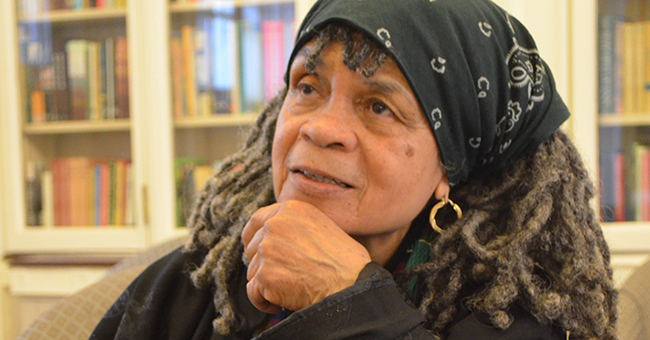
    Sonia SanchezDear Sister Sonia:

    We’ve never met in person, yet we’ve spoken on the phone dozens of occasions since I joined Beacon Press back in 2012. I’ve been so blessed to work with you as your publicist these past few years. It’s a strange feeling to “know” someone only via the phone. I feel in some ways like we’re long distance pen pals, even though you’re only in Philadelphia and I’m in Boston. I’ve come to expect that particular warmth in your voice whenever we speak and I hear that familiar “Brother Nicholas, any calls?” from you. It’s part of who you are as a person and an artist.

    You have lived countless lives and filled numerous roles: poet, playwright, teacher, activist, mother, friend, and one of the foremost leaders of the Black Arts Movement in the 1970s. You came to Beacon Press in 1995 and granted us the privilege of working with you through some of your best work: Wounded in the House of a Friend, Does Your House Have Lions?, Like the Singing Coming Off the Drums: Love Poems, Shake Loose My Skin, and Morning Haiku. You’ve been awarded for your artistry, education, and activism, named the Poet Laureate of Philadelphia, and even been made the subject of a documentary, BaddDDD Sonia Sanchez.

    For me, though, you’ll always be Sister Sonia, the woman who recommended I put tiger balm on my chest to clear up my sinus infection, who sent me a handwritten note and gift on the occasion of my wedding last year, and who always wants to know how I’m feeling as we discuss upcoming media and event opportunities over the phone.

    On this your birthday, I wish you many happy returns, and thank you for the wonderful spark you’ve brought to this world through your writing, activism, teaching, and compassion.

    You are a remarkable “BaddDDD” woman.

    Yours truly,

    Brother Nicholas DiSabatino


    About the Author 

    Nicholas DiSabatino, former Beacon Press publicist, graduated from Kent State University and has an MA in Publishing and Writing from Emerson College.

  • By Deborah Jiang-Stein 

    Deborah Jiang-Stein and Gloria Steinem

    Deborah Jiang-Stein and Gloria Steinem. Photo credit: unPrison Project

    In our fame machine culture of “Look at me, look at me!” where fame is marketed as a drug of choice, we’re consumed by the notion that the only light worth seeking is the limelight. I recently had the privilege to witness another way to hold the light.

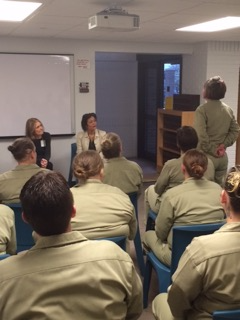
    With Gloria Steinem at my side last spring, we entered the state prison for women in Minnesota to share a tour and speaking engagement. She was in Minnesota on a generous acceptance when I invited her to a fundraiser for the nonprofit I founded, the unPrison Project, so that we could raise funds to reach the thirty-one states that have requested my speaking and our programming into their women’s prisons.

    First of all, don’t call her an icon. I hadn't realized this from her public media presence. Up close, I learned she doesn’t take on the identity as an icon. She is truly one of the most humble women I’ve ever met.

    Her work is not about Gloria Steinem. She is not dedicated to her fame; she’s dedicated to the work of her mission that elevates the status of girls and women. She’s all about the message, not the messenger, and her fame is a by-product of her work. She is accessible, and people have been able to hear her and respect her for over five generations because of her humility. As far as the myth that she only fights for the white, middle-class “feminist liberation movement” is concerned, she started early in her activism to reach communities of color and indigenous people.

    My Life on the RoadGloria helped me confirm my personal and professional purpose. Every trip I make to a prison around the country, which is a continual step into a new environment each time, is exactly what I was born to do. Learning circles, which Gloria writes about in her recent book, My Life on the Road, are as vital inside prisons as on the outside. She herself is a life-long learner and deep listener, not the Oh Holy Mother of All Answers which some people lay on her.

    My obsessed focus on elevating awareness, hope, and opportunities for women in prison is, now more than ever, my life’s work. Most of all, my time with Gloria showed me what I’ve believed for a long time: fame can lead to spiritual vacancy when humility isn’t along for the ride.

    Here’s the passage from My Life on the Road where she writes about visiting the women’s prison in Minnesota with me.

    ***

    Prison BabyWe meet outside the prison with both the surprise of strangers, and instant intimacy. I have read her book, Prison Baby: A Memoir, and she has read my writing. I know she was born to an incarcerated and addicted mother, was lucky to survive withdrawal from the heroin she had absorbed from her mother’s body and blood, and also lucky to spend her first year in a rare prison with a nursery so she could be with her mother. Then she was adopted by a Jewish family of teachers who gave her the gift of education, a gift she passes on to imprisoned women like her mother who was in and out of prison all of her life.

    Since she is way more familiar than I am with prison routine, she guides me through a filling out forms, removing jewelry, leaving everything but our clothing in a locker, and passing through metal detectors. When we are finally in the halls of the prison itself—surprising because they are bright and clean and depressing because there is no way out—we see five mothers with very young children. I am sad because I know this is a rare visiting day. Deborah is not sad because she knows this prison is rare in allowing maternal visits at all. Because it is a weekend, the first big room we enter has about thirty women listening to two volunteer musicians who have come in to entertain. When I ask about the many empty seats, the male guard explains that gatherings have to be small because prisoners far outnumber the guards, and they could be overwhelmed in a riot. One has never happened here, it is a rule made for men’s prisons.

    Steinem and Jiang-Stein at Shakopee Women’s Prison in Minneapolis, Minnesota

    Steinem and Jiang-Stein at Shakopee Women’s Prison in Minneapolis, Minnesota. Photo credit: Minnesota Department of Corrections

    Here as nationally, the number of incarcerated women has gone up by 800 percent in the last twenty years, mostly because of drugs. There is a well-stocked library, and when we enter, the librarian, a Smith College graduate, has gathered a dozen women prisoners who are talking around a table. But if our school system didn’t produce one of the lowest literacy rates in the developed world—if the rate of childhood sexual abuse, domestic abuse and drug addiction weren’t so high—those dozen women would probably not be here at all. I meet separately with twenty or so prisoners in a very competitive and successful military-style program that creates confidence, and reduces the likelihood of return, but it is so about marching and barking out orders in West Point style that we spend quite a while talking in a room together before anyone speaks spontaneously or laughs or calls me by my first name.

    I can see why Deborah is devoting her life to talking to people outside prisons about people inside, and to people inside about kindness, literacy, skills and hope in any form. They are like sponges soaking up attention and the novelty of being listened to. It’s just possible that prison could be a restorative and communal place.

    I leave with the hope of going to other prisons with Deborah, including men’s prisons where she takes her book program to fathers, too. I feel I have entered a world where I want to be again, a world where small things can make a big difference.

    From the book MY LIFE ON THE ROAD by Gloria Steinem. Copyright (c) 2016 by Gloria Steinem. Reprinted by arrangement with Random House, an imprint of Random House, a division of Penguin Random House LLC. All rights reserved.


    About the Author 

    Deborah Jiang-SteinDeborah Jiang-Stein is author of the memoir Prison Baby. She is founder of the unPrison Project, a 501(c)3 nonprofit working to empower and inspire incarcerated women and girls. Deborah advocates for creative free expression, capacity building, and mentoring. She works to build public awareness about mass incarceration as a collaborator and a keynote speaker. Deborah is a 2012 graduate of The Women’s Media Center progressive Women’s Voices, the nation’s premier media and leadership training program for women. Follow her on Twitter at @deborahdash and visit her website.

  • By Bill Fletcher, Jr.

    Teaching Assistant Orientation

    Photo credit: Center for Teaching Vanderbilt University

    Graduate students have been attempting to organize labor unions for decades. Until recently, those at private universities and colleges have been blocked from unionizing largely due to a Supreme Court decision from 1980, NLRB v Yeshiva University, that placed graduate students into the camp of managerial personnel and, therefore, ineligible for unionization and collective bargaining. The National Labor Relations Board has shifted the entire discussion with a decision affecting Columbia University graduate students. Just recently, Yale University students filed a petition for union recognition.

    The claim that graduate students were somehow managerial never passed the ‘straight face test.’ They are paid poorly, are subject to the direction of professors, and have little control (or say) over their teaching load. They are treated as if they can and should survive on the honor of having an audience with a full professor. For years, graduate students have argued that this is absurd.

    Graduate student unionism is not a whim, as demonstrated by this multi-decades long justice struggle by wave after wave of graduate students (despite the odds!). It speaks to a broadening sense of the need and importance of unionism beyond traditional workforces.

    To the extent that many of us are aware of labor unions and labor unionism, it is frequently associated with blue collar employment or, more recently, public school teachers. Yet entire sectors of the economy witness little or no union presence, though they desperately need it. This absence is not, in the main, due to a lack of interest in labor unions. Rather, employers and their allies in government have made it exceedingly difficult for most workers to join or form labor unions. The case of graduate students is on point. The Supreme Court decision of 1980 in Yeshiva threw a monkey wrench into efforts to expand the reach of unions. Its arguments did not correspond to the changing nature of work in the USA.

    And herein lies the larger issue and why the recent NLRB decision is of such importance. The nature of work and the workplace have changed dramatically since the passage of the National Labor Relations Act in 1935 (which granted the right to unionization and collective bargaining). Jobs and categories that at one point might have appeared to have been legitimately independent and/or managerial have shifted in their role, authority, and relationship to power. Medical personnel, particularly doctors, who at one point were highly independent, are increasingly subject to the dictates of insurance companies and medical networks. The days of independent doctors, such as early 1970s television’s Marcus Welby, MD are long-gone (if you, the reader, even remember that television series), as the medical industry shifted dramatically beginning in the late 1980s.

    Graduate students are part of this changing workforce. Many, if not most of them, are encumbered by immense amounts of debt both from their undergraduate years as well as their current graduate education. Once upon a time, the future of a graduate student was largely dependent on the good graces of their professor-supervisors. Such a system was never fair and appropriate, in that it was based on personality rather than the putting into place a system to protect the basic rights and responsibilities of the graduate student. Hopefully we are on the verge of a new era of expanding the ability of graduate students and other professionals to organize.

    Graduate students of the world, unite!


    About the Author 

    Bill Fletcher, Jr.Bill Fletcher, Jr. is a talk show host, writer, and activist.  His book from Beacon Press, “They’re Bankrupting Us!” And Twenty Other Myths about Unions, addresses many of the misconceptions about unions and unionism. Follow him on Twitter, Facebook, and at www.billfletcherjr.com.

  • By Marc Bekoff

    Laboratory mice

    Photo credit: Maggie Bartlett, NHGRI.

    This essay appeared originally in Psychology Today.

    A number of people have asked me to weigh in on the National Institutes of Health (NIH) recent announcement that they would like to lift the ban on animal-human chimera research. Basically, a chimera “is a single organism composed of cells from different zygotes. This can result in male and female organs, two blood types, or subtle variations in form.”

    I’m against this sort of research for any number of reasons, most of which Jessica Pierce and I discuss in our forthcoming book The Animals’ Agenda: Freedom, Compassion, and Coexistence in the Human Age. In addition to arguing that the time has come to stop invasive research—and this surely is highly invasive, some might say reprehensible research—and to develop and to use non-animal preparations and models, many of which are already available, we argue that existing animal welfare regulations are extremely weak, taxonomically far too narrow, and patronize other animals because human interests invariably trump those of the nonhuman animals (please see, for example, “Rats Like Tickling: Why Is the Animal Welfare Act So Lame?” and “Invasive ‘Rat Research’ Should be Abolished Once and for All”).

    Animal welfare also does not focus on individual animals, whereas the “science of animal well-being,” proposed in The Animals’ Agenda does (please also see “Animal welfare cannot adequately protect nonhuman animals: The need for a science of animal well-being”). 

    What will the chimeras be called, just who are they, and how will they be protected? Existing regulations do not consider rodents to be animals

    The Animals' AgendaI’m also very worried about the lives of the hybrid animals themselves. For example, what will they be called—there is a lot in a name—and just who are they? As sentient beings, they will experience rich and deep emotions as did the animals who provided the genes for these unprecedented and unknown “monsters.” However, because existing animal welfare regulations are weak and narrow and clearly favor researchers with agendas that are not that animal-friendly, I worry about how these individuals will be treated. For example, the United States’ federal Animal Welfare Act (AWA) does not consider some rodents to be animals, and they and birds, fishes, other vertebrates, and invertebrates are not protected by the AWA. Here is a quote from the federal register: “We are amending the Animal Welfare Act (AWA) regulations to reflect an amendment to the Act’s definition of the term animal. The Farm Security and Rural Investment Act of 2002 amended the definition of animal to specifically exclude birds, rats of the genus Rattus, and mice of the genus Mus, bred for use in research.”

    Many people do not believe that the AWA actually does not consider rodents to be animals, however, this really is the case, as absurd as it may seem. Another concern is how this research is to be controlled and what sorts of oversight there will be. Unfortunately, many researchers cannot be relied on to work on behalf of the animals, and I fear that it’s going to be almost an “anything goes” atmosphere because researchers will be so excited by their creations, and as such, there will be a good deal of harm, suffering, and death, not only as the chimeras are created, but also when they are being used in different sorts of research. It’s essential to remember that these chimeras will be sentient, feeling beings, who care about what happens to them.

    Because of the blatant and self-serving shortcomings of the current AWA, my concerns are well grounded in precedent and there are no compelling reasons to think the AWA will change anytime soon. Because of these reasons I am totally against this sort of research and hope NIH and other researchers will change course and continue to ban this sort of work.

    Monsters are a challenge to anthrozoology

    ​Lastly, I want to emphasize that creating chimeras is a challenge to anthrozoologists who are interested in human-animal relationships. As I mentioned above, the AWA does not consider rodents to be “animals,” so just who are the chimeras? Will new regulations have to be developed to protect them, or are they to be dispensed with along with rodents and other beings who really are animals?

    There are many serious questions that need to be considered before the ban on chimera research is lifted, and it's not at all clear if the necessary homework has been done. 


    About the Author 

    Marc Bekoff, author of The Emotional Lives of Animals, is professor emeritus of ecology and evolutionary biology at the University of Colorado, Boulder, and a former Guggenheim fellow. He has published more than a thousand scientific and popular essays and thirty books. His forthcoming book co-authored with Jessica Pierce, The Animals’ Agenda: Freedom, Compassion, and Coexistence in the Human Age, will be released in April 2017. He lives in Boulder. Follow him on Twitter at @MarcBekoff and visit his website.


  • By Lynn Hall

    Grand Teton National Park

    Grand Teton National Park. Photo credit: Lynn Hall

    At 10,500 feet, I sit on the end of a switchback leading up Paintbrush Divide in Grand Teton National Park. I’m supposed to continue moving—running when I can, hiking when I can’t—to crest the pass and descend back to Jackson Lake, completing a twenty-mile loop. But instead of collecting myself to continue upwards, I sit and stare. Thousands of feet below me, the basin is a fertile palate of greens: the sages, olives, and emeralds of pine trees, wild flowers, and shrubs. Across the expansive valley, Grand Teton juts into the air more than 3,000 feet higher than where I am now. Its lower, concave slopes are still snow covered, as are the upper gulleys and ledges. The grandness of this basin is nearly impossible to absorb. I have to sit a long while before I even begin to believe the beauty is real.

    This summer I’m spending days upon whole weeks running, hiking, and climbing. My excuse is that I need to train for a September 100-mile ultra-marathon through the mountains of northern Utah. But the real reason I am seeking out the wilderness so fervently is that it is the only way I know to cope with mounting anxiety about my forthcoming memoir.

    Caged Eyes: An Air Force Cadet’s Story of Rape and Resilience will be the first traditionally-published memoir about sexual assault within the US military. It isn’t just a memoir of the “worst night of my life,” as so many stories of rape are referred to. It’s also a candid look at the layers of entwined trauma: sexual abuse when I was a teenager, a later rape when I was a cadet at the Air Force Academy, and a subsequent meningitis infection which would cause chronic pain and end my career. There are just as many layers of antagonists: a mother who, despite her best intentions, would ultimately betray me; an institution which failed to protect me; and classmates who ostracized me.

    Hardest of all, my memoir is an admission of all of my former self’s failings, my failings to help myself and to be strong. Caged Eyes is a memoir brimming more with vulnerability than accusations.

    At first, writing was cathartic, even therapeutic. Writing was a way for me to explore what happened to me. I examined my reactions and found forgiveness for myself. I found forgiveness for others. When I shared those early versions and readers met me with empathy and solace, my shame slowly dissipated.

    Eventually the therapeutic effects ran dry. When I forced myself to relieve these moments again and again, when there was no longer healing attached to any of it, the memoir at times became torturous.

    A root symptom of post-traumatic stress disorder is the unconscious belief that whatever trauma one experienced is inescapable and permanent. As Raymond Douglas wrote in his memoir, On Being Raped, “Rape is always now.” Every time I re-immersed myself in my memoir, I experienced the rapes and the spinal taps and the intensive care unit and my mother’s abandonment and my classmates’ condemnation anew, just as if it was “always now.”

    Turning the hard years of my young adulthood into 90,000 words of beauty and activism is the single greatest accomplishment of my life so far. I am equally proud of myself and grateful for the opportunity.

    But it’s also true that publishing this memoir at times feels re-traumatizing. These events of those years are now even more inescapable. Each time I rewrote the manuscript, or reviewed copy-edits, or now look at my young eyes staring back at me from the book’s cover, I felt the grief return. It’s as if the eighteen-year-old who was once pinned to a library carpet and raped is forever trapped there.

    I read the same plot-line for the umpteenth time, still unable to rescue her from the library floor or the intensive care unit, and her fate remains unchanged. As I am redeemed, she is forever trapped.

    As I march towards publication day, my post-traumatic stress disorder has worsened. Once a few months ago, I dreamt of being forced to undergo yet another spinal tap, as if the doctor’s needle was as violating as a rape. I awoke with such vivid sensations of men holding me down that I couldn’t tell it had been a dream. Besides nightmares, panic attacks have returned. I wake in the night unable to breathe or move. During the day, I might go to Walgreens, and the antiseptic smell emanating from the pharmacy brings me back to an emergency room. Loud children in the grocery store unnerve me, as does standing in a crowd.

    Preparing for the release of this memoir requires me to remind myself on a day-to-day basis that I am no longer eighteen, no longer a cadet at the Air Force Academy, no longer pinned to that library floor. I remind myself by seeking out the wilderness.

    I’ve done just that all along this process. Once, I took a long hiatus from writing, and over three years I climbed each of Colorado’s fifty-eight highest 14,000-foot peaks. Eventually, I combined my passion for mountaineering with my love of running, and I began to race in ultra-marathons on mountain trails.

    When writing saddled me with grief, I climbed the sandy hills of Great Sand Dune National Park with friends. When I was too consumed with rage to continue writing, I camped in Yellowstone and Glacier National Parks with my partner. After I finished the last draft, I ran in the desolate Canyonlands of Utah. To cope with the anxiety while agents read the manuscript, I climbed Mt Rainier in Washington. After I finished working on a book proposal with my agent, I scrambled on the slick rock in Arches. I ran a double traverse of Rocky Mountain National Park while editors considered the book proposal. I ran a double traverse of the Grand Canyon while waiting for the cover design and author endorsements.

    And now I am here in yet another national park, the Grand Tetons, while I await publication.

    Ironically, the wilderness is where I continuously re-establish my present-day safety. Here I reduce my survival to basics: Have I had enough to eat? Where will I find more water? Can I stay warm enough or cool enough? Even in these untamed places—with bears and snakes, lightning, cliffs and exposed ledges—I prove again and again that I am no longer the girl of my past. I reconnect with my most true self who has grown into her strength and confidence. I know my past is behind me.

    The wilderness reminds me of the beauty in the world, in my life, and in myself. Nature’s majesty is the anecdote to the feelings of being trapped in a story which was sometimes brutal.

    On this one-hundredth anniversary of the national parks, I celebrate what our wilderness gives to me and to all of those who seek out its medicine.


    About the Author 

    Lynn Hall is an activist in the movement against sexual violence whose writing has appeared in Signs: Journal of Women in Culture and Society and Hippocampus Magazine, among other publications. She lives in Boulder, CO. Her memoir Caged Eyes: An Air Force Cadet’s Story of Rape and Resilience comes out in February 2017. Follow her on Twitter at @LynnKHall and visit her website.

  • By Dennis A. Henigan

    Insurrection

    No reasonable person who has heard, or read, Donald Trump’s words about Hillary Clinton and her determination to “abolish the Second Amendment” can fail to be appalled at his suggestion of violence to an audience in Wilmington, North Carolina:

    Hillary wants to abolish—essentially abolish the Second Amendment. By the way, if she gets to pick, if she gets to pick her judges, nothing you can do, folks. Although the Second Amendment people, maybe there is, I don’t know.

    Trump was saying, without ambiguity, that once Hillary Clinton is elected President, she will appoint judges who will, in Trump’s view, “abolish the Second Amendment” and the only people who can successfully defend the Second Amendment against this judicial assault are those willing to take action by force of arms, either against President Clinton, or the judges, or whoever else must be targeted. 

    The suggestion of politically-motivated violence against public officials is terrifying on its face, but it is certainly nothing new.  Indeed, Trump’s comments are a specific application of the “insurrectionist” view of Second Amendment rights that has long been a core tenet of the ideology of the National Rifle Association and the far right. According to that view, the overriding purpose of the Second Amendment is to guarantee the populace the arms it may need to resist government tyranny.  An NRA lawyer explained, “…the Second Amendment was directed at maintaining an armed citizenry for mutual defense, and perhaps most significantly, to protect against the tyranny of our own government.” (emphasis supplied) “The founders sought to protect arms from government interference,” he continued, “because those same arms might be needed to protect the people from government.” (emphasis supplied) Some years later, an NRA official put it somewhat more colorfully: “the Second Amendment…is literally a loaded gun in the hands of the people held to the heads of government.” 

    The NRA likes to refer to the Second Amendment as our “First Freedom,” because it is seen as the ultimate protector of all our other rights. In 2010, the NRA’s Wayne LaPierre received deafening cheers at the Conservative Political Action Conference when he declared that “liberty is but an illusion,” unless we are ready to defend it against the government by force of arms: 

    Our divine rights, they might have been endowed by a Creator, but they are preserved by mortals, if we mortals have the means and the will to make it stick…Freedom is nothing but dust in the wind till it’s guarded by the blue steel and dry powder of a free and armed people…Our founding fathers understood that the guys with the guns make the rules.

    (emphasis supplied) It is worth pausing on that last phrase. Under the NRA’s view, we are free only to the extent that our guns allow us to impose our will on others.

    Who is to determine when the government has become a tyranny, justifying armed resistance? If the right to be armed is an individual right, as the NRA insists and as the Supreme Court first held in the 2008 Heller decision, and the point of that right is to enable resistance to government, then it must be up to each individual to decide when the time for insurrection has come. And “tyranny” is very much in the eye of the beholder. For Timothy McVeigh, whose 1995 bombing of a federal building in Oklahoma City was at the time the most deadly terrorist attack in U.S. history, the FBI and ATF became agents of tyranny when they set siege to the Branch Davidian compound in Waco, Texas. The Ku Klux Klan invoked the insurrectionist theory of the Second Amendment to justify its resistance to forced racial integration. Today, right-wing “citizen militias” cite the Second Amendment as they train with assault weapons to resist a federal government that has allegedly destroyed sacred property rights. To the killers of police officers in Dallas and Baton Rouge, perhaps police shootings of black civilians tyrannized minority communities sufficiently to justify armed resistance. Inevitably, the NRA’s insurrectionism becomes a prescription for anarchy in which only those with the most deadly weapons prevail.  After all, “the guys with the guns make the rules.” It is hard to imagine a doctrine more at odds with democratic government and the rule of law. It is an absurd paradox to find a right of insurrection in the Constitution when such a right would be the end of Constitutional government.

    Although Donald Trump has been endorsed by the NRA, it is doubtful that he saw himself as invoking the NRA’s insurrectionist theory of the Second Amendment, or that he ever had a serious thought about the validity of a constitutional right of armed resistance. On its face, his suggestion of violence as a remedy against the rulings of Clinton-appointed judges should be disqualifying for any Presidential candidate. But what makes his words especially dangerous is that they likely resonated with the cadre of gun extremists who have thoroughly absorbed the NRA’s insurrectionist ideology. In their view, what could be a more serious threat to liberty than the appointment of judges who would destroy the Second Amendment itself—the freedom that is the foundation of all our other freedoms? If you believe that “the guys with the guns make the rules,” what could be a more powerful justification for armed resistance than the need to rewrite the rules set by a Clinton judiciary that would destroy our First Freedom?

    We can only hope that Trump’s stupid, irresponsible comment did not plant the seeds of violence. But if it did, we know that the NRA plowed the fertile ground in which they could grow.


    About the Author 

    Dennis A. Henigan is director of legal and policy analysis at the Campaign for Tobacco-Free Kids and formerly vice president of the Brady Center to Prevent Gun Violence. Follow him on Twitter at @DennisHenigan and visit his website.

  • By José Orduña

    2016 Democratic National Convention from the Wells Fargo Center in Philadelphia, PA

    2016 Democratic National Convention from the Wells Fargo Center in Philadelphia, PA. Photo credit: ABC/Ida Mae Astute

    I couldn’t bear to watch the DNC or the RNC in their entireties as they aired on television, but over the course of those days following the conventions, I was pulled into watching clips by an impulse similar to the one that makes me watch blackhead removal videos on the Internet. I’ve watched so much close-up footage of sebum being squeezed out of skin holes that the pleasure of being revolted has been subsumed into a dull impulse to click on the following link. I was surprised, though, to have my sense of revulsion restored by the peaks and plateaus of depravity that shone through the drone of political theatre this time around.

    One convention featured the jingoistic speeches of retired generals, and ex-CIA director Leon Panetta, of protestors chanting “No more war!” being out shouted by people chanting “U-S-A!” The other convention was the Republicans’. As a Mexican immigrant naturalized as a US citizen in 2011, this is the second US general election for which I am eligible to vote. And as someone who cares about the lives of Latin Americans both in the United States and abroad, I find myself reeling at the fact that I’ll have to vote for a lesser evil that celebrates the endorsement of individuals that should be recognized as war criminals.

    Much has been written about the horror of Trump. Liberal commentators all seem to agree that he is a candidate unique in his potential for destruction, someone who is abnormal, and categorically evil. Some, like Vox’s Ezra Klein, have gone so far as to say, “Trump’s nomination is the first time American politics has left me truly afraid,” scrubbing history, and the present moment of bi-partisan war crimes, mass deportations, and ongoing racial terror. The amnesia and myopia of this kind of political commentary, which seemed to unify after the Khizr and Ghazala Khan spectacle, have been stomach-turning. Rather than engage critically with the machinations of power represented during this particular incident, liberal commentators seemed to come together in a chorus of outrage, ignoring the fact that in addition to Trump’s insults, the DNC also dishonored the Khans by using them as ethno-religious representatives because their son died exerting US military power in a war that was voted for by Hillary Clinton.

    This kind of amnesia and myopia is chief among the litany of horrors a figure like Donald Trump represents. Were it not for Trump’s perfectly villainous rhetoric—his blatant racism, his overt misogyny, his Islamophobia, his disgusting insinuations—there might be a more honest appraisal of the other candidate’s policies. More so-called progressives might be inclined to seriously ask themselves why individuals like Robert Kagan (pusher and champion of the unilateral invasion of Iraq), Mike Morell (former acting director of the CIA who, during an interview with Charlie Rose in 2014, rhetorically asked how someone could not torture if they thought it might save American lives and insidiously suggested leaders believed torture to be effective despite the CIA’s “KUBARK” interrogation manual plainly stating in 1963 that it isn’t), and John Negroponte (US ambassador to Honduras from 1981-1985, during which he facilitated the funding and training of death squads and helped set up Honduras as the staging ground for the US-led contra war) have publicly endorsed Hillary Clinton.

    Donald Trump has said he would build a wall along the US/Mexico border, but what he should have said is that he would continue building the wall Bill Clinton broke ground on in the mid 90s south of San Diego, California. And three decades after John Negroponte’s havoc-wreaking time in Honduras, havoc that continues to compel migration north, he’s endorsed Hillary Clinton, a candidate who has just recently helped legitimize the military coup that replaced democratically elected President of Honduras with a violent and repressive right-wing government. In 2014, when CNN’s Christiane Amanpour asked Clinton what should be done about the unaccompanied minors that had fled that violence in Honduras and come to the United States recently, she replied that the United States government should send them back.

    Karla Ortiz, an eleven-year-old girl born in the United States to undocumented parents, was brought on stage during the DNC. She told her story, garnered some sympathy, and helped signal that the DNC is the party for immigrants and Latinos. Trump would deport her parents, while Clinton would focus on deporting the parents of other little girls just like Karla, parents who might have made mistakes in the past, rendering them ineligible of sympathy and dignity. During the Obama Administration, the Democrats meekly pushed for what they referred to as comprehensive immigration reform. The mainstream media publicized it as a bill that would help immigrants. In reality, it was a bill to help a small number of special undocumented immigrants while making life horrific for the vast majority of those without papers. If it had passed, it would have brought about an unprecedentedly large border militarization and surveillance apparatus, essentially a physical and virtual wall along the US/Mexico border.

    Watching the DNC and RNC have reinforced my belief that November—this or any other—is not the month during which substantive political progress will be made. I used to feel that the Democrats and Republicans were two sides of the same coin, but they seem much more bound up than that. They seem to stand in a productive opposition that sustains them both. That fact has become increasingly clear after the primaries concluded and Clinton’s platform seemed to find it’s footing solely on the idea that she is not Trump.


    About the Author 

    image from www.beaconbroadside.comJosé Orduña was born in Córdoba, Veracruz, and immigrated to Chicago when he was two. He is a graduate of the Nonfiction Writing Program at the University of Iowa and active in Latin American solidarity. He is the author of The Weight of Shadows: A Memoir of Immigration and Displacement.

  • By Alondra Nelson

    Twelve-foot bronze statue of Alex Haley

    Twelve-foot bronze statue of Alex Haley. Photo credit: Joel Kramer

    Today marks the fortieth anniversary of Alex Haley’s Roots: The Saga of an American Family. The appeal of genetic ancestry testing, especially among African Americans, can’t be understood without taking into account the massive influence of Haley’s novel (as well as the miniseries adapted from the book a year after its publication in 1976). A potent symbol of the Black power movement, Roots stimulated interest in genealogy and affirmed the importance of African-American history. Sociology professor Alondra Nelson felt the effects of the cultural sensation, too, when the miniseries first aired. Later on, she would investigate her own genealogical roots and the unexpected story of how genetic testing is affecting race in America. In this excerpt from her book The Social Life of DNA: Race, Reparations, and Reconciliation after the Genome, Nelson takes us back to 1977 and recounts how Haley’s work inspired her to begin her journey of self-discovery and genetic intrigue. 

    ***

    Like many Americans, my family and I were riveted by the Roots miniseries when it first aired in January 1977. I vividly recall sitting in front of the television with my mother, father, sister, and two brothers watching the story of Alex Haley’s family unfold in Technicolor.

    My father, having just completed a tour at sea, reclined in an armchair, his feet up. My mother was on the sofa with one or two of us kids twined tightly around her. The other two of us were on the floor, alternately being admonished by our parents not to lie too close to the screen or told, courtesy of a sibling, to move out of the way. On Sunday evening, when it became apparent that we would view the first episode in its entirety—well past our bedtimes—we knew we were in uncharted territory.

    The Roots occasion provided one of those unforgettable moments when a child sees her parents in a new light. Watching Roots, I also watched my parents, who were visibly stirred by Haley’s account. More than a few times during those eight evenings, my mother’s eyes welled with tears. She frequently shook her head and murmured “Uhm-uhmuhm,” as I had heard Mary, her Philadelphia-born mother, do many times. An inherited response for emotions that defy language, perhaps. My father, who hailed from New Orleans, was characteristically stoic, but occasionally allowed a “That’s a damn shame” during an especially graphic or tragic scene. I realize now that while watching Roots, my parents similarly watched us, their children. They were worried and protective, interspersing their own commentary between scenes, hoping to ameliorate the dramatic effect of this painful history.

    The Roots effect expanded beyond our family home, perched on the edge of a craggy San Diego canyon, to my grade school, nestled in a valley. I was called Kizzy and Kunta Kinte by my mostly blond classmates during first period at my Southern California private school. But during our lunch breaks, the teasing gave way to earnest but clumsy conversations. In the schoolyard, we tried to make sense of what Roots meant for our interracial friendships, for our discussions in Sister Nora’s American history class, and for our nation in the wake of its bicentennial. In our own ways, we each wondered, Who are we in relation to this history? Did this really happen? If so, how did we get from then to now—and where do we go from here?

    Haley made his mark as a collaborator on The Autobiography of Malcolm X, the late activist’s influential account of his political transformation published in 1965. This work emerged at the beginning of the black power era. Roots, published in 1976, and the television miniseries that was based on it, which premiered a year later, were culminating symbols of the era. This was the time of the Afro and the dashiki—of the “Black is beautiful” ethos. Between 1965 and 1977, black Americans turned to their African origins with intensity.

    This interest in African origins and, in turn, genealogy was piqued in 1977. This watershed year also saw the publication of Black Genealogy by Charles L. Blockson, a primer of root-seeking attuned to the needs of African Americans, who faced especially steep hurdles in tracing ancestry. The Afro-American Historical and Genealogical Society (AAHGS), the first national black organization dedicated to genealogy and family history, was also established in 1977. In the intervening decades, genealogy only grew in appeal for African Americans. In the last decade, with the decoding of the human genome, new tools were introduced that expanded the popularity of genealogy exponentially and, moreover, gave it multifaceted uses.

    I began research for this book in 2003 after noting mention in the press of a DNA testing service that promised to help blacks trace their roots. I was captivated. At that time, genetic ancestry testing was in its infancy and traditional gatherings of genealogists were where the early adopters of these new root-seeking techniques could be found. I attended scores of these gatherings, large and small, throughout the country from Oakland, California, to Bedford, Massachusetts, and numerous places in between. My travels also took me to the United Kingdom. In these places, I encountered genealogists who had been using archives and oral history to reconstruct their family stories and who were willing to try the new genetic-ancestry-testing services that were just hitting the market.

    I’ve also participated in events and conferences at which genetic genealogy testing was discussed, including meetings at churches, libraries, and universities, and conducted fieldwork and interviews in settings both virtual and concrete. I interacted with genetic genealogists and eventually, in a now well-established tradition of social science research called “participant observation,” I also became a root-seeker. I started conducting research on my own family’s history, which besides Pennsylvania and Louisiana traverses parts of the southern United States as well as the country of Jamaica, and became a card-carrying member of the Afro-American Historical and Genealogical Society.

    Building a bridge to Africa has inspired black American arts, letters, and politics for generations. Even if these speculative “roots” tests I read about never materialized, here a cutting-edge answer was being proposed to a central enigma of African America—a remedy that seemed ripped from the pages of a sci-fi novel. Speculation soon gave way to the news that a black geneticist named Rick A. Kittles had launched African Ancestry with his business partner, Gina Paige. Among the earliest direct-to-consumer testing companies in the United States, it was the first niche-marketed to people of African descent. As an ethnographer and historian of African America, with a special interest in science and technology—as befitting a child born from the union of a cryptographer and a mechanical technician—I knew that I had to join Kittles on this journey.

    I used what social scientists call “snowball sampling” when conducting my interviews with root-seekers. In other words, I interviewed genealogists about their decision to use genetic ancestry testing and the effects of the results on their lives, and they, in turn, referred me to others. As I would discover, what was snowballing was not only the number of people in my interview network, but the surprising ways the test results were being put to use. That is, I was also being given an unexpected map of how genetic information was being used by individuals, communities, and institutions. Yes, personal and family information was gleaned. But in these conversations there was also growing mention of how broadly genetic ancestry testing was being used as the industry evolved. For over a decade, I’ve followed Kittles and African Ancestry, and in this time, have come to take a long view of genetic ancestry testing, a perspective that is more mosaic than the predictable, ritualized scenes of revelation and surprise we have become accustomed to witnessing on popular genealogy television shows.

    As a wide-eyed girl watching Roots, and wondering about mine, I never could have dreamed a future where one day I’d have the surreal experience of having my genealogical results revealed to me before a crowd of African diaspora VIPs and civil rights leaders, and with a prominent actor, Isaiah Washington, as master of ceremonies. Although this experience elicited mixed emotions in me, I can personally attest that new branches on ancestral trees are the undeniable graft of genetic genealogy.


    About the Author

    Alondra Nelson is Dean of Social Science and professor of sociology and gender studies at Columbia University. She is author of the award-winning book Body and Soul: The Black Panther Party and the Fight Against Medical Discrimination and her writing has appeared in the New York Times,Washington Post, Science, Boston Globe, and the Guardian. She lives in New York City. Follow her on Twitter at @sociallifeofdna and visit her website.

  • By Steven Hill

    Millennials

    Photo credit: State Farm

    Millennials may be the most educated generation to date, but they’re earning less today than preceding generations. Factor in high unemployment, stagnant wages, a slowly recovering economy, and student loan debt, and their economic well-being looks precarious. What’s more, Millennials may see a reduced Social Security retirement benefit if changes are not made to how we fund the most popular government program ever. Is there a solution? How can we shore up Social Security’s funding?  In his recent book Expand Social Security Now!: How to Ensure Americans Get the Retirement They Deserve, author Steven Hill shows why Millennials actually have nothing to worry about from Social Security—if we make the right changes. In the following passage, he explains why we should expand it rather than cut it back.

    ***

    Billionaire Peter G. Peterson has been one of the pioneers of this kind of intergenerational doomsaying. Headlines about the old stealing from the young certainly grab the media spotlight. But this one is an old, old trope that never made any sense. Peterson first raised it back in 1982, in the midst of the deliberations of the Greenspan Commission. Social Security, Peterson wrote, “threatens the entire economy. . . . The Social Security system will run huge deficits . . . these deficits will push our children into a situation of economic stagnation and social conflict and create a potentially disastrous situation for the elderly of the future.”

    Peterson became greatly distressed when the Greenspan Commission did not undertake his prescribed overhaul of Social Security. So after Peterson made his billions on Wall Street, he founded his eponymous Peterson Foundation, as well as other organizations like the Concord Coalition and Committee for a Responsible Federal Budget, to help promote his wild-eyed prophecies about the coming intergenerational war. He has used his various organizations to, among other crusades, fund college and high school campaigns and organizations called “Up to Us,” The Can Kicks Back, Lead . . . or Leave, and Third Millennium, which have served as the youth arm of his various entitlement-busting efforts. The Can Kicks Back president Ryan Schoenike was quoted in the Washington Post as saying, “The [federal] debt is now the top of line issue for most young people,” but Salon’s Alex Pareene called that “a weird lie.” Pareene also pointed out that this wasn’t the first “pretend youth group” founded or funded by Peterson. Peterson has spent a good chunk of his billions stirring up a youthful mob with pitchforks, pushing them to bang at the gates of their grandmas and grandpas for stealing their birthright.

    But Peterson hasn’t been the only Cassandra prophesying a generational war between young and old. More recently, the Washington Post’s Robert J. Samuelson took up the cause. “We need to stop coddling the elderly,” he wrote in a 2013 column, calling Social Security and Medicare “a growing transfer from the young, who are increasingly disadvantaged, to the elderly, who are increasingly advantaged.” In a 2014 column, Samuelson continued his anti-elderly and antigovernment debt diatribe, writing, “Giving the elderly as a class special treatment heaps the costs of deficit reduction on workers and children.”

    Pitting the elderly against children makes little sense for many reasons, but one obvious one is that today’s children will one day be seniors themselves. And they will need the retirement benefits that people like Peterson and Samuelson are trying to cut from retirees. Robbing Peter to pay Paul might make sense from a maniacally focused budget buster’s perspective, but it makes little sense from a public policy perspective. If that makes sense, then why not cut funding from cancer research, or diabetes treatment, since those ailments mostly affect older people and not the young. But obviously the young today could be attacked by those ailments tomorrow. Society benefits as a whole when it tries to address conditions that affect humanity as a whole.

    One of those conditions is growing old. Everyone will pass through that stage of life (unless death comes knocking prematurely), and it makes no sense to not do all that is humanely and financially possible to help the elderly. Otherwise, where might this sort of knee-jerk reaction end? Why not pit middle-aged people and their needs against seniors? Or against children,for that matter? Or, as Altman and Kingson put it, “There is much more inequality within any given age group than there is between age groups.” For example, there is a lot more inequality between wealthy seniors and poor seniors, and between youth from wealthy and poor families, than there is between seniors and youngsters. It simply makes no sense to carve up the class distinctions in this way and point an incriminating finger that pits the young against the old.

    Interestingly, economist Dean Baker, from the Center for Economic Policy and Research, points out that other countries have successfully supported both the elderly and the young. According to Baker, “Countries that spend a larger share of their GDP supporting their seniors also spend a larger share of their income supporting the young.” In his study, Baker found that a dollar of additional per capita spending on kids is associated with sixty-seven cents of additional spending on seniors. In other words, he says, it’s not a case of one or the other. “The countries that are willing to spend more to support their seniors are also willing to spend more to ensure that their kids get a decent start in life.” And in looking at policy choices over the past couple of decades, what becomes additionally clear is that any savings from cuts to Social Security and Medicare are not necessarily going to benefit programs for children. More likely they will end up as tax cuts for businesses, banks, or the wealthy, or will pay for the latest high-tech versions of military equipment.

    In fact, if you want to really deal with the sources of debt that will drown the prospects of younger people, let’s talk about health-care costs. The nation now spends over 17 percent of our GDP on health care, which is twice as much as the amount spent by virtually every other developed nation (and we only cover about 89 percent of the US population, compared to those nations covering 100 percent). Those costs are simply unsustainable and will bankrupt future generations. Note that cutting Medicare or Medicaid benefits, as the Pete Peterson’s of the world want to do, will solve nothing because it will just push those costs onto the private sector (in fact, that would make things even worse, since Medicare and Medicaid are actually much more cost efficient than the private health-care system). So yes, future generations will in fact drown in debt—if we don’t address health-care-cost inflation. But that has nothing to do with Social Security, or even the thrifty Medicare.

    Social Security will always have somewhat of a perception problem among younger Americans. For a certain number, it will always be viewed as “money for old people who get it from the government.” For people of any age who are working and having taxes deducted from their paychecks, Social Security is a benefit for someone else—elderly retirees. But at some point in their life, those people will no longer be able to work, and, like any type of insurance, Social Security will be there to protect them with “wage insurance” from a complete loss of earned income. Social Security is self-insurance in that way, that is, protection against the risks we all face due to old age, disability, or death. That’s a point that must be brought home to every new generation of young Americans.

    And the evidence shows that younger people are figuring it out. Much to the chagrin of the “generational war” propagandists, their campaign does not seem to be gaining traction. A poll in August 2015 commissioned by senior advocacy group AARP found that nine in ten young people (adults under thirty) believe Social Security is an important government program, and nearly nine in ten (85 percent) want to know it will be there when they retire. Nevertheless, the fact that this baseless idea periodically arises from the crypt is proof that if enough money is thrown at a bad notion, it can live forever.


    About the Author 

    Steven HillSteven Hill is a Senior Fellow with the New America Foundation and a Holtzbrinck Fellow at the American Academy in Berlin. He is the author of six books, including Raw Deal: How the “Uber Economy” and Runaway Capitalism Are Screwing American Workers, which was selected by The Globalist as one of the Top Ten Books of 2015. His op-ed’s, articles and media interviews have appeared in the New York Times, Washington Post, Wall Street Journal, The Atlantic, Politico, CNN, C-SPAN, BBC, Financial Times,Guardian, Bloomberg News, Fox News,National Public Radio, The Nation, Salon,Slate,Observer, Fast Company, Business Insider, HuffingtonPost, Le Monde, Die Zeit, Al Jazeeraand many others. His other books include Europe’s Promise: Why the European Way Is the Best Hope in an Insecure Age and 10 Steps to Repair American Democracy. He is a co-founder of FairVote/Center for Voting and Democracy. Follow him on Twitter at @StevenHill1776 and visit his website.