• A Conversation with Reverend Elizabeth M. Edman and Deborah Jian Lee

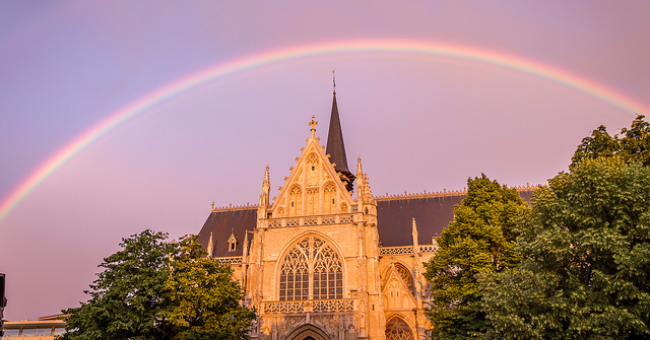
    Rainbow over the church

    Photo credit: Sergei Mutovkin

    In Queer Virtue: What LGBTQ People Know About Life and Love and How It Can Revitalize Christianity, Reverend Elizabeth M. Edman draws from over three decades of experience studying, preaching, and teaching from the western canon of Christian Scripture to attest the inherent queerness of authentic Christianity. Journalist Deborah Jian Lee reports from the front lines of the battle younger and more diverse Evangelicals are waging to reclaim Christian ideals and harness them to promote social change in Rescuing Jesus: How People of Color, Women, and Queer Christians are Reclaiming Evangelicalism. While Edman and Lee have written for different target audiences, they both address a growing movement within Christianity to embrace and accept the LGBTQ community. We caught up with them to ask about this shift in the landscape of progressive religion in this two-part conversation. Here we present the second part.

    ***

    What is the history of opposition to the LGBTQ community from the Religious Right? 

    Deborah Jian Lee: The Religious Right has routinely said, “Instead of us needing our LGBT members to be whole, we need to cut them off from the community or they need to cut off parts of their identity from themselves. They must conform to our heteronormative standards in order to be accepted.” And we see this history not just from messages from the pulpit, which are powerful and devastating, but also in the way the Religious Right has incorporated this belief into our political system and into the social structures of the church.

    We saw this when Focus on the Family pushed for Amendment 2 in Colorado, which opposed legal protections for LGBTQ people. We saw this in the way marriage amendment proposals appeared on ballots in the 2004 election. We see this in the way that Evangelical institutions, from colleges to churches to non-profit organizations, discriminate against sexual minorities in their employment and admission practices. It’s just so devastating because the statistics point to a huge spike in mental health risk for sexual minorities who live in non-affirming communities. Even though suicide rates are astronomical, even though youth LGBT homeless rates are so much higher (and oftentimes a direct result of non-affirming religious beliefs held by parents)—despite the volumes of evidence that non-affirming theology causes direct psychological and physical harm, certain parts of the Evangelical community are totally unmoved. Instead, they are committed to holding this hardline stance against the queer community.

    But what gives me hope is the fact that so much of that is changing. In the past, there wasn’t a voice that called these values and practices into question. And now there is. It’s a growing population of queer Evangelicals are mobilizing and really changing the church for the better.

    Rev. Elizabeth Edman: You were talking earlier about the people who are fleeing the church in droves, and of course that takes place in progressive Christianity as well—the sheer drop in numbers has a lot of people panicked about the fate of Christianity, particularly in the Western world. But thinking about the decline of Christianity as a numbers problem is just so off base, because what the church is supposed to be about is bringing us to an authentic understanding of who God created us to be.

    I can’t tell you how many queer people I’ve talked to who have had the experience of finding home in an Evangelical community and then being thrown out of it. And it drives people out of the church altogether. It just does immense damage. It’s a profoundly abusive act to pull somebody in and shove them out like that, especially when you’re reaching into people’s deepest sense of self.

    I recently had this amazing conversation with a young man who said to me, “You know, when you talk about Christianity this way, it just makes sense! I’m queer and I’m Christian, and I’ve always had this sense that these parts of me have been in dialogue with each other, but I’ve always been told that they’re not. I’ve always been told that there’s this wall between them. And as you talk about the relationship between these two parts, it’s like I can feel them organically beginning to speak to each other. And it just feels so right and so good.”

    What’s amazing about the story of the queer undergraduates at Biola is that when that false barrier is ruptured, when those different parts of a person are able to speak to each other, and then to connect to other people with the same thing taking place, real church emerges, you know? Authentic church can emerge. It’s alive.

    Lee: And it’s life-giving.

    Rev. Edman: Yes, and that’s evangelism. That’s what the good news is.

    Lee: Yes, that’s exactly it. We need people of color, queer Christians, and women with total agency and independence to be their whole selves. We need them to bring their experiences of the world and their unique cultural perspectives to the body of Christ because we can learn from that. We need that.

    Rev. Edman: Absolutely!

    This year’s Pride theme was “Solidary Through Pride.” How do your books speak to this year’s Pride theme? 

    Queer VirtueRev Edman: Queer Virtue posits that there’s this path of discerning an identity, getting honest about it in the face of risk, reaching out to others who share a comparable identity marker, building community around that, and then looking to the margins to see who’s not included. There are two parts in the book. In the first part, I explore that path step by step, theologically, by looking at both how I see that playing out in queer communities, what it means in queer communities, and then making the case that this path is resonant with Christianity and in many ways identical to the Christian path. The second part of the book is asking: where does the rubber hit the road? How do we live this out as an ethic, both in queer experience and in Christianity? This becomes an ethical lesson for the church. The first step of this path is discernment of identity. And the chapter in the second half of the book that correlates to that is called “Pride.”

    Knowing who you are is crucial to living an ethical life at all; and knowing who you are is crucial to navigating healthy dynamics of Self and Other. You can know who you are and be proud of who you are without disparaging other people. So pride, the healthy kind of pride, is the ethical correlation to a healthy sense of identity. You see this operating within LGBTQ communities where people are increasingly naming, with growing finesse, a sense of who we are as sexual beings. And when the LGBTQ community is healthy, you see people being able to claim their own identity and recognize other people’s identity with respect and love. And it’s just awesome to see. My hope would be that Christians could develop a kind of Pride that is fundamentally about solidarity, where you’re able to name your own identity—Love it! Love it in yourself!—and then allow other people to name themselves and find places where you can share spaces that are respectful and affirming.

    Lee: Rescuing Jesus begins by showing how an inability to enact true solidarity and intersectional justice led to the collapse of the progressive Evangelical movement of the 1970s and 1980s. Back then, in order for any progressive movement within Evangelicalism to make even small incremental progress, that movement would need to prove their conservative cred on every other issue. Conservative white Evangelical culture consistently pits minority groups against each other, which ultimately undermines any kind of intersectional justice movement.

    We saw this with the evangelical feminist movement, which blossomed at the end of the 1970s, led by The Evangelical Women’s Caucus. This group had chapters around the country and would gather in big conferences that focused on upending patriarchy within Evangelicalism. But in the 1980s, as lesbians and allies in the group worked to pass a resolution that supported gay civil rights, the group split. Many of the women feared this resolution would undermine their credibility within the Evangelical world and cost them their jobs at churches and Evangelical institutions. These women left the Evangelical Women’s Caucus and formed Christians for Biblical Equality, which has done a lot of great work to advance women’s equality in the church while purposefully avoiding  issues of sexual orientation. As a result, there are these two Christian feminism groups. The one that supported gays and lesbians lost power and lost membership over time, almost had to shut their doors. The one that stood in opposition to gays and lesbians flourished and became the most influential egalitarian Evangelical group that is still thriving today. The lesson, which minority groups within Evangelicalism have internalized for years: “If I want to make progress in these issues that matter to me, I need to deny equal rights, representation, and fairness for all other minority groups.”  

    What’s interesting and hopeful about this new generation is that people embody intersectionality. It’s much harder for this new generation to segment themselves. This generation of Evangelicals rejects the pattern of their predecessors that pitted minority groups against each other. Instead, they’re working towards authentic intersectional justice that includes everybody.

    For example, I interviewed Darren Calhoun, a leader within the Evangelical movement who’s black, gay, and Christian. He talks about how for a long time, the LGBT movement was all about marriage equality. And he talked about how he values marriage equality, but, as a person of color, he wants the movement to address the urgent issues that affect queer people of color, such as higher rates of homelessness, police brutality, mass incarceration, abuse within the prison system, employment and housing discrimination, etc. It’s so encouraging to see that people like Darren, people who embody multiple minority identities, are gaining prominence as faith leaders who are reshaping evangelical activism in revolutionary and downright inspiring ways.

    Finally, it’s impossible not to be aware of Orlando as we talk. How are you thinking about this in light of your work?  
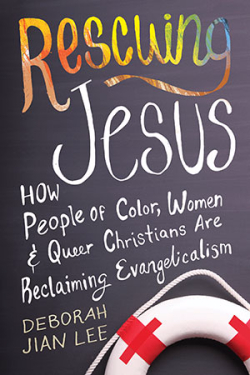
    Rescuing JesusLee: The response by LGBTQ people to the tragedy in Orlando is just another testament to what this community has to teach the rest of us. This mass shooting retraumatized a community that is still fighting for safe spaces in the country, that is still fighting against policies and ideologies that degrade them, and yet amid this adversity they’ve persisted in articulating an enduring message of love. I’m so grateful for the way the queer community has expressed their grief, their anger, their hope, their love, and their stories in the wake of Orlando. I’ve learned so much about the sacred spaces they’ve created for each other. Especially among the younger generation, I’ve seen an intentional focus on the intersectional identities of the victims of the shooting at Pulse and some amazing, swift moves to organize so that our society can better protect the most marginalized of the marginalized.

    Here’s one of many examples. A few queer faith activists organized to form Will Listen With Love, which is a Facebook group of pastors, spiritual leaders, mental health providers, and peer counselors who have made themselves available to support LGBTQI people who are in pain following the massacre in Orlando. In just a few days, hundreds signed up to be available to counsel those hurting. 

    On top of that, LGBTQ Christians continue to engage with and educate their faith communities. I’m just so floored by the love they show to the communities that reject them and the patience and generosity they demonstrate in these relationships. I hope straight cis-people in the church recognize just how much of a gift they are receiving.

    Rev. Edman: I have been floored by the level of grief I hear LGBTQ people expressing, and I have to say I am feeling it myself. One purpose I had in writing Queer Virtue was to bind up the wounds of queer people. The week after Orlando, I heard this pop song that talks about waiting ages for a beloved to show up, seeing that person standing alone and knowing that this is the person you’ve been waiting for; this is someone you already love. It reminded me instantly of the experience of growing up queer, waiting and waiting to find our community. And I heard it from the perspective of someone inside the community waiting with open arms for young people to find us. I pictured the faces of those young Latinx queers at Pulse and I just sat down on the floor and sobbed.

    Religious leaders play a vital role in reminding all people that they are loved and lovable. The need for religious affirmation of queer lives is acute. It’s not enough to communicate that God loves LGBTQ people in sort of a generic “God loves everybody” way. We have to communicate that queer people are valued for specific reasons. That’s what Queer Virtue tries to do.

    So, for instance, queer people place ourselves at risk in order to live openly in the world. One refrain I heard over and over again right after Orlando was, “It could have been me.” It takes very little for queer people to become conscious of the risk we take every day. But we come out anyway. We go to the bars. We march in Pride. We put our bodies on the line for the truth of love. Queer people model a kind of courage that is very similar to what Christians are supposed to model. Christians could learn a lot about who we Christians are supposed to be simply by paying attention to queer lives and queer experience, and this is a prime moment for Christians to listen hard to what LGBTQ people are made of.  


    Read part one of this conversation.


    About the Authors 

    Reverend Elizabeth M. EdmanThe Reverend Elizabeth M. Edman is an Episcopal priest and a political strategist who has been expanding people’s understanding of faith and sexuality for over twenty-five years. She has worked on the most pressing contemporary issues in the intersection of religion and sexuality, serving as an inner-city hospital chaplain to people with HIV/AIDS from 1989 to 1995 and helping to craft political and communications strategies for marriage-equality efforts. She lives in New York City. Follow her on Twitter at @liz_edman and visit her website.


    Deborah Jian LeeDeborah Jian Lee is an award-winning journalist, radio producer, and the author of Rescuing Jesus: How People of Color, Women and Queer Christians are Reclaiming Evangelicalism. She has worked as a staff reporter for the Associated Press, taught journalism at Columbia University, and written for Foreign Policy, Forbes, Slate, GOOD, Reuters, WBEZ, WNYC, and others. Follow her on Twitter at @DeborahJianLee and visit her website.

  • By Dina Gilio-Whitaker

    Dollar General

    Photo credit: Mike Mozart

    When a thirteen-year-old member of the Mississippi Choctaw Band of Indians entered into a job-training program with Dollar General, no one could have foreseen how it would turn out. Referred to as John Doe to protect his identity, the boy alleged that he’d been sexually molested and harassed by Dollar General manager Dale Townsend. Ordinarily, a case like this involving a major crime on an Indian reservation would fall under federal jurisdiction, but the US Attorney’s office in Jackson failed to file a lawsuit, and the boy’s parents sued Townsend and Dollar General for damages in tribal court.

    Three lower courts, including the tribal Supreme Court, a Mississippi state court, and the Fifth Circuit Court of Appeals, agreed that the lawsuit against Townsend had no jurisdictional standing. Federal law holds that non-Indians cannot be tried in tribal courts. But the case against Dollar General, on the other hand, was another matter.

    The lower courts all agreed that because Dollar General entered into a contractual agreement with the Mississippi Choctaw it was subject to tribal law, based on the precedent set in Montana v. The United States (1981). The issue before the Supreme Court in Dollar General v. Mississippi Band of Choctaw Indians was whether or not Indian tribal courts have jurisdiction to adjudicate civil tort claims against nonmembers, including as a means of regulating the conduct of nonmembers who enter into consensual relationships with a tribe or its members.

    In a 4-4 decision, the SCOTUS affirmed that yes, tribal courts do have jurisdiction in these kinds of consensual relationships (even if the deadlock sets no precedent). Now the case can proceed in tribal court.

    It was a dangerous kind of case to be in front of the Supreme Court from a Native standpoint. For the past several decades, there is a sort of unspoken rule in Indian country to avoid the Supreme Court at all costs because of the kind of damage that can be (and has been) inflicted, especially where issues of jurisdiction are concerned. Issues of jurisdiction are inevitably about sovereignty, and in a country that still asserts domination over the originally free and independent nations of this land, negative decisions have far-reaching effects.

    As John Echohawk, executive director of the Native American Rights Fund, said, “Although this result does not create a national precedent, it avoids another stinging loss from a Supreme Court which refuses to recognize the lawful governing authority of Indian tribes over all persons who come onto Indian lands, especially those like Dollar General who enter into and profit from business dealings with tribes and their members on their reservations.”

    One of these stinging losses came in 1978 in the case of Oliphant v. Suquamish Indian Tribe, where the court ruled that “Indian tribal courts do not have inherent criminal jurisdiction to try and to punish non-Indians, and hence may not assume such jurisdiction unless specifically authorized to do so by Congress.”

    The problem here is twofold. Not only does the highest court of a colonial power assert its authority to decide legal matters pertaining to Indian territories, but it also affirms the power of Congress to legislate the lives and territories of indigenous peoples (known as the plenary power doctrine)—all without their consent. This is the foundation of a settler colonial system which crystallizes into a structure of domination, constantly interfering with the pre-existing sovereignty of those previously free and independent nations.

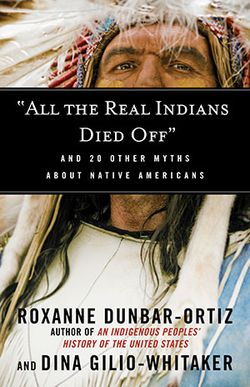
    All the Real Indians Died OffWith regard to court decisions and these troubling legal doctrines—and this is something we cover in our upcoming book “All the Real Indians Died Off” and 20 Other Myths About Native Americans—it comes down to the racist and ahistoric way the Supreme Court decides cases, even today. Not only does the court rely on legal fictions such as those that construct the doctrine of discovery (discussed in Myth #3), but when it comes to Indian law, the SCOTUS has failed to evolve beyond nineteenth-century racist stereotypes and beliefs in the same way it has in other realms, such as segregation laws.

    Native legal scholar Robert Williams, Jr. wrote about the racism of the Supreme Court in his book Like a Loaded Weapon: The Rehnquist Court, Indian Rights, and the Legal History of Racism in America. He contends that the entire body of federal Indian law that the Supreme Court helps construct is built on the concept of Indian inferiority and savagery. Regarding Oliphant, he writes: “According to Oliphant, Indian tribes, as lawless and uncivilized savage peoples, were implicitly divested of any asserted rights that might conflict with the superior sovereign interests of the United States under the discovery doctrine” (pg. 98).

    Indian country has narrowly avoided another legal catastrophe only because of the absence of Scalia who was known to be virulently anti-Indian. Depending on who fills the empty seat, we might not be so lucky next time.


    About the Author

    Dina Gilio-WhitakerDina Gilio-Whitaker (Colville Confederated Tribes) is an independent writer and researcher in Indigenous studies, having earned a bachelor’s degree in Native American Studies and a master’s degree in American Studies from the University of New Mexico, and also holds the position of research associate and associate scholar at the Center for World Indigenous Studies. Her work focuses on issues related to Indigenous nationalism, self-determination, and environmental justice, and more recently the emerging field of critical surf studies. She is a co-author (with Roxanne Dunbar-Ortiz) of the forthcoming book from ‘All the Real Indians Died Off’ and 20 Other Myths about Native Americans. An award-winning journalist, she is a frequent contributor to Indian Country Today Media Network and Native Peoples Magazine. Follow her on Twitter at @DinaGWhit and visit her website.     

  • By Mark Trecka

    The Sovereignty of ContextIn October 2015, New Mexico-based interdisciplinary arts collective, Postcommodity, executed the largest binational land art installation in history. The two-mile long installation, titled Repellent Fence, was comprised of twenty-six large scare-eye balloons, flown between sixty and one hundred feet in the air, tethered to the ground at intervals of four hundred feet, crossing the U.S.-Mexico border. The installation lasted for three days and was, in the group’s own words, “a social collaborative project among individuals, communities, institutional organizations, publics, and sovereigns.” The members of Postcommodity are: Raven Chacon, Cristóbal Martínez, and Kade Twist. Artist Scott Williams served as the project’s site manager. In part three of this four-part series, writer and artist Mark Trecka, with the support of The GroundTruth Project, continues his report on the drama and ideas surrounding the installation.

    ***

    Saturday, October 10th

    Saturday has been a long day of logistical maneuvering. Even the seemingly simple task of keeping count of the balloons, on such a scale, can prove to be complicated. And in order to see to it that all twenty-six balloons fly at an even height, anchored at intervals across very uneven terrain, each length of cord has been measured and cut precisely and specifically for each site.

    With twenty-five balloons aligned in the air, turning slowly, and the twenty-sixth securely anchored, those on the ground see an opportunity to slow down and seize a moment. The wind has cooperated. It breathes calmly.

    “This project is a real strong gesture towards humanity,” Raven Chacon’s father Lorenzo Chacon says, addressing a small group assembled at the site of that last balloon. He goes on, saying that there is something immediate about the installation, that the statement it makes is “more powerful than all the politicians in both countries.”

    He and Kade Twist’s father, Charles Twist, stand in an improvised ceremony, flanking the balloon, the final material element of the Repellent Fence.

    “These eyes, they have watched everybody forever. They have always watched. And now they are speaking because of these young men and their vision and insight. What they’ve already seen, these eyes will expose now.” Charles Twist’s Cherokee-inflected voice is clear, his manner is articulate. “People will have to answer because these eyes are watching. It’s one thing to say you are being watched and not see the eyes…”

    Charles Twist

    He is a preacher from Bakersfield, California, and he speaks as though he is here to convert this little desert congregation to the faith of the repellent eye. But there is no sense that anyone here remains unconverted. The fathers’ gloved hands hold the parachute cord that tethers the final balloon to the earth.

    “Ladies and gentlemen,” Lorenzo Chacon says, as they begin to let the cord slide, whirring through their gloves. “That’s our spirit rising up,” Charles Twist says, finishing the sentence.

    A blue and white Cessna 206 flies by and does five or six passes. “Someone in there is taking pictures,” Scott Williams says.

    “They’re taking pictures?” Raven Chacon says, smiling. “Right on.”

    ***

    Later that evening, the Saddle and Spur Tavern is buzzing with activity. The tavern serves as the bar for the Gadsden Hotel, the unofficial headquarters and meeting point for those in town for the installation. “I want to see those balloons,” one patron says while another reveals that they can be seen magnificently from the top floor of the hotel.

    Roberto Bedoya sidles up to the bar. He is the Executive Director of the Pima Arts Council in Tucson. A middle-aged Chicano in jeans and a polo shirt, Bedoya displays understated social graces and a sense of humor. Earlier in the afternoon, he had anchored one of the scare-eye balloons with the weight of his body, sitting on the cinder block to which it was tethered, amusing everyone in the midst of the installation. “Don’t fly away, we need you for the keynote,” someone joked.

    Spirits are high in the tavern. The installation is up and there is an air of celebration. But ever present are the interminable logistics of the weekend. There will be a spirited fiesta in Agua Prieta stretching late into the night, and Scott Williams is working out which vehicles will cross the border, selecting those that have the least amount of equipment in them to minimize hassle in case of a search.

    Just after nine p.m., I cross in a car with Canadian indigenous artists Elle-Máijá Tailfeathers and Jordan Wilson and American artist Ben Babbitt. We have to pause briefly at the crossing, but no credentials are requested by Mexican border authorities.

    At La Casa de la Cultura in Agua Prieta, two hundred or so people spread out over the concrete plaza. Beneath a tent on the north side, women spoon out a homemade pozole of rich, oily red broth and set tamales on Styrofoam plates. Children help themselves to popcorn from an old-fashioned popcorn machine. There is an ensemble of fifteen teenagers with acoustic guitars preparing to perform, dressed in white collared shirts, while a rock band plays on the center stage. Children careen from one end of the plaza to the other, weaving in and out of clusters of adults, playing an improvised game of dodgeball with a regulation size scare-eye balloon. The Casa de la Cultura has decorated the plaza with these balloons.

    At La Casa de la Cultura

    Music blares through P.A. speakers every moment of the fiesta, except when the mayor or the artists are speaking. The night closes with a traditional Yaqui deer dance, during which the air seems to become entirely saturated with sound and colored stage lights. Rattles, drums, and men’s voices form a searing wall of sound, cascading out of the speakers, seemingly pushed to their limit. Two young men in traditional Yaqui ceremonial garb enact the ancient dance in which is portrayed the drama of a sacred deer and his pursuant hunter. The enthusiasm for the Repellent Fence on this side of the border, the gestures of honor and gratitude, are manifest; loud and colorful.

    Those who spent the day out in the field, in the sun and dust, are visibly exhausted. This exhaustion and disorientation lend the illusion of distance to recent memories: the sound of paracord whirring through gloved hands, stomachs dropping as the balloons ascend.

    Scott Williams watches the young men, the headdress of a deer head, and antlers blurring in the stage lights. He laughs inaudibly, overwhelmed. Williams will cross back into Douglas and head to the installation site where he will camp for the night. He is now the custodian of the Repellent Fence. He sleeps beneath it.

    When I leave the Casa de la Cultura, Tailfeathers and Wilson stay behind. Drawing upon their experience on the previous night, they decide to cross back into Douglas on foot. As Canadian citizens, they will undergo greater scrutiny at the border and do not want to slow down the Americans who are otherwise likely to be simply waved across.

    ***

    The yellow paper Repellent Fence programs which have been circulating all weekend indicate a Saturday symposium at the Mexican Consulate in Douglas, organized by Albuquerque-based, Carcross/Tagish curator Candice Hopkins.

    Hopkins introduces the event, saying that it, like the Repellent Fence itself, “is an opportunity to suture the wounds that have been created by borders and fences.” It is a lofty claim, but no one present seems to drag his or her feet when approaching big concepts or lofty claims.

    Hopkins poses the problem of sovereignty as something that is “not always fixed, but sometimes taken, sometimes given.” She anchors the afternoon’s discussions with a statement about what she sees as the problem of borders: “The more fixed borders become, the more they are defended, to the point where now what we have is a slim line of metal that in its own way has embodied its increasingly threatening nature.”

    A variety of Canadian and American indigenous artists and scholars of transborder issues speak throughout the five-hour symposium. A rigorous focus can be read on the faces of those in attendance, community members, artists visiting from nearby Bisbee and from as far as the Northern Territories, Germany, Chicago.

    The mood moves from intellectual to emotional to humorous and back again, those distinctions blurring and culminating with Roberto Bedoya’s keynote address.

    Kade Twist introduces Bedoya, explaining that he was one of the first professionals that Postcommodity approached with the Repellent Fence concept. “He thought we were crazy and incredibly naive but he appreciated the courage. But every step of the way, he’s been there. Roberto is probably one of the most important Chicano intellectuals in Arizona. And that’s why we wanted him here, to give this keynote speech. You know, he’s—” Twist’s voice breaks off. He continues, haltingly, to describe Bedoya as an important mentor. He is overcome by emotion, so much so that he is barely able to finish his introduction. He finishes simply, saying that Bedoya will talk about “the sovereignty of context.”

    Twist swallows and brushes the back of his hand across his eyes. “That’s what this whole experience has been about” he says.

    Bedoya takes the podium, lightheartedly teasing Twist for the emotional display. He expands slightly on Twist’s introduction and then begins to talk ideas, saying, “Kade was talking about courage…I can be easily seduced by what I call the ‘courage of imagination’ and in some ways—” but Bedoya’s voice too breaks off. The room is silent except for a few emotive sounds. Bedoya fights back tears, barely winning. Although he quickly regains his composure, the level of emotional charge in the room has been raised.

    Bedoya’s talk is part lecture, part free verse, and all feeling. It is less a presentation of problem and solution and more one long, emotional question.

    “How does one compose meaning, animate space, trouble the cultural policies of placemaking, trouble White sovereignty as manifest in the laws of property?” The audience responds, humming quietly together. He has struck a chord. “Trouble reason with eyes from the sky, the ground, the past, present, and future, manifest in the Sonoran Desert?”

    Bedoya challenges concepts of creative placemaking, wary of its relationship to the “racist history of placemaking.”

    “I dig positions outside,” he says. “One strategy I employ as an outside narrative, as a counter-phrase to ‘creative placemaking,’ I use the term ‘creative placekeeping,’ which embraces cultural memory, the stories and lives of the inhabitants of a locale, the story of birds, of wind. This keeping does not align nicely with property because of its phenomenological power.”

    He evokes the late Catholic activist and poet Thomas Merton, quoting his work On Cities in which he distinguishes between buildings’ occupation of cities and peoples’ inhabiting of them. “I love this distinction,” Bedoya says, “because creative placemaking narrative can be reduced to a story of buildings and the built environment and not the story of inhabitants. And when I say ‘inhabitants,’ I don’t just mean people, but I also mean birds, I mean snakes, I mean those beautiful plants out there that are guarding the balloons.” The room rumbles with laughter under Bedoya’s spell.

    “Land is not just property we own but space that demands stewardship as a placemaking, placekeeping activity that acknowledges what is sacred in the land via vistas, ceremonies, song and care,” Bedoya continues almost musically. “This worldview is an obligation embedded in the sovereignty of context, a form of governance that the land asserts. The sovereignty of context and creative placemaking and placekeeping practices animate spaces.”

    “So,” he says, “let’s end with, sort of, a song. I’m not—I mean, I’m really not a poet, a singer or anything but like…a weird…guy.” Bedoya shrugs as the audience laughs uproariously, cathartically.

    “Let’s end with a song,” he says again and smiles.

    “From the dreaming, the beginning. During the dreaming, the present and the future moving across the country, across the land. Form an owl, form a wind, form the sharing in context. Sky, ground, water, fictions. Through and from them, eyes, I, humming questions with a cumbia beat, listening to the belonging inside and outside of logic. Inside the sovereignty of context and its aesthetic ordering that generate poet paladins like Kade…like Raven…where are you, honey?…Like Cristóbal. These poet paladins, who oppose amnesia and erasure of context, ask us to stare down the ways of disbelonging and to be repellent.”


    Continue on to part four in this series. Read part one and part two. 


    About the Author

    Mark TreckaMark Trecka is a Chicago-born writer, artist, and performer. His work has appeared in the Huffington Post, Impose Magazine, The End of Being, and elsewhere. He blogs and Instagrams for @featherproof and has recorded and performed with Pillars and Tongues, Dark Dark Dark, and others. He lives in New York’s Hudson Valley. Follow him on Twitter at @MTrecka and visit his website.


  • By Atef Abu Saif

    A view of Jabalia refugee camp

    A view of Jabalia refugee camp, Gaza. Photo credit: IRIN Photos

    In his memoir The Drone Eats with Me: A Gaza Diary, Abu Saif chronicles everyday civilian life in Gaza, shattered by Israel’s 2014 invasion. Chronicling his own family’s struggle to survive, he provides a rare window into the texture of a community and the realities of a conflict too often obscured by politics. In the following passage, Abu Saif and his family are celebrating Eid, the conclusion of Ramadan. What kind of Eid will his family have, he asks, when warfare has displaced so many other Gazans?

    ***

    Today is Eid. After a month of fasting, Eid is like a long sigh of relief. The kids get up early, woken by the hymns and chanting from the minarets of all the surrounding mosques, whilst the sun is still struggling to get out of bed in the east. Normally at Eid, the kids play in the streets, excited by the pocket money they’ve just received from their parents. This is always the single largest amount of money they’ll receive all year. They rush out and buy toys, go to the fairground, fly between the heaven and earth. Eid is what every child waits for all the year. It was always a favorite moment for me when I was growing up. It’s exactly the same for my kids.

    Last night, we all spent about two hours debating what kind of Eid we were going to have. The kids all wanted to celebrate Eid as it should be. This means buying them new clothes, having their hair cut (even if they had it cut a week ago), letting them buy toys and other things to entertain them and permitting them to blow their pocket money on sweets and chocolates or paying for rides. “It’s Eid!” they insist. “It’s Eid!” That’s their logic. Our argument, Hanna’s and mine, is that there are many children who lost their parents and cannot celebrate Eid this evening and it is very upsetting for them to see other children celebrating while they cannot. “What about the displaced people camping in the schools,” we say, “who don’t have anywhere to live anymore, who don’t even have the means to wash themselves properly?”

    After various excuses and justifications, I realize our arguments are falling on deaf ears. In the end, it’s not their fault. They’ve looked forward to this all year. I succumb to their pressure and agree to buy them one new piece of clothing each, that’s all, and maybe a haircut. But no sweets, no toys.

    ***

    Last night, I spent three hours walking through Jabalia Souq. There was a rumor about an extended truce for another twenty-four hours, starting at 2 p.m. You need to believe some of these rumors just to keep yourself going. But deep inside, your instincts tell you that any truce or cease-fire will ultimately prove to be a joke. You can get a whole range of answers to the question “Will there be a truce?” And each answer falls within what we might call analysis. Any Tom, Dick, or Harry’s opinion is an “analysis.” Nobody has any real information. People will tell you, “I heard so-and-so saying this and that,” or, “I think the situation reveals such and such.” The only conclusion you come to is that Gazans no longer care if a truce has been declared or not; they want to have their own truce, even if the pilot of the F16 doesn’t want one, or the drone operator sitting at his desk doesn’t want one, or the captain of the warship doesn’t like the idea of his prey moving freely in the streets. The answer as to whether there’ll be a truce tomorrow is no longer relevant. They will have their own truce on Eid. They will enjoy Eid as much as they can. At 3 p.m. yesterday, a house in my father’s neighborhood was struck by shrapnel. As it happened, no one was home. Only a neighbor passing down the street at the time was injured. Of course, such information was jumped on by Hanna as a reason against me taking the kids to my father’s place last night to let them play in the Internet café next to his house.

    Yesterday, the souq had been full of people, mainly buying clothes. A few shops were open, selling sweets and chocolates; it was so packed I could hardly move. When the souq is like this, you find yourself being carried along automatically by the pressing of others. I tried to buy the dried, salty fish you’re supposed to have on the morning of Eid. This is the custom. The fish is dried and stuffed with salt months before and on Eid morning, you fry it and cook tomatoes in the oil left over from the fish. After a month of fasting, you need a salty meal to encourage you to start drinking water again frequently. The key to everything is how you cook the fish. That’s the secret.

    ***

    We fry the fish this morning but we have no bread to eat it with. All the bread in the fridge is rotten as there’s been no electricity for three days in a row. Only last night, at ten o’clock, did it return for just eighty minutes. This morning, it’s back to square one. Everything in the fridge has to be thrown out: meat, chicken, even vegetables. Until last night, the bread was fine, but this morning we have to go hunting for new bread. My father-in-law agrees to set off on his bike to the bakery in the center of the camp. Luckily, it’s open and he returns after less than one hour of queuing, laden with warm loaves.

    I haven’t drunk cold water for three days. Even in the supermarket, you can no longer find cold drinks. The larger supermarkets have their own generators but they don’t waste the power on cold drinks. My friend Faraj told me that Wafi brought some ice from relatives living in an area that still has electricity. He gave Faraj some. I asked him if he could spare me some for a glass of water. I feel as if a glass of water with ice is the most precious thing I can own right now.

    Tensions erupted in the souq last night. Displaced persons from Beit Hanoun felt the shops selling sweets and chocolates were being insensitive. It was a gesture of indifference towards their suffering, they claimed. Shouts were heard and then fists thrown, right in the middle of the souq, turning everything into a mess. People were divided into two camps, just as the kids and Hanna and I had been, back at home. In the end, I guess life must go on, even at a minimum. No one was badly injured and we managed to separate the aggressors on both sides and get them to explain their position on the matter. The most common greeting we’ve heard this Eid has been “Thank God Eid arrived while you are still safe.” We kept repeating this phrase to the angry people in the souq, to remind them how privileged they were to survive these massacres.

    Last night, while standing with my friend Sohail in front of his house, a group of people arrived, helping an exhausted, half-dead old man. Sohail recognized him. He was a friend of his late father. He was the headmaster of a school in Bureij Camp. The Israeli army had arrested him five days ago and kept him near the Erez checkpoint with no food and just one bottle of water. For the past five days, he’s been sitting and sleeping on the bare sand. He was in a battlefield, of course, but without enjoying the privileges of someone on a battlefield, namely the right to defend himself from the bullets flying past him or the shells crashing on all sides. A few hours ago, the Israelis asked him to leave the place. He asked, “Where should I go?” “Anywhere—just away from here,” they said. He walked for three kilometers until he approached the eastern parts of Jabalia. He collapsed in the street and could not continue. But he had to keep going, to find safety. People gathered around him, splashed water on his face. Finally he opened his eyes. The first question he asked was “Where am I?” They told him that he is in Jabalia. Then he asked them to bring him to Sohail’s house.

    Once inside, he took a shower and relaxed until his sons arrived after being summoned by Sohail. His story had another twist to it that his sons would tell us. After kidnapping the old father from his house in al-Mughraqa village near the Gaza Wadi, the soldiers locked the mother and two sisters in the bathroom of their house before leaving. The three women were trapped there for two days and nights, living on nothing but water from the tap, screaming all day long and receiving only echoes in return. After two days, someone heard them and broke down the door, finding them on the verge of death, on an edge—neither “protected” nor “protective”—as the Israelis would say.

    Two days into the war, a baby girl was born even after her twenty-three-year-old mother had died. This is true. On the way to the hospital, the doctors in the ambulance discovered that the child was alive and that surgery could still save her. And it did. The old man, the survivor, smiled for the first time when he heard this story, realizing that it was still good to be alive.


    About the Author 

    Atef Abu Saif was born in Jabalia Refugee Camp in the Gaza Strip in 1973. He is the author of five novels, including A Suspended Life, which was shortlisted for the 2015 International Prize for Arab Fiction. He lives with his family in Gaza. Follow him on Twitter at @atefabusaif.

  • By Ashlyn Edwards

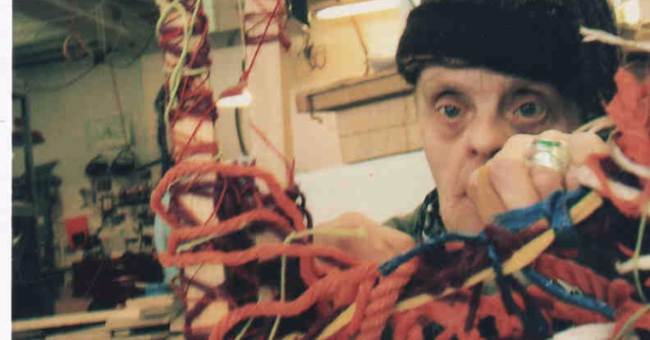
    Judith Scott

    Judith Scott

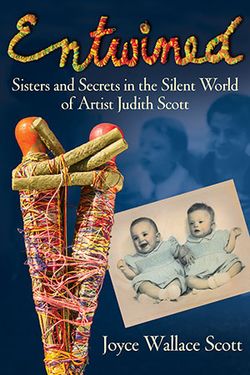
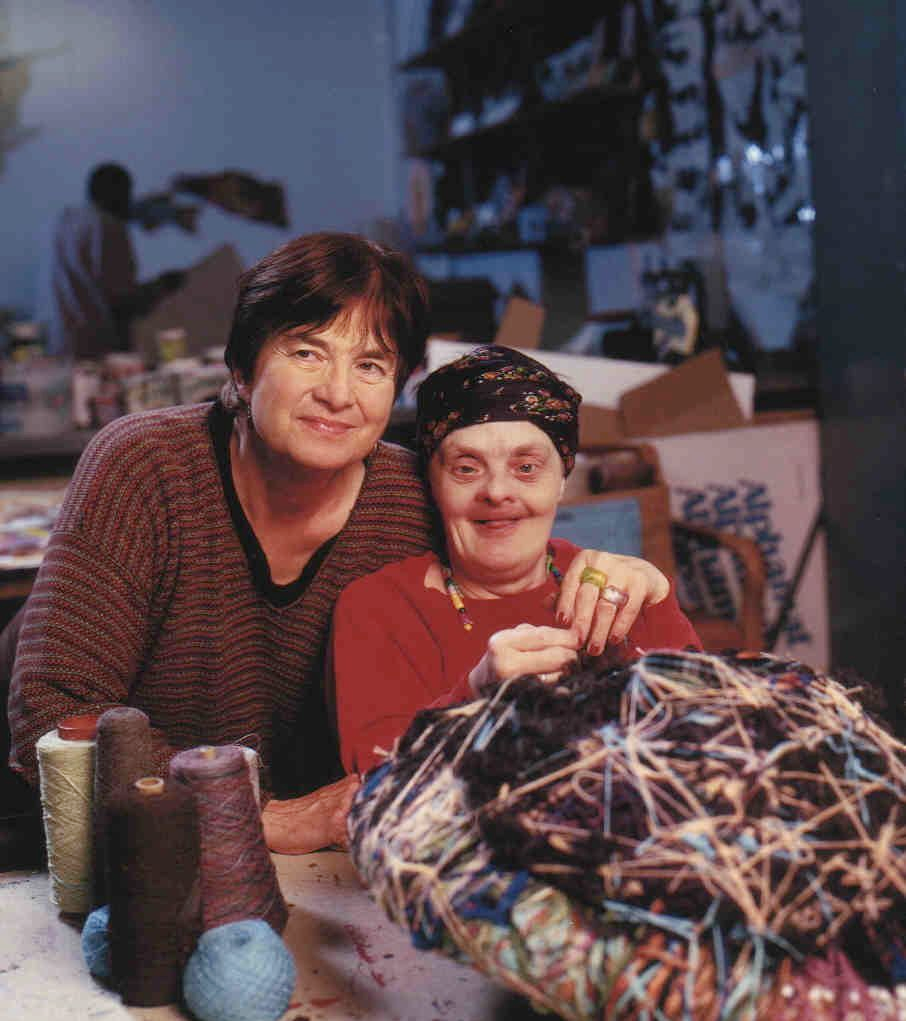
    As a publicity intern with Beacon Press this summer, the first new book I was given the opportunity to read was Entwined: Sisters and Secrets in the Silent World of Judith Scott, in which author Joyce Scott tells the story of her fraternal twin sister, Judith, an acclaimed fiber artist who was deaf and born with Down syndrome. I was repeatedly struck by how Joyce beautifully captured resonant images from her life and her bond with her sister, despite the many hardships they faced. Joyce recounts their separation at age seven when Judy was institutionalized, their reunion thirty-five years later, and afterwards, Judy’s success as an internationally-known artist. It seems that while Judy used intricately woven pieces to convey emotions through the complexity of her sculptures, Joyce uses words to the same ends. She interlaces their narratives with themes of loss, the importance of creative expression, and the unrequited love of family to create a nuanced work.

    Joyce enrolled Judy at Creative Growth, an arts education program in Oakland, California for adults with disabilities. In this passage, she describes Judy’s creative process, the intensity of her personality, and the power of her artistic vision.

    ***

    On this morning, as on most others, Judy is noticeably stooped and moves with caution as she walks carefully to the small white bus that takes her and her friends to Creative Growth. Judy, as she ages, seems older than her years. However, stoop or no stoop, when she arrives, she slips deftly past the crowds waiting to sign in at the entrance and begin their day of artistic expression. She admits no delay and feels an immense pull towards her emerging piece, which seems to beckon her. As she moves to her chosen place toward the back of the huge studio, now bright with morning light, a box of tissues on the table catches her ever-scanning eye and disappears with a swift sweep into her capacious black bag. Had someone’s car keys, address book, or lunch box been visible, they too would have suffered the same fate. Sometime before lunch, the tissues find a place in her evolving creation. Often the objects that become hidden deep within her work seem to reflect her life experience, perhaps recapturing in some way the losses she experienced at the institution. I look at Judy and wonder how she can translate those lost years of institutional living so vividly into the living heart of her work. Judy is ‘stealing’ back and transforming what was taken from her when she was seven. The thirteenth-century Sufi poet Rumi once wrote, ‘What was lost in the looking comes back completely changed.’ This seems like a perfect evocation of Judy’s sculptures.

    Judy takes down and examines her current sculpture, which she had placed carefully on the shelf behind her yesterday. She gives it a loving pat. She pulls out her large box of yarns from its hiding place under the bench—yarns she deliberately selected days before—this time colors of muted earth tones. Laying her scissors on the table, she pulls out the chair next to her and places her packed lunch, her black bag, and her magazines on it. Looking around quickly to see who might be watching, she swiftly pushes the chair and its precious contents out of sight beneath the worktable, then pulls it a bit closer to her. Years of institutional life have left their mark, and she is ever vigilant and guarded about her possessions.

    Now it is time to start work. While other artists are still waiting in line to check in, some patient, some restless, Judy is already focused on her latest creation. Turning the piece around, she selects an area and begins weaving an orange thread through, around, and in and out of strands already in position. She works without stopping throughout the morning, pausing only to glance occasionally around the studio, ignoring all but a few staff members who come by to greet her and observe her latest creation. When Tom di Maria stops by, they greet each other with high fives, and Judy nods knowingly in the direction of the soda machine, the signal for him to buy her the regulation Diet Pepsi that convention now demands.

    Her current piece, like others before it, may take several months of intense work before Judy considers it complete. Only she can decide when it is finished. Although various staff artists may be astonished by what they see in the different stages of creation, they recognize that there is no persuading her to stop. Out of respect for her creative process, they never try. Judy continues to cover and recover a piece a dozen times before she is satisfied. Countless masterpieces, thus glimpsed but momentarily, have vanished forever, consigned to oblivion by Judy’s resolute, unwavering personal vision. For her, they are but one step in her creative process.

    Only when she and she alone is satisfied does Judy, with a dramatically expressive sweep of the hands, signal to staff artist Stan Peterson that he can take it upstairs to join the growing collection of her work in storage.

    At lunchtime, she puts her things away. She quickly consumes her banana and sandwich, and resumes work until 3.

    ***

    Judy’s sculptures evoke intense emotion and quickly gained acclaim in the art world. In this excerpt, Joyce describes reactions—the public’s, Judy’s, and her own—to the first formal exhibition of Judy’s work at Creative Growth. In this passage, her insights into what Judy communicates without language demonstrate the depth of their bond. 

    ***

    EntwinedNow Creative Growth is bright and festive. A line has gathered in the street, all admirers of outsider art. Wearing coats and sweaters against the cool night air, they are patiently chatting together as they wait for the doors to open. They are a potpourri of Bay Area art collectors, professors, aging hippies, Piedmont matrons, Goth girls, and young ponytail types. Inside, Creative Growth’s board of directors, together with some distinguished patrons of the arts, have already been admitted by the gallery doorman. Everyone wants to meet Judy. Most are middle-aged professionals, all elegantly dressed. Radiating confidence and enthusiasm, they seem pleased with the event as it unfolds. Perfumes mingle and bright scarves catch Judy’s eye.

    In greeting these eager strangers, Judy’s responses vary from ignoring some with what borders on disdain to embracing others with eyes full of tears. I wonder, does the person she embraces remind her of someone she has loved or does she sense something within that person that engenders a deeply felt connection? I cannot say. She cannot say. Many reach out their hand to hers, others make gestures of goodwill and admiration; the man in the brown turtleneck silently pantomimes applause, his partner singles with pleasure, a strong thumbs up.

    I too am warmly greeted. Nina, an artist on staff, admires the borrowed Thai silk jacket I am wearing. She squeezes my hand and smiles. Strangers come up to introduce themselves and say how excited and thrilled they are about this evening and, more particularly, about Judy’s work. Several journalists and photographers are full of questions for me: ‘What was it like growing up with a twin with Down syndrome?’ ‘Are you identical?’ ‘Has she always been deaf?’ ‘Did you realize she was an artist before you enrolled her at Creative Growth?’

    I look over at Judy, this small, self-possessed figure sitting amid all the confusion of people surrounding her, wildly plumed as always, lacking the language of those around her, yet supremely centered in her solid, certain self. Judy knows her worth. She has never allowed herself to feel discounted by the world or by anyone. Despite decades of institutionalization, her light was miraculously not extinguished and now shines with brilliance. It dazzles us. She cannot name the recognition she receives in this moment. Living in a world without names, without sound, this night of recognition is like … like what to her? It must wrap around her like the embrace of a warm Midwestern night, these admitting smiles, these loving eyes. Judy has known hard eyes and soft eyes and understands the difference.

    As I watch guests enter the exhibition gallery, I see reflected in their eyes the same shock and stunned surprise that I experience in the presence of these pieces. I recognize their sense of awe as they move into the room, their sense of the unspoken coming to life, being given form. Emotions, experiences in their pure form, undiluted by words or the repetition of stories told and retold. Instead, they find the concentration of a life distilled into these mysterious forms with their dense, rich colors. Feelings too deep for words and stories never before spoken or heard are here expressed, and we cannot help but gasp. Here, deeply moving but unfathomable, we detect the experience of betrayal, the sense of loss and longing; here, the feeling of closeness, of oneness, of love. Feelings covered, hidden, compressed into a small tight space and protected; here, feelings exposed and exploded, a riot of joyous color.

    These oranges and reds, perhaps out rich Ohio summer sun, the greens our trees and grasses, the soft bumps reminiscent of the rabbits we loved. Here, in one piece, she seems to be trying to forget something. I can feel its presence hidden under dozens of layers of covering.


    About Joyce Wallace Scott 

    Joyce ScottJoyce Wallace Scott, MA, is an educator, RN, development specialist, and published poet. She serves on the advisory board of the Creative Growth Art Center in Oakland, California, and is currently involved in establishing the first program for artists with disabilities in Bali, dedicated to her sister’s memory. She lives in Dutch Flat, California, with her husband.

  • A Conversation with Reverend Elizabeth M. Edman and Deborah Jian Lee

    Rainbow over the church

    Photo credit: Sergei Mutovkin

    In Queer Virtue: What LGBTQ People Know About Life and Love and How It Can Revitalize Christianity, Reverend Elizabeth M. Edman draws from over three decades of experience studying, preaching, and teaching from the western canon of Christian Scripture to attest the inherent queerness of authentic Christianity. Journalist Deborah Jian Lee reports from the front lines of the battle younger and more diverse Evangelicals are waging to reclaim Christian ideals and harness them to promote social change in Rescuing Jesus: How People of Color, Women, and Queer Christians are Reclaiming Evangelicalism. While Edman and Lee have written for different target audiences, they both address a growing movement within Christianity to embrace and accept the LGBTQ community. We caught up with them to ask about this shift in the landscape of progressive religion in this two-part conversation. Here we present the first part to close out this year’s Pride month.

    ***

    Your books have different target audiences, yet speak to a growing movement within Christianity to embrace and accept the LGBTQ community. Talk about what you mean by reclaiming and revitalizing Christianity. 

    Deborah Jian Lee: For Rescuing Jesus, I’m speaking to a range of people including Evangelicals, ex-Evangelicals, progressive Christians, the spiritual but not religious, and the Nones, who don’t ascribe to any particular religion. I write about those on the margins of Evangelicalism, namely people of color, women, and LGBTQ Christians. Oftentimes people from these communities feel disqualified from the faith and feel like they must choose between their faith and other important aspects of their identity. They’ve confronted the Evangelical establishment’s strict ultimatum: leave your culture, your gender, and your sexuality at the door or leave the church altogether.

    But in Rescuing Jesus, I tell the story of a rising generation of people of color, women, and queers who have rejected this ultimatum and are asserting their full humanity, remaining within the faith community and reclaiming Evangelicalism as their own. By doing so, they are saying, “God made me in His image, and I am an essential part of the Body of Christ.” They’re also challenging church and social systems that perpetuate their oppression by carving out a robust evangelical social justice movement.

    It sounds counterintuitive to what “evangelical” has come to stand for in recent decades, but they convincingly argue that this is the very heart of the gospel message. When Jesus walked this earth, he spoke about justice, about subverting power structures and the status quo, and about uplifting those on the margins. Today, the marginalized that are reclaiming Evangelicalism are pointing the world towards the gospel and a Jesus who is all about radical inclusion and an abundance of love. Their message has the power to transform American Christianity.

    Rev. Elizabeth Edman: In so many ways, our work is really resonant with one other’s, but we come at the issue in different ways because the movements we’re addressing are coming at it in such different ways. Within Christianity, my primary audience is progressive Christians. I’ve also got an audience of LGBTQ people, Christian or not, who have suffered spiritual damage from a false and rigid proclamation of Christianity and other world religions as well. What you’re describing within Evangelicalism is this rigid proclamation, which some folks in the Evangelical establishment are trying to rebrand, retool, make sexy, but not really change. Progressive Christianity is different from that, because over the past thirty or so years, as various denominations have tried to include queer people particularly, we’ve done that not by proclaiming a fresh gospel, but by easing up on what have been considered the rules on their church in order to include people. And at the same time, there’s been a sort queering of the tradition—that I think also mirrors what you’re describing—by people who themselves have been marginalized, reclaiming the tradition by proclaiming something else, something new and something fresh.

    Queer VirtueYou were talking about people claiming their own Christian identity, and in doing so, issuing a new kind of theology, which I think is exactly right. In Queer Virtue, I make the assertion that authentic Christianity is and must be queer. What I mean by that is I see within Christianity relentless rupturing of binaries, akin to the impulse within queer theory to rupture false binaries. You’ve got Jesus in his person rupturing the false divide between human and divine, life and death, sacred and profane, and ultimately, the divide between Self and Other. This queering takes place throughout the tradition, and queer people already have an idea of what that means on the ground. How does this inform the way we live? Queer people discern an identity. We have to get honest about that in the face of real risk, reach out and find other people who share a comparable identity marker, build community, and then look to the margins to see who’s not included. That, to me, is an ethical path of queerness. And isn’t it interesting that this ethical path so closely aligns with the ethical path Jesus told his followers to walk? I think that’s not a coincidence. My essential premise is that Christianity could learn a lot from queer people who are walking this queer path every day. That’s the hope that I see for reclaiming Christianity and revitalizing it.

    What is it about this moment in time that makes this issue more urgent? What’s the difference between today’s progressive religious movement and previous ones? 

    Rev. Edman: We are at an urgent moment because Christianity, broadly I would say, is losing its moral authority. I think we are losing our status as a credible moral voice in today’s world. There are a lot of reasons for that. Of course, you and I are talking primarily about American Christianity, but this isn’t just taking place in the United States. What I perceive in our increasingly globalized world is a crying need for moral perception.

    I spent a few years as a college chaplain working with young adults who are trying to make meaning in a world where old ways of perceiving truth have been called into question, have begun to fall away. So for me, and I would say, for them, rupturing binaries has potential to be a very powerful and vital lens for making meaning in a world where walls are coming down like crazy. That’s the urgency for me. Christianity offers a tremendous window for understanding who we are and who we can be in this moment in history. And perceiving queerness within in the tradition, to me, could help the church be the church more than it’s being right now.

    Lee: Yes, Christianity is on the decline, and today the second largest religious group is the Nones. The good news for Christianity: the current progressive movement is led by faith leaders who embody a cross-section of marginalized identities. As they do theology and shape church culture from these unique vantage points, they’ve shaped a movement that works to uplift people across the spectrums and intersections of race, gender, sexual orientation, and so many other identities.

    Rescuing JesusThese people are the future of Christianity—they can speak to the Nones. Actually, reporting on these leaders had a direct impact on my own faith journey. I’m a None. I’m part of the mass exodus from the Church. I grew up atheist, but in my teens I became a Christian when I experienced my first place of belonging in a Chinese immigrant church. In my white suburb, I had experienced verbal, and sometimes physically violent racism. But I found sanctuary in this church, where I learned about a divine love that embraced everybody. Then in college, I got involved with the larger (whiter) evangelical movement, which was mired in the culture wars. I eventually left evangelicalism because, well, as an LGBT-affirming feminist woman of color who talked about identity a lot, I heard plenty of leaders and friends suggest that my progressive beliefs disqualified me from Christianity. So I left my faith community, which was one of the hardest things I’ve ever done.

    When I reported Rescuing Jesus, I met people who experience similar exclusion, but are staying and casting a vision for a more inclusive Evangelical church. I met people who ministered to the marginalized and to the very people who rejected them, and in doing so, they saved lives and created new, beautiful communities.

    One of the most inspiring stories I encountered came from a group of queer students attending Biola University. This is a renowned Evangelical institution based in southern California, and like many Evangelical colleges across the country, they have these policies that prohibit what they call “homosexual behavior.” If you come out or if you’re outed, you don’t know what could happen to you. You could be disciplined, questioned by the administration, expelled. You could lose your scholarship. You could be forced into reparative therapy. You could be outed to your family before you’re ready and your parents could cut you off from their financial support. You could become homeless. The stakes are just so high, so most people stay closeted. But at Biola, there was the group of queer students who started an underground support group. They created a safe place where people could be their full selves within this oppressive institution. It was this collection of people who found each other and spent every week loving each other and helping each other heal from the spiritual wounds they had experienced through being in an Evangelical community that told them they were an abomination and that they did not belong.

    I’ll never forget attending their end-of-the year party in 2013. A couple dozen of them sat in a circle in this cramped room, sharing stories about how the group had saved them from depression, isolation, suicidal thoughts. They held each other and cried. They joined hands and prayed for each other. They loved each other with an urgency and rawness that felt so life-affirming. It looked like the very gospel that brought me to Christianity in the first place. And to my surprise, this moment played a part to my own eventual return to the Christian faith.


    Stayed tuned for part two of this conversation.


    About the Authors 

    Reverend Elizabeth EdmanThe Reverend Elizabeth M. Edman is an Episcopal priest and a political strategist who has been expanding people’s understanding of faith and sexuality for over twenty-five years. She has worked on the most pressing contemporary issues in the intersection of religion and sexuality, serving as an inner-city hospital chaplain to people with HIV/AIDS from 1989 to 1995 and helping to craft political and communications strategies for marriage-equality efforts. She lives in New York City. Follow her on Twitter at @liz_edman and visit her website.


    Deborah Jian LeeDeborah Jian Lee is an award-winning journalist, radio producer, and the author of Rescuing Jesus: How People of Color, Women and Queer Christians are Reclaiming Evangelicalism. She has worked as a staff reporter for the Associated Press, taught journalism at Columbia University, and written for Foreign Policy, Forbes, Slate, GOOD, Reuters, WBEZ, WNYC, and others. Follow her on Twitter at @DeborahJianLee and visit her website.
  • By Carole Joffe

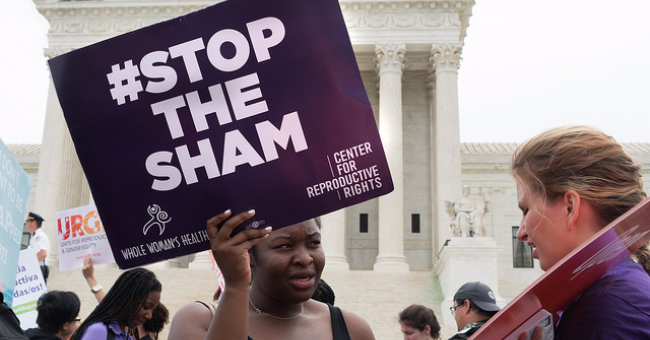
    Whole Woman’s Health v. Hellerstedt. Demonstrations in front of the Supreme Court on June 23, 2016

    Whole Woman’s Health v. Hellerstedt. Demonstrations in front of the Supreme Court on June 23, 2016. Photo credit: Victoria Pickering

    “(I)t is beyond rational belief that H.B.2 could genuinely protect the health of women, and certain that the law ‘would simply make it more difficult for them to obtain abortions.’” So wrote Justice Ruth Bader Ginsburg in her concurrent opinion with the 5-3 majority in the landmark case, Whole Woman’s Health v Hellerstadt. 

    This case represents a monumental victory for the abortion-providing community in particular, the abortion rights movement more generally, and of course, the more than one million American women each year who seek abortion care. When Texas politicians first introduced H.B.2, the notorious bill under contention (this was the bill that inspired state senator Wendy Davis’ marathon filibuster in the Capitol), there were forty abortion clinics in Texas; complex legal proceedings left about twenty in operation up till this ruling. Had the Court decided otherwise, the number of clinics that met the bill’s requirements—hospital admitting privileges for abortion doctors and Ambulatory Surgery Center (ASCs) regulations which stipulated that clinics must essentially conform to the physical specifications of small hospitals—would have gone down to less than ten.

    The Court’s decision will have implications beyond Texas. Approximately 162 abortion clinics have closed since the first “backlash to Obama” election in 2010, which greatly increased the number of state legislatures with Republican majorities and Republican governors. Hundreds of abortion restrictions have been introduced since that time, many similar to the Texas ones that have been just struck down. To be sure, not all of the clinic closures are directly due to such TRAP (Targeted Regulation of Abortion Providers) laws, as they are called. Some have closed because of the retirement of a particular physician and the inability to find a replacement. Others, particularly those in urban areas where other clinics tend to locate, have closed because of an insufficient volume of patients, as the abortion rate has steadily declined. But there is no question that many of these clinics—and certainly most of the closed twenty in Texas that the Court took pains to note—folded because of their inability to come up with the money for the huge costs of making the upgrades demanded by the ASC regulation, a figure that could reach over a million dollars. The hospital admitting privileges requirement has arguably been even more challenging, as this was a problem fundraising could not solve. Whether because of their own anti-abortion sentiments, or, more likely, fear of protestors, Texas hospitals have been extremely reluctant to grant admitting privileges. But even granting ideological neutrality of hospitals, the admitting privileges requirement is complicated, ironically, by the fact that abortion is so safe:  therefore, it is impossible for providers to accumulate the ten patient admissions per year that many hospitals require for a physician to maintain privileges.

    This decision will have enormous consequences for abortion access in Texas and beyond—but not immediately. In Texas, we will witness the considerable challenges of reopening clinics once they have been closed. As the law professor David Cohen has aptly pointed out with regard to the twenty closed clinics, reopening is complicated “because of practicalities of hiring, leases, the availability of doctors, etc. You can close a clinic in an instant; reopening one, especially one that has been closed for a year or more, is not so easy.” Elsewhere, in those numerous states that similarly have imposed ASC and admitting privileges requirements, we can anticipate that these restrictions will ultimately be struck down as well. Indeed, just one day after the Court announced its decision, there have been positive developments in Alabama, Mississippi, and Wisconsin. In other states, pro-choice lawyers will need  to litigate in order to have similar restrictions overturned.

    Finally, the positive decision in Whole Woman’s Health is not just a victory for providers and supporters of abortion. It is a resounding pushback against the “junk science” we have seen coming from conservatives, particularly since the George W. Bush presidency, and an affirmation of the importance of scientific evidence. The many lies about abortion that right-wingers in and out of office have promoted—e.g. abortion causes cancer, infertility, and mental illness—are not unconnected to the lies about climate change, homosexuality, effectiveness of condoms, and so on, that have become so common place in our political discourse.

    Given that Justice Anthony Kennedy himself legitimized the discredited notion of “post abortion syndrome” and “abortion regret” in Gonzales v Carhart, the last major abortion case in 2007, it was particularly heartening to see Kennedy join in the Majority in Whole Woman’s Health.

    The positive outcome of this case does not mean, of course, that the abortion war is over—it never is. Officials in Texas and elsewhere will no doubt devise other ways to make abortion care as cumbersome as possible, and thanks to the tireless lawyers at the Center for Reproductive Rights and the ACLU Reproductive Freedom Project, these too will be challenged. But for now, abortion providers and their supporters are savoring a long overdue burst of sanity. 


    About the Author 

    image from www.beaconbroadside.comCarole Joffe is a professor in the Advancing New Standards in Reproductive Health (ANSIRH) Department of Obstetrics, Gynecology & Reproductive Sciences at the University of California-San Francisco and a professor emerita of sociology at the University of California-Davis. She is the author of several other books, including Doctors of Conscience and Dispatches from the Abortion Wars. Follow her on Twitter at @carolejoffe.

  • By Amanda Beiner

    HENIGAN-cover_art-CROPPED

    When associate publisher Tom Hallock first suggested that Beacon publish a myth-busting book about gun control, we knew we had to move quickly. The urgency of this issue put the new book on a sped-up schedule. While discussing the idea with other staff members, it seemed everyone could rattle off countless gun “myths” that pop up time and again in conversations about the epidemic of gun violence in the US. I set about researching books covering gun policy and came across Dennis Henigan’s Lethal Logic.

    Guns Don't Kill People, People Kill PeopleWhat struck me most about Lethal Logic was how much and how little had changed. At the time of its original publication in 2009, Columbine was still the deadliest school shooting in US history. Our president had not yet wept with the parents and teachers of Sandy Hook Elementary. In the intervening seven years, the United States has seen twenty-one mass shootings and countless acts of gun violence in elementary schools, on military bases, in churches, nightclubs, and as President Obama noted, “on the streets of Chicago every day.” Helene Atwan, our director, and I had a phone call with Henigan about updating and revising his book for our myth series with a new title, “Guns Don’t Kill People, People Kill People” And Other Myths About Guns and Gun Control. He was more than willing to work with us on the new edition and appreciative to see new life brought to his book.

    This month, the Orlando Pulse shooting left forty-nine innocent people dead and another fifty-three injured. Senate Democrats launched a fifteen-hour filibuster, and House Democrats held a sit-in in an effort to effect some movement gun control. Public outcry against gun violence and mass killings demands new legislation. Now, more than ever, we felt it was important to make this resource available to the public as quickly as possible. We worked to move up the publication date to June 28 for the ebook edition and July 26 for the print edition.

    Turning this book around from acquisition to publication in less than five months was a huge team effort which involved almost everyone at the press, from our director to our editorial intern, our production and marketing teams going all out, and the author, who dedicated nights and weekends to meet a very tight deadline. We hope lawmakers, activists, lobbyists, and the general public will use the book as a tool to bring clarity to the continuous stalemate of the gun control debate.


    Buy the ebook on Kindle, iBooks, Barnes and Noble, and Kobo.


    About the Author

    Amanda Beiner is the assistant to Beacon Press director Helene Atwan.

  • By Eileen Truax

    Queer Undocumented Unafraid

    Arizona SB 1070 Protest, May 2010. Photo credit: Flickr user Xomiele

    There are about twelve million undocumented people living in the United States. As many as two million of them came as children. They grow up here, going to elementary, middle, and high school, and then the country they call home won’t—in most states—offer financial aid for college and they’re unable to be legally employed. In 2001, US senator Dick Durbin introduced the DREAM Act to Congress, an initiative that would allow these young people to become legal residents if they met certain requirements. The DREAM Act has yet to be passed. But this young generation has been organizing. Some of them are also from the LGBT community. As journalist Eileen Truax shows in Dreamers: An Immigrant Generation’s Fight for Their American Dream, they live with two identities that go against the accepted norm. Here she shares the experiences and struggles of a Dreamer who had to come out as undocumented and queer. 

    ***

    Just as with every Dreamer I meet, I found out about Jorge through someone else, who had met him through a friend. I met him in El Hormiguero, a community center in the San Fernando Valley in northern Los Angeles, where students, activists, and other members of the community hold meetings on various topics. The meeting where I met Jorge had such a provocative title, I had no choice but to go and see what it was all about: “Undocuqueer Healing Oasis.” It was a space where gays, lesbians, bisexuals, transvestites, and transgender people could share their experiences and talk about what it’s like to live with not just one but two identities that go against the accepted norm. They share how they struggle to get ahead or just keep going, even though it takes more work, and sometimes you just feel tired and overwhelmed.

    Jorge was the special guest at this session. The meetings at El Hormiguero usually have ten to fifteen participants, sometimes more. At each one, someone is invited to share an experience in a particular area that he or she has to deal with every day or to tell a success story. Jorge’s area of struggle is definitely coming to terms with his identity as an “undocuqueer.”

    Jorge was born in El Cora, a ranching area in the state of Nayarit, Mexico. His family was poor and made their living by farming. His father grew papayas, mangos, cocoa, and avocados to feed the family and to sell. As the children got older, they helped out with the crops.

    Jorge’s parents’ relationship was far from perfect. His childhood was scarred by domestic violence and abuse. Even now, at twenty-eight, looking back on what he calls “my first confrontation with injustice” caused his voice to break with emotion. When he was six or seven, he already knew he was different by the way he played with the other children and how he felt, but at the time he didn’t understand exactly what it was. And he knew his parents noticed too, but they never talked about it with him. One day Jorge was playing with a little girl, and although he doesn’t remember the exact nature of the game, he remembers very well that it was something that irritated his father to no end when he came home from work and saw them. His father grabbed Jorge by his shirt and violently yanked him up, then threw him onto the floor and said, “I don’t want any faggots in my house.”

    “I didn’t cry. I was more confused than angry, because I didn’t know what he was calling me, but I could tell by his tone of voice and how he was treating me that it was something really bad,” Jorge said, his eyes wide, as if he were remembering something that had happened just a few days ago. “Ever since then, I knew I was different.”

    For Jorge, his journey across the border was a pleasant, almost happy experience. He remembers a little pickup truck with almost ten people riding in the back that left from Tepic, the capital of Nayarit, and drove up to Tijuana. They got there on a Friday around noon and crossed the border later that day when an uncle came to pick them up. By eight o’clock that evening they were in their new home. Since his uncle was documented and had a car, they had worked it out to cross over with him (Jorge reminded me that the situation at the border was very different sixteen years ago, in a pre-9/11 world). An aunt was waiting for them, and so began Jorge’s new life in Orange County, about forty miles south of Los Angeles. Unlike other Dreamers who describe their arrival in the United States as marking a painful rupture with their previous life in Mexico, Jorge recalled it as a positive time. Although it marked the beginning of his life as an undocumented immigrant, it also put an end to his father’s physical and emotional abuse.

    While his mother worked cleaning houses, her children started going to school. It was hardest for her oldest son, as adapting to a new culture and language at eighteen was not easy. It was easier for Jorge and his other brother, who was one year younger. They were able to make friends and always attended the same school. Even though everything was going pretty well, Jorge always felt burdened by the stigma of being “different.” Now he knew that there were other people like him, and he had the words to identify himself. He knew he was gay, but he could not say it openly.

    “At that age, thirteen, fourteen years old, I liked one boy and then another,” Jorge said. “Your body is changing, but I couldn’t enjoy those experiences because I had the shadow of my father hanging over me. At the time I wanted to tell my mom, but I was afraid she would react the same way my father did. What had happened with him kept me from coming out of the closet; it haunted me. Those were at least two very dark years in my life. I was depressed and had low self-esteem; it was really painful. I felt like my mom could tell, but she didn’t have the vocabulary to ask me.”

    Until one day she did find the words. As they were driving home one afternoon, Jorge’s mother stopped the car at a red light, turned down the radio, looked over at her son, and said in her gentlest tone of voice, “I want to ask you something because I’m confused: Do you like boys or girls?”

    Jorge thought of his father and felt the pain rising in him as strongly as ever as he turned away. His first impulse was to lie and say he liked girls, to protect himself.

    “I like boys.”

    The light changed, and his mother kept driving. She pulled the car into a parking lot, turned off the engine, and got out. Jorge imagined the worst: she was leaving him there alone in the middle of the parking lot, in his school uniform. Alone. In spite of his panic, a strange feeling of relief washed over him for a fraction of a second, knowing that he had told the truth. But then something entirely unexpected happened: his mother opened his car door and gave him a hug: “Maybe I don’t understand what’s happening,” she said, “but we’ll figure it out together. We’ll be okay.”

    Now the emotion that Jorge hadn’t conveyed as he told me about his immigration experience broke through the surface as he remembered that special moment.

    “A woman on her own, an undocumented immigrant, who only went to school until the second grade, challenging the system, fighting machismo, and homophobia, and relying on her love for me as a mother—she said: This is my son, and I’m going to protect him. In that moment all the pain that my father caused started to melt away, little by little, and I started to enjoy being gay. I told some of my friends, even some teachers at school, and I began to feel supported and loved,” he said.

    “I knew that my father had renounced our relationship. I’ve tried to reconcile with him, but he didn’t care…I recently made the decision to not let him have that power over me. For two years, I’ve had to work with that pain and tell myself that it was time to let the wound heal, what happened wasn’t my fault. I’ve tried to understand where my father was coming from, a Catholic, machista family. In a way he is a victim of those belief systems, and if he decided to close the door, that’s on him. I have to be happy and heal the pain so I can experience intense love and happiness and not let that scar me.”

    Though Jorge took an important step forward by accepting his homosexual identity, there was another bitter pill left to swallow with his immigration status. Thanks to their mother’s strength and determination the Gutierrez children had enjoyed a certain degree of stability by living in the same neighborhood. But when it came time to go off to college, it was the same old story: the crushing implications of being undocumented hit them head-on.

    “You start to see what being undocumented means, but you don’t really get it until your friends from school start getting driver’s licenses and you can’t, and that’s really hard,” Jorge said. “You want to get a job, but you don’t have a Social Security number, and when you fill in your college application and it asks you for that number again, and you know you don’t have one…I felt like that was somehow going to magically change. I came home and asked my mom, ‘Do I have a Social Security number?’ And I already knew the answer, but I felt like something was going to change during the walk home from school.”

    I stopped Jorge at this point in his story. As I was writing this book, many Dreamers expressed to me that same hope that something magical would somehow occur to change their circumstances. I asked Jorge what he thought was behind this.

    “I think when you get here as a child and they tell you if you get good grades, if you’re a good student, you can be whatever you want,” Jorge said. “So you think things are going to change, that you’re special, and that’s not going to happen to you. But life is different. At the time I sent my application to California State University, Fullerton, based on a counselor’s advice. It was a very difficult experience for me. I was really mad at my family, at my situation, for not having any resources, for not being able to go to the school I wanted, because I really wanted to go to Berkeley.”

    The first three years at Fullerton were utterly exhausting for Jorge. His mother kept on working to support the family, but she had no money to help with school, so Jorge had been working since he was fourteen. While he went to college, he worked at a pizzeria, an ice cream parlor, and a photo store and helped his mother on weekends with a side business doing party decorations. The money he earned went toward tuition, clothes, books, and sometimes helping with the rent. Jorge went from home to work and back again. He felt frustrated and questioned whether what he was doing made any sense. He didn’t know how to talk about it, and he didn’t know anybody in the same situation he was in. Then, a semester before graduation, just as he was about to throw in the towel, he was invited to join the Orange County Dream Team.


    About the Author 

    Originally from Mexico, Eileen Truax is a journalist and immigrant currently living in Los Angeles. She contributes regularly to Hoy Los Angeles and Unidos and writes for Latin American publications including Proceso, El Universal, and Gatopardo. Truax often speaks at colleges and universities about the Dreamer movement and immigration. Follow her on Twitter at @EileenTruax.

  • By Susan Katz Miller

    Mosque

    Photo credit: Susan Katz Miller

    This essay appeared originally on Interfaith Ramadan. 

    I happen to be a Jewish woman who says inshAllah. And, Alhamdulillah. Quite a lot. So earlier this year, I was frustrated and depressed when a college student conversing with his father on a cell phone while waiting for takeoff said he would call again when he landed, inshAllah, and then he was escorted off the plane when another passenger interpreted this conversation as somehow threatening.

    Here in the US, we have seen a terrible rise of Islamophobia in the US since 9/11, and during the insanity of our current Presidential race. And yet, I refuse to abandon my use of these two phrases, which connect me to Arabic, and to Islam, and to three wonderful years spent in a predominantly Muslim country. In fact, I often find myself giving mini-lessons on these phrases (inshAllah means God Willing, Alhamdulillah means ‘Praise God’ or ‘Thank God’), and the cultural and religious context of their uses. In this way, I try to contribute to interfaith understanding, while simultaneously reminding myself of various forms of privilege that often allow me to utter these phrases without fearing for my life or liberty when someone overhears me on a plane.

    The realization that Allah is simply Arabic for the word God first came to me in high school, when I met Devick, an exchange student from Paris. Devick’s Jewish family had immigrated to France from Morocco, and I noticed he wore a gold pendant with an Arabic inscription. I asked him what it said, and he replied, “Allah.” I was, naively, rather shocked that a Jewish boy would wear this, until he patiently explained, “Allah is God in Arabic. I am Jewish, but Arabic is my first language.” Oh. Right.

    Years later, after college and the start of my journalism career, I had the great good fortune to move to Dakar, Senegal, a majority Muslim country. I improved my French and studied Wolof, and worked as a stringer and freelance reporter filing travel and political stories from across West Africa. I got to interview the President of Senegal for Newsweek’s international edition, but I also spent a lot of time just siting under mango trees or in market stalls, drinking tea with Senegalese friends.

    After three years of hearing inshAllah every time a future event was mentioned, and Alhamdulillah for every past event, throughout the day, every day, in every conversation with a West African, I found these phrases had entered my vocabulary. Though I do not necessarily believe in the kind of God that plans the future or listens to our thanks, it felt right to acknowledge the beliefs of those I conversed with in this way. Here, I know we could insert an entire conversation about cultural appropriation and misguided post-colonial adventuring. But for me, acquiring the habit of using these phrases opened my mind, the mind of a skeptical, hard-bitten journalist trained as a science reporter, to thinking about how acknowledging the uncertainty of the future, and expressing gratitude for the past, can be spiritual practices beyond any theistic belief in a God who intervenes in human affairs.

    There is a moment when you utter either of these phrases, a sort of intimacy with the listeners who understand them, a sense of shared spirituality transcending specific religious identities. For me, inshAllah can have a wry and even poignant edge to it, and somehow soothes my anxiety about control. None of us knows what will happen. But whatever happens, we know we will have to figure out how to accept the new realignment of facts and connections and emotions in our new reality.

    Alhumdulillah, by contrast, conveys a celebratory catharsis. My daughter just graduated from college, Alhumdulillah! My father recovered from heart surgery, Alhumdulillah! Or even just, I managed to get dinner on the table, Alhumdulillah! For me, the relief embedded in this phrase resonates with the Shehecheyanu, the Jewish prayer of thanks for reaching a season or holiday or moment in the life cycle. I am less interested in whether theologians think we all worship the same God, or whether or not there is a God even listening to us. These exclamations, for me, serve as a reminder of a global and perhaps mystical sense of interconnection. And they also instill a sort of mindfulness, as cues to cultivate wonder, and to strive for peace. Alhamdulillah.


    About the Author 

    KATZMILLER-Credit-StephanieWilliamsSusan Katz Miller is a former reporter for Newsweek and New Scientist and author of Being Both: Embracing Two Religions in One Interfaith Family. She lives with her interfaith family outside Washington, DC. Follow her on Twitter at @beingboth and visit her website.