• By Mark Trecka

    Scare Eye through the Border

    In October, 2015, New Mexico-based interdisciplinary arts collective, Postcommodity, executed the largest binational land art installation in history. The two-mile long installation, titled Repellent Fence, was positioned across the U.S.-Mexico border and was, in the group’s own words, “a social collaborative project among individuals, communities, institutional organizations, publics, and sovereigns.” Like much of Postcommodity’s work, Repellent Fence draws on the members’ Indigenous perspectives and seeks “to engage the assaultive manifestations of the global market and its supporting institutions.” The members of Postcommodity are: Raven Chacon, Cristóbal Martínez, and Kade Twist. In part two of this four-part series, writer and artist Mark Trecka, with the support of The GroundTruth Project, continues his report on the drama and ideas surrounding the installation. 

    ***

    Postcommodity first began discussing the logistics of the Repellent Fence project with the Tucson-Pima Arts Council eight years ago. At several points throughout the weekend, the artists joke that Roberto Bedoya, the head of the council, thought they were crazy in the early stages of their talks. The projected site was moved several times over the years, responding to local political issues, safety concerns, and practical realities. Eventually, the border towns of Douglas, Arizona and Agua Prieta, Sonora emerged as an an ideal location for the work because they are “two communities really interested in binational cooperation,” Cristóbal Martínez explains.

    Early attempts to execute the piece across the border within the Tohono O’odham reservation were met with resistance.

    With the 1853 redrawing of the U.S.-Mexico border, the Tohono O’odham lands were cut in half. Today, there are essentially two Tohono O’odham tribes: one in the U.S. and one in Mexico. While technically one tribal entity, they function separately and speak different languages.

    Postcommodity imagined this as an ideal context for the Repellent Fence, but the presence of the border and the border fence has complicated the lives of the Tohono O’odham people so thoroughly, it seems that even making a statement about its complications is more than the community is willing to do.

    In meetings with Postcommodity, tribal members on both sides expressed anxiety about confrontation with border patrol. The artists were met with essentially “no interest from the larger [T.O.] community in having this installation,” Kade Twist says.

    “There is a lot in this work about imagining more desirable futures at the border, but at the same time not in any way trying to ignore the really serious humanitarian crisis and political and economic crises that are happening down there,” Martínez says. In the move from the Tohono O’odham reservation to the desert wilderness in the towns of Douglas and Agua Prieta, the project “just got more confusing. It just got more noisy. Which is what we like and what we’re interested in.”

    “I see it from beginning to end as a mockery of itself,” Twist tells me. “A fence is already a mockery of itself. Birds don’t know what fences are.”

    ***

    Saturday, October 10th 

    By noon on Saturday, there are three balloons up on the Mexican side and two on the U.S. side. The wind has mostly abated. The crew on the U.S. side, headed by Chacon and Williams, taxis two pickup trucks back and forth between the hangar and each of the installation sites. Even though only about twenty percent of the balloons are in place, the scale and the character of the project are becoming evident as the scare eyes begin to form a striking aerial sculpture.

    Floating at an almost even height, the vivid orbs create an image of marked precision amidst the wilds of the desert’s organic context.

    The mix of people present to witness the project are an excitable lot. Groups of two or three at a time encounter each other among the dust and creosote and talk for a few minutes.

    Scare eyeNear the fence, John Thomas is taking pictures. He hands me his card, which is embellished with a barbed-wire graphic. He has the look of an international correspondent in utility vest and hiking boots, all dust-colored. He explains that he has been traveling the border region for months, researching for a book.

    “I’m going to go talk to them, see what they think,” he says, gesturing at two border patrol trucks parked in the distance and hurries off, heading uphill, east along the fence.

    “We’re not really allowed to comment on any of this but you all have a good time out there,” one of the Border Patrol officers tells Thomas. “Just be sure you aren’t passing anything back and forth through the fence.”

    ***

    Around two p.m., a large, white, late-model pickup with several GoPro cameras mounted on the hood and roof makes its way up the dirt road running parallel to the line of balloons, perpendicular to the border. The truck stops and a large man in his seventies gets out. He is wearing a digital camouflage cap, grey shirt, cargo shorts, and sandals. His complexion is ruddy.

    He immediately aims a telephoto lens skyward towards the line of scare-eye balloons, takes a few pictures, lowers the camera, and nods to a nearby photographer who is working for Postcommodity.

    “Somebody told me there were some balloons out here and I wanted to come check it out,” he says with mock innocence. “Well, I feel inspired. I don’t know to do what.”

    This is Glenn Spencer, president of an organization called the American Border Patrol, described by the Southern Poverty Law Center as “a vitriolic Mexican-basher and self-appointed guardian of the border who may have done more than anyone to spread the myth of a secret Mexican conspiracy to reconquer the Southwest.”

    Spencer explains that he owns a ranch that abuts the border in nearby Hereford, Arizona, and that he is “interested in the border situation.” When asked about life on the border, he says gravely, “Well, it’s constant death, people killing—no no no, it’s very pleasant,” he finishes laughing.

    The joking half of this spiel tumbles out overwrought, avuncular. His delivery feels well practiced.

    He talks at length about how the fence has improved his quality of life. Before it was built, he says, he and his German shepherds “couldn’t even go out because of the drug smugglers, especially at night. I live on the San Pedro River. They still come up through there, but not through my place.”

    Asked if he does anything in particular to deter those people, he says, “Well, we just use shotguns—no no, I’m just—” he laughs and sighs, “—no no no, we don’t bother anybody. We set up some night vision cameras and we’ll report them to the border patrol.”

    The wisecracking about the use of shotguns seems strange, considering who he is.

    “I’m pretty well-known down in these parts,” he says, equivocating when asked if he has installed night vision cameras anywhere other than his own property. “I run two organizations, one called American Border Patrol. It’s a nonprofit. We’ve been down here thirteen years and we document what goes on.”

    Spencer’s history is full of controversy. It includes an arrest in 2003 for disorderly conduct with a weapon, criminal damage, and endangerment. In response to some noises that Spencer reportedly heard outside of his Sierra Vista, Arizona home, he fired several rounds from a lever-action .357 caliber rifle into the dark of night.

    The incident led to Spencer’s being ejected from his subdivision and it was at that time that he acquired his property in Hereford, just across the border from a ranch once owned by John Wayne and reportedly now owned by a drug cartel.

    Another balloon goes up just north of us, and another on the Mexico side. The trucks roll out in the distance, taxiing back to the hangar to retrieve another and to move on to the next installation site. The scare-eye balloons sway a little and rotate slowly in the moderate wind, regarding the arid afternoon from a terrific vantage.

    “We’re sort of a watchdog,” Spencer explains. “And some of the people in Washington don’t care for watchdogs, which is understandable.” He describes the specifics of the tests he performs which suggest that surveillance cameras and the border fence are largely ineffective in preventing migrants from crossing.

    “What I have learned over thirteen years is that there is an attempt to keep the truth about the border from the American people. OK? And it works.” Spencer has dropped the playing-dumb act and begins to speak passionately. He goes on to talk about the globalist conspiracy of the United States government, its ongoing attempts to break down the sovereignty of the U.S., and the construction of the border fence as nothing more than a ruse to make U.S. citizens believe that they are being protected when in fact the government’s real, secret goal is to eliminate all borders.

    “They are wasting your money to convince you that they’re busy,” he says.

    The solution, as Spencer sees it, lies only in his own designs and technology, developed by his organization American Border Technologies.

    In June 2009, the FBI and a SWAT team visited Spencer’s ranch while tracking Shawna Forde, a member of the anti-immigrant Minutemen Civil Defense Corps operating in that area. Forde was on the run from law enforcement after murdering Raul Flores and his nine-year-old daughter Brisenia Flores in their home in Arivaca, Arizona. She was apprehended leaving Spencer’s ranch. Spencer maintains that Forde had dropped by, unannounced, and that he was unaware that she had, hours earlier, been instrumental in a murder.

    It is nearly three p.m., and Postcommodity’s photographer has moved on, driving off to rendezvous with the crew at the sixth balloon on the U.S. side.

    Spencer grows gradually agitated. “Cultural exchange? Thirty-five years ago, the Los Angeles school district ranked in the top ten in terms of educational level achievement. It’s now in the bottom two percent.” He becomes more passionate, growling, “That’s called a cultural exchange.”

    When asked if the problem might not be a matter of philosophies of education or funding, Spencer becomes defensive but responds handily.

    “[Mexican immigrants] are dropping out of high school because they can’t graduate, because they can’t pass algebra, because it’s not something that their culture is used to. So that’s the problem. It’s huge numbers. Look at Donald Trump. You can put all the balloons up you want, but I think he is going to surge,” Spencer says, pivoting and inching toward his truck.

    Spencer is visibly angry at this point. He drops his voice and growls, “I don’t hate Mexicans. I love ’em.” He clears his throat and composes himself. “But I want everybody to get along and there’s a better way of doing it and this piecemeal way of doing it, including the border, doesn’t work. OK guys? See ya.”

    He seems nervous, but as he opens his truck door, he shouts, more amiably, “I might fly over later.” I ask what his plane looks like and he describes his Cessna 206.
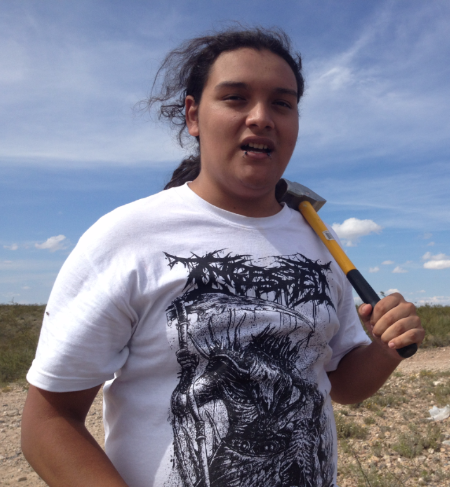
    Nataani HanleyI wave and shout a thanks for his time and he seems flustered while trying to decide whether to pull forward or make a three-point turn or reverse along the dirt road. I turn and notice that sixteen-year-old Navajo student and artist Nataani Hanley had sauntered up at some point during our conversation and has been standing a few feet behind me, holding a sledgehammer up on his shoulder.

    “What are you guys doing?” Hanley asks casually. He is interested in securing a drink of water and a ride back to the hangar.

    Hanley talks about his upcoming opera project at the Heard Museum in Phoenix; he muses on the connections between operatic tragedy and the various genres of underground heavy metal. He is a sweet and thoughtful young man, mature beyond his years just enough to be aware of how much of a sixteen-year-old he is.

    When I explain to him that he may have scared Spencer off, he is apologetic. He tells me that Spencer seemed “aggressive, in a way. Not like, upfront aggressive but like, with his ideas.”

    Hanley and I discuss Spencer’s response to the idea of transborder cultural exchange and conclude that his stance could be summed up as such: cultural exchange with Mexico is bad because it ruins our culture and our culture is better than Mexico’s culture.

    “Well, what about all their culture ruining Native American culture?” Hanley says. I joke that we could have asked Spencer just that, and many other questions, if Hanley had not walked up behind me with a sledgehammer on his shoulder. He laughs. “I’m sorry, man. I just wanted some water.”


    Continue on to part three in this series. To read part one, click here.


    About the Author 

    Mark TreckaMark Trecka is a Chicago-born writer, artist, and performer. His work has appeared in the Huffington Post, Impose Magazine, The End of Being, and elsewhere. He blogs and Instagrams for @featherproof and has recorded and performed with Pillars and Tongues, Dark Dark Dark, and others. He lives in New York’s Hudson Valley. Follow him on Twitter at @MTrecka and visit his website.
  • By Michael Bronski, Ann Pellegrini, and Michael Amico

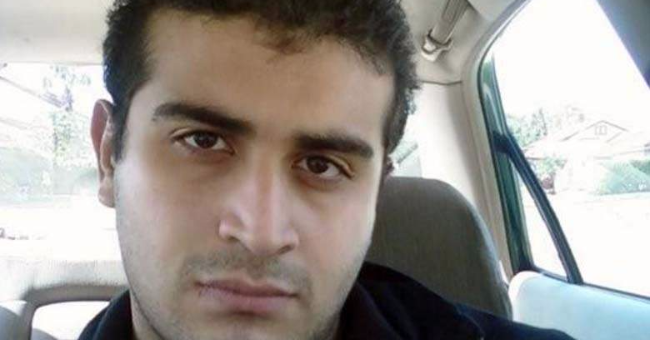
    Omar Mateen

    Omar Mateen

    The Orlando, Florida shooting has—in the wake of an ongoing investigation and every changing narrative—produced a massive amount of opinions. Many of these are misinformed, naive, spurious, ill-intended, inflammatory, and second or third guesses. As the story continues to unfold and more information emerges, the facts seem to become even more confusing, and less conclusive of any one single, cohesive explanatory theory.   

    As the news emerged that Omar Mateen had been a regular at the nightclub Pulse, and had visited gay male dating apps, his intention for doing any of this is still unclear. Given his homophobic public statements, the best we can say now is that—aside from whatever actual political ideologies he held—he was obsessed, on some level, with homosexuality.

    This has caused a wealth of commentators—on the left, right, and center—to conclude that he was a self-hating homosexual. In this swirling crucible of non-confirmed information, this “explanation” resonates with many people. The reality is that it simply plays into—and restates—an old myth: that all homophobes are really all repressed homosexuals.

    In our book “You Can Tell Just by Looking” and 20 Other Myths about LGBT Life and People, Ann Pellegrini, Michael Amico, and myself look at this myth and what it really tells us about the heterosexual imagination.

    —Michael Bronski

    ***

    “Oh, he is such a homophobe. He’s probably really gay. That explains it.” How often have you heard this? How often have you thought it? Ironically, appeals to common sense are usually made when logical explanations fail or when the explanation is just too confusing to make immediate sense. That is the case with this myth, and, perhaps, with the idea of homophobia itself. Society, culture, economics, power structures, family relationships, prejudices, religion, and so many other factors enter into the creation and maintenance of homophobia. Isolating any one factor, such as a person’s supposed sexuality, and singling it out as the chief cause overlook this complexity. More important, with this myth, it also risks de-politicizing homophobia by turning it into a matter of one individual’s warped psychology.

    Furthermore, the word homophobia has become so broadly defined, and so broadly used, that it can refer to a staggeringly wide range of emotional states, from simple annoyance at the presence of homosexuals to murderous rage. There are enormous differences between these ends of the spectrum and everything in between. But one fact unites these emotional states: the wide application of homophobia to explain an entire gamut of negative reactions toward homosexuality is a direct result of the increasing visibility of social expressions of homosexuality.

    The word “homophobia” is a recent invention. After the gay liberation movement began in the late 1960s, LGBT people and their allies needed some idea, and preferably one that matched their intuition, for how others could be so deeply repelled, and in so many different ways, by the increasing visibility of homosexuality. Psychologist George Weinberg coined “homophobia” in the late 1960s, and it was used intermittently by other writers until Weinberg popularized it in his 1972 book, Society and the Healthy Homosexual. Weinberg defined “homophobia” as the revulsion to, or fear of being in close contact with, a lesbian or gay man. Since that time it has become common usage—as well as generating similar terms such as biphobia and transphobia—and has decisively shaped the public discussion of how we think about emotions and actions that manifest animus against lesbians and gay men. Although “homophobia” may be a useful word in some instances, it is often immensely misleading in describing the hows and whys of people’s feelings and actions. Nonetheless, many people made the connection that a fear of proximity to homosexuality somehow implicated a person in homosexuality.

    This connection often feels intuitive. We have all experienced a situation when people hide something about which they feel ashamed, guilty, or nervous. They may begin to act defensively, or attempt to shift the blame, or shame, onto someone else. This is true of a five-year-old who is caught stealing a cookie from the kitchen after she should be in bed. Or of a co-worker who has not completed his assigned project on time and begins pointing fingers to shift the blame. It is easy to see how this reflexive emotional response might allow many people to think that when a person acts out or articulates a vivid homophobic response to a situation—say, reacting to the public presence of obviously gay men on a street by exclaiming loudly, “When did all the fags move into this neighborhood?”—that person might be hiding something about his own sexual desires. But maybe not. It is important to remember that the myth that most homophobes are repressed homosexuals is very often a story to explain and negate straight-male aggression against gay men.

    Homophobia, according to Weinberg, is a symptom of deeper prejudice that gains its meaning and power from the ways individuals fear people different from themselves. Weinberg locates the roots of homophobia in specific moral and political views about the world, including religious beliefs that homosexual acts are sinful and the idea that nonheterosexual behavior is a threat to traditional values. Racism is similarly influenced and constructed by a long, complicated history in the United States and is entwined with legal, social, and economic issues. Although Weinberg wrote that the fear of “being homosexual” was about much more than homosexuality per se, the connection between the fear of gay people and the fear of being gay yourself rang so true to readers that it became the main idea people took away from the book. And it quickly became ingrained in both LGBT and mainstream culture.

    But Weinberg did not claim that the people who feared homosexuals most—and, again, he was writing almost entirely about men fearing other men—were repressed homosexuals. Human beings are capable of a wide range of erotic feelings. Heterosexuals can feel conflicted about their same-sex attractions, but so can people primarily attracted to the same sex. None of these internal conflicts would be extraordinary, since our culture—even now, which is far more accepting than in the past—does not encourage individuals to understand, and be comfortable with, their sexual desires. We are taught not to explore or express them. In his 1948 study Sexual Behavior in the Human Male, Alfred Kinsey and his team of researchers wrote, “The anatomy and functional capacities of male genitalia interest the younger boy to a degree that is not appreciated by older males who have become heterosexually conditioned and who are continuously on the defensive against reactions which might be interpreted as homosexual.” Weinberg noted a similar defense. Whether predominantly heterosexual or homosexual, people who are not comfortable with their same-sex attractions may try to negate these desires through what Weinberg calls “chronic self-denial.” He also argued that people with deep unhappiness about this conflict may experience a “flight into guilt.” Both of these results might be described as “repressing” same-sex erotic attractions because they make these people feel uncomfortable, nervous, and even panicked when confronted with homosexual people of the same sex as themselves.

    You Can Tell Just By LookingThese psychological responses reflect some of the social and political realities with which we all live. Repression is not simply an internal process. Repression is a response to an entire social world. Homosexuality comes to have meaning, whether pleasant or uncomfortable, only because it is viewed and understood through that world. A person cannot repress “homosexuality” as such because it is not an entity with clear boundaries. It would be absurd to argue that all white racists secretly think they are black or want to be black. The “repression of homosexuality” is the repression of a whole string of associated ideas that for one person may connect to same-sex attraction. Another person may have different associations. We all repress, to some degree, aspects of our erotic desires, sometimes because they are culturally frowned upon, but also because they can be associated with feelings that make us uncomfortable. When something in this repressed chain is drudged up by a reminder of it in daily life, we need to get rid of the discomfort it causes. This is why it makes sense to people that acts of violent homophobia are due to the repression of homosexual tendencies.

    Another persuasive aspect of this myth is that it reinforces the widespread cultural fantasy that heterosexual men are unfazed by the possibility of same-sex desire. In this fantasy “real” straight men are so secure in their heterosexuality that they would never need to act out against gay people and, especially, gay men. It is insecure straight men, and closeted gay men, who are the problem. Heterosexual men thus have no connection to, or blame for, homophobic violence.

    Rather than homophobes repressing their homosexual feelings, it is more likely that they are avoiding the idea of homosexuality. In his 1946 foundational study of prejudice, Anti-Semite and Jew, Jean-Paul Sartre, writing just after the Holocaust, boldly argues that anti-Semitism has less to do with Jews than with the fragile psyche and identity of the anti-Semite.

    The anti-Semite has essentially created a fantastical idea of the Jew (which has nothing to do with actual people or culture) that “explains” everything that is wrong with both the society in which the anti-Semite lives as well as his own life. In the anti-Semite’s fervid imagination, the mythical Jew has too much social power, controls the banks and national wealth, and controls cultural institutions such as universities. In its most extreme version, the anti-Semite imagines that “the Jew” conspires against Christians, molesting and murdering Christian children. This fantasy Jew, which Sartre called “the idea of the Jew,” becomes the scapegoat for all that is wrong with the world. Sartre further argues that anti-Semitism is not an “opinion,” that is, a view based upon facts, but a “passion,” which is deeply believed despite all facts to the contrary. When the anti-Semite is even fleetingly reminded of this “Jew,” he feels entitled to react, sometimes violently, with a strongly felt anti-Semitism, telling himself that he is only defending himself and his culture, not attacking another person or group.

    Sartre’s ideas strike home today. Homophobic passion, impervious to facts, is spouted by many evangelical Christians. Does this mean that televangelists such as Pat Robertson or the late Jerry Falwell, whose pronouncements about homosexuality are extreme and do great damage, are closeted homosexuals? Their homophobic diatribes can be so sexually explicit a listener might think these men were intimately familiar with homosexuality. It is tempting to say that this familiarity indicates that they are secretly gay. But it makes more sense to say that their relationship to homosexuality is complicated, and like Sartre’s anti-Semite, makes sense of their world. Robertson has used homosexuality to explain earthquakes and Hurricane Katrina. This is completely illogical, but passion is not logical. It is possible that homophobes may be envious of the pleasure they deny themselves. This pleasure is then projected onto the sinful homosexual. A recurrent theme in most antigay jeremiads is that gay men are wildly promiscuous and engage in outré sexual acts. Here the idea of the homosexual, not actual homosexuals, represents forbidden pleasures. Just as Jews historically are associated with money, homosexuals have become associated with sex. Wild, out-of-control sex becomes the very meaning of homosexuality. In a culture that does not deal honestly with pleasure, and in which sex is sometimes depicted as a biological force that leads to social anarchy if not properly controlled, the fantasy of the sex-crazed homosexual can generate intense social and personal antagonism.

    Recent scientific studies have attempted to prove the connection between homophobic attitudes and repressed homosexuality. One study, “Is Homophobia Associated with Homosexual Arousal?” (1996), assessed the level of homophobia in white, heterosexually identified, male college students through questionnaires, and then tested whether they were aroused by gay porn by attaching a plethysmograph to measure the engorgement of their penis. The men who had been identified as homophobic were twice as likely to have a penile response to the gay porn, yet were also either unaware of their physiological response or denied it. Media reports trumpeted the study as proving that repressed same-sex attraction caused homophobia. But this was a serious misreading. The study did not prove that these “homophobic” males were secretly turned on by male homosexuality. Or that they were homosexual themselves. All this study demonstrated was that their homosexual arousal could occur as a result of the very anxiety around its possibility. Whether they were already attracted to the same sex is a different question.

    A 2012 series of studies of 164 students from the United States and Germany also identified homophobia through a series of questions. But these studies used answers to additional questions, rather than physiological changes, to assess arousal in response to both sexual and nonsexual images. The studies concluded that “homophobia is more pronounced in individuals with an unacknowledged attraction to the same sex and who grew up with authoritarian parents who forbade such desires.” What the series actually demonstrates, however, is that homophobic responses are never just psychological or personal, but also always cultural, social, and maybe political.

    These homophobia studies received a huge amount of media attention when they were published. The press release for the second string of studies claimed that it

    sheds light on high profile cases in which anti-gay public figures are caught engaging in same-sex sexual acts [including that of] Ted Haggard, the evangelical preacher who opposed gay marriage but was exposed in a gay sex scandal in 2006, and Glenn Murphy, Jr., former chairman of the Young Republican National Federation and vocal opponent of gay marriage, who was accused of sexually assaulting a 22-year-old man in 2007.

    Such extrapolations are absurd. No one explanation of homophobia, whether it is a political position or a scientific measurement, can be fully accurate if it denies its connections to the many other frames through which we see the world.

    Whatever the complications of each individual psyche, we all live in a world that influences us every day in myriad ways. Homophobia, in all of its forms, expresses real social anxieties over how something will fit in or disrupt the world “as it is.” But that world is seen differently by every individual in it. That’s its trouble and its promise.


    About the Authors 

    image from www.beaconbroadside.comMichael Bronski has been involved in gay liberation as a political organizer, writer, and editor for more than four decades. The author of several award-winning books, including A Queer History of the United States, he also coauthored “You Can Tell Just by Looking”: And 20 Other Myths about LGBT Life and People. Bronski is Professor of the Practice in Activism and Media in the Studies of Women, Gender, and Sexuality at Harvard University and lives in Cambridge, Massachusetts.


    image from www.beaconbroadside.comAnn Pellegrini is professor of performance studies and religious studies at New York University, where she also directs NYU's Center for the Study of Gender and Sexuality. She has written extensively about religion, sexuality, and US public life. Her publications include Performance Anxieties as well as the coauthored Love the Sin and “You Can Tell Just by Looking”: And 20 Other Myths about LGBT Life and People.


    image from www.beaconbroadside.comMichael Amico is a PhD candidate in American studies at Yale University, and is writing a history of the love between two men in the Civil War. He has written for LGBT youth publications, such as Young Gay America, and provided political analysis for the Boston Phoenix and other venues. He also coauthored “You Can Tell Just by Looking”: And 20 Other Myths about LGBT Life and People.

  • By J. A. Mills

    African elephant

    Call it superpower leadership, sibling rivalry, or rising to the occasion. Whatever the label, the presidents of China and the United States have joined forces to literally save the world.

    This is how the world achieved game-change on climate change: U.S. President Barack Obama and China’s President Xi Jinping spoke one-on-one about concerns over human-caused greenhouse gas (GHG) emissions speed-warming the planet. The U.S. acknowledged that it, too, has a problem with GHG emissions. Then the world’s number one and number two GHG emitters—China and the U.S. respectively—jointly pledged to limit their climate impacts and lead the world to do the same.

    Something similar is happening with ivory. Britain’s Prince William raised concerns about China’s ivory consumption in a private meeting with President Xi Jinping. The U.S. acknowledged that it, too, has an ivory trade problem. The U.S. burned six tons of ivory stockpiles in a gesture of good faith, after which China burned 6.1 tons. Then China and the U.S.—the world’s number one and number two largest consumers of wildlife—made a joint pledge to stop ivory trafficking at home and abroad, and to ban legal domestic ivory trade. The U.S. announced a “near-total” ban on ivory trade the week before this month’s China-U.S. Strategic and Economic Dialogue, after which China announced it would set a timetable by the end of the year for phasing out commercial trade in ivory.

    Through these bold, unprecedented measures, Presidents Xi and Obama may save humanity from climatic catastrophe and elephants from extinction. Will they go a step further and help the other wild species—such as tigers and rhinos—that are being hunted down for their commercially valuable parts?

    When I went to China for the first time in 1991 to investigate bear farming, I learned the country intended to farm bears and a long list of other rare and threatened species “just like cows and pigs,” as my main government escort phrased it. In fact, China’s Wildlife Protection Law mandated the farming of this long list of wildlife for commercial trade and consumption. What most people do not know is that China now battery farms tigers and has recently begun farming rhinos, all under blessing of the country’s Wildlife Protection Law.

    This law is up for revision now, and Chinese legislators, business leaders, conservationists, animal welfare advocates, and celebrities have pushed for the farming and consumption mandates to be removed. Unfortunately, China’s State Forestry Administration—the agency charged with protecting species in the wild—helped start, build and promote bear, tiger, and rhino farms. This is the same agency that advocated for so-called “limited” legal international trade in ivory on behalf of China’s ivory traders, which resulted in the recent wholesale slaughter of African elephants, undermining the 1989 international trade ban that has allowed them to make a dramatic comeback in the wild.

    Surveys have repeatedly shown that majorities of Chinese people support bans on trade in ivory, tiger bone, and rhino horn. However, the results of a new study by Chinese researchers also found that consumers in China continue to prefer wild-sourced products over farmed-raised because they believe those from the wild are more effective. In other words, if trade in these commodities becomes legal again, buyers will prefer those taken from the wild.

    “For many species, commercial breeding and legalized trade in farmed products will have the opposite effect to what is desired for conservation,” according to another new study. “[The] main reasons are consumers’ preference for wild products…and laundering of illegal products into the legal wildlife trade.”

    Researchers from Princeton University and the University of California at Berkeley just released results from their analysis of the repercussions of “limited” legal ivory trade from Africa to China and Japan in 2008. “The intuition that legalization will reduce illegal production is not always true," said co-author Nitin Sekar, who began the study as a graduate student at Princeton and received his doctorate in 2014. “The economic intuition was that if we allow the sale of some legal ivory in Japan and China, then there would be fewer people left to purchase it illegally. We found that that intuition was incorrect. The black market for ivory responded to the announcement of a legal sale as an opportunity to smuggle even more ivory.” Said Sekar’s co-author Solomon Hsiang, now an associate professor of public policy at UC Berkeley: “I used to be a strong believer in legalization as a crime-reducing policy, but this has really forced me to rethink that. [W]hen people talk about legalization, it may be smart in some cases, but in which cases is not as obvious. This is a case study for how wrong it can go.”

    So, why is China’s State Forestry Administration in the business of promoting rather than stopping trade—legal and illegal—in parts and products from endangered species when that approach went so dramatically wrong with elephant ivory? It all goes back to China’s Wildlife Protection Law. When the law debuted the 1980s, it not only mandated the farming and consumption of wildlife, but deemed the endeavor virtuous and of great benefit to the People’s Republic of China. This mandate grew from Mao Zedong’s emphasis on animal husbandry as a cornerstone to the success of Communist China. Mao’s regime even ordered the People’s Liberation Army (PLA) to help ensure the success of animal husbandry and also medicine manufacturing. Scholars have noted that China’s decision to join CITES—the Convention on International Trade in Endangered Species of Wild Fauna and Flora—in 1981 went against the priorities of the Ministry of Foreign Trade and Economic Cooperation, the Ministry of Public Health, and the PLA. In fact, the PLA was “implicated in protecting the smugglers of tiger bone and rhino horn” after China banned their importation to comply with CITES.

    The PLA, several government ministries, pharmaceutical manufacturers, as well as provincial and municipal governments invested money and manpower in establishing China’s bear and tiger farming industries, the country’s new rhino horn farming effort, and unsuccessful attempts to farm musk deer and pangolins. Another key player was China’s Northeast Forestry University, which, until recently, produced all of the country’s biologists—some of whom hold key leadership positions in today’s State Forestry Administration. This is why the only way to stop this growing drive for commodification of bears, tigers, rhinos, and dozens of other wild species is to take the matter out of the hands of those married to these mandates from the past, which, like the unmitigated burning of fossil fuels, are proving dangerous to Earth as the global community knows and loves it.

    Nothing short of Xi Jinping and Barack Obama forging a bilateral agreement like their climate and ivory agreements will stop the enduring and expanding effort to commodify a long list of the world’s most beloved wild species. As the joint China-U.S. climate statement of November 2014 says: “The seriousness of the challenge calls upon the two sides to work constructively together for the common good.”


    About the Author 

    image from www.beaconbroadside.comJ. A. Mills has worked for TRAFFIC, World Wildlife Fund, Conservation International, and Save the Tiger Fund. She is now a consultant to the MacArthur Foundation and lives in Washington, DC. Visit her website at jamillsauthor.com. Follow her on Twitter at @JAMillsAuthor.

  • By Kay Whitlock

    The Crossroads

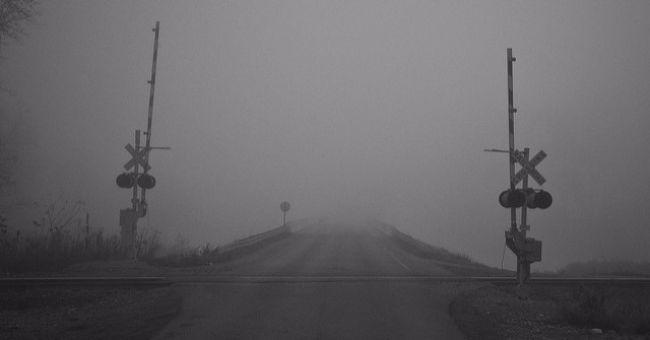
    Photo credit: Flickr user Mike+Tiffy

    I’ve been lost for a while/I think I may be off by a million miles…
    I asked directions back at the station/I had a feeling I could trust that guy
    I was mistaken, now I got a feeling/That I’ll be driving down this highway till the day that I die
    Still I don’t care even if I got to crawl/Till I ain’t got any knees at all
    I’m gonna find my way/Back to the crossroads some day.

    —Singer/songwriter Todd Snider, “Back to the Crossroads”

    When I am filled with pain, and seeking change in my life but unclear, uncertain, or even ambivalent about new directions and possible choices, I spend time in quiet reflection and meditation. Then I head for The Crossroads.

    I go to make an inchoate plea for insight, revelation, and guidance—what some folks would call a prayer. I go when the daylight language of “issues” and politics as usual sounds like meaningless gibberish and possesses such a profound aura of lifelessness that even zombies cannot arise and lurch toward us in its presence.

    I am at The Crossroads now because I feel weary and so restricted and clogged in my thinking about the nature of justice and the relationship of structural violence to sudden explosions of violence in homes and communities.

    In mythology and story—found in Greek, Yoruba, and so many other cultures—The Crossroads is a place, symbolic and actual, where different paths converge. The Crossroads is a place of meeting and farewell; of union, reunion, and parting. Best approached at midnight, The Crossroads is a matrix: a situation or environment in which the conscious self encounters the unconscious shadow; where the living encounter the dead; where choices are made and a particular direction must be selected.

    I was already heading there when, in the midst of a road trip across Iowa with my partner and various members of her/our family to visit special places for the purpose of scattering the cremains of both of her parents who died last year, we heard about Orlando and the mass murder and mayhem on Latin Night at Pulse, an LGBT nightclub. The grief and love we were already feeling surged. As we all now know, forty-nine people were killed—mostly young queers and transgender people of color, Latinx and Black, and some a mix of both, mostly of Puerto Rican descent—and more than fifty were injured.

    My partner, queer friends, and I have been rambling on endlessly, thinking about our own histories, seeking names, photographs, and details of lives. Orlando was something hardly any of my straight friends and family would really talk about. Most responded only briefly, if at all, with distancing and jarring abstractions having to do with issues and enemies and monsters. Only one person really responded with her whole heart.

    Here were the limits of legal “equality” laid out in blood across the dance floor and in the bathrooms of Pulse, and in Orlando hospital rooms and surgeries, tended to by sudden mobilizations of nurses, doctors, and paramedics.

    It could have happened to almost any queer—especially LGBTQ people of color—at any time over so many decades. Richard Kim and Veronica Bayetti Flores and others have written movingly about the meaning—sanctuary, community center, and lifeline—of bars and nightclubs to so many queers. My own queer self was forged partly in political arenas. But only in the early 1970s did I come to a celebration of my whole self in bars and nightclubs—especially in dance clubs—with names like Three Sisters (Six Tits to the Wind, as some of us called it), Hide ’n Seek, Rusty’s, Mademoiselle, The Duchess, Grand Central, and Ice Palace. There I learned to embrace and rejoice in my desire, fleshy, fully embodied, sensate, and utterly freeing, the life-affirming, unrestrained varieties of queer desire that the cautious, respectable framing of “gay rights” and “LGBT equality” always avoids.

    That this tragedy involves homophobia, transphobia, and racism is clear. Perhaps also toxic masculinity. But none of that is the whole story. How do we make sense of Omar Mateen? He came of age in a society permeated with anti-LGBT culture wars and suspicion and animosity directed against people of color, immigrants, and Muslims. He knew a lot about violence (he physically abused his former wife, who described him as mentally unstable, and was known for making bigoted and “inflammatory” statements on various occasions), security and weaponry. He may have been gay or at least felt queer stirrings at some point, regardless of whether he was gay, felt compelled to enter a queer club—not just on any evening, but on Latino Night—and start shooting.

    Almost instantly, police and mass media framed the shooter, twenty-nine-year-old Mateen, killed by police three hours after he entered Pulse, as a Muslim terrorist, possibly an immigrant, loyal to ISIS, the so-called Islamic State. Never mind that he was born in the United States. Never mind that he seems not to have been a religious Muslim or that pundits couldn’t agree on what kind of Muslim he really was. The FBI had once investigated Mateen and closed the file on him. Is that a failure? What are the limits of surveillance and control? Or are there any?

    Apparently not. Even as it becomes increasingly clear that Mateen was not quite the credentialed ISIS-affiliated “radical Islamist jihadist” many have made him out to be, liberal LGBT advocacy groups place uncritical faith in the government’s Kafkaesque “terror watch list” wanting it strengthened via gun control legislation. And just to emphasize that the problem of mass violence is only the province of fanatics and extremists, they also ask for guns to be denied to those convicted of hate crimes. (Never mind that the thirty-odd years of having various federal and state hate crime laws have not produced any safety for anyone, especially the communities these laws are said to protect, but have expanded police violence.)

    The hunt is on, as it always is, to pinpoint the presence of danger and evil in particular categories of people in order to exonerate ourselves.

    The Obsession with Enemies 

    What happens to a society like the United States that—today as well as historically—focuses on enemy formation as an organizing principle for establishing safety? What does it mean when we emphasize containing, controlling, and crushing enemies—and then conflate the hunt for enemies with the search for justice?

    What happens when almost all the proposed responses to enmity involve some combination of intensified surveillance, educational and cultural censorship, and formal/informal means of policing, punishment, and monitoring that primarily target communities we have already demonized?

    Such questions haunt me. They show up constantly in my work, which is centered on revealing and challenging structural forms of violence—violence embedded in mainstream public/private institutional policies and practices, and in popular culture, in the United States. Structural violence: police brutality, militarism, the violence of institutionalized racism, and patriarchy that provides the template for what our society has come to call “hate violence.” The work takes me into places where the issues are fraught and framed by contested images, symbols, and stories of danger, enmity, fear, violence, and personal/collective pain and trauma—especially in fear-and-anger soaked moments of crisis and tragedy.

    None of this hunt to locate the source of moral vacancy, violence, danger, and evil outside of ourselves is new; it is as old as settler colonialism, the genocide of Indigenous peoples, and chattel slavery. Michael Bronski and I talk about this at some length in Considering Hate: Violence, Goodness, and Justice in American Culture and Politics. In the late nineteenth century, European theories of “born criminals,” which quickly gained currency in the U.S.,  placed white, heterosexual men without a trace of readily identifiable physical or cognitive disability at the apex of virtue and civilization. “Born criminals,” by contrast, flagged as dangerous all people of color, anyone with discernible disabilities, certain white ethnic groups considered to still be primitive and atavistic, and gender nonconforming people. This mainstream theory morphed into eugenics, which sought to apply “sound scientific principles” of racism to the biological control of peoples thought to be dangerous to the civilized and moral (white, able-bodied, affluent) body politic.

    Today, the hunt continues, through varied forms of racial and sexual profiling; through the widespread use of so-called “evidence-based predictive risk assessment” instruments  in courts and correctional institutions; through the incessant compiling of ever more expanded lists of “criminals” and people on terror watch lists; through new variations of old “born criminal” and eugenic ideas that seek biologized ways to predict violence and danger. Our society’s obsession with human triage shows up in countless forms: shredding the social safety net; establishing systems of mass incarceration that morph into expansions of community-based forms of ongoing control and surveillance; the school-to-prison pipeline, and an apparently perpetual commitment to war.

    But it is not possible to neatly sort out good and evil people into separate, distinct piles, because the capacity for both is found in all of us, and throughout all of our communities. There aren’t enough fences, walls, police, jails, prisons, surveillance technologies, drones, or ground troops to keep us “safe” from having, somehow, to live with one another and even ourselves.

    Activist and scholar Rachael Kamel notes that so many Orlando commentaries focus on “how to separate the sheep from the goats. Was the shooter ‘really’ gay? Was he ‘really’ an Islamist (whatever that is)?…Here’s an idea: it will never be possible to separate human beings into the good ones and the bad ones, the ‘real’ Muslims (or Christians or Jews) and the violent ones, the real queers and the closet cases. We are all mixed up with one another…”

    Back to the Crossroads 

    Efforts to create safety and community cohesion through strategies of control, containment, and domination of the fearful, despised, and subservient Other are destroying us. Proposed reforms only tinker with the machinery of domination, making cosmetic changes while leaving oppressive supremacist ideologies and systems in place. And in truth, the central structures of domination serve as the default architects and implementers of change. Solidarities are expressed in the moment, and they are important, sometimes even life-changing for those who participate. But on a societal basis, they don’t last. How can they? We have no national foundation for imagining justice as the radical creation of just social, economic, cultural, and ecological relationships within a context of wellbeing for all.

    We have to create that foundation ourselves, together.

    What would happen, Bronski and I ask in our book, if we disentangled justice from the framework of hate and vengeance and imagined justice in new ways? Here’s how we’ve imagined it, but others may take it into deeper and more expansive directions:

    Justice: the evolving pursuit of trustworthy, respectful, and nonexploitative relationships, together with accountability for interrupting, preventing, and redressing violence, in its myriad forms, against individuals, peoples, communities, and ecologies. 

    That’s why I’m at The Crossroads at midnight. To depart from those who seek only punishment and revenge. To at last move wholeheartedly, without equivocation, toward a justice defined by radical, collective embrace of the neighbor.

    The most popular bit of American Crossroads lore has it that the great Delta bluesman Robert Johnson went out one dark Mississippi night, in the moonlight, to trade his soul to the Devil for the ability to play the guitar like nobody else. In a society drenched in the white supremacist need to conflate darkness with Blackness, criminality, and evil, it’s not surprising that encounters here are said by those who speak only in daylight language to be meetings with The Devil.

    That’s the penchant for racist drama, of course, a cautionary tale tailored to explain the magnificent artistry of a poor, exploited man of color who died way too young. I prefer to think he did indeed go to The Crossroads; he has a song about it. But it wasn’t the Devil he encountered. It was himself.

    Dr. Martin Luther King, Jr. told the story somewhat differently in a sermon called “A Knock at Midnight” given less than a year before he was assassinated. Taking inspiration from a passage in the Gospel of Luke, he spoke to the role of the church in grappling with contemporary injustices and anxieties. A weary sojourner arrives at a friend’s house—The Crossroads—and this friend has nothing to “set before” the sojourner. So the friend goes to a neighbor and asks for bread in order to nourish the sojourner. The bread represents hope, love, and just social and economic relationship. But midnight is a dispiriting time, filled with paralyzing fears and great hypocrisies; it is a time and the temptation to relinquish hope for significant change is great.

    The neighbor refuses to give the bread.

    What a terrible time. Yet Dr. King reminds us, midnight is also a time when relentless persistence and strong patience in the face of great adversity and indifference can produce astonishing transformation. We must never consent to this indifference, which is located not only in some designated Other, but also, too often, in ourselves.

    Real justice would mean working toward a society in which the dear friends killed in Orlando were still alive, still dancing, still with hopeful futures ahead in a society that values them. And the man who killed them might be among them, this time not with an assault rifle but a kind regard for himself and his neighbors.  


    About the Author 

    Kay Whitlock is a writer and activist who has been involved with racial, gender, queer, and economic justice movements since 1968. She is coauthor of Considering Hate: Violence, Goodness, and Justice in American Culture and Politics with Michael Bronski, the award-winning Queer (In)Justice: The Criminalization of LGBT People in the United States with Joey L. Mogul and Andrea J. Ritchie, and cofounder and contributing editor for the weekly Criminal Injustice series at CriticalMassProgress.com. She lives in Missoula, Montana. Follow her on Twitter at @KayJWhitlock.

  • By Ginny Gilder

    Gay Pride parade“I don’t mind being gay, but I’m never gonna fly that rainbow flag,” I protested to my girlfriend, Lynn. We were on a California beach near Santa Cruz celebrating my friend Camille’s fiftieth birthday, a group of a dozen lesbians, most of whom were dancing, clapping, prancing around the beach with big rainbow flags held high. Lynn and I stood on the edge of the group, shoulders hunched, our hands noticeably empty of any sticks hoisting multi-colored fabric, thrust deep in our pants pockets.

    It was 1998. My fourteen year marriage to my three children’s father was foundering. I was stepping into a new life with Lynn, who was also ditching her decades-long marriage, gingerly carrying my dream of merging our five children into one family. We’d fled our Seattle coop and the pain and guilt of our progressing divorces for a weekend to revel in our new identities as gay girls. So why, at my first chance to bond with other lesbians, did I feel such distaste?

    Perhaps I should have realized, in the twilight of the twentieth century and at the dawn of the twenty-first, that my approach to my own homosexuality proved coming out was not just a private, but a public act, and a political one. I did not make any of my choices—first, as a twenty-five year old to live in hiding from myself as a straight person, then to confront, acknowledge, and slowly embrace my full identity fifteen years later—in a vacuum. They were all reasonable decisions made in the context of American society’s views on homosexuality.

    Lynn and I made it through the party without offending anybody. Afterwards, I started sorting out what being gay actually meant. I balked at the idea that, because my true love was a woman instead of a man, I should claim membership in a group that was so publicly adamant about its identity. I didn’t want to set myself any further apart from the mainstream. Couldn’t I just be out and proud quietly? Did I have to advertise my diverse status? I questioned whether my sexuality, a solitary dimension of my identity, should trump everything else about me, loom above other aspects of myself as the essential identifier. What was the point, other than to magnify my sense of separation? Waving that damn rainbow flag all over the place would just give people a reason to label, judge, and avoid me. I couldn’t see the upside.

    Even in liberal Seattle, though, I began to discover the perils of being gay in America. I wasn’t publicly shamed or physically attacked. But I had crossed a line with my father that had diminished his view of and respect for me; I couldn’t blink away the stares evoked by my holding hands with Lynn in public; and I couldn’t ignore my distressed kids’ stories about their classmates’ reactions to my sexuality.  Of course I knew about Mathew Shepard’s beating, torture and death, in Laramie, WY, which happened a month before my friend Camille’s birthday. I’d heard about attacks on gays in communities around the country, from Rockford, AL to Redding, CA, from Queens, Philadelphia, and Newark to Cortez, CO, Elizabethtown, KY, and Grant Town, WV. Maybe stepping out in solidarity with other gays wasn’t all about me.

    My own experience of daily life, combined with the glaring reality of discrimination of gays everywhere (in 2013, perceived sexual orientation was the genesis of over 20% of hate crimes reported to police in the US) taught me the value of joining a community that acknowledges the challenges of being gay; battles daily for protection, validity, recognition, and respect; and reminds me to keep my head up proudly. I didn’t embrace the need for solidarity with the greater GLBTQ community overnight, but slowly my awareness of belonging to this larger movement awakened, along with my desire to participate, to strengthen and be nurtured by it.

    Today, Lynn, now my wife, and I own a piece of property we named “Rainbow Rock.” Rainbow stickers adorn our vehicles. We attend Pride parades, donate regularly to several organizations working to promote and protect gay rights, and seek to engage and educate others. Lynn also joined the national board of Lambda Legal, where she served for six years. In short, we have embraced our rightful place in this diverse and precious community.

    Joining forces with others creates a sense of harmony, safety, and affirmation in a world where difference is usually deemed threatening. In the immediate wake of the Orlando murders, the need for solidarity couldn’t be more evident, both within the GLBTQ community and the broader American citizenry. Hate seems to lack boundaries these days. Sticking together, remembering love is far more powerful than hate, rejecting the politics of fear, affirming the potency of diversity as a source of profound and lasting strength—now that’s solidarity.

    As an out and proud gay girl living in this country I love, I’m counting on our solidarity, both within the gay community and the broader citizenry, to help heal the broken hearts of those in the Orlando community. I’m counting on that solidarity to confront the dysfunction of a rage-filled minority, terrified by the idea of a pluralistic society dedicated to freedom of expression. And, I’m luxuriating in that solidarity, knowing that there’s a place I belong, without question.


    About the Author 

    Ginny GilderGinny Gilder is an Olympic silver medalist in rowing, the founder and CEO of an investment business, and co-owner of the Seattle Storm. The mother of three children and stepmother of two, Gilder lives with her wife, Lynn, and their two poodles in Seattle, Washington. Follow her on Twitter at @ginnygilder and visit her website.


  • By Caroline Light

    In solidarity with the victims or the Pulse nightclub shooting in Orlando

    In solidarity with the victims or the Pulse nightclub shooting in Orlando. Photo credit: Exile on Ontario St

    This week we shoulder the weight of our grief and outrage after yet another mass shooting by a heavily-armed gunman, this one directed at patrons of an LGBTQ night club in Orlando on Latin night. Forty-nine innocent people are dead and more than fifty wounded. Once again we struggle to make sense of the senseless, asking how we keep following the same nightmarish script. But just as the loss feels most raw, and some of us may be tempted by reductionist appeals to xenophobia, it is urgent for us to take stock of the cumulative effects of our nation’s violent past.

    This nation was founded on chattel slavery and settler colonialism, which required armed violence to sustain. Starting very early, our nation’s legal apparatus and culture worked in tandem to grant to some—originally European-descended, property-owning white men—access to tools of mass violence, to fortify white property and political power in the name of self-defense. Centuries ago, as Europeans claimed land that was already occupied, the calculated murder of Native populations guaranteed the ascendency of white Manifest Destiny. It is difficult to calculate the millions of Native lives lost, some to systematic mass killings—where entire villages were wiped out by white men with rifles—and others to famine, displacement, and the (often deliberate) spread of disease. In one instance alone, in Pound Ridge, New York in 1644, armed Dutch men obliterated a sleeping village of approximately 500 Lenape. Similar atrocities proliferated, culminating in the massacre at Wounded Knee, South Dakota in 1890, where between 150 and 300 Lakota died at the hands of U.S. Soldiers.

    Justified as necessary to national protection and expansion, these mass killings were largely characterized as “Indian wars” in which both sides carried equal responsibility. More recently, we have been able to see them as massacres, as genocidal efforts to eradicate an entire people, but our history books often fail to name them as such. Their mischaracterization in popular memory sanitizes the violence of U.S. history, perpetuating what Roxanne Dunbar-Ortiz calls the mythology of pre-colonial North America as “a land without people.”

    There are other brutal precursors to our current state, in which mass murder has become a common occurrence. Shortly after slavery was outlawed by the Thirteenth Amendment, white men armed with the newest firearms and weapons decimated entire African-American communities. They did this in cities throughout the U.S.: in Colfax, Louisiana in 1873, with an estimated death toll of 150; in New Orleans in 1866, where 238 were killed; in Atlanta, Georgia in 1906, with the loss of between twenty-five and forty lives; in East St Louis in 1917, with a death toll estimated between forty to 150. It happened too in 1921, when whites firebombed Greenwood, an affluent Black community in Tulsa, Oklahoma, known as Black Wall Street. An estimated 300 were killed, and almost $2 million in property was destroyed.

    These mass lynchings were often characterized as “race riots,” a terminology that downplays the deliberate—often state-sanctioned—white supremacist effort to neutralize Black competition for political power and capital. Homicidal outbursts of armed masculine rage were not exceptional; rather, they proved vital to the nation’s development as a center of (white) capital, defended by the use of selectively-circulated weaponry.

    As we look back today on these atrocious crimes against humanity, the connection to contemporary mass shootings may appear tenuous. Certainly there are striking differences between today’s tragedies where individual (most often, but not always white) men attack unsuspecting groups of unarmed people and massacres where large groups of armed men—often acting with state complicity—sought to eradicate entire communities whose existence and independence challenged the powerful.

    But the shootings in Orlando and Charleston have their roots in a tradition of violent resistance to minority groups’ tenacious struggles for equality. The targeted individuals were routinely subject to systemic violence and exclusion, including—but not limited to—hate crimes, police violence, and hyper incarceration. Even against overwhelming odds and pervasive violence, each targeted group resisted the exclusionary terms of U.S. citizenship, by standing up against the theft of land and property; by resolutely participating in the political process; by stubbornly insisting on their humanity.

    From colonial times to the present, our nation’s legal structures have long allowed easy access to military-grade weapons, particularly to those who would serve existing power structures. While contemporary mass killings may appear to be perpetrated by individuals on singular, twisted “missions,” their violence is often grounded in the same exclusionary ideologies that fed past massacres, mis-characterized as “race riots” or “Indian wars” in the historical record.

    Today, when we call what happened in Orlando an “act of terror” without similarly naming these past instances of mass killing, we make a similarly reductionist mistake. And by placing the blame on “foreign” ideologies, we evade responsibility for structural heterosexism and racism, as well as our toxic reliance on guns. Whether they declare their allegiance to religious or political dogma, those who secure “the latest” in firearm technology to kill innocent people enact a tradition that is as American as the proverbial apple pie. Recognizing these points of historical continuity is the vital first step to changing this toxic script. 


    About the Author 

    Caroline Light is Director of Undergraduate Studies in Harvard’s Program in Studies of Women, Gender, and Sexuality, and author of forthcoming Beacon title Stand Your Ground: America’s Love Affair With Lethal Self-Defense (Spring, 2017). Light’s Ph.D. is in U.S. history, and her research and teaching address histories of immigration, citizenship, and consumer culture through the intersecting lenses of gender, race, and sexuality.

  • By Rashod Ollison

    Chaka Khan

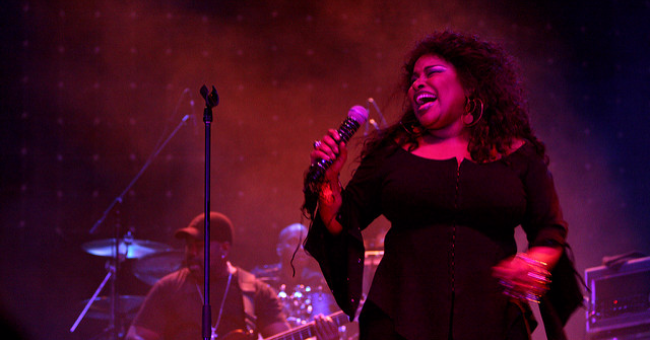
    Chaka Khan. Photo credit: Chrisna Herbst

    Fresh-cut watermelon smelling like rain and ribs sizzling on a grill bring the music back. The songs complement the food and the weather and Technicolor the memories of when we were all just kids with nothing in our pockets but waxy penny candy. We thought we knew everything. We knew nothing. All that mattered was that my cousins and I in Arkansas—with our Jheri curls and short sets, scarred knees and Tabasco tongues—were all together and that Cousin Rodney’s boom box had fresh batteries.

    We knew nothing of Black Music Month, which was first recognized on June 7, 1979—the same summer black boys and girls in Atlanta went missing and were later discovered dead in the woods or in a lake somewhere. That went on for two years. The fear of what happened to kids who looked like us more than 500 miles away still scared the grown folks, who called us inside as the sun slid down the sky and fireflies flickered dots of green light. But for hours throughout those sweltering summer days, we were lost in songs, shocked into life by voices as familiar as mustard greens splashed with hot vinegar or the cherry incense and Mary Jane smoke that thickened the air at the home of Aunt Kay, my favorite relative to visit.

    Back then, we danced and swooned to Rick James and Teena Marie, Midnight Star and Atlantic Starr, Cameo, Evelyn “Champagne” King, Maze and Frankie Beverly, the early hip-hop of UTFO, Chaka Khan, Prince and Michael Jackson, whom I thought was God. We were jammin’ to their music all year, of course, but it was something about hearing those voices and rhythms in the summer—at family barbecues or just shootin’ the shit with cousins under a shade tree with a radio nearby—that made those songs sound brighter and more immediate.

    Perhaps it’s apropos that we celebrate Black Music Month at the beginning of summer. Black folks throughout the Diaspora have long brought heat and flavor to all kinds of musical expressions. What we know as modern pop in America glimmers with elements of Black music, no matter who’s on the microphone. Be it mutations of rhythmic patterns from Africa and Latin America or histrionics bastardized from the black church, blackness will forever permeate American music.

    Much like the country itself, black music has never been a melting pot but very much a mosaic. There has been, however, a lot of fragmentation since those cassette days. My generation, those of us born in the late ’70s, grew up between tradition and technological progress. We were bused across town to schools with better resources and fewer black faces, where our musical palettes expanded to include Pat Benatar, Whitesnake, Bananarama, and later, Nirvana and Nine Inch Nails. Our parents, aunts, and uncles went to the Budweiser Superfest, the ultimate summer concert featuring a bill filled with hot black acts only heard on black radio.

    Then corporations swallowed black stations, and the same six songs played all day and night. Gangsta rap from the West Coast and noisier, grimier rap from the East Coast publicly warred with each other and bounded up the Billboard pop charts. White boys in the suburbs affected black boy posturing as sanctioned by MTV. Soul soon became “neo,” braiding the romanticism of the ’70s with hip-hop touches. D’Angelo was heralded as the second coming of Marvin Gaye, then became erratic and missing in action like Sly Stone. Erykah Badu crooned esoteric lyrics in a voice reminiscent of Diana Ross as Billie Holiday before challenging her audience with even more adventurous sounds and lyrics. Lauryn Hill showed great promise then receded from view.

    Modern black music these days, at least what’s getting pumped through the mainstream, feels distinctly different from what moved us during those blistering Arkansas summers. Generally speaking, there’s an inward feel to the approach that doesn’t always come across as ingratiating as the music we pop-locked to. Those thick grooves of Zapp and Roger, the kind of funk that moved even the most rhythmically challenged among us (and that would include yours truly), aren’t found in the morphing music of Kendrick Lamar or the charming cheesiness of Pharrell Williams.

    Black music, whatever that means today, feels as though it’s trying to belong to everybody. And that was surely the intention of many black artists from yesteryear, the economically sound dream of crossing over. But something always gets muted or lost when you rearrange yourself for an outside gaze. It was nice when the music seemed exclusive to my experience—when codes in the vocal ticks and lyrics made the music feel as though it were a complicated handshake between homeboys or a hug from a loving aunt. Perhaps little black boys and girls are having that same experience these days to the music of Drake and Beyoncé. I don’t know.

    But I cherish my memories tethered to the sweet taste and rain scent of watermelons grown in my grandparents’ garden and ribs slow-cooking on the grill, all complemented by music that made blackness feel like a gift.


    About the Author 

    Rashod Ollison was an award-winning pop music critic and culture journalist. He was a staff critic and feature writer for the Dallas Morning News, Philadelphia Inquirer, Journal News (Westchester, New York), Baltimore Sun, and Virginian-Pilot. He also wrote a music column for Jet magazine. A native of Little Rock, Arkansas, Ollison lived in Virginia Beach. 

  • By Mark Trecka

    1_HangarPano

    In October, 2015, New Mexico-based interdisciplinary arts collective, Postcommodity, executed the largest binational land art installation in history. The two-mile long installation, titled Repellent Fence, was positioned across the U.S.-Mexico border and was, in the group’s own words, “a social collaborative project among individuals, communities, institutional organizations, publics, and sovereigns.” Like much of Postcommodity’s work, Repellent Fence draws on the members’ Indigenous perspectives and seeks “to engage the assaultive manifestations of the global market and its supporting institutions.” In this four-part series, writer and artist Mark Trecka, with the support of The GroundTruth Project, reports on the drama and ideas surrounding the installation.

    ***

    Inside the Saddle and Spur Tavern in Douglas, Arizona, it is easy to forget that about a mile south down G Street, just past the Douglas Meat Warehouse, the United States ends and Mexico begins.

    It is easy to forget that the U.S.-Mexico border is a mile away even though the Saddle and Spur doubles as the Gadsden Hotel’s bar. Opened in 1907, the hotel is named for the 1853 Gadsden Purchase, in which John Gadsden, the American ambassador to Mexico, negotiated the $10 million purchase of 30,000 square miles of Mexico. The deal determined the line of 1,945 miles that is the present-day border.

    Some of the patrons in the tavern on this particular Thursday night are locals, placid expressions turned toward flat-screen TVs. But a larger number of them are visiting from elsewhere, in town for the launch of Repellent Fence, a two-mile aerial art installation which organizers believe is the largest project of its kind ever launched. The latter are crowded into booths, eating enchiladas, drinking beer and discussing the wind.

    Eight years in development, Repellent Fence is the brainchild of interdisciplinary arts collective Postcommodity, comprised of artists Raven Chacon, Cristóbal Martínez and Kade Twist. All three are Indigenous and the collective explores modern life through an Indigenous lens, challenging ideas of place and modes of modern living. Multimedia installations showing slaughtered animals in public or commodified spaces, reclaimed Indigenous symbols, and noise—both figurative and literal—all feature in the group’s body of work.

    As Martinez moves from table to table inside the Saddle and Spur, providing updates and discussing the logistics of desert wind, it is no longer easy to forget the border’s proximity.

    The installation, Martinez explains, is part of a broader project to “reawaken the people’s public memory: ‘We are a single people, living in a single town that so happens to be separated by a wall.’”

    Martinez, forty-one, is from Pueblo de Alcalde, near Española in northern New Mexico. He is Mestizo, a scholar of rhetoric and can often be seen in conversation nodding slowly, patiently considering his own words and affirming those of others. Even from a distance, Martinez displays a kind of palpable emotional aura.

    Albuquerque artist Scott Williams, thirty-five, sits at a table drinking a Pacifico. He explains that the launch will likely be delayed by wind. Williams is working for Postcommodity as the installation’s site manager. He is tall and hardy, with long, blonde hair and a blonde beard. He wears a thoughtful countenance and has the fashion of a professional camper.

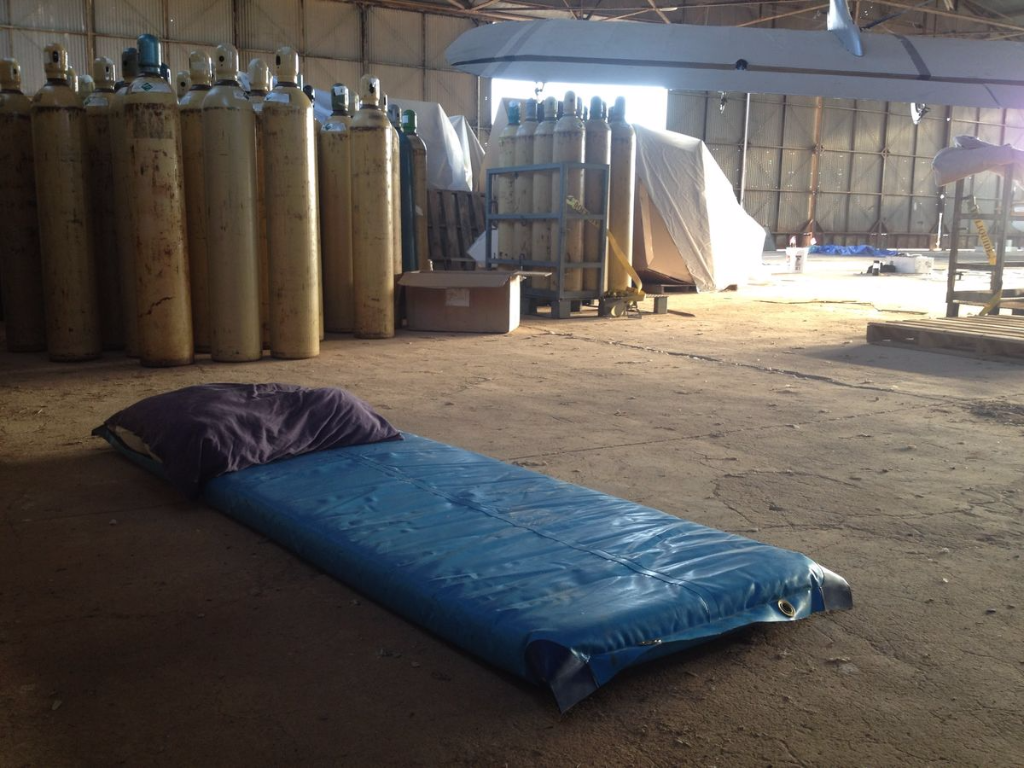
    Williams is tired. He has been in Douglas and Agua Prieta for a few days already, marking sites in the unwieldy terrain of the Sonoran desert on both sides of the border, measuring rope, readying the material elements of the project. He is staying at the Gadsden, along with the rest of Postcommodity, but only until the installation is up. At that point, he will camp near the border.

    Hangar campsite

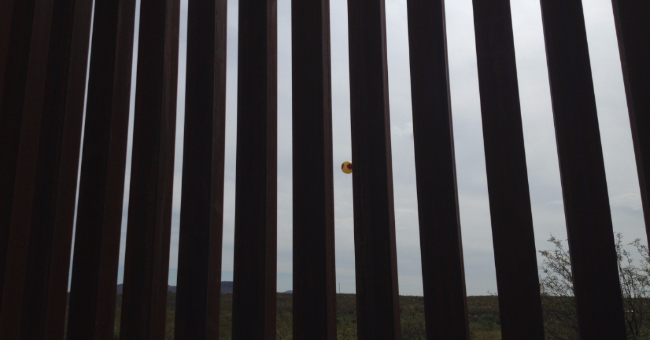
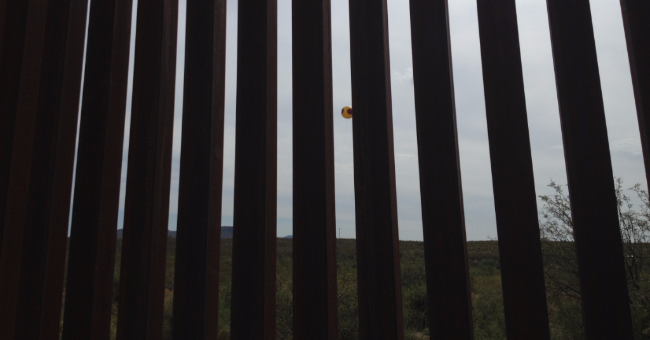
    Though the piece is titled Repellent Fence, it is only the implication of a fence: twenty-six balloons, each ten feet in diameter, flying between sixty and 100 feet in the air, tethered to the ground at intervals of 400 feet, spanning two miles of the Sonoran Desert.

    The black-slatted, serpentine border fence is the halfway point.

    Like the fin of some impossibly huge, slumbering, subterranean monster, the fence divides the desert in two: the American side and the Mexican one. Raven Chacon refers to it as “a violent interruption,” and this idea is central to Postcommodity’s work.

    “We wanted to depoliticize the word ‘Mexican’ as something that has become a dirty word. It is an Indian word, deriving from the word Mēxihcah—and we wanted to repatriate that word as the sacred word that it is,” Cristóbal Martínez explains.

    He speaks very deliberately, saying that the word means the people of the maguey plant.

    “Our peoples have long been moving throughout this hemisphere in trade and economic systems that were eventually hijacked through colonial intervention,” he says. “We’re trying to repatriate that damage.” 

    ***

    Friday, October 9th

     The thrash of unimpeded desert wind rattles the corrugated metal walls of the airplane hangar at the Douglas Municipal Airport. Rows of huge, sun-faded, stenciled letters above the entrance read:

    DOUGLAS INTERNATIONAL AIRPORT

    ELEV. 4173

    A PORT OF ENTRY

    This designation is anachronistic. Constructed by the U.S. Air Force in 1942, the airport has long since been deeded to Cochise County and serves little more than a few flights a week, private propeller planes, an occasional helicopter. There is no control tower, no staff to speak of.

    The airport consists of that hangar and a few miles of runway, crisscrossing into the Sonoran Desert, defining a kind of nether region that angles towards the border fence. Walking the runways, one has the sense of approaching a space that is somehow “in between.” The land beyond the runways and before the fence feels like discarded space, useless for its purgatorial quality, its proximity to the border. But it is not discarded. It is entirely overseen.

    Towers with surveillance cameras watch every direction. Border Patrol trucks sit at the crest of a hill. At a glance, it is a wild place, but there are eyes everywhere. Jackrabbits run like mythic cats through creosote, unaffected by thorns and and surveillance cameras, and turkey vultures skate violent gusts of wind, oblivious to the black slatted fence.

    A discarded plastic Coke bottle has been turned into something else by sun and dust, bone-colored now. It had likely been used as a water bottle by someone walking out here, crossing from one place to another.

    The group of about two dozen people assembled inside the hangar is made up of friends, family and associates of the artists, a handful of German students on an art exchange program, a crew of documentary filmmakers. Almost everyone lends a hand inflating the terrific and imposing balloons. A curatorial team from the Arizona State University Art Museum folds yellow programs that detail the weekend’s events: walking tours, panel discussions, an opening reception.

    Chacon Scare Eye

    Chacon offers me a warm greeting. He is thirty-seven, Navajo, an experimental musician, composer of modern chamber music, a metal head and an educator. He wears a gray work shirt screenprinted with the logo of his DIY record label, dusty black Levi’s and work boots. Although the task unfolding before him is immense, he seems anything but anxious.  

    With a mellowed excitement, he talks about the owl that he and Scott Williams encountered that morning. “There was a huge, white owl in the hangar here when we came in, just massive.” His accent is Navajo, Burqueño, and a little bit hesher. “It was flying around and slamming into the walls, man. We had to open up the big doors here so it could get out,” he says.

    The activity in the hangar echoes loudly: the documentary camera crew yelling to each other, the clank and hiss of giant helium tanks as they are rolled, dragged, and tapped. Chacon casually switches gears: “Well, you want to help fill up some balloons?”

    Postcommodity has had these balloons manufactured specifically for Repellent Fence, but they are modeled on a consumer product called the “scare eye.” Scare-eye balloons are marketed to people hoping to deter birds from their homes, crops, or boats, and are manufactured and sold by brands such as Bird B Gone and Bird-X.

    Postcommodity’s custom version is about five times the size of the kind sold at Lowe’s but the design is otherwise the same: a vivid and stylized red, black, and white eye printed four times, encircling the diameter of a bright yellow globe.

    By apparent coincidence, the scare eye makes use of indigenous medicine colors and iconography.

    In 2008, the group flew a Repellent Eye Over Phoenix, essentially directly over the headquarters of Maricopa County sheriff Joe Arpaio, infamous for the institutionalization of racial profiling in the Phoenix area and harsh treatment of prisoners.

    “The open eye symbol is a symbol of enlightenment, of awareness, of watching and accountability. It’s like an early form of surveillance,” Kade Twist told me weeks ahead of the launch.

    “It means something to ancient pre-Columbian cultures, and it means something to us, and in between those two things, there are layers of irony there that we can leverage,” he says. “But more than anything, there is a sincerity that this is a symbol that has traveled throughout the Americas. At its heart, this is a way of demonstrating that we are organized around shared iconography. There's shared interest and shared histories.”

    In addition to his work as an artist, Twist works as a public policy consultant who specializes in American Indian healthcare. He is the most businesslike of the group, perhaps the most comfortable in a white button-down, with a relatively fresh haircut and trimmed salt-and-pepper goatee. Twist is 43, Cherokee, from Bakersfield, California.

    Despite everyone’s hopes, the installation will indeed not go up Friday due to the winds.

    “We’d like to apologize for any inconvenience that the change of schedule has caused anyone, but we are really at the will of Mother Nature,” Twist says with a wry smile, addressing the group assembled in the hangar.

    Over the course of a couple hours, the artists and volunteers have inflated thirteen of the twenty-six balloons. The mood is jovial, even if there is an underlying frustration about the delay. Outside, a massive hawk careens in the wind. The remaining thirteen balloons will be inflated in Agua Prieta in the courtyard of the Casa de la Cultura, which has served as the base camp for the Mexican half of the operation.

    The decision to delay the launch was made after the total loss on Thursday of a test balloon. Wind divorced the balloon from its anchor on Thursday afternoon. Only the documentary film crew was present to witness the thing take flight and there are rumors of spectacular footage of the accidental launch.

    On Friday afternoon, after those at the hangar have dispersed, Twist, Chacon, Martinez, and Williams troubleshoot the malfunction, standing out at the site of the errant balloon’s anchor.

    Nataani Hanley joins the crew to lend a hand. He is a sixteen-year-old, six-foot-tall, broad shouldered Navajo with two lip piercings and long, night-black hair. He is wearing a black T-shirt with a heavy metal band logo on it. Hanley is Twist’s nephew and Chacon’s apprentice in the Native American Composer Apprentice Project. 

    Chacon and Williams untangling parachute chord

    Chacon and Williams work on untangling the length of parachute cord from a massive hediondilla bush and determine that it may have been severed by its own cinderblock anchor, fraying and breaking, angled in the wind which, as they work, continues to gust. The group has decided that pounding two lengths of rebar in an X across a flat cinderblock will provide adequate anchorage. The question now is whether or not there is enough rebar in town to execute the updated design.

    Martínez takes a call, speaking in Spanish. He pauses to tell the others that Agua Prieta city administrator Laura Rios is on the phone. Spanish-language network Telemundo wants to do an interview. Chacon and Twist both have their hands full of materials: paracord, rebar, sledgehammers. A balloon has been lost and the entire project is on hold. The wind is gusting up to thirty miles per hour.

    Everything drops away for a moment as the three artists deftly iron out the logistics of the Telemundo interview; Martinez holds his phone against his sleeve. Six p.m. at the Gadsden Hotel tonight, just before the opening reception. The plan is developed, proposed, and accepted in a matter of thirty seconds. Everyone turns back to loading Twist’s Suburban and Chacon’s wife’s pickup.

    “It’s great to think that balloon probably crossed the border illegally,” Williams jokes.


    Click here to read part two.


    About the Author 

    Mark TreckaMark Trecka is a Chicago-born writer, artist, and performer. His work has appeared in the Huffington Post, Impose Magazine, The End of Being, and elsewhere. He blogs and Instagrams for @featherproof and has recorded and performed with Pillars and Tongues, Dark Dark Dark, and others. He lives in New York’s Hudson Valley. Follow him on Twitter at @MTrecka and visit his website.

  • By Dennis A. Henigan

    Gun and bulletsThis essay appeared originally on HuffPost Crime.

    I am sitting here, in my only orange shirt, in observation of National Gun Violence Awareness Day, and my thoughts turn to the New York Times’ remarkable recent study of 358 shootings last year in which four or more people were killed or wounded. As the Times noted, these were not the high-profile mass shootings in unlikely places like schools, churches and movie theatres that capture national attention, but rather “a pencil sketch of everyday America at its most violent.” The Times’ reporters penetrated beyond the body count to describe the circumstances of these shootings, in which 462 died and over 1300 were injured. The scenarios were varied, but the terrifying descriptions point to a conclusion common to all: if no guns were available, violence may have ensued, but countless lives would have been saved and serious injuries avoided.

    Typically, the violence was sparked by the most banal of offenses, like one person shoving another in a bar, or a Facebook taunt, or a disagreement over the music at a house party. They occurred mostly outdoors, at virtually any place groups of people gather; at neighborhood barbecues, family reunions, music festivals, basketball tournaments, Sweet 16 parties, public parks. Only about one-third were gang-related or were drive-by shootings typical of gang violence. Even those that were gang-related were prompted, not by criminal activity like drug dealing, but by eruptions begun by a boast, an insult or some other sign of disrespect. Take the guns out of the picture, even if the combatants had been armed with other weapons, like knives or baseball bats, there is no doubt countless lives would have been spared.

    The gun lobby gets much mileage from the slogan, “Guns don’t kill people, people kill people.” The Times’ study shows how far this idea is divorced from the brutal reality of everyday gun violence, particularly in our inner cities. The truth is that “Guns don’t kill people, they enable people to kill people,” more effectively and efficiently than any other widely available weapon. Even grossly incompetent shooters can be multiple killers. In one shooting at a Cincinnati Elks Lodge, according to police officials, as many as half of the twenty-four victims were not the intended targets. The perpetrators of such shootings are often high on drugs or alcohol. Some barely know how to hold a gun, yet it gives them lethal power over whoever crosses their field of fire. In the shootings surveyed, more than 100 bystanders were killed or wounded, including a ten-year-old boy who was struck in the eye as he peered out his window at a fracas in an Orlando, Florida housing project, a soldier struck by a stray bullet during a shootout in a public square in Savannah, Georgia and a nineteen-year-old college sophomore killed when a gunman sprayed a crowd outside an Ocala, Florida club. It is the gun that affords this kind of indiscriminate killing power; few are killed by stray knives or baseball bats. Put simply, guns make killing easy.

    Guns Don't Kill PeopleThe National Rifle Association and its allies will insist that no laws will prevent dangerous people from getting guns, invoking the bumper sticker slogan that “When guns are outlawed, only outlaws will have guns.” Yet we know that every gun used in those multiple shootings started out in the legal gun market and that even modest regulation of the legal market can help to deny violent individuals access to guns. As I argue in my forthcoming book, “Guns Don’t Kill People, People Kill People” and Other Myths About Guns and Gun Control, when the Brady Law background checks began in 1994, there was an immediate and substantial drop in the percentage of violent crimes that involved guns, inaugurating a long-term decline in gun crimes and homicides. Moreover, we know that other high-income nations have violent crime rates similar to ours, but their homicide rates are a fraction of the U.S. rate because their strong gun laws deny violent individuals in those countries easy access to guns. To the extent that lethal gun crime continues to plague our communities, it is due, not to the futility of all gun laws, but rather to the weaknesses of U.S. gun laws. For example, Brady background checks, now required only for sales by licensed gun dealers, should be extended to all gun sales.

    Before the end of National Gun Violence Awareness Day, there likely will be at least one shooting involving four victims or more; in all, today between 250 and 300 Americans will be killed or injured with firearms. We simply cannot afford to continue to allow the simple-minded slogans of the gun lobby to dictate national gun policy.


    About the Author 

    Dennis A. Henigan is director of policy analysis and research at the Campaign for Tobacco-Free Kids and a former vice president of the Brady Campaign and Brady Center to Prevent Gun Violence. For over twenty years, he was a leading advocate for stronger gun laws. Under his direction, Brady Center lawyers recovered millions of dollars in damages for gun violence victims, as well as winning precedent-setting decisions on the liability of gun sellers. His work as a public interest lawyer has been profiled in the New Yorker.

  • By Suzanne Kamata

    Hokkaido Forest Path

    Hokkaido Forest Path. Photo credit: Flickr user Mr Hicks46

    Like many, I was appalled to read that a Japanese boy was “abandoned” in a bear-infested forest as punishment. I imagined a Hansel-and-Gretel-type scenario, in which an adolescent boy was led deep into woods, handed a sack of trail mix, and left to fend for himself. Like many, I was angry to learn that the boy was only seven years old.

    But then, I heard the rest of the story. In the father’s version, his son was misbehaving. He’d been throwing stones at cars and so forth. In an effort to get him to behave, the father stopped the car along the side of a rarely-used road and told him to get out. He drove a little ways ahead and the boy came running towards the car. After a few minutes, or perhaps seconds, the boy was allowed back into the car. The parents hoped that he had considered his bad behavior and was ready to apologize. As it turned out, he was not. So the father stopped the car again, made the kid get out, and drove a little ways up the road, out of sight, stopped the car and waited for the boy to come running again. When he did not, the parents got out of the car and went to get him. He was nowhere in sight.

    I was reminded of that time that my Japanese husband took our young daughter, who is deaf and uses a wheelchair, shopping at Conan, a large, Walmart-sized home supplies store. He left her in the shampoo section and told her to stay put while he went off to check on something else. When he returned, she was gone. As I listened to the story later, I was livid. How could he have done such a thing? How could he have let her out of his sight? However, when we retold the story to Japanese family and friends, they were most impressed by our daughter’s resourcefulness. Separated from her father and unable to talk, she had tapped on a store employee’s shoulder, and written down her father’s name. He was then paged over the store’s intercom system and they were reunited.

    For most Americans, the idea of leaving a seven-year-old kid alongside the road, or a disabled kid alone in a big store, sounds criminal. But let’s dial down the hysteria for a moment and take a look at a few cultural differences. For one thing, it is not unusual for a child to walk down a road alone in Japan. Japanese children are raised to be independent. Elementary school children walk to and from school, usually without any adult supervision. In big cities like Tokyo and Osaka, small kids can be seen riding the subway on their own. They can do this because Japan is, by and large, a safe, well-ordered society.

    In the beloved Japanese picture book Finding Little Sister by Yoriko Tsutsui, little Naomi, who looks to be about five, is playing outside on the curb when her mother takes off to go to the bank, leaving her alone with her younger sister, Ellie. The mother promises to be back before Ellie wakes up, but she isn’t. Naomi tries to amuse her little sister by playing with her in the street. The smaller child wanders away. There are big trucks, a strange, scolding man and other untold dangers. Naomi finally finds her little sister, and the mother appears at the end with a worried look on her face. This story, first published in Japanese in 1979, as well as Miki’s First Errand, by the same author, in which a little girl goes to the corner store by herself for the first time, are meant to show children gaining responsibility. As an American mother reading these books for the first time, I was shocked. What if these girls had been kidnapped? What if they’d gotten hit by a car? Japanese readers, however, applaud the bravery and independence of these young heroines.

    In another book, Parenting Without Borders: Surprising Lessons Parents Around the World Can Teach Us, Christine Gross-Loh writes, “Most cultures believe kids need space to develop mastery and autonomy and self-reliance. But kids in America, who typically don’t experience many genuinely adult-free moments, aren’t often able to have the space they need to find out who they are and what they are capable of, and to develop that self-control and judgment they’ll need as they grow older.”

    As an American, I think that, yes, it was unwise for the parents of Tanooka Yamato to take their eyes off of him, but perhaps we should also applaud them for raising such an independent, resourceful boy. Although his parents did not expect him to blaze a trail through the woods, that is in fact what he did. He tramped five kilometers through wild terrain until he came to a building used for training by the Japanese Self Defense Force with mattresses and a water faucet just outside. He stayed in this building for six days, and when he was finally, miraculously, found, he was safe.


    About the Author

    Suzanne Kamata is the author and/or editor of seven books including the anthologies Love You to Pieces: Creative Writers on Raising a Child with Special Needs and Call Me Okaasan: Adventures in Multicultural Mothering, and the award-winning novel Gadget Girl: The Art of Being Invisible. She is the Fiction Editor of Kyoto Journal, and Fiction Co-editor of literarymama.com. She earned an MFA from the University of British Columbia, and currently teaches at Tokushima University in Japan. Follow her on Twitter at at @shikokusue.