• By Steven Hill

    Golden piggy bankSocial Security is bankrupting us. It’s outdated. It’s a Ponzi scheme. It’s socialism. It’s stealing from young people. The opponents and pundits determined to roll back the United States to the “good old days” before the New Deal regularly trot out a number of bogeymen and bigfoots to scare Americans into not supporting their own retirement well-being. That hasn’t worked too well. Americans of all political stripes remain strongly supportive of Social Security and other so-called “entitlements” like Medicare. But the other reason for plastering the media waves with a chorus of myths and lies is to stir up a political climate that causes politicians of both parties to cease looking for better alternatives other than to cut, cut, cut, or even to maintain the inadequate status quo. Below are rebuttals to some of the biggest whoppers regularly told about one of the most popular and successful federal programs in our nation’s history.

    1. Social Security is going broke and will bankrupt the country.

    Social Security is not going broke, not by a long shot. The Social Security Board of Trustees released its annual report to Congress in July 2015, and among all the tables, charts, and graphs in that big fat report, it would be easy to miss the most important take-home message: Social Security is one of the best-funded federal programs in U.S. history. That’s because it has its own dedicated revenue stream, which is composed of the insurance premiums paid by every worker (deducted from our paychecks by what is called “payroll contributions”), which are automatically banked into the Trust Fund. Even the Pentagon and the defense budget do not have their own dedicated revenue stream.

    In fact, Social Security has not one dedicated revenue stream, but three. Besides the payroll contributions, Social Security is also funded by income generated from investing all those set-aside wages into U.S. treasuries. That money earns a sizable return on the investment. And Social Security is also funded by revenue that comes from levying income tax on Social Security recipients (yes, your Social Security check and that of other Americans is treated as income and taxed—and it brought in $756 billion to the Trust Fund in 2014). Those three revenue streams combined have banked $2.8 trillion in the Trust Fund and resulted in a $25 billion surplus in 2014.

    Bankrupt? That charge does not even pass a good laugh test.

    Indeed, because Social Security has its own funding source, and by law is not allowed to spend any money it does not have, it is actually impossible for Social Security to add to annual operating deficits or the national debt. Moreover, the Social Security Board of Trustees is required by law to report to Congress every year about the financial fitness of the program. The annual trustees report projects its revenues and payouts, not just for the next five, ten, or twenty years, but for the next seventy-five years. It’s one of the few programs anyone can identify that has had the wisdom to plan for the future, rather than planning around short-term political calculations and the next election cycle.

    Over the next twenty years, as more and more of the huge population bloom known as the baby boomers continues to retire, Social Security is projecting a modest shortfall of just 0.51 percent of gross domestic product (GDP). If nothing is done to plug that gap, sometime in the 2030s the Trust Fund will have enough to cover only 75 percent of benefits. But there are so many budgetary ways to cover that shortfall, it becomes clear that the problem is not the finances of finding the money but the politics of partisanship and paralysis. No other government program can claim that it is fully funded for almost the next quarter century. What government critics ever say that the Defense Department or the Departments of Energy or Education are going bankrupt? Yet those programs don’t have dedicated revenue streams, and certainly no one plans or projects costs for those programs over the next seventy-five years.

    For example, simply removing the payroll cap and taxing all income brackets equally would not only be fairer to all Americans, it would also raise all of the money and then some to plug any Social Security funding shortfalls twenty years from now. Opinion polls have demonstrated that most Americans—even 70 percent of Republicans—think if they pay Social Security tax on their full salary, others should as well. That’s just one example of the many adjustments we can enact that would make the U.S. retirement system more fair, robust, and stable, and better adapted to the realities of today’s economy.

    2. Social Security is unsustainable because we have fewer workers for every retiree, even as our society is “greying” and people are living longer.

    Another charge leveled by critics is that the number of workers compared to the number of non-workers—what is known as the dependency ratio—is declining, and so as a result Social Security is unsustainable. President George W. Bush really pushed hard on this point in his bid to gut the program and turn it into private accounts. In his 2005 State of the Union address, President Bush said:

    “Social Security was created decades ago, for a very different era…A half-century ago, about 16 workers paid into the system for each person drawing benefits…Instead of 16 workers paying in for every beneficiary, right now it’s only about three workers. And over the next few decades, that number will fall to just two workers per beneficiary…With each passing year, fewer workers are paying ever-higher benefits to an ever-larger number of retirees.”

    President Bush’s key strategist, Karl Rove, had the president tour the country to promote his privatization plan for Social Security, and he repeated his talking points everywhere he went, in state after state. President Bush must have set some kind of record: rarely has anyone been so wrong so often about Social Security as the president was during his “privatization or bust” tour.

    Yet this claim by not only President Bush but key Republican and even some Democratic leaders reflects a deep misunderstanding. The “dependency ratio” is not just a factor of the number of workers compared to the number of retirees. It has to be configured according to the number of total dependents, including children. A different picture emerges when children are included.

    The fact is, declining birthrates have resulted in a fall in dependent children, so the rise in the number of retired will be partly offset by a decline in the number of dependent children. According to Gary Burtless, an economist and demographic expert at the Brookings Institution, when the decline in children is factored in, total dependency ratios in many countries in 2050 will look more favorable than the ratios were in the 1960s. In the United States, for example, the dependency ratio peaked in 1965, when there were ninety-five dependents (both children and retirees) for every one hundred working adults. By 2050 the figure will be eighty dependents for every hundred workers, which, while much higher than the highly favorable figure of forty-nine dependents in 2000, will still be markedly lower than the number of dependents in 1965.

    How did we as a society manage to get wealthier in the 1960s and ’70s despite a much higher dependency ratio? The answer, in a word, is “productivity.” Labor productivity is a measure of the amount of goods and services produced by each worker, which in a well-functioning economy increases over time due to the implementation of technology, greater education and job skills training, as well as more efficient business practices. If our labor productivity continues to increase, and the political system passes on the economic gains in the form of a broadly shared prosperity, then the rising tide will float all boats. Political analyst Michael Lind has argued that “productivity growth can solve much or all of the pension funding problem,” and as proof of that he points out that if the ratio of workers to retirees goes from 3 to 1 today to the expected 2 to 1 in the future, that is quite a minor shift compared to a change from a ratio of 16 workers to 1 retiree in 1950, or even 8 workers to 1 in 1960, to 3 to 1 today—a shift made relatively smooth and painless by education, training, and technology-driven productivity growth over the past half century.

    That doesn’t mean that we can ignore factors like dependency ratios, but the fact is that as long as our economy is healthy, robust, and growing, creating jobs and increasing productivity, and the political system is inclusive and passes on the increased prosperity to the general public in the form of higher wages and a robust safety net, there is no reason that the greying of society or the ratio of workers to dependents should hamper the nation’s economic future.

    3. IRA s and 401(k)s have replaced private pensions and Social Security. Americans want to be self-reliant on their own private retirement accounts, because you can do better investing on your own.

    Expand Social Security Now!One would think that the volatility and havoc wreaked by the stock market in recent years would have laid to rest the notion that “self-reliant” Americans can invest and save on their own. It’s really not that easy to build up a private nest egg in savings that an individual will need to cover their needs during their post-work years. The fact that three-quarters of Americans nearing retirement have less than $30,000 in their private savings—less than 5 percent of what they will need—shows what a bust of an idea this really is.

    For years, advocates for deregulation and entitlements have pushed for privatized retirement accounts—401(k)s, IRAs, and other private savings vehicles managed by Wall Street’s financial managers, which skims off the top their own lucrative fees. At the same time, businesses have pushed to shut down their “defined-benefit” pensions, which have long provided a guaranteed monthly payout for life, just like Social Security’s lifetime annuity. Now that we have nearly three decades of experience with replacing pensions with 401(k)s and IRAs, and of Americans trying so hard to stuff their retirement piñatas, it’s clear that most American retirees are no more secure than before. In fact, they are much less secure.

    The 401(k) system that was positioned in the 1980s to replace pensions was sold to American workers as the new and improved successors to the guaranteed payout of a defined-benefit pension. Business leaders and the politicians took away what worked and replaced it with an experiment. But that experiment has failed, and proven to be more fragile and inefficient than the system it replaced. Besides having failed to produce enough retirement savings for the vast majority of Americans, the 401(k) system has forced everyday Americans to face a number of significant risks, the most obvious being that you can lose your personal savings to unpredictable stock market gyrations or a housing-market downturn, especially since most people have little expertise in how to navigate the ups and downs. But there is also the uncomfortable fact that, with wages flat over the last few decades, millions of individual workers have been unable to save enough. Consequently, as we have seen, 80 percent of the federal subsidy for individual retirement savings goes to the top 20 percent of income earners—the people who need it the least.

    4. Social Security is stealing from young people and saddling them with a level of overwhelming debt.

    Billionaire Peter G. Peterson has been one of the pioneers of this kind of intergenerational doom-saying. Headlines about the old stealing from the young certainly grab the media spotlight. But this one is an old, old trope that never made any sense. Peterson first raised it back in 1982, in the midst of the deliberations of the Greenspan Commission. Social Security, Peterson wrote, “threatens the entire economy…The Social Security system will run huge deficits…these deficits will push our children into a situation of economic stagnation and social conflict and create a potentially disastrous situation for the elderly of the future.”

    But Peterson hasn’t been the only Cassandra prophesying a generational war between young and old. More recently, the Washington Post’s Robert J. Samuelson took up the cause. “We need to stop coddling the elderly,” he wrote in a 2013 column, calling Social Security and Medicare “a growing transfer from the young, who are increasingly disadvantaged, to the elderly, who are increasingly advantaged.” In a 2014 column, Samuelson continued his anti-elderly and antigovernment debt diatribe, writing, “Giving the elderly as a class special treatment heaps the costs of deficit reduction on workers and children.” 

    Pitting the elderly against children makes little sense for many reasons, but one obvious one is that today’s children will one day be seniors themselves. And they will need the retirement benefits that people like Peterson and Samuelson are trying to cut from retirees. Robbing Peter to pay Paul might make sense from a maniacally focused budget buster’s perspective, but it makes little sense from a public policy perspective. If that makes sense, then why not cut funding from cancer research, or diabetes treatment, since those ailments mostly affect older people and not the young. But obviously the young today could be attacked by those ailments tomorrow. Society benefits as a whole when it tries to address conditions that affect humanity as a whole.

    5. We have to raise the retirement age because people are living longer and the nation can’t afford to pay for all these aging retirees.

    Wrong. We do not have to raise the retirement age. There are common-sense changes we can make to Social Security that would not only safeguard it financially for the future, but would actually allow us to double the monthly benefits for retirees. For example, we could increase tax fairness by lifting the cap on the payroll tax so that wealthy Americans make the same percentage contribution as every other American. At the same time, the payroll contribution base could be extended to profits from investment income, such as capital gains. This would raise additional revenues in a progressive fashion that could be used to enhance the program for all Americans.

    6. Social Security is un-American and too “socialistic” for most people in the United States.

    Un-American? Too socialist? Social Security remains one of the most popular and successful government programs in history—opinion polls show nearly 70 percent of Republicans don’t want it to be cut or hurt. So if Social Security is too “socialist,” Americans must all be a bunch of closet socialists. Millions of Americans from all political persuasions now depend on Social Security, and no amount of divisive rhetoric, or even Pete Peterson’s billions of dollars, can change that fact.

    7. The United States already has the world’s highest living standard, with an overly generous retirement system for seniors. We must be more realistic.

    The United States is quite a bit less generous to its retirees than other developed nations. The Organisation for Economic Co-operation and Development (OECD) tracks and compares features like national pension systems. According to its numbers, the U.S. pension “replacement rate” for the average earner—the share of gross income the pension is expected to replace—is 38.3 percent, which is below the OECD average of 54.4 percent and 58 percent for countries in the European Union. For low-income workers—defined as earning 50 percent of the average wage—the United States was even more stingy, with a replacement rate of 49.5 percent compared to the OECD average of 71 percent and 73.9 percent for EU countries. Like in the United States, retirement pensions in most of these other nations are funded by regular payroll deductions from both workers and employers.

    On other replacement metrics like “transfers in retirement income,” which measures the share of retirement income made up by both public pensions and social welfare assistance, the United States also looks stingy. The OECD average is 58.6 percent while the U.S. average is only 37.6 percent, barely half the average of the EU countries at 70.6 percent and just above Mexico and South Korea. Consequently, the poverty rate for seniors in the United States is substantially higher than in most other OECD countries, nearly 20 percent compared to 12.8 percent in the OECD and 8.9 percent among EU countries in the OECD. The U.S. rate is even higher than in Chile and Turkey.

    My proposal for Social Security Plus shows how to greatly expand the retirement payout for America’s retirees, as well as how to pay for this expansion. This proposal would not only double the current payout, it would also make our retirement system fully portable. That’s the type of bold step that our country needs. Our American nation is heading into an anxious era driven by a new, high-tech economy in which more workers will have to gain access to a portable safety net without the benefit of a single employer or a regular workplace. Many workers will have multiple employers, none of whom would be expected to provide much of a safety net under the current, antiquated model. If we are going to provide adequate resources for our retired seniors, we have to update, upgrade, and modernize our retirement system.


    About the Author 

    Steven HillSteven Hill is a Senior Fellow with the New America Foundation and a Holtzbrinck Fellow at the American Academy in Berlin. He is the author of six books, including Raw Deal: How the “Uber Economy” and Runaway Capitalism Are Screwing American Workers, which was selected by The Globalist as one of the Top Ten Books of 2015. His op-ed’s, articles and media interviews have appeared in the New York Times, Washington Post, Wall Street Journal, The Atlantic, Politico, CNN, C-SPAN, BBC, Financial Times,Guardian, Bloomberg News, Fox News,National Public Radio, The Nation, Salon, Slate,Observer, Fast Company, Business Insider, HuffingtonPost, Le Monde, Die Zeit, Al Jazeera and many others. His other books include Europe’s Promise: Why the European Way Is the Best Hope in an Insecure Age and 10 Steps to Repair American Democracy. He is a co-founder of FairVote/Center for Voting and Democracy. Follow him on Twitter at @StevenHill1776 and visit his website.

     

  • By Dina Gilio-Whitaker

    Washington Redsk*ns helmet

    Washington Redsk*ns helmet. Photo credit: Flickr user Keith Allison

    The war that is Native American cultural appropriation rages on. And make no mistake, this is a war for the control of meaning on what constitutes cultural appropriation, and thus what is considered acceptable in the U.S. American mind when it comes to American Indian culture and even intellectual property rights. In the world of media those with the biggest platforms have a decided advantage when it comes to influencing public opinion. It’s something Dan Snyder, owner of the notorious Washington Redsk*ns, knows full well.

    Last week the Washington Post released a new poll claiming that an astounding “nine in 10” of Native American respondents were not offended by the team name. The poll contradicts what decades of tireless work by Native activists have claimed, that yes, the name is racist and reflects a deeply entrenched collective colonial national mentality. In a nutshell, this colonial mentality is built upon centuries of narratives and legal fictions that construct American Indians as inferior people compared to (white) settlers who are supposedly racially and culturally superior.

    Such an inherent sense of superiority is the only reason it is possible to suggest that a name that celebrates a history of genocide actually honors the victims of that history. We can talk about how the team name harkens back to an incredibly violent period of U.S. aggression against indigenous peoples, which you can read about in many places, including here, here, and here. But what I want to talk about is why the Post’s poll is BS.

    First of all, the methodology of a poll is what confirms (or denies) a poll’s validity. In this case, the Post’s method was to randomly sample 504 “Native Americans” by telephone to find out their feelings about the term. One wonders how a list of “random” Native Americans was compiled to begin with.

    But the bigger issue is that the concept of who is actually a Native American is one of the most highly contested aspects of cultural appropriation to begin with. One can claim to be Native American without any verifiable connection to a Native community. And many people do, as a matter of no more than bragging rights, with no more than a rumor of a long-ago Indian somewhere in the family tree.

    But if you are going to conduct a poll based on a specific group people, you need a more rigorous set of criteria, especially when it comes to Native Americans who are the only group of people in the U.S. who are required to produce documentation to fit legal definitions of Native identity. A definition more suitable for any serious opinion poll would be based on people with documentable links to a Native community. In Indian country, there is a saying that being Indian is not about what you claim, but who claims you.  

    In the Post’s poll, of those claiming to be Native American less than half are people with verifiable claims to a Native community. Only 44% claimed to be enrolled as a member of a Native American tribe. The majority of the poll respondents were what many actual American Indians would consider “wannabes.”

    Consider another poll conducted in 2014 at the California State University at San Bernardino. This poll used a more strict definition, drawing from over 400 surveys “directly from individuals who could be verified as being the race or ethnic group they claimed (important for self-identified Native Americans).” The findings of the surveys revealed that 67% found the term “Redsk*ns” to be a racist word and symbol.

    Dan Snyder has stridently claimed that he will never change the name of the team. And why would he when to do so would likely interfere with the profitability of his multi-zillion dollar franchise? Given his extreme wealth, it’s much easier (and presumably cheaper) just to try to control the national narrative about what is and is not offensive to Native Americans.  Controlling the flow of information is something Snyder is famous for in the sports journalism world, and he’s been accused of buying off the Washington D.C. media.

    Dan Snyder’s grandstanding about the offensive team name is a joke that would be funny if it weren’t so serious for what it means to U.S. American national culture and how it contributes to the common misunderstandings of average Americans. In our upcoming book, “All the Real Indians Died Off” and 20 Other Myths about Native Americans, Roxanne Dunbar-Ortiz and I devote two entire chapters to the controversies surrounding appropriation of Native American cultures.  We discuss the Washington Redsk*ns team name in depth and the broader topic of Native American team mascots in one chapter, and in another we tackle other facets of appropriation including Halloween costumes, spirituality, and identity.  Look for the book’s release this October.


    About the Author 

    Dina Gilio-Whitaker (Colville Confederated Tribes) is an independent writer and researcher in Indigenous studies, having earned a bachelor’s degree in Native American Studies and a master’s degree in American Studies from the University of New Mexico, and also holds the position of research associate and associate scholar at the Center for World Indigenous Studies. Her work focuses on issues related to Indigenous nationalism, self-determination, and environmental justice, and more recently the emerging field of critical surf studies. She is a co-author (with Roxanne Dunbar-Ortiz) of the forthcoming book from ‘All the Real Indians Died Off’ and 20 Other Myths about Native Americans. An award-winning journalist, she is a frequent contributor to Indian Country Today Media Network and Native Peoples Magazine. Follow her on Twitter at @DinaGWhit and visit her website. 

  • By Haley Stafford

    Polly Bemis, 1894

    Polly Bemis, 1894

    This year, my class took part in National History Day, a program for middle-school students to put together a project on a historical topic of interest. I didn’t have a clue as to what I wanted to research. All I knew was that the theme was “Exploration, Encounter, and Exchange in History.”

    My teacher noticed my struggle and recommended I read Thousand Pieces of Gold by Ruthanne Lum McCunn. This biographical novel instantly had me hooked on Polly Bemis, born Lalu Nathoy, a Chinese-American Pioneer woman who encountered great hardships, explored new ideas and roles on the American frontier, and exchanged her hardships for generosity. After reading the novel, I found McCunn’s journal article which went further in depth about Bemis’s life. The rich detail in both the article and book sparked my interest in pursuing my own research and paved the path for me to do my project on Bemis.

    After gaining a better understanding of Bemis’s life journey, I realized I couldn’t fit all of it in a paper or exhibit, which is why I made a documentary about her. I often found myself going back to McCunn, who became the center point of my project. I first contacted her through email, asking her to share her expertise on Bemis. McCunn was generous enough to share her research with me through two Skype interviews. Not only did these exchanges provide excellent footage for the content of my film, they also patched many of the holes in my research. McCunn had researched Bemis for decades and clarified important events of her life. She was essential to extending my knowledge of Bemis, and also ensured that my research was historically accurate.

    Polly Bemis was a remarkable woman. She overcame poverty in China and racism in Western America. Many Chinese women who were forced into prostitution killed themselves in order to escape their hardship. Bemis found a will to live on and endure adversity. After she gained her freedom, she still felt the need to help others and give back to her fellow pioneers. Bemis’s legacy of perseverance and resilience makes her an extraordinary Chinese-American pioneer and a true survivor of the American West.

    Here’s the documentary I made about her for National History Day. 


    About the Author 

    Haley Stafford is an eighth-grade student at Mount Logan Middle School in Logan, Utah.

  • By Wen Stephenson

    Sixteen interfaith clergy about to be arrested to #StopSpectra

    Sixteen interfaith clergy about to be arrested to #StopSpectra. Photo credit: Wen Stephenson

    They sang, they prayed, and when the cuffs were put on, they went as they came—peacefully.

    On Wednesday morning in Boston’s West Roxbury neighborhood, an interfaith group of sixteen Boston-area religious leaders—Jewish, Christian, Buddhist, Hindu—sat down and held a prayer service in the middle of Grove Street, physically blocking construction of Spectra Energy’s fracked-gas West Roxbury Lateral pipeline, part of a major expansion of its Algonquin Incremental Market (AIM) pipeline system. All told, their civil disobedience brought the number of arrests for nonviolent direct action along the construction route to more than eighty since October (including my own on April 28).

    In some ways, such protests of this pipeline—which will end at a compressor station across the street from West Roxbury Crushed Stone, an active quarry where weekly blasting shakes the foundations of neighborhood homes—are hardly even controversial. Residents don’t want a dangerous high-pressure (750 psi) pipeline running yards away from their front doors. The City Council has voted unanimously to oppose it. The mayor is challenging the Federal Energy Regulatory Commission, the industry-captured Washington agency that rubber stamped the project, in court. Boston’s state and federal legislators are against the project. Opponents note that no one has demonstrated sufficient demand to justify a massive new gas pipeline into Boston—which already has at least 3,000 documented leaks in its decrepit distribution system, as researchers at Boston University have shown.

    You might think that in a democracy this project wouldn’t get built.

    Most reporting on this pipeline fight has centered on these real and pressing local concerns. And yet the reasons to stop this project extend far beyond Boston.

    Thanks to convincing studies by researchers at Harvard and Cornell showing vast methane leakage throughout the U.S. production and distribution system, we now know that increasing our reliance on fracked gas is a catastrophe not only for local communities but for the global climate—meaning for today’s young people and future generations, beginning with the poorest and most vulnerable, whether in Boston or Bangladesh.

    Far from being a climate-friendly “bridge fuel,” science shows that fracked gas, because of all that leaking methane—a far more potent greenhouse gas than CO2 in the near term—is little if any better, and possibly worse, than coal when it comes to global warming. At the very moment when fossil-fuel use needs to plummet—even as carbon emissions from Massachusetts power plants are rising and the state is failing to meet its legally-mandated emissions cuts—our kids can’t afford for us to build any new fossil-fuel infrastructure, including gas.

    We know that we can meet our energy needs without these new pipelines. Indeed, rigorous analysis shows that we can replace fossil fuels entirely by mid-century—as the international scientific consensus says is necessary if we’re at all serious about climate change. Doing so, however, will require responding to the climate crisis as the global emergency, and global injustice, that it is.

    So the clergy sang and prayed on Grove Street, and put their bodies in the way of a pipeline, with a simple message: Business as usual got us into this fix; business as usual ends here.

    Does that appear extreme? Business as usual is extreme.

    In his 1963 “Letter From a Birmingham Jail,” the Rev. Dr. Martin Luther King Jr. answered charges of extremism from his fellow clergy. “Was not Jesus an extremist in love?” King wrote. “Was not Amos an extremist for justice…So the question is not whether we will be extremist but what kind of extremist will we be…Will we be extremists for the preservation of injustice—or will we be extremists for the cause of justice?”


    About the Author 

    Wen StephensonWen Stephenson, an independent journalist and activist, writes for The Nation and is the author of What We’re Fighting for Now Is Each Other: Dispatches From the Front Lines of Climate Justice. Follow him on Twitter: @wenstephenson.

  • By Sharon Leslie Morgan

    John Amos as Kunta Kinte in “Roots” blessing his baby daughter Kizzy in the tradition of his Mandinka ancestors

    John Amos as Kunta Kinte in “Roots” blessing his baby daughter Kizzy in the tradition of his Mandinka ancestors

    On January 23, 1977, more than 100 million people across America tuned their television sets to ABC to watch one of the first and still few programs to truthfully tell the story of American slavery. The historic miniseries, based on the novel by Alex Haley, recounted the genealogical saga of one of the first black people in America to successfully trace his ancestry backwards from the tobacco fields of Virginia, through the Middle Passage, to the West African Gambia village of Juffure. Revolutionary in its content, it was a story that embodied extreme examples of both horror and hope, along with the emotionally wrenching roller coaster of events that tied those reactions together.

    Me and my son Vincent, circa 1970s

    Me and my son Vincent, circa 1970s

    On that evening, I was a twenty-five-year-old single mother, living at my mother’s house on the Southside of Chicago with my seven-year-old son. Three generations of our household were riveted for four nights until the series’ end. My heart raced with fear as teenaged Mandinka warrior Kunta Kinte was chased through the bush by vicious slave catchers. It trilled as Kunta Kinte raised his “new born African” baby girl up to the skies to “behold the only thing that is greater than yourself.” I cried uncontrollably when his cruel master cut off his foot to stop him from running away and again when his wife Bell wailed in anguish as their precious daughter Kizzy was sold away.  

    This was the story of MY ancestors….and the progeny of more than 500,000 people who were kidnapped from Africa and enslaved in America. Alex Haley instantly became my hero, as did the characters in his tome—whether real, fictional, or merely actors in the miniseries. I devoured Haley’s book and, when I met Levar Burton and Cicely Tyson later in life, I hugged them in gratitude for their portrayals.

    Even prior to seeing “Roots,” I had embarked on a mission to uncover my own family roots. I started when my son was born in 1969 in the hope of building a legacy for him that I did not have. My interest was jumpstarted big time after watching “Roots.” I began making annual pilgrimages to my father’s birthplace in Montgomery, Alabama so I could walk in the footsteps that led him to Chicago. Thirty-nine years later, I am still at it.

    My Kunte Kinte is my great grandfather, Tom Leslie, born in 1845. He wasn’t born in Africa, but he was born into slavery, as was his mother Harriet. They endured their servitude in “black belt” Lowndes County, Alabama. I have a document that places him firmly in the maw of moral turpitude when he and his mother were sold (just like Kizzy—with no warning or recourse). Harriet’s going price was $400. Tom was valued at $1,000.

    Tom died in 1938, but his wife Rhoda was still alive when I was a child. She died at age 104 when I was three. I met her. My family story says she was thrown against a wall as a baby by the wife of her owner, who was her father. She did not die, she only went into convulsions. In the aftermath, she and her mother Easter were sold away.

    To date, I have found more than two dozen people in my ancestral family tree who were enslaved. My discoveries represent the tip of an iceberg whose depths are likely never to be fully plumbed. Imagine my joy when DNA testing proved one of my uncles has Mandinka roots (like Kunta Kinte) and a female ancestress with origins in Moçambique!

    Gather at the TableWhen I wrote Gather at the Table with Tom DeWolf, I was on a mission to reconcile my personal conflict with the egregious history uncovered by my family research. In the research and the writing, I was forced to confront the cognitive dissonance of a nation whose principles, wealth, and continuing behavior are based on a foundation of genocide, slavery, disenfranchisement, hate, cruelty, torture, and murder.

    Slavery happened. For more than 250 years, America’s “peculiar institution” enslaved people based on race and doomed its victims to perpetuity in that state. That is a FACT. It was HORRIBLE. What films like 12 Years a Slave and TV programs like “Underground” and “Roots” do is FORCE us to LOOK.

    When Tom told me he was watching “Roots” at the same time I was, and that it made a profound impact on his life, I was SHOCKED. Until he said that, I had no idea white people had any empathy or feelings of remorse for how we got to this day where America remains so obviously stuck in the unhealed vise of history’s grip and oblivious to its consequences. (Witness black people being slaughtered in the streets and people in their millions cheering a Hitleresque misogynist who aspires to the American presidency.)

    I am characteristically unimpressed when the money mongers of Hollywood or TV Land announce sequels or remakes. However, I find myself strangely attracted to the announcement of a “Roots” reprise. History Channel president Paul Buccieri says “Roots will allow new audiences to experience this epic family saga with a new vision that is both inspiring and tremendously entertaining.” (I can relate to being “inspired” but have problems coming to peace with the idea of being “tremendously entertained.”)

    There is no doubt our memories need to be refreshed. The millennial generation has no personal experience whatsoever with slavery, Jim Crow, or the African American struggle for civil rights. Although research has proven otherwise—about their mindset as well as the state of social affairs—many blissfully think things are “hunky dory.” After watching “Roots,” they will have the option to either embrace a narrative of truth or succumb to new depths of collective denial.

    I shall reserve my opinion about the “Roots” reboot until I see it. My hope is that it will accomplish the same thing it did for me and Tom = Make a profound impact on the soul of America.

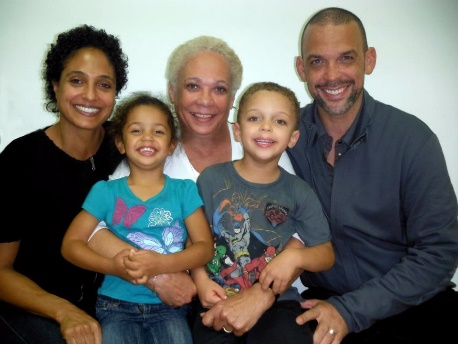
    Our family, 2016

    Our family, 2016

    On Memorial Day 2016, I will rush to my television at the appointed hour and tune into The History Channel with my heart in hand. My son (who is now forty-seven, married, and no longer lives with me) will no doubt be watching as well. He will be sitting on his cushy sofa next to his wife in their lovely apartment in Harlem. Their arms will be lovingly wrapped around my grand babies (aged six and eight). As we watch in our disparate locations, we will surely mutually channel how, during slavery, the little bodies of our beloved offspring—had they been born in another time and place—would have been abused by relentless field work; their little hands burned and bleeding from the pricks of cotton bolls.

    Sadly, these are the roots we must embrace in order to empower our future.


    About the Author 

    image from www.beaconbroadside.comSharon Leslie Morgan is the co-author of Gather at the Table: The Healing Journey of a Daughter of Slavery and a Son of the Slave Trade. She is the founder of Our Black Ancestry, an online community of family researchers.

  • By Nicholas DiSabatino

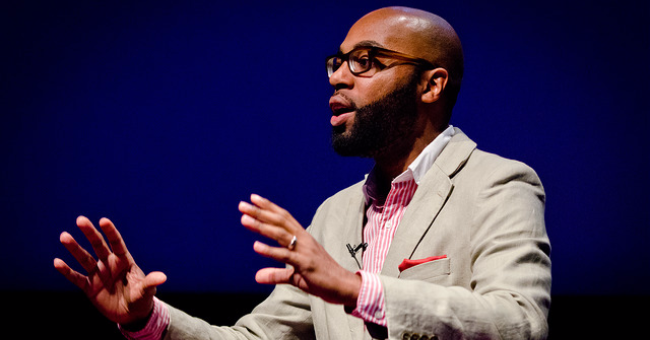
    Christopher Emdin speaking at TEDxNYED

    Christopher Emdin speaking at TEDxNYED. Photo credit: Wayne K. Lin.

    One of the most gratifying aspects of working on Dr. Christopher Emdin’s New York Times bestselling book, For White Folks Who Teach in the Hood…and the Rest of Y’all Too: Reality Pedagogy and Urban Education, is seeing the reaction of educators on Twitter. Since it went on sale this past March, the book has elicited enthusiastic and thoughtful tweets, fulfilling a definite need in the conversation concerning urban education.

    It helps to have an impassioned author with an already built-in Twitter following (Emdin’s successful #HipHopEd community) as well as a winning combination of a provocative title, gorgeous cover—to see how the cover was made, please check out this great blog piece from former Beacon Press Designer Gabi Anderson here—and a book with practical, meaningful ideas for not just white folks, but all educators.

    Below is a look at several of my favorite responses to the book from a variety of educators on Twitter, reposted with their permission.

    Aaron Brengard, a principal at San Jose’s Katherine Smith Elementary School, is using For White Folks as a resource and book club with his staff.

     “Hey @chrisemdin – #forwhitefolks still going- nothing but amazing conversations & holding one another accountable.” Brengard Tweet for Emdin

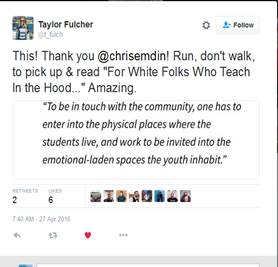
    Taylor Fulcher, who works with the Nashville Charter School organization, RePublic, thinks the book is required reading for all educators.

    “This! Thank you @chrisemdin! Run, don’t walk, to pick up & read “For White Folks Who Teach in the Hood…” Amazing.

    Fulcher Tweet for Emdin

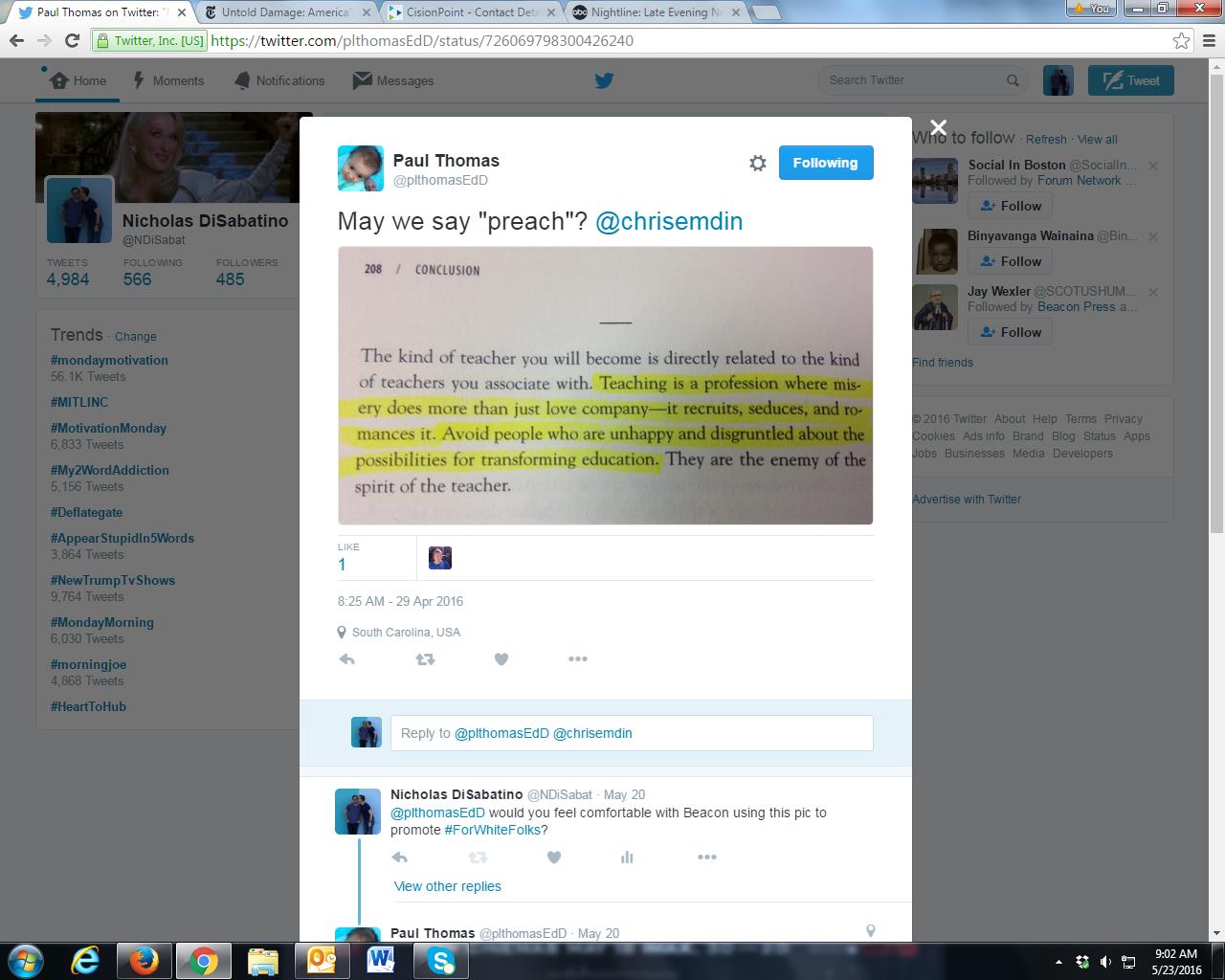
    P. L. Thomas, a professor of Education at Furman University in Greenville, SC, shared this highlighted passage from the book on his Twitter feed. Thomas has been an enthusiastic supporter of the book since it went on sale.

    “May we say ‘preach’”? @chrisemdin

    Thomas Tweet for Emdin

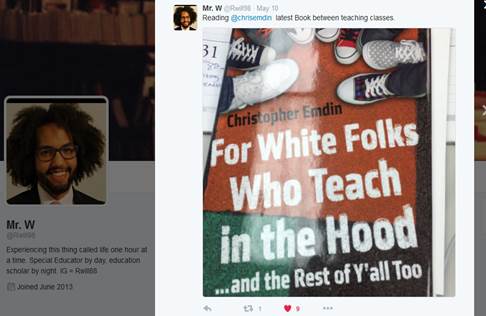
    Mr. W, a teacher with a passion for special education, reminded educators online that there’s always time to read about reality pedagogy between classes.

    “Reading @chrisemdin latest book between teaching classes”

    W Tweet for Emdin

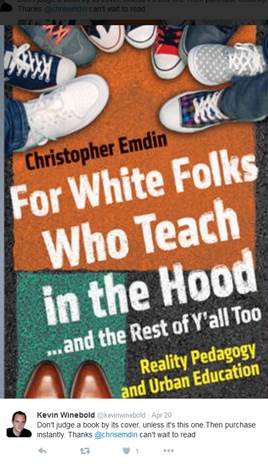
    Kevin Winebold, a musical director in NYC, is a big fan of the cover of the book.

     “Don’t judge a book by its cover unless it’s this one. Then purchase instantly. Thanks @chrisemdin. Can’t wait to read.”

    Winebold Tweet for Emdin

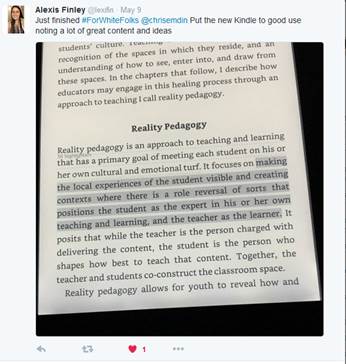
    Alexis Finley found a good use of her new Kindle to highlight some of her favorite passages from the book here.

    “Just finished #ForWhiteFolks @chrisemdin Put the new Kindle to good use noting a lot of great content and ideas.

    Finley Tweet for Emdin

    Emdin’s Twitter following has grown exponentially since his book went on sale, and will continue to do so. As Race, Education, and Democracy Series editor Theresa Perry wrote in the book’s Series Note: “[For White Folks] is filled with wisdom, theoretical and practical knowledge that has been formed in praxis. It is required reading for teachers, teacher educators, and community activists…it is smart, compelling, filled with emotions, and brimming over with commitment.”


    About the Author 

    Nicholas DiSabatino is the publicist at Beacon Press.

  • By Michael Bronski, Ann Pellegrini, and Michael Amico

    Kristen Stewart speaking at the 2012 San Diego Comic-Con International in San Diego, California.

    Kristen Stewart speaking at the 2012 San Diego Comic-Con International in San Diego, California. Photo credit: Gage Skidmore.

    As the social landscape of sexual identities evolves, younger people such as actress Kristen Stewart are viewing love without labels. Star of Olivier Assayas’s film Personal Shopper, which won the Best Director Award at the Cannes Film Festival last weekend, Stewart told Variety in an interview, “There’s acceptance that’s become really rampant and cool. You don’t have to immediately know how to define yourself.” As of March, she has been in a relationship with French actress and musician Soko, and does not feel rushed to define her sexuality. Her embrace of sexual fluidity challenges the notion that “homosexuals are born that way,” one of many myths addressed in “You Can Tell Just By Looking”: And 20 Other Myths about LGBT Life and People by Michael Bronski, Ann Pellegrini, and Michael Amico. In this passage, the authors discuss how restrictive this viewpoint can be for heterosexuals and the LGBT community, and how important it is to view sexuality as an ongoing process that forms the basis of character and personality. 

    ***

    Attempts to explain what causes homosexuality have a long, and often ugly, history. Various medical theories that pathologized homosexuality have caused and justified outright violence against LGB people, most notably, the use of electroshock treatments as part of therapeutic attempts to cure homosexuality in the 1950s. As terrible as this history is, it does not mean that attempts to consider what causes homosexuality—or how it evolves—are necessarily bad or dangerous for LGB people.

    The nineteenth-century invention of the homosexual and the heterosexual as distinct kinds of persons was followed almost immediately by various scientific attempts to explain why some women and men desire their own sex. Karl Heinrich Ulrichs was an influential early thinker who argued that the male homosexual had the body of a man and the soul of a woman, and that the reverse was true for a lesbian. This scientific explanation seems naive and misguided to us today, but it was an important step in giving people a way to think about the origins of their sexual desires.

    A growing body of contemporary scientific research suggests that sexual desire—both gay and straight—may be related to brain structure. The most widely publicized such study is Simon LeVay’s 1991 study of “the hypothalamus, which controls the release of sex hormones from the pituitary gland.” His study claimed the hypothalamus “in gay men differs from the hypothalamus in straight men. The third interstitial nucleus of the anterior hypothalamus (INAH3) was found to be more than twice as large in heterosexual men as in homosexual men.” LeVay’s research garnered front-page coverage in the New York Times. The ensuing criticisms of LeVay’s study—many by other scientists—received far less attention.

    Along with his survey sample being too small for an accurate study, his basic assumption that male/female brain differences are comparable to gay/straight differences—assumptions oddly similar to Ulrich’s—made little sense. Additionally, he never took into consideration the lived sexuality and experiences of his subjects.

    Other brain research has been examining how “exposure to sex hormones in the womb during a critical period in brain development affects future sexual orientation.” These studies also suffer from a confused set of assumptions. Historian of science Rebecca Jordan-Young notes that, “Sexuality is notoriously hard to define. So when a headline proclaims, ‘Prenatal Environment May Dictate Sexual Orientation,’ just what is it, exactly, that it is said to have dictated? Is it whom someone desires? Whom one has sex with? What a person calls him or herself?” The rigid models and language used by these studies male/female and heterosexual/homosexual—cannot capture the multidimensional character of sexuality.

    Genetic studies of sexual desire appear at first less problematic. Scientists have hypothesized that homosexuality runs in families. Studies done on twins seem to support this, finding that the identical twin of a lesbian has almost a 50 percent likelihood of being lesbian herself. A similar correlation—or concordance rate—was observed in cases of gay men with an identical twin brother. Concordance rates were lower, but still significant, in cases of fraternal twins and nontwin siblings. Identical twins share 100 percent of their genetic material, fraternal and nontwin siblings, approximately 50 percent. These differing rates are consistent with the idea that there is some genetic component to homosexuality.

    Although these studies demonstrate that there may be a genetic basis to homosexuality, none of the studies has explained how this works. Genetic studies give us a picture of associations, but not the direct genetic mechanism by which genetic inheritance could “cause” homosexuality.

    For much of the twentieth century, the most influential scientific theories concerning homosexuality came from psychiatry and psychology. These theories, importantly, introduced the idea that individuals play some role in the formation of their sexuality, even as they are always doing so in relation to others and to a larger culture.

    Sigmund Freud, the founding father of psychoanalysis, thought that homosexuality was a normal variation of human sexual desire. He also thought that all people experienced, at least unconsciously, desire for the same sex at some point in their lives. Nonetheless, he believed that sexual development should end in reproductive heterosexuality, and in some of his writings portrayed homosexuality as a detour from that end point, an arrested development. But he also consistently argued that the path to reproductive heterosexuality was so difficult for anyone that it could not happen without compromise. In order to achieve mature reproductive heterosexuality, individuals have to restrict—give up—the much wider range of ways their desires might be experienced and expressed. Desires are shaped by cultural norms but not fully determined or “caused” by them. This insight is one of the reasons why Freud spent much more of his work explaining how people become “heterosexual.”

    One of the most influential proponents of the pathology theory was psychiatrist Irving Bieber, who argued, in 1962, that “heterosexuality is the biologic norm and . . . unless interfered with all individuals are heterosexual.” Bieber identified the “causes” of homosexuality as negligent parenting, or other dangerous environmental factors such as society’s glamorization of homosexuality. Another prominent psychiatrist, Fredric Wertham, argued in his 1954 Seduction of the Innocent that Batman and Robin were coded homosexual lovers and Wonder Woman was a man-hating lesbian. (Wertham also testified at a congressional hearing that comic books corrupted young people and led to juvenile delinquency.) While images of LGB people in the media do shape people’s imaginations of what is possible to express about themselves, they do not do so in this simplistic way.

    New research, such as Evelyn Hooker’s important 1957 study showing that homosexuals were no more likely to suffer from psychopathologies than heterosexuals, changed the mind of medical professionals. Society’s views were also changing during this time. Most important, the gay liberation movement—and other activists speaking the truth about their own lives demanded change. In 1973, the American Psychiatric Association reversed its decades-long stance and dropped its categorization of homosexuality per se as a disorder from the Diagnostic and Statistical Manual of Mental Disorders (DSM). Irving Bieber and other conservative psychiatrists fought against this change and, for the next decades, also spoke out against the gay rights movement. But it is now the overwhelming consensus of “the behavioral and social sciences and the health and mental health professions” that homosexuality is, to quote the American Psychological Association, “a normal and positive variation of human sexual orientation.”

    So, if there is no proof that homosexuals are biologically born that way, or that they are made that way through unhealthy parenting or bad cultural influences, then maybe individual agency is the real question, and people do just choose to be gay or lesbian.

    The question of “born that way” versus “choice” is much more complex than either the political debates or scientific studies generally admit. The problem is that to many people, the word “cause”—like “choice” and “born that way”—marks a kind of big bang theory of sexuality that explains everything about who we are and how our sexual desire works.

    It is more useful to think about cause as the more expansive question of how a person comes to have a character, or a personality. Sexuality is not a containable part of yourself, or simply reducible to a sex act. Rather, it is an ongoing process formed by the interactions of our psyche, body, and environment. Both we, as individuals, and the world around us are implicated. Sexuality, like personality, is a product of a string of minute choices—wanted, forced, compromised—that we consciously and unconsciously make during our endless negotiations of the world into which we are born. We can never know the precise moment when a person becomes gay. Nor can we know exactly how or why it happens. The same can be said about when, how, or why a person becomes straight.

    Every day we make decisions, both direct and indirect, that lead to consequences we may never intend—but which we may come to understand and experience as profoundly desirable. For example, a young woman who attends a women’s college may encounter a vibrant community of lesbian, bi, and queer women. Perhaps this opens up possibilities for her own desire she did not know she had—possibilities she might not have discovered, or admitted, had she chosen a co-ed school. Her choices affected the path of her desire and self-identification; but, so did the countless other turns she took from the moment she was born, turns that also inevitably involved her in the lives of others. (In this instance, these turns include getting into, and affording, a private college.)

    To ask what causes homosexuality is to try to understand how we, as humans, learn to grapple with a world of ultimately unanswerable mysteries—including the mystery of our own desire. This mystery entangles us in other vital questions: how our feelings and relationships come to have the meanings they do. How community results from these actions. And how we come to survive and live productively within it all.


    About the Authors 

    Michael Bronski has been involved in gay liberation as a political organizer, writer, and editor for more than four decades. The author of several award-winning books, including A Queer History of the United States, he also coauthored “You Can Tell Just by Looking”: And 20 Other Myths about LGBT Life and People. Bronski is Professor of the Practice in Activism and Media in the Studies of Women, Gender, and Sexuality at Harvard University and lives in Cambridge, Massachusetts.

    Ann Pellegrini is professor of performance studies and religious studies at New York University, where she also directs NYU's Center for the Study of Gender and Sexuality. She has written extensively about religion, sexuality, and US public life. Her publications include Performance Anxieties as well as the coauthored Love the Sin and “You Can Tell Just by Looking”: And 20 Other Myths about LGBT Life and People.

    Michael Amico is a PhD candidate in American studies at Yale University, and is writing a history of the love between two men in the Civil War. He has written for LGBT youth publications, such as Young Gay America, and provided political analysis for the Boston Phoenix and other venues. He also coauthored “You Can Tell Just by Looking”: And 20 Other Myths about LGBT Life and People.

  • Beacon Press, 24 Farnsworth Street, Boston, MA, 02210 (Tel No. 617-742-2110) is committed to protecting your privacy. We use any information we obtain about you to communicate with you and to provide a personalized experience on our site. Please read on for more details about our privacy & use policy.

    Information: what do we collect, how do we collect it, and how do we use it?

    • We will not collect any personally identifying information from you other than the information you supply to us on a voluntary basis.
    • When you subscribe to our newsletter, enter a contest, or participate in a promotional feature, we may ask for your name, address, and e-mail address so we can distribute the newsletter or administer the promotional feature/contest and notify winners.
    • We monitor site traffic patterns and site usage to help us develop the design and layout of our site.
    • We may also use the information we collect to notify you about important changes to our Web site, new services, and special offers we think you will find valuable. If you would rather not receive this information, please refer to the section labeled “Disclosure of Information to Others.“

    Using “Cookies”

    “Cookies” are small pieces of information that are stored by your browser on your computer’s hard drive. Our cookies do not contain any personally identifying information. Most Web browsers automatically accept cookies, but you can usually change your browser to prevent that. Even without a cookie, you can still use most of the features on our site.

    Social Media

    Our Sites may provide you with the ability to register, log into, “like” or otherwise interact with third party social media services, including, but not limited to, Facebook, Instagram, Twitter, Pinterest, YouTube, and other social media services. These features may enable integration and/or access to your social media accounts. We do not control these social media services or your profiles on these services, and we do not establish privacy settings or rules for how your personal information on these services will be used. If you choose to log on to or submit information through any of these social media services, your personal information will be subject to the applicable social media service’s terms and conditions and your current privacy settings on such social media service. By accessing any social media service, you will be assuming the risk that the personal information you provide on that service may be viewed and/or used by third parties for any purpose. You agree that we are not responsible for any acts or omissions by these social media service providers.

    Public Areas, Forums, Reviews, and Community Areas

    Please remember that any information you share in public areas, such as forums, message boards or feedback sections, becomes public and anyone may take and use that information. Please be careful about what you disclose and do not post any personal information that you expect to keep private.

    Notice to Non-US Users

    If you are located outside the United States of America, you should be aware that your personally identifiable information will be transferred to the United States of America, the laws of which may be deemed by the your country to have inadequate data protection. If you are located in a country outside the United States of America and voluntarily submit personally identifiable information to us on the Sites, you thereby consent to the general use of such information as provided in this Privacy Policy and to the transfer of that information to, and/or storage of that information in, the United States of America.

    How To Opt-Out or Correct Your Information

    You may always opt-out of receiving future commercial emails and newsletters from Beacon Press. We provide you with the opportunity to opt-out of receiving such communications from us by clicking on the “unsubscribe” link within the email you receive. You may also opt out of receiving further communications from us or correct your information by sending us a message at marketing@beacon.org. Please note that your request not to receive unsolicited commercial emails from us will not apply to messages that you request or that are not commercial in nature. For example, we may contact you concerning any purchases you have made with us, even if you opt out of receiving unsolicited commercial messages.

    Google Analytics

    We are using a tool called “Google Analytics” to collect basic information about use of this site. It collects information such as how often users visit this site, what pages they visit when they do so, and what links from other sites brought you to ours. Google Analytics collects only the IP address assigned to you on the date you visit this site, not your name or any other identifying information. We do not combine the information collected through the use of Google Analytics with personally identifiable information. Although Google Analytics plants a permanent cookie on your web browser to identify you as a unique user the next time you visit this site, the cookie cannot be used by anyone but Google. Google’s ability to use and share information collected by Google Analytics about your visits to this site is restricted by the Google Analytics Terms of Use and the Google Privacy Policy. You can prevent Google Analytics from recognizing you on return visits to this site by disabling cookies on your browser, or using the Google Analytics Opt-out Browser Add-on available directly from Google.

    Disclosure of Information to Others

    Beacon Press. does not sell, trade, or rent your personal information to others.

    Updating Your Information

    You may update or change information related to your interaction with Candlewick Press, Inc. by e-mailing your changes to marketing@beacon.org. For other questions related to updating or changing your account information, please send an e-mail to the same address.

    Your Consent

    By using our Web site, you consent to the collection and use of information you provide pursuant to the terms of this privacy policy. If we decide to change our privacy policy, we will post those changes on this page so that you are always aware of what information we collect, how we use it, and under what circumstances we disclose it. We therefore ask you to check back here regularly.

    How To Contact Us

    If you have any questions about this Privacy Policy, you may contact us as follows:

    By mail:
    Online Privacy
    Attn: Customer Service
    Beacon Press
    24 Farnsworth Street
    Boston, MA 02210

    Email:
    marketing@beacon.org

    Tell Us What You Think

    Beacon Press welcomes your questions, suggestions, and comments about privacy. Please send an e-mail to marketing@beacon.org.

  • A Q&A with Steven Lipkin, MD, PhD and Jon L. Luoma

    DNA Lab

    DNA Lab. Photo credit: University of Michigan School of Natural Resources & Environment

    We are living in an age that promises to be a watershed in the history of health and medicine. Genetic testing is experiencing the kind of exponential growth once seen with the birth of the Internet as the plummeting cost of DNA sequencing makes it increasingly accessible for individuals and families. In The Age of Genomes: Tales from the Front Lines of Genetic Medicine, which went on sale this week, geneticist Steven Lipkin, MD, PhD and science journalist Jon Luoma explore the transformative potential and risks of genetic technology through the true stories of patients facing devastating neurological diseases, cancer, and other maladies. Physician Siddhartha Mukherjee, author of The Gene: An Intimate History, called The Age of Genomes “a thrilling and deeply relevant book” that “remind[s] us how profoundly the new science of genomics and will impact all of us in the future.” Our blog editor Christian Coleman caught up with Dr. Lipkin and Luoma to ask about the implications of genome sequencing we should consider, medical and sociological, as well as the possible side effects to look out for.

    Christian Coleman: What are some of the benefits of having access to the stores of genetic data we have now?

    Steve Lipkin, MD, PhD: Genetic information has become an important part of preventative health. About six percent of the American public belongs to a family that carries a genetic disease, and this number is likely to rise with likely improvements (albeit also increased costs) in quality of life and lifespan. If a person has no diseases that run in their family and has no personal medical issues, then the chances that they will learn something interesting from genetic testing is low. One exception to this rule is when couples are planning to start a family, because many serious genetic diseases are recessive (e.g. mutations from both parents contribute), and so don’t usually have family history. For example, I found that I carry four known recessive disease mutations. While they don’t obviously affect me, this information is useful for my daughters if and when they want to start families.

    CC: Speaking of starting families, advances in genetic medicine will impact women’s reproductive options. Tell us what kind of relationship a patient should have with her geneticists and what she can expect from her appointments. 

    SL: The availability of in vitro fertilization and pre-implantation genetic diagnosis (PGD) has changed the landscape for couples who want to use genetics to improve the lives of their children for serious childhood diseases. PGD for pediatric genetic diseases—and there are thousands—has helped alleviate a tremendous amount of suffering for children.

    The newer thing is that in the United States, Europe, and Japan, PGD for adult genetic disorders is widely available. There is currently great variance of opinion among the general public, different medical specialties, and individual medical providers about whether the potential risks of PGD outweigh the benefits of preventing a serious disease that a person may or may not develop over a lifetime.

    The Ethics Committee of the American Society for Reproductive Medicine (ASRM), whose members provide these services, concluded in 2013 that “PGD for adult onset conditions is ethically acceptable as a matter of reproductive liberty.”  The precise number of parents having ART (advanced reproductive technologies)/PGD performed for adult-onset conditions is not well known, and this procedure is not regulated in the United States at the state or federal level. Anecdotally, it is increasing a lot.

    In the next decade, we will likely see effective gene editing techniques that allow correction of gene mutations without side effects for embryos.

    CC: You write about the “knowledge imperative,” the patients’ desire to know as much as possible about their genes for the sake of health and planning for old age. While generally beneficial, in what ways can the knowledge imperative be harmful to them? 

    Jon L. Luoma: Lydia (not her real name), a patient who appears in the book’s second chapter, “The Unactionables,” originally visited Steve’s clinic because she was deeply worried that she might have inherited genes linked to the terminal ovarian cancer that afflicted her mother. On that score, she got some good news: her family’s medical history suggested no unusual risk for that disease. But the family history also raised a red flag: that she might instead be at risk of inheriting genes linked to Alzheimer disease, which had afflicted both her father and an uncle.

    A careful examination by a neurologist, following by genetic screening, could improve her knowledge about whether she was at increased risk for this devastating malady. But since Alzheimer disease can’t be cured, was it knowledge this patient—or any patient—wanted to have?

    Lydia had been fully prepared to pursue testing for cancer, where aggressive screening and early detection can mitigate known risks. But she wound up deciding that she didn’t want to further pursue knowledge about the risks she might bear for incurable Alzheimer disease. Other patients might have preferred to proceed with testing in order to plan their lives accordingly. Yet even that might be a fraught decision—the presence of deleterious genes might only increase the probability, rather than certainty, of suffering a related disease, raising the risk of unwarranted anxiety and depression.

    CC: The price of DNA testing and genome sequencing has come down considerably, but how do you see the influence of class and socioeconomics playing out in genetic medicine? It seems as though upper-middle-class patients and celebrities have the access to the most rigorous testing. 

    SL: We live in an age of wealth disparity, with the wealthiest segment of the population owning an ever-growing, oversized slice of the world’s riches and financial assets. Over the longer term, differential availability of genetic services has the potential to create an underclass with high burden of disease and a wealthier class that has a lower burden, and possibly enhanced attributes. This is very concerning to me. Genomic knowledge for family disease prevention can have powerful effects, whether positive or negative, on the “fairness gap” between the genetic haves and have-nots across the planet, and this will likely reverberate across generations.

    What is striking about emerging treatments for genetic diseases is how dramatic the inequalities could turn out to be, with the potential for some patients to be left with little access to relevant care, others to have limited access because they are fortunate enough to have the right insurance, and a third group, the very wealthy, having complete access: the medical corollary of “the haves, have nots, and have yachts.”

    CC: Our country has an unsavory history with eugenics. How much of a risk do we run revisiting genetic discrimination when seeking genetic counselling or, as you noted in a few cultures, choosing a life partner or to have a child based on DNA testing? 

    JLL: Genetic discrimination is another matter. As noted in Chapter 8, “Generation XX/XY,” two sets of studies, one from as recently as 2014, revealed that as many as forty percent of people who might benefit from genetic testing avoid it because of fears of genetic discrimination. Their fear isn’t so much that some sort of eugenics regime is going to be imposed on them, but rather that genetic data might be turned against them in the job market or by health insurers.

    In fact, the chapter highlights a number of cases where the risk of genetic discrimination was real, including what turned out to be a hapless attempt to identify employees at risk for repetitive stress disorders by one major company, and a preposterous but persistent denial of health insurance to two children who could not possibly have inherited their mother’s recessive genetic disease, because their father was not a carrier.

    Some of the worst of this may be behind us. In 2008, Congress overwhelmingly passed, and President George W. Bush signed, the Genetic Information Non-Discrimination Act (GINA), which prohibits genetic discrimination in employment and health insurance. However, there are some notable gaps, including the fact that GINA does not ban discrimination related to life, disability, or long-term care insurance. Further, as with, say, age- or race-based discrimination allegations, claims can be difficult to win. (There were some 700 such claims outstanding in the U.S. as the book was nearing completion.)

    As one bioethicist puts it, “Discrimination can be implicit, indirect, and subtle…and be hard to prove. Patients may be treated ‘differently’ and unfairly, raising questions of how to define “discrimination.”

    CC: What current developments in genomics are you most excited about? 

    SL: There’s a lot going on! I anticipate that improvements in gene editing technology will have major impacts on many areas. These will likely increase the rate of genetic testing in terms of disease correction for children. Many families will be able to benefit from this and will drive the burden of genetic disease down. This will likely come in as being expensive, but hopefully costs will come down as the technology increases in scale.

    There are new ideas about synthetically constructing animal genomes and placing them in cells. This is a very bold and innovative idea, and is becoming more topical. However, as the gene editing technologies improve, this synthetic approach may well be more cumbersome. Clearly, this area needs regulation as the ability to introduce new animal species or cross speciation can have effects on the environment that we may not be able to predict and result in unintended consequences.

    In the cancer space, gene editing technology is being used to generate exciting new therapies that use the immune system to attack cancers, and to kill cancer cells directly. There are many labs and companies pursuing these, which so far has worked better for leukemias and lymphomas because they may be more immunogenic.


    About the Authors 

    Steven Monroe Lipkin, MD, PhD, FACMG, has been a practicing clinical geneticist for almost twenty years. He directs the Adult and Cancer Genetics Clinic and is the vice chair for Translational Research at the Sanford I. and Joan Weill Department of Medicine at Weill Cornell in New York City.

    Jon R. Luoma’s writing about science and the environment has appeared in National Geographic, GQ, the New York Times Sunday Magazine, and Audubon, where he was a longtime contributing editor. He is the author of three previous nonfiction books: The Hidden Forest, A Crowded Ark, and Troubled Skies, Troubled Waters.

  • Martin Moran

    Photo credit: Joan Marcus

    “Nice is OK. But let’s admit it: anger is awesome.” That’s what playwright and actor Martin Moran says in his one-man play All the Rage during a scene in which he recounts the time he watched a well-dressed woman on a Manhattan corner scream murderously at an aggressive Humvee driver. “That woman is full of poison,” he goes on to say, “and I need to drink some of that.”

    All the RageThe poison, of course, is rage, a potent and complicated emotion that’s dangerous when wielded outward, and equally harmful when left to smolder inside. Moran decided to go on a quest to examine rage when prompted by people who often asked him “Why aren’t you angry?” after he’d told his story of how he forgave the man who sexually abused him as a boy for three years. Previously, he had written about coming to terms with the trespass of his childhood in his memoir The Tricky Part. But the question of rage, asked repeatedly by others, still haunted him. Why didn’t he have more anger? Did he leap too soon to forgiveness? Was he avoiding or unaware of his own buried rage? And what exactly is rage anyway? What purpose does it serve in our lives? Moran went on his quest to find out.

    Moran’s journeys took him from Colorado to New York to Johannesburg. He found himself in a wild confrontation with his fuming stepmother, in a room translating the details of an asylum seeker’s torture, in an S&M dungeon with a group of sex therapists, and lost in Africa with a guide who couldn’t read maps. In each of these encounters, Moran found himself looking deeper into the complexities of the human condition: into how we wrong and are wronged, how we seek redress but also forgiveness, how we yearn to mend what we think is broken in us and liberate ourselves from what’s past.

    With humility, humor, and masterful storytelling, he wove these experiences together into his one-man play. Adapted and expanded from the same play, his new memoir All the Rage, just released this week, illuminates how rage can be the other side of compassion, how trauma can lead to forgiveness and unexpectedly open us to the humanity of others.

    Indeed, anger is awesome.

    Watch the scene of Moran reenacting the well-dressed woman’s outburst at the Humvee driver here.


    About Martin Moran

    Martin MoranMartin Moran makes his living as an actor and writer in New York City. He has appeared in many Broadway and Off-Broadway plays, including Titanic, Cabaret, Bells Are Ringing, and Floyd Collins. He won a 2004 Obie Award for his one-man play, The Tricky Part, which New York Times theater critic Ben Brantley praised for the quiet victory of "rendering chaos with this kind of clarity." Moran continues to perform The Tricky Part all over the country.