• By Rev. Elizabeth M. Edman and Michael Bronski

    Queer Virture

    Photo credit: Gabi Anderson

    Happy Publication Day to Reverend Elizabeth M. Edman and her new book Queer Virtue: What LGBTQ People Know About Life and Love and How It Can Revitalize Christianity! In Queer Virtue, Rev. Edman asserts that Christianity, far from being hostile to queer people, is itself inherently queer. Christianity incessantly challenges its adherents to rupture false binaries, to “queer” the lines that pit people against one another. Rev. Edman also argues for the recognition that queer people can help Christians better understand their fundamental calling and the creation of a sacred place where LGBTQ Christians are seen as gifts to the Church.

    Queer Virtue is part of our Queer Action/Queer Ideas Series. Series editor Michael Bronski wrote the following note for the book, showing how Rev. Edman’s book builds on the tradition of literature that gives us an innovative way to think about the complex relationship between faith and queerness. After Bronski’s note, you will find five filmed micro sermons Rev. Edman made specifically for the book, each one outlining the virtue queer people possess and what Christianity can learn from it. You can learn more about Rev. Edman and her book on her website. 

    ***

    The words “queer” and “virtue” hardly ever appear together. Like alpha and omega, sin and grace, and wrong and right, they are always seen as opposing ends of a spectrum. Elizabeth Edman’s Queer Virtue: What LGBTQ People Know About Life and Love and How It Can Revitalize Christianity brilliantly, succinctly, and with enormous empathy and insight argues that these terms, far from being oppositional, are wedded in ways that make them distinctly unique. Indeed, brought together they are the quintessence of Christianity.

    Queer VirtueThe last four decades, since the advent of Gay Liberation in 1969, have produced a wealth of literature dealing with the troubled, ever-evolving relationship between feminism, (homo)sexuality, and Christianity: Mary Daly’s revolutionary Beyond God the Father: Toward a Philosophy of Women’s Liberation (1973), John Boswell’s Christianity, Social Tolerance, and Homosexuality: Gay People in Western Europe from the Beginning of the Christian Era to the Fourteenth Century (1980), Mark D. Jordan’s The Invention of Sodomy in Christian Theology (1997), and Patrick S. Cheng’s From Sin to Amazing Grace: Discovering the Queer Christ (2012) all gave us fresh ways to think about how historically and theologically the relationship between Christianity and queerness is far more complex than we had ever imagined. Queer Virtue builds on these works and takes them a step further—if modern Christianity is in a crisis, it can be saved, revitalized, by the contemporary queer experience and consciousness. Edman’s vision challenges and reawakens Christianity from the inside and forces believers and nonbelievers alike to rethink and reanimate their long held assumptions.

    We live in a country in which the lived experience of being LGBTQ and the internal experience and practice of being Christian seem to continually clash: same-sex marriage debates, religious freedom exemptions, the implications of antigay sentiments, and the limits of hate crime laws are in the headlines every day. Queer Virtue addresses none of this directly—and yet, with theological and political perceptivity, Edman gives us new ways to think about all of these issues by demanding that we understand queerness not as compatible with Christianity, but an embodiment of it.

    —Michael Bronski, Series Director, Queer Action/Queer Ideas

    Rev. Edman’s Queer Virtue Micro Sermons 

    Identity: “Whether you are queer or Christian or both, knowing who you are is the first step to living a good life, to being the person God created you to be.”

    Risk: “Abraham and Sarah left everything they knew to follow God’s call. This kind of risk is the verb form of faith. Queer people live this kind of risk every day, all over the world, simply by being the people God created us to be.”

    Touch: “Love—including divine love—involves touch that both wounds and heals. Queer people take on this paradox openly, modeling what it means to push past fear and find the love we all need.”

    Adoption: “Queer people create communities that, for many of us, become adoptive families. Christian community is supposed to be like that: an inviting home, not an exclusive club.”

    Scandal: “Queer people have long been cast as scandalous, just as Jesus was in his day. Like Jesus, queer people know: embracing scandal creates an ethical vision that frees us from shame and affirms the dignity of every human being.”


    About the Authors
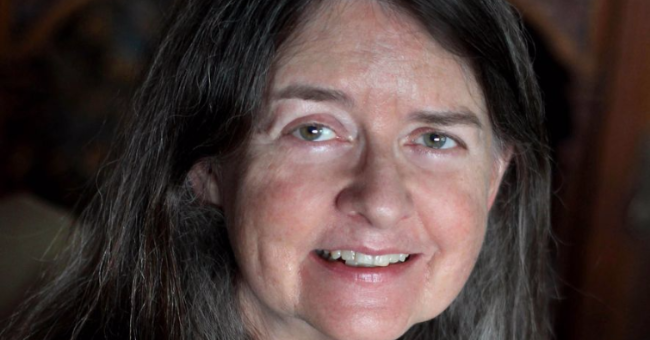
    Rev. Elizabeth M. EdmanThe Reverend Elizabeth M. Edman is an Episcopal priest and a political strategist who has been expanding people’s understanding of faith and sexuality for over twenty-five years. She has worked on the most pressing contemporary issues in the intersection of religion and sexuality, serving as an inner-city hospital chaplain to people with HIV/AIDS from 1989 to 1995 and helping to craft political and communications strategies for marriage-equality efforts. She lives in New York City. Follow her on Twitter at @liz_edman and visit her website.


    image from www.beaconbroadside.comMichael Bronski has been involved in gay liberation as a political organizer, writer, and editor for more than four decades. The author of several award-winning books, including A Queer History of the United States, he also coauthored “You Can Tell Just by Looking”: And 20 Other Myths about LGBT Life and People and Considering Hate: Violence, Goodness, and Justice in American Culture and Politics. Bronski is Professor of the Practice in Activism and Media in the Studies of Women, Gender, and Sexuality at Harvard University and lives in Cambridge, Massachusetts.

  • By Stefan Bechtel

    Bison“In March, 1886, I received a severe shock, as if by a blow on the head with a well-placed mallet. I awoke, dazed and stunned, to a sudden realization of the fact that the buffalo hide-hunters of the United States had practically finished their work.” 

    The writer was William Temple Hornaday, then a thirty-two-year-old taxidermist at the U.S. National Museum (later the Smithsonian). He’d been asked by his boss to put together a mounted display of the museum’s collection of Bison americanus, only to discover that “the people’s official museum was absolutely destitute of good bison specimens of any kind.” These great shambling creatures, with their magnificent prehistoric silhouettes, in their unimaginable numbers, symbolized the wildness and grandeur of America better than any other animal, perhaps even the bald eagle. Yet all Hornaday could find were a few dusty old skins and skeletons—sad, neglected relics, like discarded overcoats whose owners would never return.

    Hornaday (1854-1937) quickly put together a census of all the bison in existence, writing to ranchers and private owners across the country. He discovered, in a second everlasting shock, that there were now less than 500 animals left in the world. Though the North American west was once darkened from horizon to horizon by buffalo herds estimated at more than thirty million—the largest herds of quadrupeds ever to walk the face of the earth—they were now teetering on the brink of extinction. And it was a real possibility: A single flock of passenger pigeons, which took five hours to fly overhead, had once been estimated at two billion birds. But by 1914, the species had flickered out forever.

    Ironically, Hornaday had begun his career as a big game hunter, killing what he loved. (Not an uncommon practice in the nineteenth century). Now he mounted what later became known as “The Last Buffalo Hunt,” an expedition to the Montana territory to hunt down and bring back a small collection of specimens for mounting and display, to show Americans the glory of what they were about to lose. On the train headed west, ranchers all told him it was too late: All the wild buffalo were gone. But he managed to collect a few (including one frightened, live, motherless calf, whom he brought back). Later, his famous six-figure grouping of a protective bison bull with cows and calves at a watering hole was displayed on the main floor of the Smithsonian, greeting literally millions of visitors over the next sixty years.  

    Mr. Hornaday's WarBut Hornaday, always quirky, difficult, and relentlessly persistent, did not stop there. He’d always been a man who loved a good fight (he even fought with his friends), so he went to war on behalf of the bison. As time went on, Hornaday became one of the noisiest, angriest, and most unstoppable conservationists of his day, second only to his friend and colleague Theodore Roosevelt. He was the founder of the National Zoo in Washington, and for thirty years served as director of the Bronx Zoo—sorry, he hated that name, insisting on “The New York Zoological Park”—a soapbox from which he lectured, cajoled, lambasted, and wheedled the American public, the Congress, and anybody else who would listen about the alarming state of the “the grandest quadruped [he had] ever seen.” He also initiated captive breeding programs at the zoo, to see if it were possible, first, and if so, to rebuild the perilously depleted population. With Roosevelt, Hornaday created the American Bison Society, dedicated to bison conservation. And he began fighting to create wild reserves in the west, to give the buffalo a place to roam should their numbers recover.

    In his “spare time,” Hornaday also wrote a raft of books about zoology and conservation, fought lax game laws and gun manufacturers, and became a major player in the “Plume Wars” against feathered hat dealers, who were ravaging rookeries in the Everglades and other wild places. He was a vigilante for justice for the animals, a political agitator for the natural world, a man who never knew how to keep quiet in the face of what he considered to be a monstrous crime in progress. 

    So it was that just after the first frost of 1907, a steam engine pulling two railroad cars carrying fifteen buffalo pulled into the railroad station in desolate Cache, Oklahoma, near the Wichita Mountains. A huge crowd had gathered, including Quannah Parker, the great Comanche warrior. Prophets of the plains people had foretold that the bison, who they believed had disappeared into a sacred mountain in the Wichitas, would one day return, like rivers of living water. Now, due to the passionate intensity and sheer doggedness of a diminutive white man from New York named William Temple Hornaday, the prophecy was being fulfilled. He had even helped create the Wichita National Forest and Game Reserve, sixty thousand acres of protected wildlands.

    Today, due largely to this one man’s efforts, there are about 500,000 living American bison in the world.

    It’s a shame Mr. Hornaday is not around to celebrate President Obama’s signing of the National Bison Legacy Act, making the American bison our new “national mammal,” and offering this great shaggy beast both honor and protection. He would have loved it!


    About the Author 

    Stefan BechtelStefan Bechtel is the author of ten books, including Mr. Hornaday’s War, Tornado Hunter, and Roar of the Heavens. A founding editor of Men’s Health magazine, his work has appeared in Esquire and the Washington Post, among other publications. He lives in Free Union, Virginia. Visit his website.

  • By Bernardine Dohrn

    Father Daniel Berrigan

    Father Daniel Berrigan. Photo credit: Flickr user Jim Forest

    In 1970, we received a “Letter from the Underground” from Father Daniel Berrigan, printed in the New York Review of Books. It was a note from a comrade, for Dan too was a “most wanted” fugitive from the FBI and federal law enforcement officials at that time. A Jesuit priest, an acclaimed poet, a committed anti-war activist, his “Letter” was delivered, as was much communication then, not by mail or (landline) telephone, but via the media.

    Father Dan wrote that “Outlawry is the normal condition in which decent men and women are called upon to live today.” Dan and his brother, Father Philip Berrigan, and Mary Moylan, were three of the Catonsville Nine activists who broke into a local draft board office in Maryland in 1968, and then carried paper draft files out into the parking lot where they set them on fire with homemade napalm. Their federal trial was an appeal to higher law, God’s law, and Nuremberg responsibility. The defendants were found guilty of destruction of US property, destruction of Selective Service files, and interfering with the Selective Service Act of 1967.  They were sentenced to a total of eighteen years in prison, Father Dan to three years.

    Dan Berrigan refused to report to prison, and during his time “underground” he repeatedly appeared publically to conduct church sermons or to give anti-war speeches, further infuriating FBI Director J. Edgar Hoover. His was both a playful “underground” and a passionately moral one. He wrote, of the Catonsville action: “Our apologies, good friends, for the fracture of good order, the burning of paper instead of children…”

    The Weather Underground responded with a much less eloquent “communiqué” to “Brother Dan,” just after he was arrested in 1970. “We watched you, Dan, on TV when they took you to jail, smiling and with hands raised, handcuffed, giving the sign of peace. You have refused the corruption of your generation.”

    Mary Moylan would pursue her own path as a fugitive, joining the women of the WUO for a brief period. Phil Berrigan served six years in federal prison, often in solitary confinement; Dan served a year and a half. Their courageous direct actions against the Vietnam War became a catalyst for lay Catholic activism against the military draft and the machinery of war that mushroomed to include some twenty draft board break-ins across the country, and the 1971 “burglary” of an FBI office in Media, Pennsylvania. This creative, bold activism against US military aggression, powerfully told in the documentary Hit and Stay: A History of Faith and Resistance (by Joe Tropea and Skizz Cyzyk), took place during an era when the Catholic Archbishops of New York City, Cardinal Francis Spellman and Cardinal Terence Cooke, were vehement anti-communists and outspoken champions of the Vietnam War.

    Like many, Dan Berrigan did not stop with the dramatic defeat of the US military in Vietnam. Father Dan and most of his early cohorts accelerated and refined their radical, non-violent, very direct action, anti-war activism. In tandem with the yeasty Catholic activism of Central and Latin American liberation theology, the Berrigans and the vibrant US Catholic peace movement began to focus on abolishing nuclear weapons and forged the Ploughshares Movement. 

    In 1980, the Berrigan brothers and six friends broke into the memorably named King of Prussia, Pennsylvania nuclear missile factory owned by General Electric and took ball-peen hammers to the warhead cones. The militants poured their own blood over the war materials and then waited for the police to arrive. This time, the legal battle raged over a decade, and Father Berrigan served some twenty-three months, including time in detention awaiting trial. In total, Dan Berrigan spent seven years incarcerated for his direct action activism against U.S. wars. The wars he opposed themselves amount to a litany of carnage, war crimes, and the human agony of permanent war: Vietnam, Nicaragua, El Salvador, Iraq, the former Yugoslavia, Palestine (after visiting the Middle East, he accused Israel of “militarism” and the “domestic repression” of Palestinians), Afghanistan, Guantánamo torture, and CIA drone attacks. He has been a consistent opponent of all forms of social inequality in the US—and of the tyranny of his own Jesuit order.

    “No modern war can be just, because it’s indiscriminate and because it’s launched against the people and the world…Man is at war with the global ecosystem and with his fellow man, and I denounce it.” 

    Dan Berrigan extended and made contemporary the fervor of Dorothy Day, the Catholic Worker movement, liberation theology, and the Christian anarchist movement. His art, his intellectual depth, his training could not predict his lifelong practice of refusing to let his life be a mockery of his values. He acted with his teams, and with imagination and focus. He was willing, even insistent, on taking the consequences of his defiant and illegal actions. He remained an active rebel within his Jesuit order and his church, and within his own country, challenging its ongoing, rapacious addiction to warfare. 

    Father Dan, Presente. 


    About the Author 

    Bernardine Dohrn, activist, academic, international child rights and women’s advocate, is retired Clinical Associate Professor at Northwestern University School of Law, and founding director of the Children and Family Justice Center for twenty-four years. Dohrn is an author/co-editor of three books: Race Course: Against White Supremacy; A Century of Juvenile Justice; Zero Tolerance:  Resisting the Drive for Punishment in Our Schools. Dohrn was a Lecturer at the University of Chicago (where she graduated from the College and Law School) and is visiting professor, Leiden University faculty of law, the Netherlands.

  • By Melinda Chateauvert

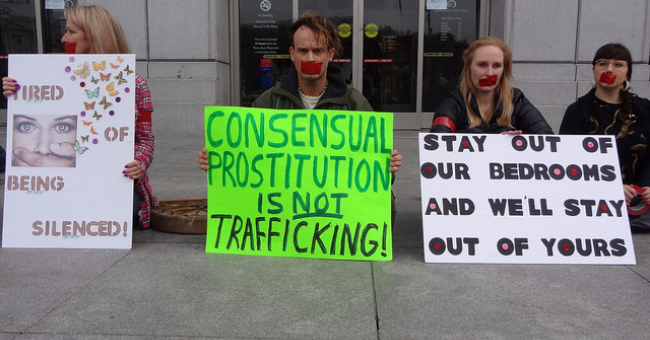
    Sex Workers Demand Inclusion, 2/11/2014

    Sex Workers Demand Inclusion, 2/11/2014. Photo credits: Carol Leigh, the Scarlot Harlot

    Over the last week and before the print edition appeared, Emily Bazelon’s cover story “Should Prostitution be a Crime?” for the New York Times Magazine, sex workers and their allies were sharing and discussing it widely through Facebook, Twitter, and their blogs. I was thrilled to see people I know, activists I’ve admired and worked with, being given a national platform to have their say. This was and is a phenomenal media moment for the sex workers’ rights movement.

    Yet, except for a throwaway nod to Margo St. James and COYOTE (Call Off Your Old Tired Ethics) and a minimal reference to the online sex worker weekly Tits and Sass, the article hardly mentions the many sex worker-led U.S. organizations, local and national, that seek to decriminalize prostitution and make the lives and work of sex workers safer. Though the portraits of sex worker activists are more diverse, the article does not acknowledge the racial, gender, and sexual diversity of the movement. Instead, and perhaps predictably—this is “white savior” Nicholas Kristof’s platform after all—the article is framed as decriminalization advocates against abolitionists. More disturbingly, abolitionists are given organizational strength. Equality NOW, GEMS (Girls Educational and Mentoring Services), and the other promotors of harmful and hateful policies are spotlighted, almost as though the Times wants to ensure pearl-clutching concerned readers know where to send their money. Parenthetically, it seemed the Times’ anti-prostitution editorial staff designated the “NYT Picks” in the comments section because almost every one of them was against decriminalization.

    Sex Workers UniteBazelon’s deinstitutionalization of the sex workers’ rights movement into a “fractious bunch” is a serious oversight. The many organizations currently active use many different strategies and take sometimes conflicting approaches to achieve a modicum of physical safety, civil rights, and labor protections for people working in the sex industry. Those vigorous tensions, as I documented in Sex Workers Unite: A History of the Movement from Stonewall to SlutWalk, would have given readers a much better understanding of the movement and its goals.

    Almost everyone in the movement agrees abolishing laws that prohibit adults from earning money in exchange for consensual sex would be good, and they often cite the decriminalization of marijuana as the most recent example. But porn performers, strippers, and other workers in the corporate legalized sectors of the sex industry are more affected by social stigma and whorephobia than criminal laws. This difference leads to diverse strategies: some seek to destigmatize “whores” through cultural projects, others believe the First Amendment or the Supreme Court’s decisions on sexual privacy are constitutional grounds for abolishing laws against prostitution. Many groups are providing non-judgmental harm reduction services to people wherever they are, services that provide vital health and safety interventions against HIV infections, drug overdoses and other dangers. Those differences make the movement vibrant, and it pushes activists to adopt intersectional analyses that address the multiple personal, financial, and social circumstances under which people decide to engage in sex work.

    Listed below are a dozen sex workers’ organizations—created by and for sex workers—and what they do. Finding the websites for these groups isn’t difficult, but you’ll see more results by turning off “safe search” blocking. Even though these are registered with the IRS as non-profit organizations or advocacy groups, and the websites are “safe for work,” blocking algorithms tend to load anti-prostitution and anti-pornography websites while suppressing links to sex workers’ rights groups.

    The Red Umbrella Project (RedUP) brings the voices of people in the sex trades through storytelling, using their stories for policy advocacy and community organizing. A new documentary, The Red Umbrella Diaries, in which former and current sex workers read and stage autobiographical pieces about their lives, has been making the film festival rounds. Several stories were first published in RedUP’s Prose and Lore anthologies.

    The Sex Workers Project, which is part of the Urban Justice Center in New York City, provided legal assistance and social services advocacy for anyone in the sex industry whether by choice, circumstance, or coercion. SWP attorneys pioneered a human rights approach to serving victims of trafficking in the courts, and their policy reports on sex work and human trafficking are grounded on clients’ real life experiences.

    The St. James Infirmary in San Francisco opened in 1999 to provide non-judgmental holistic health care to current and former sex workers of all genders and sexual orientations as well as their family members. Their 290-page Occupational Safety and Health Handbook for people in the sex trades is an invaluable resource.

    The Best Practices Policy Project (BPPP) researches policies affecting sex workers and people adversely affected by anti-prostitution policies, such as its 2015 report “Nothing About Us, Without Us: HIV/AIDS-related Community and Policy Organizing by US Sex Workers,” documenting the stigmas transgender women face when attempting to access medical care and the criminalization of their lives. (Full disclosure: I participated in this research.) BPPP with Desiree Alliance and other sex worker groups have challenged the Obama Administration’s National HIV Strategy for its silence on the critical role of sex workers in preventing HIV. In 2010 and 2015, BPPP led the campaign to report the human rights abuses of sex workers in the U.S. to the U.N. Human Rights Commission in Geneva.

    HookOnline.org, a nonprofit organization offering advice on and advocacy for men working in the sex industry, has extensive online resources, hosts “live chats” as well as in “Rent U” classes on current issues. Though HookOnline was not implicated in the widely denounced Homeland Security raids of Rentboy.com in August 2015, the escort site provided much of the funding for its work.

    Sex Workers Demand Inclusion, 2/11/2014

    Sex Workers Demand Inclusion, 2/11/2014

    The Sex Workers Outreach Project (SWOP USA) is undergoing a revival since the loss of its founder Robyn Few. With a national board as well as dozens of local chapters throughout the U.S., SWOP seeks to end violence against sex workers, develop new movement leaders, and provides assistance to those who have been persecuted by law enforcement. For people in need of crisis counseling, general support, referrals or information about safety and legal rights, SWOP USA operates a 24/7 hotline: (877)-776-2004. Every year since 2003, SWOP has coordinated International Day Against Violence against Sex Workers on December 17.

    ESLERP (Sex Workers and Erotic Service Provider Legal, Educational and Research Project) has mounted quixotic class action lawsuit in the federal courts, claiming that the Supreme Court’s decision in Lawrence v. Texas, as well as in Obergefell, requires the abolition of prostitution laws.

    In Alaska, Community United for Safety and Protection (CUSP), founded by Tara Burns, has successfully fought back against a 2012 state law that classified all consensual sex work as sex trafficking. CUSP’s report, documenting the lived experiences of Alaskan sex workers and policy recommendations that have changed law enforcement approaches to focus on crimes committed against sex workers including rape, intimate partner violence, extortion, and robbery. They are also lobbying for legislation that allow sex workers who are victims or witnesses of crimes to report them without fear of arrest.

    Power Inside in Baltimore, founded in 2001, doesn’t look like a “sex worker” group because for many marginalized women and girls, working in the street economy is a survival strategy. Focusing on gender-based violence and incarceration by the “Jane Crow” criminal justice system, Power Inside assists with housing, reunification with their children, access to social services and leadership development.  

    Self-determination and self-sufficiency for drug users and sex workers in Washington, DC, is the goal at HIPS, founded in 1993. Showers, laundry, community lunches, and computer lab, as well as harm reduction supplies, housing assistance, and medical attention are available at their new onsite location; in addition, their mobile van services low-income neighborhoods almost every night of the week. HIPS hotline number (800) 676-4477 offers counseling and advice to anyone, anywhere.

    SWOP Behind Bars, a new SWOP project, encourages people to donate books women’s prisons, building a nationwide network of sex worker-supported letter writing, and a newsletter to women in prison. More than one million women are incarcerated in the U.S. and the conditions—including prison libraries—are even worse than those in men’s prisons. Educational opportunities and post-release programs are practically non-existent, a form of sex discrimination that Margo St. James first fought in the 1970s.

    Red Light Legal, a brand new non-profit organization founded by an attorney who put herself through law school by doing sex work, currently offers webinars to educate sex workers on legal matters. In the future, they will provide direct legal services and representation as well as engage in policy advocacy.

    The Adult Performers Advocacy Committee was formed in 2014 by people working in the porn industry to oppose passage of California’s Measure B on the grounds that government regulations for workers’ health and working conditions should be decided by the appropriate state agency, not by voters in a ballot referendum.

    Grassroots organizing to empower sex workers has been going on for a very long time. Women With A Vision in New Orleans has been doing just that for more than twenty-five years, the one group aside from Amnesty International, Bazelon cites.  As activist and blogger Renegade Evolution wrote almost a decade ago, “We ARE organizing, you’re just not paying attention.”


    About the Author 

    Melinda ChateauvertActivist Melinda Chateauvert has been involved in many grassroots campaigns to change policies and attitudes about sex and sexuality, gender and antiviolence, and race and rights. As a university professor she has taught courses on social justice organizing, the civil rights movement, and gender and sexuality. She is a fellow at the Center for Africana Studies at the University of Pennsylvania. Follow her on Twitter at @whorestorian.

  • By Steven Hill

    Social security card on a bed of money

    Photo credit: 401kcalculator.org

    Happy Publication Day to policy expert Steven Hill and his book Expand Social Security Now! Hill argues that Social Security should not only be defended, but also substantially expanded. Three-quarters of Americans depend heavily on Social Security in their elderly years, and nearly half would be living in poverty without it. But as important and popular as it is, Social Security has become a political football. As he explains here in the introduction from his book, the stakes for our retirement plans are higher than we realize.

    ***

    The US retirement system, with all its components parts including Social Security at its core, has been the yellow brick road leading to a pot of gold at the end of most workers’ careers. Social Security has demonstrated its value decade after decade, and it has been one of the most successful government programs of all time. And yet it is threatened now more than ever by leading politicians, business leaders, and media pundits who insist, despite all the facts to the contrary, that Social Security benefits are no longer affordable and must be cut. To the extent that there is another “side” of this debate over whether to cut Social Security, it comes mainly from those who are on the defensive, fighting merely to maintain Social Security as it is, or those who propose incremental reforms to preserve the status quo—even though the status quo is increasingly inadequate. Neither “side” of this debate is addressing the reality of America’s retirement crisis.

    As we will see, although two of the three legs of the “retirement stool” have been sawed back to nubs, the only bipartisan proposal currently under consideration calls for cuts to the last remaining leg—Social Security. Each partisan side of the aisle has its own preferred way of doing that, but don’t be fooled: they amount to the same thing. They will make cuts in the ever-popular program that has long been one of the glues of our society, a sacred trust between generations and a testament to American family values. Even President Barack Obama at times has proposed his own type of cuts. Both sides are presenting the same basic face, which is biased toward the affluent and skewed toward private savings, rather than doubling down on the type of “wage insurance” that has been so successful—Social Security.

    Naturally, the entitlement busters don’t always announce their scheming plans. Instead, they have been waging a stealth campaign, and so far, it’s working. They have plans to cut Social Security benefits, privatize our contributions, increase the retirement age, minimize the cost-of-living increase, and turn the whole thing over to Wall Street managers who will reap a fortune in charging fees and premiums to oversee this transformation. We saw how well that worked out with the hedge fund–stoked home mortgage crisis that collapsed the global economy in 2008. Not enough people sounded the alarm on that one until it was too late. This time, we have to expose the banksters and make the politicians listen. We need a “people’s plan” for fixing the retirement mess that the bipartisan consensus has dropped into our laps.

    Expand Social Security Now!Imagine if the front page of every newspaper, or if the lead story on every media news show, blared a headline that shouted “Washington and Wall Street Conspiring to Gut America’s Retirement—and Only ‘We, the People,’ Can Stop Them.” Would Americans stand on the sidelines and let that happen? Would they tune out with their favorite TV shows and Twitter celebrities? Or like Paul Revere and the Minutemen, would they answer the call? I believe Americans would respond with pitchforks and torchlight parades, marching to dump the tea into the harbor.

    But most Americans don’t realize what is happening, or what is at stake. The current crisis provides a crucial opportunity to rethink the system as a whole, and to redesign this “third rail” of politics for the challenges of the twenty-first century. In this book, I will show not only how to expand Social Security but also how to pay for it, and why that would be good for America’s retirees, good for America’s businesses, and good for our nation’s continued standing in the world as a beacon of hope and prosperity. My proposed plan for Social Security Plus—including a doubling of the individual payout—would form the core of a new kind of deal for American workers. There hasn’t been a serious call for Social Security expansion in a couple of decades, yet recently more political leaders and media pundits have raised this possibility. In a relatively short period of time, Social Security expansion is being discussed by more and more people as a serious solution to America’s retirement crisis. The political needle has moved, and a moment may be arriving that will reset this landscape.

    This book provides a blueprint for how to move forward. Simply by making our retirement system more fair, we will vastly improve everyday Americans’ lives, including the younger generations, and preserve the power of hope in our nation’s dream. By making it more innovative, we will design a retirement system that has the ability to preserve Main Street’s crucial place in the emerging high-tech, new economy. And by making it more stable, we will put the national economy on a more solid footing, preserving the robust middle-class society that made the United States a great magnet for the world.

    More fair, more innovative, and more stable…and better adapted to the realities of today’s new economy. Social Security Plus will contribute to a solid foundation from which to build a strong and vibrant twenty-first-century economy.


    About the Author

    Steven HillSteven Hill is a Senior Fellow with the New America Foundation and a Holtzbrinck Fellow at the American Academy in Berlin. He is the author of six books, including Raw Deal: How the “Uber Economy” and Runaway Capitalism Are Screwing American Workers, which was selected by The Globalist as one of the Top Ten Books of 2015. His op-ed’s, articles and media interviews have appeared in the New York Times, Washington Post, Wall Street Journal, The Atlantic, Politico, CNN, C-SPAN, BBC, Financial Times, Guardian, Bloomberg News, Fox News,National Public Radio, The Nation, Salon, Slate, Observer, Fast Company, Business Insider, HuffingtonPost, Le Monde, Die Zeit, Al Jazeera and many others. His other books include Europe’s Promise: Why the European Way Is the Best Hope in an Insecure Age and 10 Steps to Repair American Democracy. He is a co-founder of FairVote/Center for Voting and Democracy. Follow him on Twitter at @StevenHill1776 and visit his website.

  • By Artemis Joukowsky

    Martha and Waitstill Sharp

    Martha and Waitstill Sharp

    The discovery that completely changed my life began with a junior high school humanities class assignment.

    It was 1976, and I was a freshman attending the Allen-Stevenson School in New York City. My history and social studies teacher, John Pariseau, assigned a class report on the subject of moral courage. Pariseau further instructed us to build our papers around a personal interview.  

    When I got home that afternoon, I casually mentioned the assignment to my mother. She just as casually suggested that I talk to her parents about their adventures in Europe during World War II. “They played an important role in rescuing Jews and other people from the Nazis,” she said. “Their story would make an interesting paper.”

    What?  I was momentarily speechless—rare for me. “Mummy Mummy and Grandpa Sharp?” I blurted. “You’re kidding me!”

    “Not at all,” she answered. “Go talk to them. They’ll tell you.”  

    She might as well have said that my grandparents conquered polio, invented jazz, or built the Empire State Building. My grandfather, Waitstill Hastings Sharp, a retired Unitarian minister, had never so much as mentioned World War II to me, much less acknowledged that he’d played a role in it. Likewise, for my grandmother, Martha Sharp Cogan. 

    Long divorced, it was difficult to picture the two of them together under any circumstance, let alone as a dauntless duo carrying out dangerous rescue missions. To think that these two remote, elderly—by all appearances absolutely ordinary people—had gone up against Nazi was inconceivable to me. 

    When I explained the assignment to my grandmother and my mother’s suggestion that I speak with her, she said she’d be very happy to talk with me. She invited me to come over for an “official” interview. Days later she ushered me into her office, and we sat across from each other. I loaded a sixty-minute cassette into my portable tape recorder, and looked at this woman whose past—whose existence beyond being ‘Mummy Mummy’—I had never truly considered. I clicked on the tape machine and said something along the lines of, “Well, tell me what you and Grandpa did during the war.”

    The story that I began to uncover in those first talks turned out to be so much more than simply the makings of a history paper—it was the stuff of history itself. She started me out slowly with a description of the January night in 1939 when she and Waitstill learned, to their complete surprise, that they’d been invited by the Unitarian Association to undertake the Unitarian Church’s first-ever international relief project, a mission of mercy to the imperiled citizens of Czechoslovakia. I learned about the frantic work of securing travel papers for social democrats, Jews, artists, philosophers and the long list of others in Czechoslovakia who faced certain extermination if they couldn’t escape. She told me of their desperate efforts to pluck these otherwise doomed souls from the Nazis’ grasp; how exhilarating it was to succeed; how heart sick they were when they failed. From time to time it was necessary to remind myself that this was Mummy Mummy talking, not some retired OSS operative. I discovered that my grandparents’ actions during the war were incredible examples of simple decency, standing up to unspeakable evil—these people I barely knew had undertaken truly heroic, lifesaving acts in the face of injustice, hatred and brutality.  

    In the days that followed that initial interview, I returned to my grandmother’s brownstone and filled up more and more of those cassette tapes. So began my education into the extraordinary lives and history-shaping accomplishments of Waitstill and Martha Sharp. Those names may be unfamiliar to even the most dedicated students of history, but the Sharps should be considered among the inspiring heroes of the Second World War.  

    Defying the NazisI got an ‘A’ on that paper (the only A I ever received). But it changed my life in ways that were much more significant than an improved report card. I had begun what would be my life’s passion of researching and sharing the Sharps’ story with others. What began with interviews with my grandmother and grandfather developed into an effort with many collaborators, individual and institutional. A short time after my grandmother’s death in December of 1999, I had the fun of discovering with Bill Sullivan and Larry Benaquist of the Cohen Center at Keene State a trove of documents, photos and personal artifacts dating back to her school days. The vast and eclectic archive includes everything from personal letters, official reports, and photos to maps, handwritten notes, calendars, date books, hotel tabs, ticket stubs, playbills, souvenirs and memorabilia of my grandparents’ travels. There are a number of deeply touching love notes between them in the collection, as well. In all over 200,000 documents are now housed at the National Holocaust Memorial Museum, Brown University, Harvard University, and the Cohen Center at Keene State. Much of the text of this book is drawn from those primary sources  as well as from their oral histories recorded in 1978, my grandfather’s biography written in 1949, and my grandmother’s unpublished manuscript, Church Mouse in the White House. Where necessary, I’ve added some additional text to provide background and context.

    The Sharps as they emerged from the research were quintessentially American, in the best and truest sense. They were relentless optimists, but also realists; fearless, but hardly foolhardy; resourceful and quick-witted; brave, but more importantly, determined and tireless. They persevered through terror and anger, joy, frustration, privation, tragedy and innumerable heart-stopping moments when lives hung in the balance. Through it all, these creedless freethinkers were buoyed by a fullness of spirit that only intensified as the threat of death lurked ever nearer.

    The Sharps acted strictly as a matter of conscience, and repeatedly put themselves in situations of mortal peril without any consideration of material gain. As both my grandparents emphasized to me, if the civilized world learned anything from the Holocaust it is that to placate, or ignore, an evil such as Nazism is morally wrong, and practically ensures there will be great suffering as a consequence. They’d seen this for themselves, first hand. Yet on the evidence of our subsequent experience with the likes of Pol Pot in Cambodia and Slobodan Milosevic in the Balkans, or the slaughters in Rwanda, Darfur and elsewhere, the civilized world must relearn this hard lesson with every generation. 

    Martha and Waitstill Sharp never saw themselves as extraordinary. They simply believed that good people need to stand up for what is good in the world, and that each of us should try to make a difference for the better in the world around us. Through their lived example, Waitstill and Martha Sharp remind us that confronting evil wherever and whenever it appears is more than a principle. It is a moral imperative, requiring direct action by individuals as well as nations. As I move from the
    role of grandson and into the role of storyteller, I can’t think of a more important message to carry from the Sharps’ world to ours today.

    I was at the ceremony in 2006 at Yad Vashem, when the state of Israel formally proclaimed my grandparents as “Righteous Among the Nations.” I felt their spirits standing with me that day, more powerfully than ever before. 

    Many of the people whose lives were saved understood the debt of gratitude they owed the Sharps, and in the postwar years made of point of thanking them and honoring their work. But most of the people whose lives were affected by the actions of my grandparents never knew who the Sharps were.

    For me, in the years after putting together that first humanities paper, the legacy of the Sharps has become a life’s passion.  And, as I’ve  immersed myself in their story, it has been gratifying to see that some other people have championed their achievements as well. For many years, I have felt driven to explore, understand, and promote my grandparents’ extraordinary acts of heroism as best I could. This book is part of my continuing efforts to give the legacy of the Sharps the attention I feel it deserves.

    I remember a wonderful, provocative question that my grandmother often asked me through the years: “What are you going to do in your life that’s important?”

    I’ve learned to answer that question in many ways, but, as I will always be the grandson of the Sharps, I have taken on a lifetime commitment to make sure that the memory of their work and the legacy of their lives are carried forth. The actions and achievements of my grandparents deserve to be honored, and their courage and principles deserve to be celebrated. The story of the lives of Martha and Waitstill Sharp deserves to be told, and now I’ve had the chance to help them tell it.

     To me, nothing could be more important.


    About the Author 

    Artemis Joukowsky, the grandson of Waitstill and Martha Sharp, has spent decades researching his grandparents’ efforts. He is also the director and, with Ken Burns, coproducer of the companion documentary film,Defying the Nazis: The Sharps’ War. Additionally, Joukowsky has devoted much of his life’s work to improving the experience of living with multiple disabilities and promoting community services since he was diagnosed at age fourteen with spinal muscular atrophy, type III (SMA). Joukowsky lives in the Boston suburbs with his four daughters.

  • By José Orduña

    US Border Patrol helicopter over the Sonoran Desert

    US Border Patrol helicopter over the Sonoran Desert. Photo credit: Dan Sorensen

    This essay appeared originally on PowellsBooks.Blog.

    A large bearded man named Tommy rolls a shopping cart full of wooden crosses into a small square off the Pan American Avenue. Someone has painted them all white. One block south of where we stand, the United States ends abruptly. Between a double wall made of iron, a concrete trench is filled with loose coils of concertina wire. The metal teeth glint under the red sun. To our west sits an air-conditioned McDonald’s and just past that a Wal-Mart sprawls into the horizon. The people of Douglas and a few Mexicans from Agua Prieta—the very few affluent enough to secure a nonimmigrant visa—walk the broad aisles of the big-box store making their purchases.

    I have been volunteering at the Migrant Resource Center in Agua Prieta, Sonora, just across the border from Douglas, Arizona. It is 2012, and this is the Tucson sector of the US/Mexico border during the hottest summer on record. Since Operation Gatekeeper, a Clinton-era border militarization initiative, migrants have been increasingly funneled into the most remote areas of the desert where they are most likely to die in their attempts to cross. Later, I’ll come to read that, according to official Border Patrol numbers, there were 177 deaths in this migrant corridor during this fiscal year. This sector has inflicted the most death—177 stands as the official number of casualties according to the United States government, but this number is certainly low.

    Because there are no state mechanisms that actively seek to recover those who have been killed in the desert, the number only represents a fraction of those who have actually perished, and more accurately represents the number of dead people a Customs and Border Patrol agent happen to come upon while on patrol or when they are called. The number does not include those who died before crossing the international boundary line. Frank Amarillas, a Border Patrol spokesman for the Tucson sector, told a reporter writing for the Arizona Republic that they only count deaths referred to them by Border Patrol agents, or local law enforcement. “We are not notified in every case,” he said. William Robbins, a Border Patrol spokesman for the Yuma sector, told the same paper that in order to be counted, skeletal remains needed to have been found near the border or on a trail known to be used by migrants. 

    Two nuns who I’ve been working with at the resource center and a small group of parishioners from a local church gather in a circle around the cart. Everyone makes the sign of the cross, except me. One of the nuns, an older Latin American woman, takes my right hand. A middle-aged white man approaches from the other side and takes the other. Tommy begins leading us in prayer, and even though I’m not religious, I bow my head as he asks God to watch over his children, some of whom are currently walking through the Sonoran desert, to help us erase the boundaries that divide the world, and to bless the families of those who have perished on their journeys. 

    Until very recently I’d held a steadfast and absolutely cynical view of religion, but these faithful people, and others I’ve encountered in some of the most desolate places in this country, have complicated my beliefs. Some of these parishioners work alongside young anarchist punks—tattooed, smelly, and often foul-mouthed—leaving gallons of water on migrant trails, documenting abuse in short-term Border Patrol custody, and providing emergency medical assistance to injured or dehydrated strangers. They staff the Migrant Resource Center. They gather data the government won’t. They enact radical compassion, radical acceptance, and radical love. 

    I’d been told this was to be a vigil, but I don’t know what we’ll be doing. One of the nuns tells me they come out here every week with the white crosses that bear the names of the people killed in this sector. She says they slowly walk down Pan American Avenue taking turns picking up a cross, speaking the name of the deceased, and placing it name-faced-out toward people driving in their cars. The group begins walking south toward the militarized boundary. The first parishioner takes a cross and calls out a name. He raises it above his head and the rest of the group calls out “presente,” an affirmation of the personhood that was extinguished by the barrier. Cars slow as they pass. A woman rolls down her window and waves at us. A man in another car shakes his head without turning toward the procession.

    I can feel the sun pounding between my shoulder blades and on the top of my head. There are people out there now, in the direction we’re facing, struggling to remain alive. There are those who will meet a violent end, lost or left behind by their guide, separated from their group, ultimately succumbing to something. Their lives and deaths can’t hold our attention very long. Some of us don’t even know they’re dying, some of us don’t care, and some of us care, but that care isn’t enough to move us to act.

    It’s my turn to retrieve a white cross. I feel the weight of this gesture now as I approach the cart. A line of stationary cars has formed because of the lag time at customs. I reach for a cross and turn it to read the name, but there isn’t one there. Instead it reads “Desconocido y niño.” The words make my knees buckle and I almost fall forward.

    It indicates two deceased people, one adult and one child, were found together in a state that made identification impossible. But one of the bodies was a child, and they must have been found in close enough proximity, perhaps embracing, so that they appeared to have been together. Many of the people in their stopped cars are looking toward me. I look at them and then at the cross. I read what it says and it feels like the piece of wood I’m holding has transformed into something else. I don’t know what, but it no longer feels like an inanimate object. I raise it above my head and then carefully place it on the street, leaning against the curb for others to see. 


    About the Author 

    image from www.beaconbroadside.comJosé Orduña was born in Córdoba, Veracruz, and immigrated to Chicago when he was two. He is a graduate of the Nonfiction Writing Program at the University of Iowa and active in Latin American solidarity.

  • A Q&A with Margaret Regan

    Margaret Regan

    Photo credit: Jay Rochlin

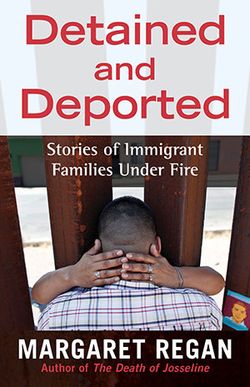
    Journalist and author Margaret Regan spoke on a panel about human rights as it relates to immigration policy with author Luis Alberto Urrea and attorney Theresa Duncan at the 2016 Tucson Festival of Books, held on March 12-13 on the campus of the University of Arizona. After the panel, C-SPAN/BookTV conducted an interview and call-in session with her specifically about her book Detained and Deported: Stories of Immigrant Families Under Fire, now available in paperback. You can click here to watch the panel discussion, and here for the full interview and call-in session. What follows below is a collection of highlight questions from C-SPAN and listeners who called in.

    One of the things you cover in Detained and Deported is the for-profit prison industry. What is that?

    Starting in the 1980s, we began to have a policy of detaining immigrants. We didn’t really have detention centers ever since we shut down Ellis Island and Angel Island in the 1950s. 1980s policy changed. We were going to do detention centers. So, what do you do? You suddenly start needing prisons. You go to the private sector because they’re agile, they can do things. Corrections Corporation of America began around 1983. Their first project was an immigration detention center in Houston, Texas. And they quickly moved into the regular prison sector also. So they are a for-profit corporation.

    There’s a difference between detention centers run by them and detention centers run by the federal government. We only have eleven out of 250 detention centers in the United States run by the federal government, and those are much more humane and better run, in my view, than those run by private prisons. Because the more money they spend on their prisons, the less profit they make for their shareholders.

    Give us a picture of what the prison industry is like here in the Tucson-Nogales area.

    Sixty miles north of Tucson, we have a whole complex of prisons that are owned and run by the Corrections Corporation of America. The big one I’m interested in is the Eloy Detention Center. That’s the third largest immigration detention center in the United States and the only one in Arizona that holds women. Fifteen- or sixteen-hundred people are there on a typical day. They told me it used to be a regular prison and it was renovated to become a detention center, but you would be very hard pressed to see the difference.

    It’s very important to emphasize that when immigrants are in detention, they’re not being held on criminal charges. They’re being held only to guarantee their presence at upcoming deportation hearings. They’re not supposed to be treated like prisoners being punished, and yet they are. Their lives are highly regulated, they have regular lockdowns. Corrections Corporation of America uses solitary confinement as punishment. Women there complain very much about the poor medical care that they get. And Eloy, unfortunately, has the highest suicide rate of any of the detention centers in the United States.  

    Does the prison corporation train the guards and the personnel at Eloy to treat the children badly or do they recruit that kind of person to begin with?

    Detained and DeportedWell, to be clear, there are no children being held in the Eloy Detention Center. Although we do have two family detention centers in Texas now where there are children. When I wrote about attending Visiting Day at the Eloy Detention Center, the guards were very harsh with the children coming to visit their parents. I don’t think anybody trains them to be mean to the children. As I wrote in my book, I think that guards in that situation are working in a fairly brutal environment, and sometimes they become brutalized themselves.

    Kids have to wait a long time to see their mom or their dad. I saw in one instance a little boy swinging on a gate in the waiting room, and a guard really yelled at him. And I never saw anybody say anything like, “Oh, this is a happy occasion, children getting to see mom and dad.” I imagine that prison culture, as a rule, tends in that direction toward unkindness—as a nice way of putting it.

    Why are we spending so much on illegal immigration and pushing immigrants into the school system? They’re way behind and American kids lose out. Why can’t immigrants go back to their own countries and fight for their own rights instead of making us taxpayers have to pay for everything like housing? Don’t you think that takes away from American families?

    Actually, it’s not factual that the American taxpayers are paying for all kinds of health-care and welfare treatments for undocumented immigrants. These are people who live in the shadows. They’re not even entitled to health care under Obamacare; that was one of the important points. And as far as educating the children is concerned, the way we pay for education is through our real estate taxes. Every immigrant living in the United States is paying taxes either via the rent that they’re paying and the landlord transfers that to taxes, or they’re paying taxes on a house they might own. It’s not true that they’re not contributing to the education of their own children.

    Are undocumented illegal immigrants in the education system here in Tucson and what effect does that have?

    We had a Supreme Court decision around 1983 that said we do not challenge children who come to the schoolhouse door and ask for their identities. And good for us as a people! We educate kids who are here in the United States across the board. We do not terrorize people into not coming to the schoolhouse, and I think that’s very good. The Supreme Court decision has been established law for thirty years now.

    In Tucson, we’re very eager to have more children come to the school because our numbers are declining. The schools are working very hard to get more kids to come. Immigrant children are like any other children. I’m not sure what the issue is. They learn English very quickly when they come here. A little girl who was my daughter’s best friend in first grade and Kindergarten came knowing only Spanish, and she was a whip-smart child. She learned English right away and turned out to be one of the best students. It’s just like any population of kids: you’re going to have kids who are the bright learners and the kids who aren’t. I was glad to have my children growing up with Spanish-speakers and learning Spanish themselves.  

    Why do you think the message that illegal immigrants are taking jobs and straining our systems resonates with so many people?

    I think these are really hard times for people. Wages have stagnated for years. I think this is a big issue in the current presidential campaign. People are frustrated. People are working and working and don’t get raises, and they’re looking to understand why.

    If you’ve seen the movie The Big Short, that’s a very entertaining and informative movie about the Wall Street bankers making tons of money on bad loans. Finally, the whole economy collapses, and the movie documents it pretty well. Then the narrator says, “As soon as this happens, Wall Street collapses.” People are losing their jobs. People’s homes are going into foreclosure. What do you start hearing? “This is the fault of the immigrants. This is the fault of the school teachers making too much money. This is fault of the public unions.” And you scapegoat people at the bottom of the barrel, and as we all know, only one Wall Street banker was prosecuted. People are frustrated, and in hard times, look to find answers. Unfortunately, that’s happened in Arizona. Arizona was one of the big foreclosure states, and the anti-immigration sentiment grew dramatically after that and politicians use that to get elected.


    About the Author 

    image from www.beaconbroadside.com

    Margaret Regan is the author of two award-winning books: Detained and Deported: Stories of Immigrant Families Under Fire, a 2015 Southwest Book of the Year; and  The Death of Josseline: Immigration Stories from the Arizona Borderlands, a 2010 Southwest Book of the Year and a Common Read for the Unitarian Universalist Association of Congregations. A longtime writer for the Tucson Weekly, Regan has won many regional and national awards for her immigration reporting, including the 2016 Matthew Freeman Social Justice Lectureship at Roosevelt University, Chicago. She lives in Tucson, Arizona.


  • By Christopher Emdin

    Christopher Emdin

    Photo credit: High Tech Slam

    In his proclamation for this year’s National Teacher Appreciation Week (May 2-6), President Barack Obama states that “our country’s teachers—from the front lines of our civil rights movement to the front lines of our education system—have helped steer our country’s course. They witness the incredible potential of our youth, and they know firsthand the impact of a caring leader at the front of the classroom.” Associate professor and educator Christopher Emdin is certainly at the front lines of a radical approach to teaching urban youth. His theory of Reality Pedagogy in For White Folks Who Teach in the Hood…and the Rest of Y’all Too is the much-needed antidote to traditional top-down schooling and promises to reframe the landscape of urban education for the better. He recognizes that at times putting this theory into practice can become daunting, and teachers need encouragement to forge ahead. In honor of National Teacher Appreciation Week, we’re sharing this excerpt from Emdin’s book in which he lists eight of his thoughts and musings to motivate educators to keep going.

    ***

    Throughout For White Folks, I have provided educators and those interested in the field of education a number of concepts to think about, new approaches to consider, and new practices to implement. However, in my work as a teacher and a trainer of teachers, there are times when the work seems too tough, inspiration is nowhere to be found, and I am so bogged down by attacks on the profession and shifting policies that lead nowhere that I must take a step back and regroup. Here, I share some thoughts I always return to on my journey in education. They are a collection of personal musings, shared with the sole intent of supporting educators on their most challenging days and reminding them of why we do this work, and what we need to do it well.

    ———

    The way that a teacher teaches can be traced directly back to the way that the teacher has been taught. The time will always come when teachers must ask themselves if they will follow the mold or blaze a new trail. There are serious risks that come with this decision. It essentially boils down to whether one chooses to do damage to the system or to the student.

    ———

    The longer teachers teach, the better they are at their practice. That practice may serve to empower students or it may break the students’ spirit. That decision belongs to the teacher.

    ———

    The effectiveness of the teacher can be traced directly back to what that teacher thinks of the student. If the teacher does not value the student, there is no motivation to take risks to engage with the student. It is easier and safer to remain in the traditional model—even though that model has failed the student.

    ———

    How successful the teacher is in the classroom is directly related to how successful the teacher thinks the students can be. Teachers limit themselves and their students when they put caps on what their students can achieve.

    ———

    Teachers who hold within themselves perceptions of the inadequacy of students will never be able to teach them to be something greater than what they are. You cannot teach someone you do not believe in.

    ———

    Planning for your lesson is valuable, but being willing to let go of that plan is even more so. It is only on the path away from where you started that you can get to where you want to go.

    ———

    Continued effort in teaching more effectively inevitably results in more effective teaching. However, this all depends on what the teacher considers to be effective. The teacher must ask what the desired result of the teaching is. You cannot be effective if you have not defined for yourself what effective means.

    ———

    The kind of teacher you will become is directly related to the kind of teachers you associate with. Teaching is a profession where misery does more than just love company—it recruits, seduces, and romances it. Avoid people who are unhappy and disgruntled about the possibilities for transforming education. They are the enemy of the spirit of the teacher.


    About the Author 

    Christopher Emdin is an associate professor in the Department of Mathematics, Science, and Technology at Teachers College, Columbia University, where he also serves as associate director of the Institute for Urban and Minority Education. The creator of the #HipHopEd social media movement and Science Genius B.A.T.T.L.E.S., Emdin was named the 2015 Multicultural Educator of the Year by the National Association of Multicultural Educators and has been honored as a STEM Access Champion of Change by the White House. In addition to teaching, he serves as a Minorities in Energy Ambassador for the US Department of Energy. He is the author of For White Folks Who Teach in the Hood…and the Rest of Y’all Too. Follow him on Twitter at @chrisemdin. Visit his website: chrisemdin.com.

  • By David Stovall

    2016 Donald Trump Chicago rally protest

    2016 Donald Trump Chicago rally protest. Photo credit: Flickr user nathanmac87.

    The 2016 report issued by the Southern Poverty Law Center (The Trump Effect) reveals a disturbing, but commonly known fact in US public schools: the United States has NEVER intended to educate the majority of its populace. Because it hasn’t, we find ourselves in a constant struggle to make sense of a world that masks the realities of economic decline, imperialism, and white supremacy. The inability to provide an education that equips the masses with the capacity to ask critical questions of themselves and government feeds into a sordid process that engages a mythical relationship. With a problematic account of history that is imbued in the larger racist colonial project of stereotype, violence, and innuendo, our society rewards diversions from historical accuracy through the glorification of the contributions of rich white males.

    Making America “great again” really means keeping America “great” for a small number of rich elites while the remainder of folks who adhere to Trump’s ideology are being duped. While some wax nostalgic about a “different time” that was steeped in American values, younger Trump supporters are sold on a myth of an America of their parents that will bring back what they believe they’ve lost. Still, in the end, the realities of anti-Black racism, rising joblessness, state fiduciary irresponsibility, and corporate greed remain missing from the analysis due to the convenience of blame.

    While it gives some of us chills to read a report where young students of color (spanning the spectrum of students who are African-American, Latin@, Native American, Muslim, LGBTQ, Asian-American, Pacific Islander, and from the Middle East) are fearful of an election that could find Donald Trump elected president, I offer a particular interpretation. Trump has simultaneously created a diversion while unearthing a painful truth. Like the traditional trope of the bully in the schoolyard, the bully often blames someone other than themselves for their own failures, while inflicting gratuitous punishment on those deemed the “enemy.” This is his attack on immigrants, Muslims, Latin@s, and the veiled attack on Black folks. The diversion is to get people to create and agree to the false narrative about members of the aforementioned groups as lazy, malcontent, and “underserving” of the great opportunities that are available to them. Missing from this analysis is the complex, winding, and brutal history of conquest, exploitation and alienation that has never entered our conversations in schools for fear of “speaking badly” about America. For these reasons, the bullying of students of color in the U.S. by Trump rhetoric and by those who feel emboldened enough to act on Trump’s call should be understood as a complex and layered reflection on the inability to address multiple oppressions. 

    I’m glad Trump got run out of town in my home city (Chicago) largely by a group of young people of color (i.e. Muslims, Latin@s, African-Americans) and their supporters. Nevertheless, he continues to gain ground in the Republican primaries. Trump remains a “viable” option in a primary race nothing short of a circus of the absurd. He is only a problem because the U.S. affirms that his type of racist, jingoistic, xenophobic rhetoric is normal, right, and good. Just like the schoolyard bully who often uses force to mask fear, the U.S. finds itself in a situation due to its inability to confront what many have known for quite some time: this place isn’t “great” for everyone. In fact, it can be pretty bad given the situation. 

    In Illinois it’s gotten pretty bad. Insurmountable debt and the failure to draft a budget for fiscal year 2016 have been placed on top of declining bond ratings and the state’s inability to pay pension debt for the last 40 years. From this juncture mental health centers have been shuttered, K-12 schools have been closed, preschools that receive state subsidies can’t pay their bills, and there doesn’t seem to be any end in sight. Despite the dreary outlook, I am impressed by the ability of young people to continue to organize and shed light on issues that need to be brought to light. Joblessness, school closures, police brutality and lack of infrastructure are not happenstance instances that are the “fault” of people that don’t work hard or care about their kids. In fact, we know the opposite is true. For these reasons (and many more), we should not be fearful of Trump the individual. The ideas he espouses are much more dangerous. They have their roots in the founding of this country.

    We cannot run from this. If we continue to run, we will remain complicit in the normalization of Trump rhetoric and sentiment.

    White supremacy predates and will last well beyond Trump. This is not a strange blip in the annals of U.S. history. It is in its foundation. Because we know this to be true, this sort of bullying should be met with an unflinching need to resist, organize and build new realities. Schools are a great place to start.   


    About the Author 

    David Stovall, Ph.D. is Professor of Educational Policy Studies and African-American Studies at the University of Illinois at Chicago. He is co-author of forthcoming Beacon Press book—with educator/activists Raynard Sanders in New Orleans, Thomas Charles Pedroni in Detroit, and Chicago Teachers Union President Karen Lewis—on the rise of charter schools in U.S., and resistance to this privatization of a common good (public education). This book will be out in Fall 2017.